


Maximized Floor Space: How Custom Overhead Crane Systems Streamline High-Density Operations in 2026
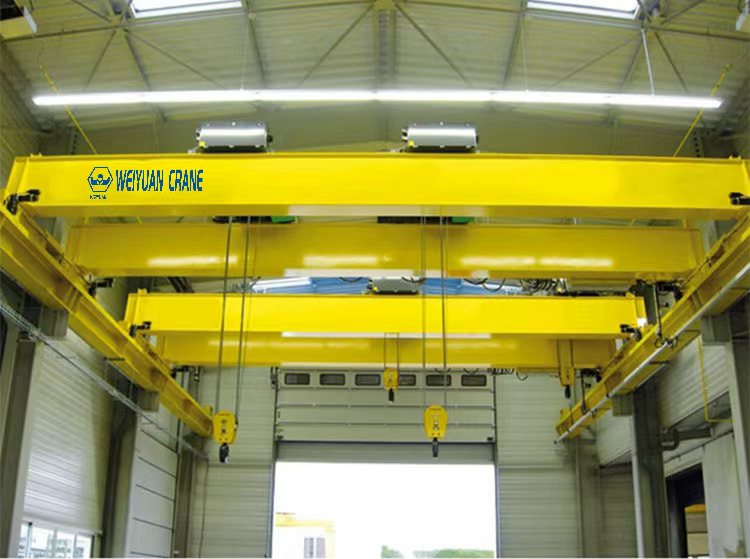
In 2026, industrial real estate costs are climbing, and facility managers face a critical challenge: how to increase production capacity without expanding the physical footprint. High-density operations—whether in automotive assembly, steel warehousing, or heavy manufacturing—often struggle with floor congestion. Forklifts and ground-based transport vehicles require wide aisles, eating up valuable square footage that could be used for revenue-generating machinery.
The solution to reclaiming this space lies not on the ground, but above it. A custom overhead crane system utilizes the empty vertical space in your facility to transport heavy loads, drastically reducing floor traffic and streamlining workflow. By moving material handling operations to the ceiling, businesses can unlock new levels of efficiency and safety in their existing facilities.
Product Description: The High-Density Solution
An overhead crane, often referred to as an overhead bridge crane, consists of parallel runways with a traveling bridge spanning the gap. A hoist, the lifting component of the crane, travels along the bridge. This design allows the system to cover a rectangular area, moving loads vertically and horizontally with precision.
For high-density operations, the primary appeal is the elimination of “dead space.” Unlike forklifts, which require maneuvering room, an overhead system operates independently of floor layout. This means machinery can be placed closer together, inventory can be stacked higher, and narrow aisles become a non-issue.
These systems are essential for industries handling heavy or awkward loads—such as steel coils, injection molds, or large machinery parts—where precision placement is critical. By automating and mechanizing these movements, companies report significant improvements in cycle times and a reduction in product damage.
Features and Advantages
Modern crane technology has evolved to prioritize not just strength, but also intelligence and spatial efficiency.
- Optimized Structural Design: Advanced box-girder or I-beam designs offer high strength-to-weight ratios. This reduces the wheel load on the building structure and minimizes the vertical space the crane itself occupies, maximizing lifting height.
- Intelligent Control Systems: Integrated Variable Frequency Drives (VFD) allow for stepless speed control. This ensures smooth acceleration and deceleration, preventing load sway—a critical feature when operating over expensive machinery in crowded spaces.
- Three-in-One Drive Mechanisms: The motor, reducer, and brake are integrated into a compact unit. This design is maintenance-friendly and provides reliable, precise positioning.
- High Duty Cycles: Designed for intense industrial environments, these systems typically meet A4 or A5 duty classes (ISO standards), meaning they are built to withstand continuous operation under heavy loads.
Technical Specifications
Selecting the right overhead crane system starts with understanding the technical parameters that fit your facility.
- Lifting Capacity: Standard models range from 1 ton to 80 tons. For ultra-heavy applications, systems can be customized up to 400 tons.
- Span Length: Standard spans range from 7.5 meters to 34 meters, accommodating most factory bay widths.
- Lifting Height: customizable from 6 meters up to 50 meters, depending on your facility’s ceiling height.
- Power Supply: Compatible with standard industrial power grids (380V / 400V / 415V, 50-60Hz, 3-phase).
- Control Methods: Options include pendant control (wired), wireless remote control (for safer operator distance), or a fully enclosed operator cabin for heavy-duty, continuous use.
Customization Options: Tailored by Weiyuan
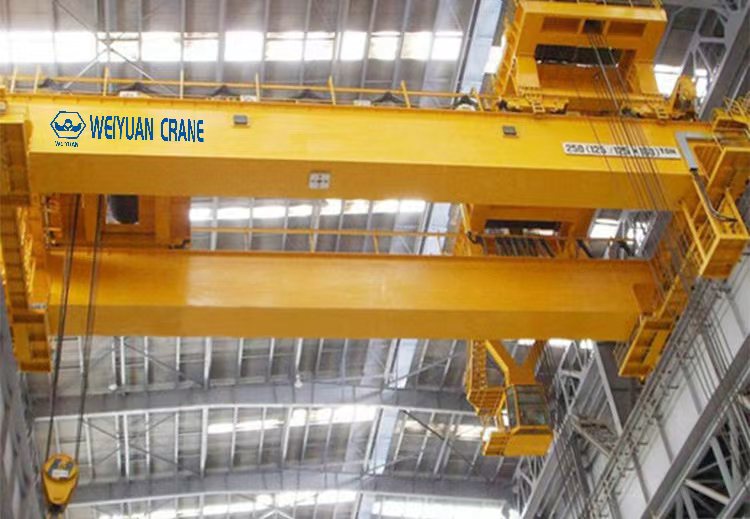
No two factories are identical, and a standard solution often leads to suboptimal results. Weiyuan provides comprehensive design services to ensure your lifting equipment fits your specific operational constraints.
Our engineering team offers:
- Structural Analysis: Free analysis of your existing workshop structure to determine the optimal crane layout.
- Specialized Environments: We design cranes for harsh conditions, including explosion-proof models for chemical plants or corrosion-resistant coatings for marine environments.
- Load Attachments: Beyond standard hooks, we integrate specialized spreaders, electromagnetic chucks, or grab buckets to handle specific materials like scrap metal or steel plates.
- Low Headroom Designs: For facilities with low ceilings, we offer specialized trolley designs that maximize the available lifting height.
Application Areas
The versatility of overhead cranes makes them a staple in various high-output sectors across Asia, Europe, and Africa.
- Automotive Manufacturing: Used for precise die changing and moving vehicle chassis along assembly lines.
- Metallurgy and Steel: Handling extreme loads like ladles of molten metal or massive steel coils.
- Logistics and Warehousing: Streamlining the loading and unloading of heavy freight in distribution centers.
- Energy and Power: assisting in the maintenance of turbines and generators where heavy components must be lifted with millimeter precision.
Safety and Compliance
Safety is non-negotiable in overhead lifting. A dropped load in a high-density facility can be catastrophic. Our systems are manufactured in strict adherence to international safety standards, including CE certification and relevant national regulations like TSG Q0002-2008.
Key safety features include:
- Overload Protection: An electronic weight limiter cuts power to the lifting motion if the load exceeds rated capacity, preventing structural failure.
- Limit Switches: These prevent the hook from over-traveling (hitting the drum) or the bridge from hitting the end of the runway.
- Emergency Braking: Redundant braking systems ensure the load holds firm even in the event of power loss.
- Operator Safety: Control circuits operate at a low voltage (typically <50V) to protect the overhead crane operator from electrical shock.
Case Studies: Efficiency in Action
Project: Tier-1 Automotive Parts Manufacturer (General Assembly Shop)
Challenge: The client needed to increase production throughput but was constrained by a crowded floor layout that caused forklift bottlenecks.
Solution: Weiyuan deployed five sets of 10-ton double girder overhead bridge cranes.
Outcome:
- Efficiency: Production line cycle time decreased by 8% due to faster material transfer.
- Safety: The facility has recorded over 8,000 hours of operation with zero lifting-related accidents.
- Space: Aisle widths were reduced, allowing for the installation of two additional robotic welding cells.
Installation and Support
We ensure your equipment performs from day one through its entire lifecycle.
- Installation Guidance: For international clients, we provide detailed video tutorials and manuals for local installation teams.
- On-Site Support: Our professional engineers are available for global dispatch to supervise installation and commissioning.
- After-Sales Care: We offer a comprehensive one-year warranty. Furthermore, we ensure availability of genuine overhead crane parts for maintenance and repairs, minimizing downtime.
Pricing and Quotes
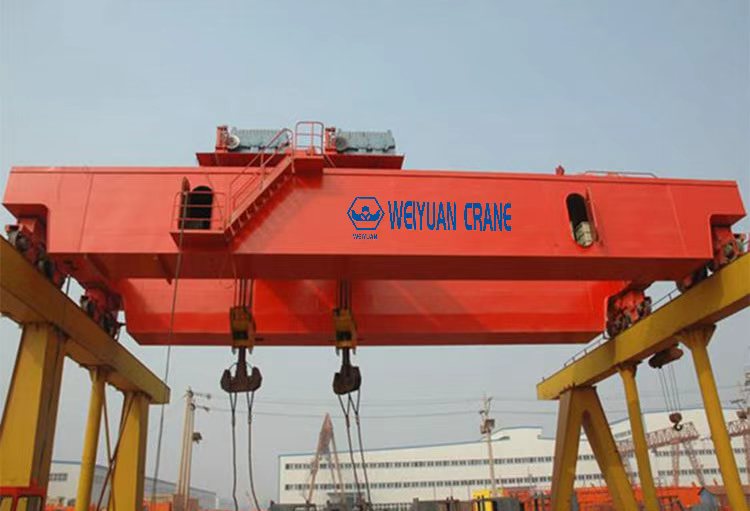
The cost of an overhead crane varies significantly based on span, capacity, and customization requirements. While searching for a “cheap” or used overhead crane for sale might seem tempting, the long-term costs of retrofitting and safety compliance often outweigh the initial savings of a new, custom-engineered unit.
To receive an accurate quote, you can:
- Submit a request via our website contact form.
- Contact our customer service hotline for a personalized consultation.
Delivery Timeline
We understand that downtime is costly. Our logistics team works to get your equipment to you as fast as possible.
- Standard Models: In-stock components allow for dispatch within 3-5 working days.
- Custom Models: Depending on design complexity, manufacturing and testing typically take 2-4 weeks.
FAQ
Q: What information do I need to provide to get a quote?
A: To provide an accurate design and price, we need: A) Lifting capacity; B) Span (width of the runway); C) Lifting height; D) Material to be lifted; and E) Power supply voltage.
Q: Do you offer overhead crane training for operators?
A: Yes. While we do not issue government certifications, our engineers provide comprehensive operational training during the commissioning phase to ensure your team knows how to use the equipment safely.
Q: How often is overhead crane maintenance required?
A: Routine inspections should be performed daily by the operator. Comprehensive preventive maintenance and inspection by a qualified technician are typically recommended every 3 to 6 months, depending on usage intensity.
Q: Can these cranes operate in hazardous environments?
A: Absolutely. We can customize the electrical systems and motors to be explosion-proof or acid-resistant for chemical and petroleum industries.
Meta Title: Maximized Floor Space: Custom Overhead Crane Systems 2026
Meta Description: Optimize high-density operations with custom overhead crane systems. Learn about specs, safety features, and how to maximize floor space in 2026.