


How to Choose the Right Jib Crane for Your Facility: A Practical 2026 Buyer’s Guide
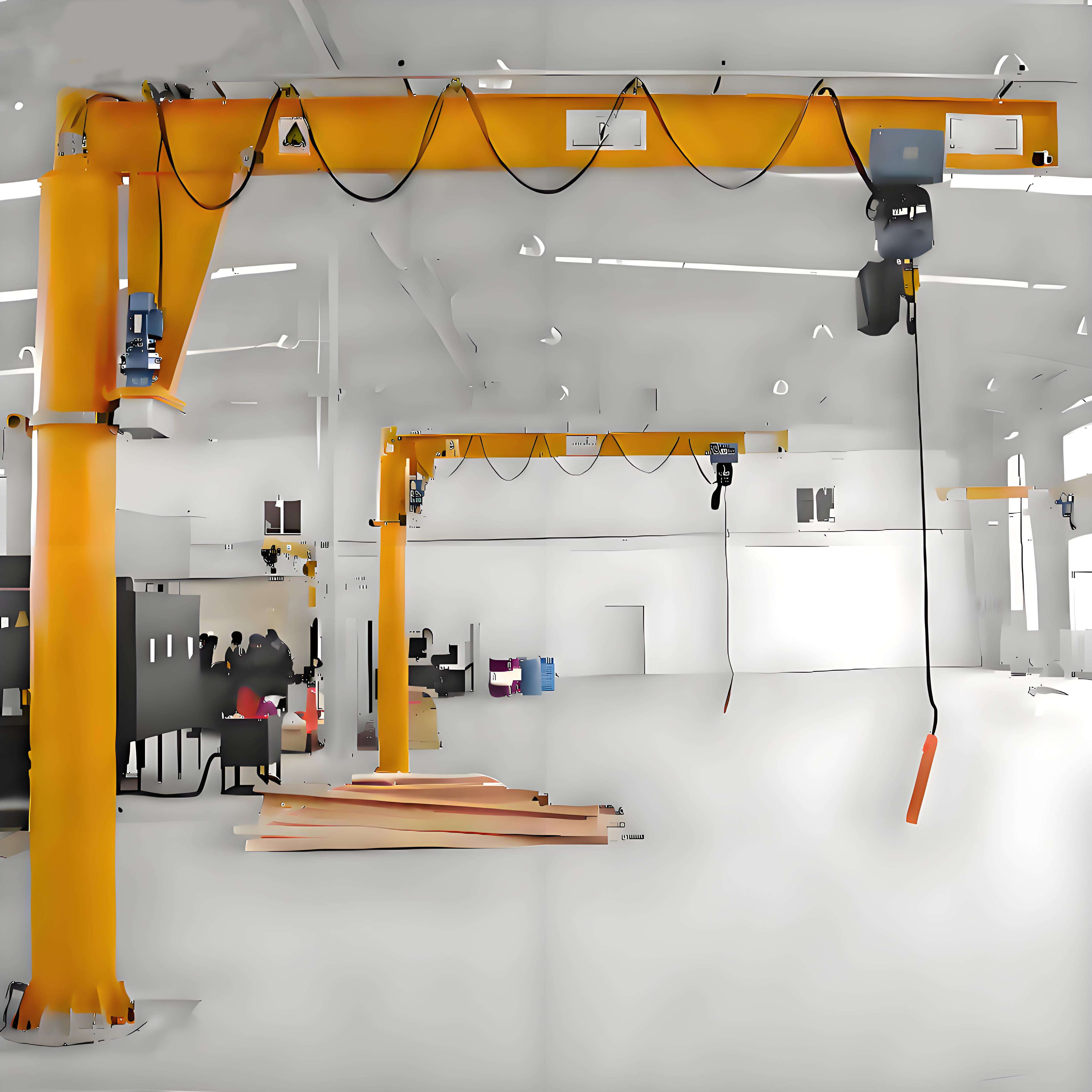
In 2026, industrial facilities are under more pressure than ever to do more with less space, fewer people, and tighter safety regulations. For operations that rely on repetitive lifting, workstation support, or localized material handling, choosing the right jib crane can significantly improve efficiency without the complexity or cost of large-scale lifting systems.
That said, selecting a jib crane is no longer a “pick a capacity and install it” decision. Updated OSHA and ISO guidelines, smarter hoists, and increasingly compact factory layouts mean buyers must evaluate their needs more carefully than before. This guide breaks down how to choose a jib crane that truly fits your facility—not just on paper, but in day-to-day operation.
What Makes a Jib Crane Different from Other Lifting Systems?
A jib crane is designed for point-based lifting within a defined circular or semi-circular area. Its core strength lies in precision and consistency rather than wide-area coverage.
Unlike a Gantry Crane, which is typically used to move loads across a broader rectangular zone using wheels or rails, a jib crane stays fixed in one location. This makes it ideal for:
- Assembly and fabrication stations
- Machine tending and tool loading
- Packaging and palletizing zones
- Maintenance and repair bays
Many modern facilities use jib cranes to handle frequent, lighter lifts while reserving overhead or gantry systems for larger, less frequent moves.
Start with the Real Question: What Problem Are You Solving?
Before comparing models or specifications, define the operational goal. Ask yourself:
- Is the crane supporting one workstation or multiple processes?
- Will it run continuously or only a few times per shift?
- Is space constrained vertically, horizontally, or both?
A jib crane excels when lifting tasks are predictable and repeatable. If your operation requires frequent relocation of loads across different zones, a Gantry Crane or mobile system may be more appropriate.
Choosing the Right Jib Crane Configuration
Freestanding Jib Cranes
Freestanding models are floor-mounted and completely independent of building structures. They offer full 360° rotation and the highest capacity range, making them the most versatile option.
Best suited for:
Open floor plans, heavy loads, and dedicated production cells.
Key consideration:
A properly engineered concrete foundation is essential. Skipping this step often leads to alignment issues or premature wear.
Wall-Mounted Jib Cranes
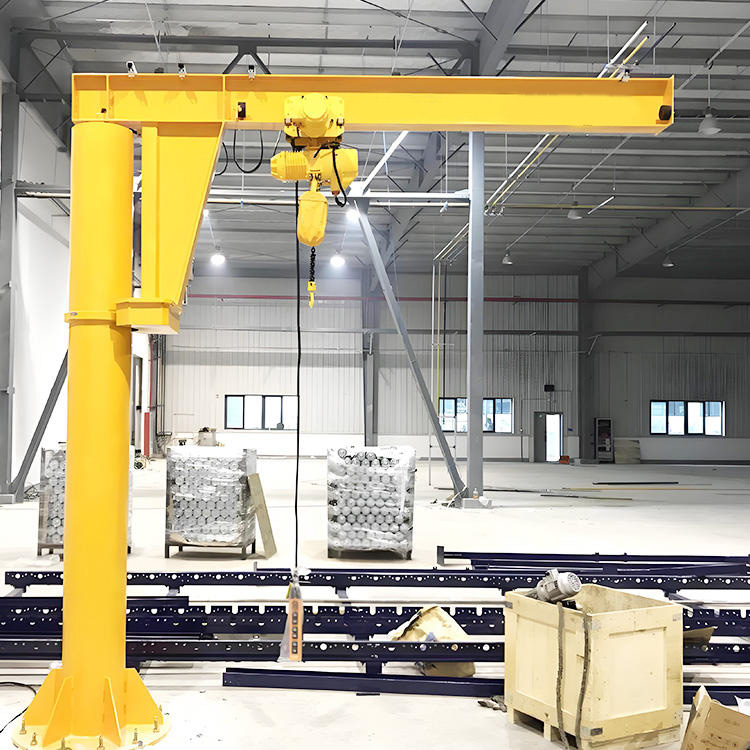
Wall-mounted jib cranes attach directly to an existing column or reinforced wall and typically provide 180°–200° of rotation.
Best suited for:
Assembly lines, workstations along walls, and facilities where floor space is limited.
Key consideration:
The building structure must be verified by an engineer to handle both vertical and horizontal forces.
Articulating Jib Cranes
Articulating jib cranes use a two-arm design that allows operators to maneuver loads around obstacles and into tight spaces.
Best suited for:
CNC machines, maintenance tasks, and complex assembly operations.
Key advantage:
Exceptional positioning accuracy where straight-boom cranes are impractical.

Weiyuan Column Jib Crane
The Weiyuan Column Jib Crane is a versatile and cost-effective freestanding lifting solution designed for precise material handling in workshops, assembly lines, and maintenance areas. With a full 360-degree slewing range and robust steel structure, this crane delivers smooth rotation, dependable performance and enhanced operational flexibility in confined workspaces. :contentReference
View Product / Get QuoteTechnical Factors That Matter in 2026
1. Safe Working Load (SWL)
Always calculate capacity based on the maximum load, including fixtures, tooling, and the hoist itself.
Industry best practice in 2026 is to allow a 15–20% capacity margin to accommodate dynamic forces and future operational changes.
2. Span and Effective Reach
The nominal boom length is not the same as usable working reach. Trolley travel limits mean the hook will not reach the absolute center or end of the arm.
Planning around the true working radius prevents workflow bottlenecks later.
3. Height Under Boom (HUB)
Insufficient clearance is one of the most common mistakes in jib crane selection. HUB must account for:
- Load height
- Hoist body length
- Rigging and safety clearance
If vertical space is limited, a jib crane may outperform a Gantry Crane, which often requires more headroom.
4. Rotation Control
Facilities with nearby equipment, columns, or piping should consider mechanical rotation stops. These prevent accidental collisions and extend crane life.
5. Manual vs. Motorized Operation
Manual rotation works well for light loads and low-duty cycles. For heavier loads or repetitive tasks, motorized rotation improves safety and can significantly reduce operator fatigue.
Safety and Compliance: Non-Negotiable in 2026
Modern compliance is not just about passing inspections—it directly affects liability and uptime.
Key requirements include:
- Certified load testing (typically 125% of rated capacity)
- Verified foundation or mounting structure
- Compatible hoist speed and braking systems
If your application involves moving loads across multiple work zones or outdoors, a Gantry Crane may offer better stability and compliance flexibility.
Maintenance and Long-Term Reliability
A well-built jib crane can operate reliably for decades when maintained correctly.
Recommended practices:
- Daily visual checks for fasteners, wire ropes, and abnormal noise
- Annual structural inspections
- Proper lubrication of pivot points
- Protective coatings in corrosive or humid environments
Ignoring routine maintenance is one of the fastest ways to turn a solid investment into a recurring problem.
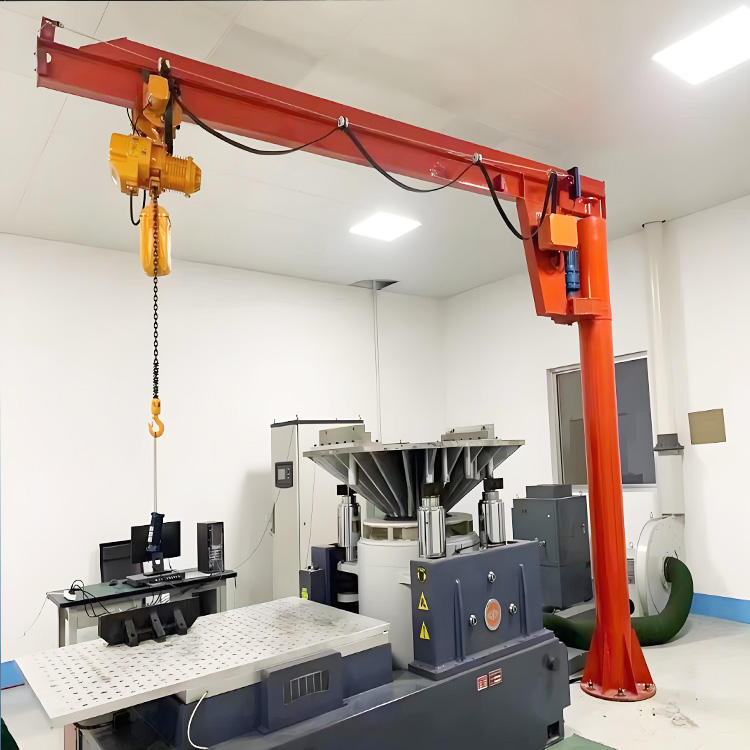
Jib Crane or Gantry Crane: Making the Right Call
The decision often comes down to layout and workflow:
- Choose a Jib Crane if lifting happens repeatedly at a fixed station
- Choose a Gantry Crane if loads must move across different areas or outdoors
Many efficient facilities use both systems together, assigning each to the tasks it handles best.
Frequently Asked Questions (FAQ)
Q1: How long does a jib crane typically last?
With proper installation and maintenance, a quality jib crane can serve reliably for 20 years or more.
Q2: Can a jib crane be upgraded later?
In many cases, hoists, controls, or rotation systems can be upgraded, provided the structure was designed with sufficient capacity.
Q3: Is a jib crane suitable for outdoor use?
Yes, when designed with weather-resistant components and appropriate surface protection.
Q4: When should I choose a Gantry Crane instead of a jib crane?
If your operation requires moving loads across multiple locations or along a production line, a Gantry Crane may be more practical.