


Key Advantages of Gantry Cranes: Your Complete Guide to Streamlined Lifting Solutions”
In the competitive landscape of 2026, industrial efficiency is no longer just a goal—it is a survival requirement. Whether you are overseeing a steel fabrication yard, a busy port, or a high-precision manufacturing facility, the way you move heavy loads determines your pace of production and, ultimately, your profitability.
While overhead bridge cranes are the traditional choice for indoor lifting, they aren’t always the most practical or cost-effective option. This is where the 【Gantry Crane】 proves its worth. Known for its structural independence and versatility, the gantry crane has become a strategic asset for businesses that need high-capacity lifting without the constraints of permanent building modifications.
This guide provides an in-depth analysis of why gantry cranes are a superior choice for modern material handling, covering technical specifications, financial ROI, and safety standards.
1. What is a Gantry Crane? (Beyond the Basics)
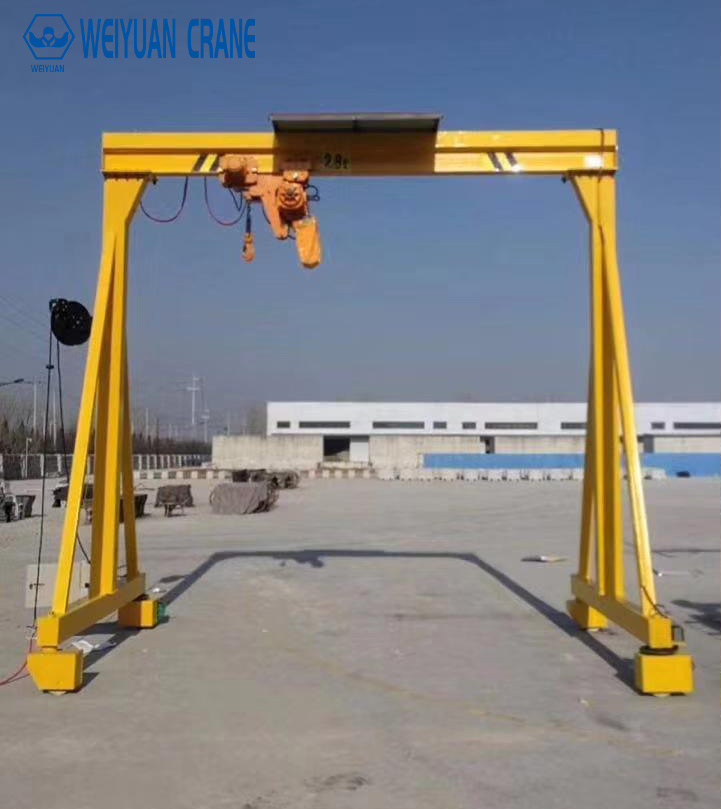
A gantry crane is an overhead lifting system supported by its own freestanding legs that move along rails or on wheels. Unlike a bridge crane, which requires the building’s columns to support its weight and the weight of the load, a gantry system stands on its own.+1
Core Anatomy
To understand the engineering behind these machines, we must look at their primary components:
- Bridge Girder: The horizontal beam (single or double) that spans the work area.
- Supporting Legs: The vertical structures that elevate the bridge.
- The Hoist & Trolley: The mechanism that performs the actual lifting and moves laterally across the bridge.
- End Carriages: The units at the bottom of the legs that contain the wheels for longitudinal travel.
- Power Supply: Usually delivered via cable reels, busbars, or even diesel generators for remote outdoor sites.
By separating the lifting system from the building’s structure, a 【Gantry Crane】 offers a level of freedom that traditional cranes simply cannot match.
2. Structural Independence: The Massive Cost Advantage
For many facility managers, the biggest hurdle in installing an overhead crane is the “Building Factor.” Many older buildings or lightweight steel structures cannot support the massive dynamic loads produced by a 50-ton crane.
No Building Reinforcement Required
Installing a bridge crane often requires adding new support pillars or reinforcing existing columns—a process that is expensive, time-consuming, and disruptive to production. A gantry system bypasses this entirely. Since it carries its own weight down to the floor, the only requirement is a foundation or rail system capable of handling the pressure.
Faster Commissioning
Because there is no need for complex structural engineering on the building itself, the lead time from purchase to “first lift” is significantly shorter. For businesses operating on tight project deadlines, this speed to market is a major financial win.

Weiyuan Heavy Duty MG Type Gantry Crane for Outside Lifting
The Weiyuan Heavy Duty MG Type Gantry Crane is a powerful and resilient outdoor lifting solution engineered for demanding outside lifting operations, combining a robust A-frame double-girder structure with weatherproof components for reliable performance in outdoor stockyards, construction and industrial environments. :contentReference
View Product / Get Quote3. Versatility Across Environments
One of the defining features of the 【Gantry Crane】 is its ability to perform in environments where other cranes fail.
Outdoor Dominance
Shipyards, precast concrete yards, and scrap metal facilities rely on gantry cranes because they don’t need a roof. Modern gantry systems are engineered with weather-resistant coatings, enclosed electrical panels, and anemometers (wind sensors) to ensure safe operation in wind, rain, or extreme heat.
Indoor Flexibility: The Semi-Gantry Solution
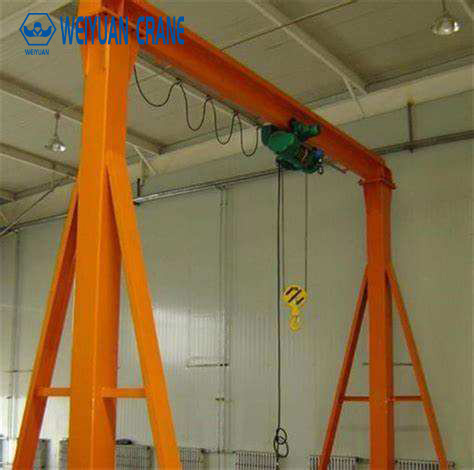
If you have a large facility but only need lifting capability along one wall, a semi-gantry crane is an ideal hybrid. One side of the bridge runs on an elevated runway, while the other side is supported by a leg traveling on a floor rail. This keeps your floor clear of obstacles on one side while providing heavy-duty lifting where you need it most.
Portable and Mobile Options
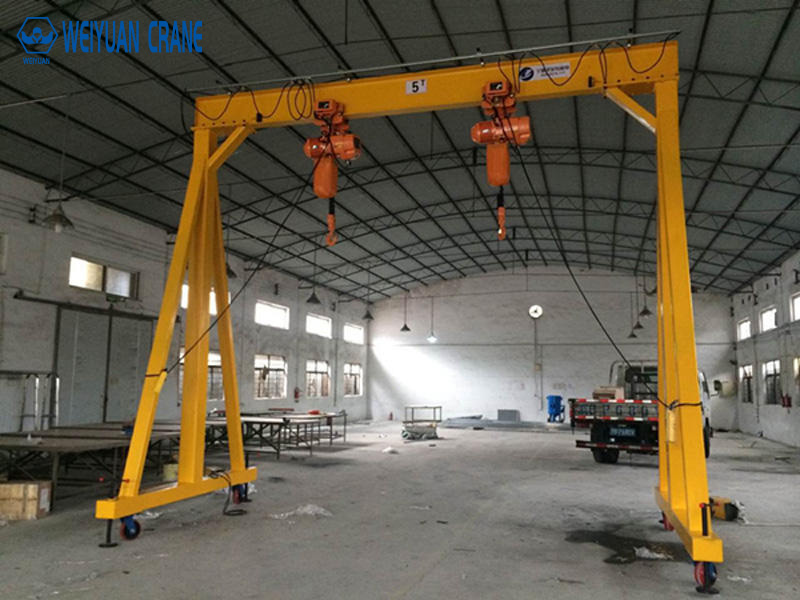
Not every gantry crane is a permanent fixture. Portable gantry cranes, often made of lightweight aluminum or steel, allow maintenance teams to wheel the crane directly over a piece of machinery for a repair and then move it back to storage once the job is done.
4. Technical Depth: Choosing the Right Duty Cycle
When evaluating a crane for purchase, looking at the maximum lifting capacity is only the first step. To ensure the machine lasts for decades, you must understand Duty Cycle Classifications (such as CMAA or ISO standards).
| Duty Class | Usage Frequency | Typical Application |
| Class A/B (Light) | Infrequent use, low speeds | Maintenance, power plants |
| Class C/D (Moderate) | Regular daily use, moderate loads | General manufacturing, machine shops |
| Class E/F (Severe) | Constant use, maximum loads | Steel mills, container ports, scrap yards |
Selecting a 【Gantry Crane】 with a duty cycle too low for your needs will result in motor overheating, brake failure, and structural fatigue. Conversely, over-specifying a Class F crane for a maintenance shop is a waste of capital. A professional engineering assessment ensures you buy exactly what you need for the long haul.
5. Maximizing ROI through Workflow Optimization
A gantry crane isn’t just a purchase; it’s a productivity multiplier. Here is how it drives measurable business performance:
Reduced Labor Costs
In many yards, moving a heavy component requires a team of several people and multiple pieces of mobile equipment. A gantry crane allows a single trained operator to perform the same task with higher precision and lower risk.
Spatial Efficiency
In warehouse and logistics hubs, floor space is at a premium. Gantry cranes allow for higher and tighter stacking of materials (like steel coils or shipping containers) than forklifts. Because the crane travels on fixed rails, you don’t need wide “turning aisles” for mobile vehicles, effectively increasing your storage capacity by 20-30%.+1
Long Service Life
High-quality gantry cranes are designed to be 20- to 30-year assets. Unlike a fleet of forklifts that may require replacement every 5-7 years, a well-maintained crane provides a much lower Total Cost of Ownership (TCO) over the life of the facility.
6. Safety: The Foundation of Industrial Reputation
In 2026, safety is a core metric of a company’s brand. An accident doesn’t just cost money; it damages trust. Modern gantry cranes are equipped with sophisticated safety arrays:
- Anti-Sway Technology: Software that automatically compensates for the “pendulum effect,” ensuring the load stays perfectly vertical during travel.
- Overload Protection: Systems that sense the weight of the load and prevent the hoist from operating if the Working Load Limit (WLL) is exceeded.
- Collision Avoidance: Laser or infrared sensors that stop the crane if an obstacle or person is detected in its path.
- Remote Radio Control: Allowing the operator to stand at a safe distance with the best possible vantage point, rather than being tethered to the machine by a pendant cable.
7. Future Trends: Automation and Connectivity
The lifting industry is undergoing a digital transformation. We are seeing a rise in “Smart Gantries” that offer:
- Predictive Maintenance: Sensors monitor motor vibrations and brake wear, sending alerts to your phone before a failure occurs.
- Automated Yard Management: Integration with Warehouse Management Systems (WMS) to automatically record the location of every item moved.
- Energy Recovery: Regenerative braking systems that capture energy during the lowering of a load and feed it back into your facility’s grid.
Frequently Asked Questions (FAQ)
Q1: Can a gantry crane be relocated if our business moves?
Yes, this is one of their primary advantages. Since they aren’t built into the building’s structure, most gantry cranes can be dismantled, transported, and reinstalled at a new site. This makes them an excellent choice for leased facilities or temporary project sites.
Q2: What is the main difference between a rail-mounted and a rubber-tired gantry?
Rail-mounted gantry cranes (RMGs) travel on a fixed path and are ideal for high-precision, repetitive tasks. Rubber-tired gantry cranes (RTGs) offer much more mobility, as they can travel across a paved yard and change paths, which is common in large container ports.+1
Q3: How do you maintain the floor rails for a gantry crane?
The rails must be kept clear of debris and checked regularly for alignment. If the rails settle or shift, it can cause “crabbing” (the crane traveling at an angle), which leads to excessive wheel wear. Annual inspections of the rail fasteners and the levelness of the track are essential.
Q4: Are gantry cranes more expensive than bridge cranes?
Initially, the crane itself might be slightly more expensive due to the cost of the steel legs. However, when you factor in the “Total Project Cost”—including the fact that you don’t have to reinforce your building—a 【Gantry Crane】 is often significantly more affordable overall.
Q5: What is the average lifespan of an industrial gantry crane?
With a consistent preventative maintenance program, an industrial-grade gantry crane can easily operate reliably for 20 to 30 years. Key components like the hoist and motors may be refurbished or upgraded over time, but the structural steel gantry itself is exceptionally durable.