


Top Benefits of Jib Cranes: Boosting Efficiency in Material Handling
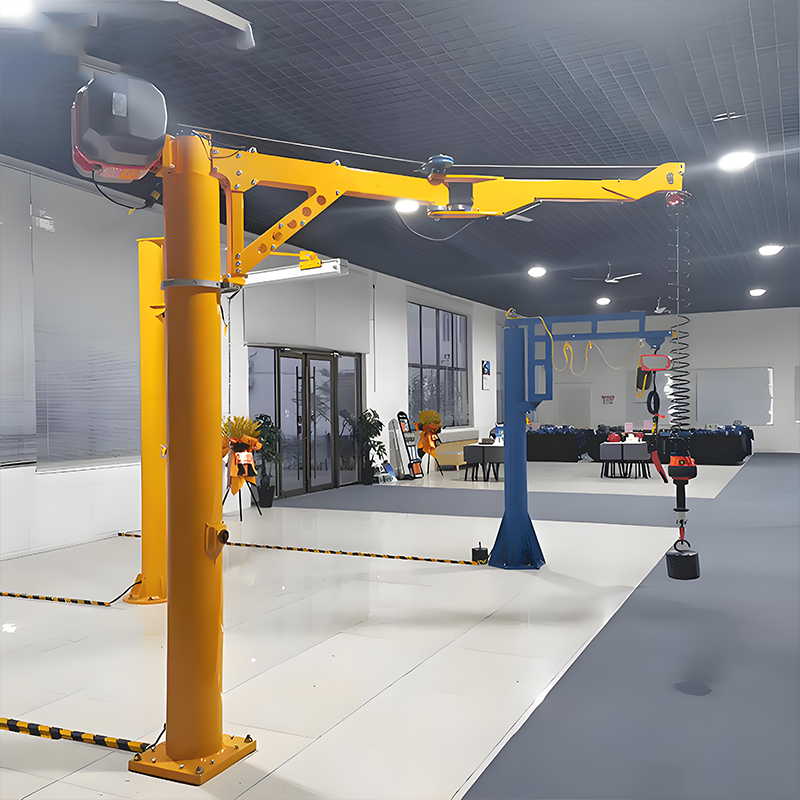
In any manufacturing, assembly, or logistics operation, bottlenecks often appear at the smallest level: the individual workstation. While large overhead systems are built to move heavy loads across entire facilities, they frequently lack the speed and agility needed for repetitive, localized lifting. This is where the jib crane proves its worth as an indispensable asset.
By providing dedicated lifting power to a specific work cell, jib cranes bridge the gap between hazardous manual handling and large-scale, facility-wide cranes. They are the precision tools of the industrial lifting world. This guide explores the significant benefits of jib cranes, their various configurations, and how they complement larger systems like the Gantry Crane to create a complete and efficient material handling ecosystem.
1. A Precision Powerhouse: What Exactly is a Jib Crane?
At its core, a jib crane has a simple yet effective design. It consists of a horizontal member (the jib or boom) that is supported by a vertical mast or attached directly to a building wall or column. A hoist and trolley are mounted on the boom, allowing for localized lifting and rotation within a specific arc.
Unlike a massive Gantry Crane designed for high-capacity lifts over huge spans, a jib crane excels at “spot lifting.” It is the perfect solution for loading CNC machines, moving parts between assembly stations, or handling repetitive tasks that would otherwise cause physical strain on a worker.
2. The Key Benefits: Why Jib Cranes Are a Strategic Investment
Integrating jib cranes into a workflow delivers immediate and measurable advantages, impacting everything from productivity to workplace safety.
A. Drastic Improvements in Localized Efficiency
The primary benefit of a jib crane is its ability to eliminate “wait time.” In many shops, operators must wait for a shared overhead crane to become available just to lift a 500-pound part a few feet. This downtime is a silent killer of productivity. A dedicated jib crane at a workstation provides instant access to lifting power, ensuring the production line keeps moving without interruption.
B. Superior Optimization of Floor Space
Jib cranes are designed with a minimal footprint in mind. Wall-mounted models use zero floor space, leaving the area clear for forklift traffic and other activities. Even freestanding pillar-mounted versions can be tucked neatly into corners or between machines. Their ability to serve multiple workstations within a circular “coverage zone” is a highly efficient way to transfer materials without needing wide, dedicated aisles.
C. Enhanced Ergonomics and Worker Safety
According to safety organizations worldwide, musculoskeletal disorders from repetitive lifting are a leading cause of lost workdays. A jib crane removes the physical strain from the operator, allowing them to position heavy or awkward loads precisely and with minimal effort. This not only prevents costly injuries but also reduces fatigue, increases morale, and helps maintain a consistent work pace throughout a shift.
D. A Cost-Effective and Scalable Solution
Compared to the significant capital outlay for a full bridge or Gantry Crane system, jib cranes are remarkably affordable. They allow businesses to add lifting capacity incrementally as production demands grow. This scalability means you can address bottlenecks one workstation at a time without committing to major structural renovations or expensive foundation work.

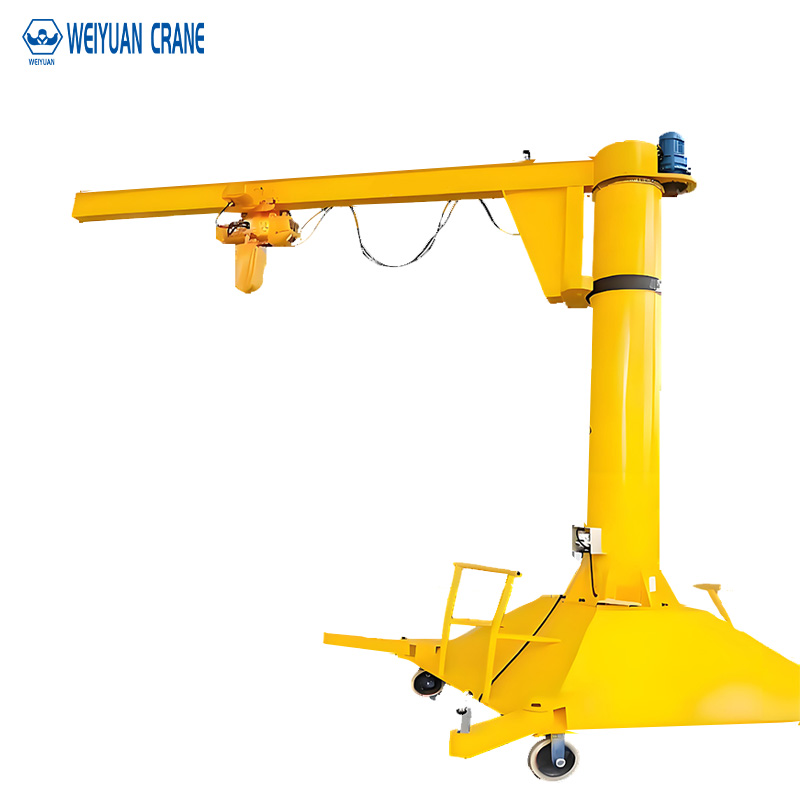
Weiyuan Column Jib Crane
The Weiyuan Column Jib Crane is a versatile and cost-effective lifting solution designed for efficient localized material handling with 360° rotation and robust freestanding structure — ideal for workshops, assembly areas, and maintenance bays.:contentReference
View Product / Get Quote3. Types of Jib Cranes: Choosing the Right Configuration
Selecting the right jib crane depends on your facility’s layout, existing structure, and lifting requirements.
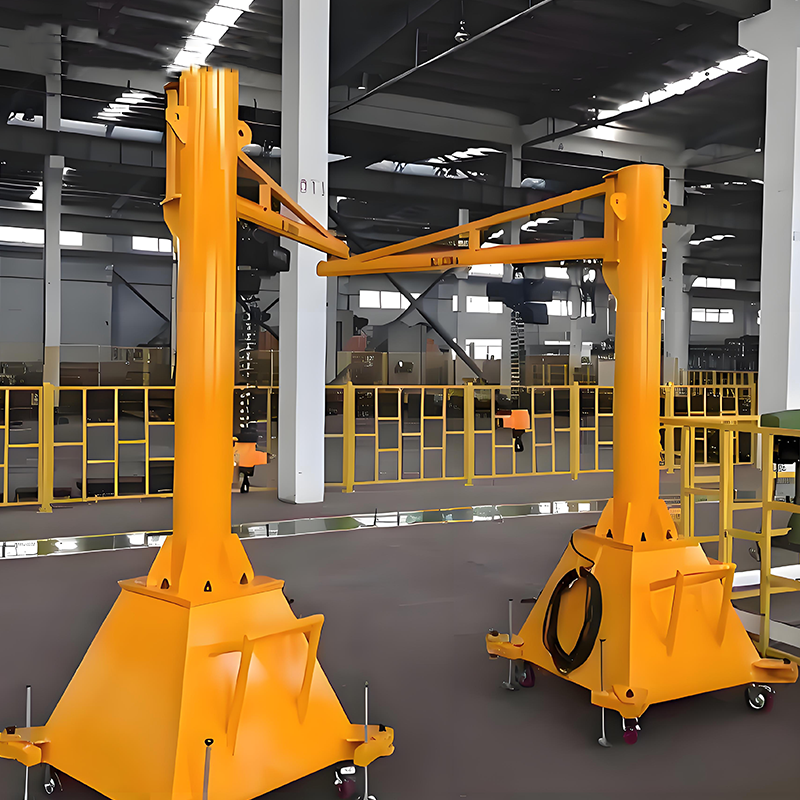
- Pillar-Mounted (Freestanding) Jib Cranes: This is the most common type, consisting of a vertical mast bolted to a dedicated concrete foundation. It offers full 360-degree rotation and is best for open workshops where a single crane needs to service multiple machines in a circular area.
- Wall-Mounted Jib Cranes: These units are bolted directly to a structurally sound building column or wall. They typically provide 180 to 200 degrees of rotation and are ideal for facilities with limited floor space or for lifting along the perimeter of a building.
- Articulating Jib Cranes: Featuring a “folding” boom with two pivot points, these cranes can reach around obstacles like columns or into tight spaces where a standard straight boom cannot navigate. They are the ultimate solution for complex workstations.
4. Jib vs. Gantry Cranes: Partners, Not Competitors
A common question for facility managers is whether to invest in a jib crane or a small Gantry Crane. The answer lies in the scope and nature of the task.
| Feature | Jib Crane | Gantry Crane |
|---|---|---|
| Movement | Rotational / Circular | Linear / Longitudinal |
| Capacity | Lower (Typically 0.5 to 10 tons) | Higher (1 to 500+ tons) |
| Application | Specific workstation / spot lift | Facility-wide / outdoor yard lift |
| Mobility | Fixed to a location | High (can run on rails or wheels) |
In a highly efficient operation, these two systems work together. A gantry might bring a large pallet of raw material into the work bay, while a series of jib cranes at each station handle the actual fabrication and assembly tasks.
5. Technical Specifications for Reliability
When specifying a jib crane, technical accuracy is the foundation of safety and performance. Always consider the following:
- Working Load Limit (WLL): Never base your purchase on the average load. Specify the crane’s capacity based on the absolute heaviest lift you anticipate, adding a buffer for safety and future needs.
- Reach and Height Under Boom (HUB): The “reach” is the length of the boom. The HUB is the distance from the floor to the bottom of the hoist. Ensure the HUB is sufficient to clear your tallest machinery while a load is suspended.
- Duty Cycle: Just like larger cranes, jibs are rated for their service class (e.g., light, moderate, or heavy use). Using a light-duty jib in a high-production environment will lead to premature failure and safety hazards.
Frequently Asked Questions (FAQ)
Q1: Can a jib crane be installed on a standard 6-inch concrete floor?
For small capacities (under 1,000 lbs), special large-base mounting plates can sometimes be used on a standard floor. However, for higher capacities, a dedicated concrete foundation is almost always required to safely counteract the overturning force.
Q2: What is the main benefit of an articulating jib?
Articulating jibs have two folding arms, allowing them to “reach around” obstacles or into confined spaces, such as the inside of a large machine. They offer unmatched maneuverability in crowded work cells.
Q3: Is a wall-mounted or floor-mounted jib better?
If your building has structurally sound columns and you need to maximize floor space, a wall-mounted jib is an excellent choice. If you require 360-degree rotation or need a crane in an open area far from a wall, a pillar-mounted (freestanding) model is necessary.
Q4: Are jib cranes suitable for outdoor use?
Yes, but they must be ordered with a “weatherization package.” This typically includes a multi-part epoxy paint finish, stainless steel components, and protective covers for the hoist and electrical systems to prevent corrosion and water damage.