


Maximizing Industrial ROI: The 2026 Strategic Guide to Overhead Cranes
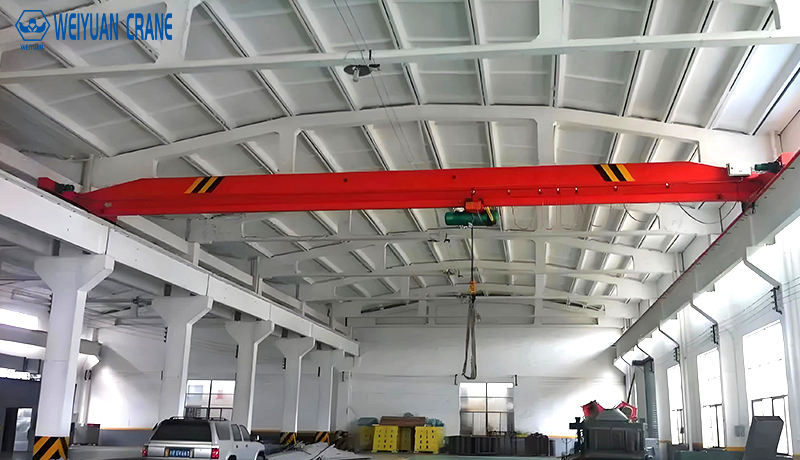
Modern industrial productivity isn’t just about how much weight you can move; it’s about where that movement happens. In a crowded factory or a high-output warehouse, floor space is the most expensive asset you own. If your material handling relies solely on forklifts and manual labor, you aren’t just moving goods—you’re clogging your primary arteries.
This is why 【 Overhead Cranes】 are considered the gold standard of industrial infrastructure. By shifting the heavy lifting to the “dead air” space near the ceiling, these systems transform a facility from a congested floor into a high-speed, three-dimensional logistics hub.
Whether you are managing a precision automotive assembly line or a heavy-duty steel fabrication yard, understanding the nuances of overhead lifting is critical for long-term operational success. This guide breaks down the technology, the strategic benefits, and the selection criteria for 2026 and beyond.
1. What Exactly is an Overhead Crane?
At its simplest, an overhead crane (often called a bridge crane) is a permanent lifting system that operates on an elevated plane. Unlike a mobile crane that navigates on tires, an overhead system is integrated into the building itself or supported by a dedicated freestanding structure.
The magic of the system lies in its three-axis movement:
- Longitudinal (Forward/Backward): The entire bridge travels along parallel runways.
- Lateral (Left/Right): The trolley carrying the hoist moves across the bridge.
- Vertical (Up/Down): The hoist raises or lowers the load.
This allows for pinpoint accuracy in positioning heavy or awkward loads anywhere within a defined rectangular work bay.
The Anatomy: What Makes It Tick?
To talk to an engineer or supplier effectively, you need to know the components:
- The Bridge: The main structural beam(s) spanning the width of your workspace.
- The Runways: The tracks, usually mounted on building columns, that dictate the crane’s travel length.
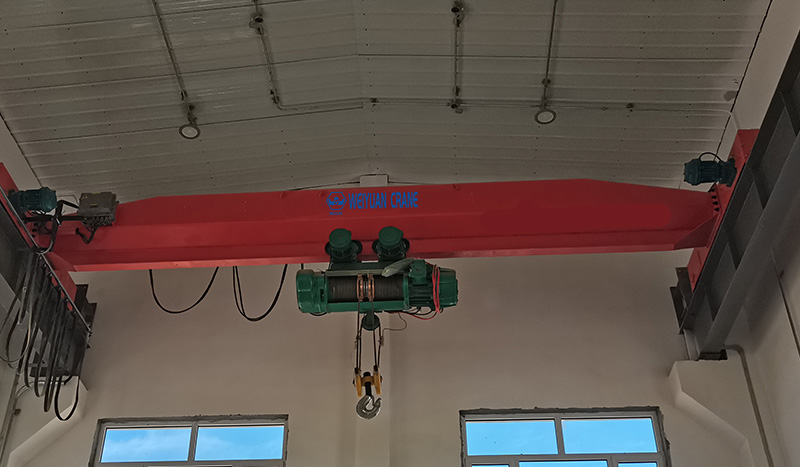
- The Hoist & Trolley: The “business end” of the crane. The hoist does the lifting (using wire rope or chain), while the trolley provides the side-to-side motion.
- End Trucks: The wheel assemblies at either end of the bridge that allow it to glide along the runways.
- The Control System: Modern units use wireless radio remotes, allowing the operator to stand at a safe, optimal vantage point.
2. Girder Configurations: Single vs. Double
The most fundamental choice you will face when specifying 【 Overhead Cranes】 is the girder design. This decision is usually a tug-of-war between your budget and your lifting requirements.
Single Girder Overhead Cranes
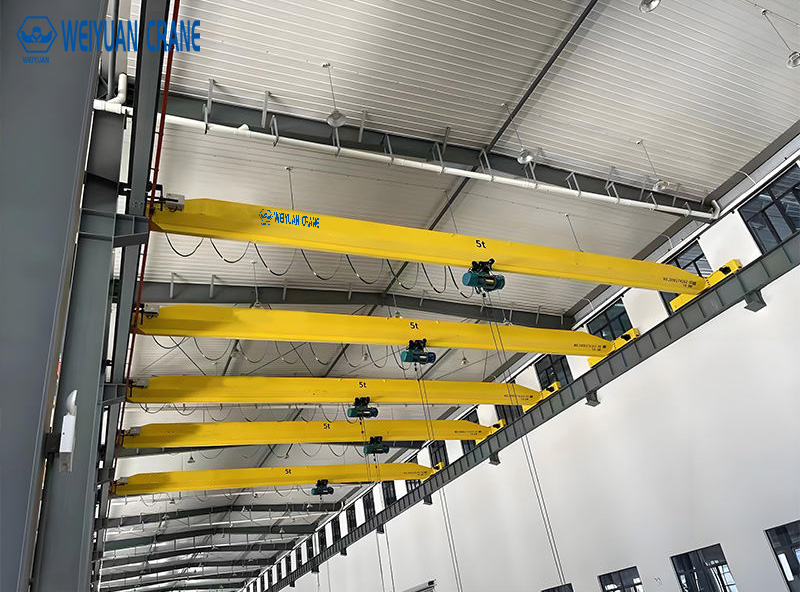
In this design, one bridge beam supports the trolley. The trolley usually “runs” on the bottom flange of the beam (under-running).
- The Pro: They are lighter, faster to install, and significantly more cost-effective. They put less stress on your building’s structure.
- The Con: They generally top out at around 20 tons and have shorter spans.
- Best For: Workshops, light manufacturing, and maintenance bays.
Double Girder Overhead Cranes
Here, two parallel beams support the weight. The trolley usually rides on rails mounted to the top of the girders.
- The Pro: These are the heavy hitters, capable of lifting hundreds of tons. Because the hoist sits between the beams rather than under them, you gain significant “hook height”—crucial if you have a low ceiling but need to lift tall items.
- The Con: Higher initial investment and heavier structural requirements for your building.
- Best For: Steel mills, foundries, and heavy equipment assembly.
3. Top-Running vs. Under-Running: Where Do the Wheels Go?
Beyond the number of girders, you must decide how the crane sits on the runways.
- Top-Running Cranes: The end trucks ride on top of rails mounted to the runway beams. This is the standard for high-capacity lifting. It offers maximum stability and can handle the most extreme duty cycles.
- Under-Running (Underslung) Cranes: The wheels grip the bottom flange of the runway beams. These are often suspended directly from the roof trusses. This is a brilliant solution for facilities with no room for support columns or where you need to maximize the “clear” floor space. However, capacities are generally lower.
4. The Strategic Business Case for Overhead Lifting
Why invest six figures into a permanent crane system when a forklift is cheaper? Because the ROI of 【 Overhead Cranes】 is found in the “hidden” savings of industrial operations.
A. Reclaiming the “Hidden Asset” (Floor Space)
Forklifts require wide aisles to turn and maneuver. In a 20,000-square-foot facility, you might be losing 15% of your floor space just to “traffic lanes.” By moving your material handling overhead, you can compact your machinery layout and increase your production capacity without building a new wing.
B. Precision and Product Protection
In sectors like aerospace or mold-making, a “bump” during transport can cost thousands in scrap. Overhead cranes equipped with Variable Frequency Drives (VFDs) allow for millimeter-level positioning. They eliminate the “jerk” of traditional motors, ensuring a smooth start and stop that keeps delicate loads perfectly stable.
C. Safety: The Foundation of E-A-T
Safety isn’t just about following the law; it’s about protecting your most valuable asset: your people. Manual lifting and forklift collisions are leading causes of workplace injury. An overhead system removes the human element from the “danger zone” of the lift. With modern anti-sway technology, even less experienced operators can move heavy loads with minimal risk.
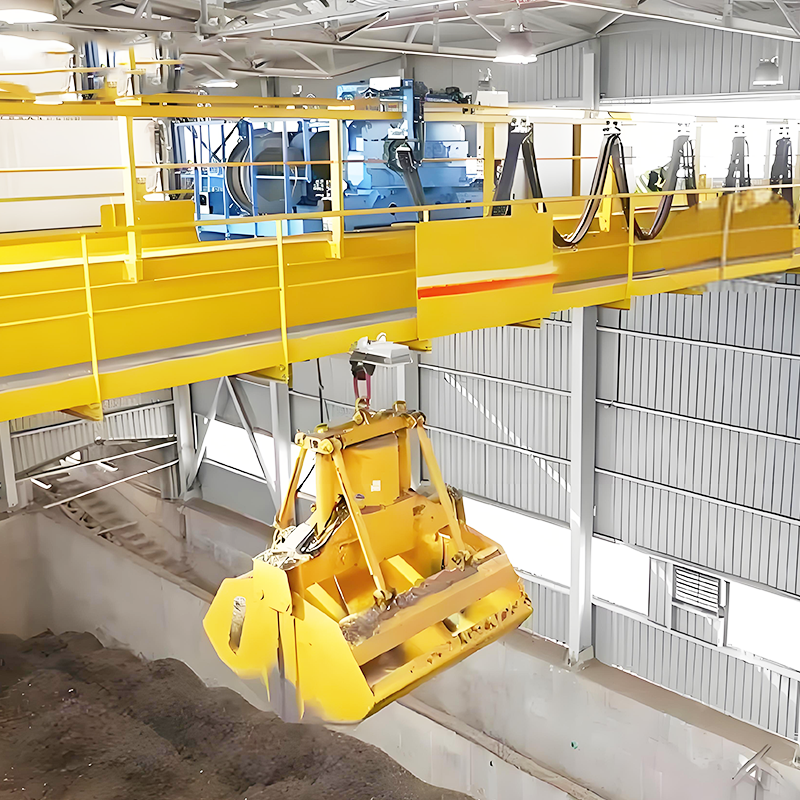
Weiyuan QZ Type Grab Crane for Steel Scrap | 30 Ton, Heavy-Duty, High-Efficiency
The Weiyuan QZ Type 30 Ton Grab Crane is engineered specifically for demanding steel scrap handling operations. Built on a heavy-duty double-girder platform with a high-strength orange peel grab, it delivers reliable performance and high efficiency in continuous scrap yard and foundry material handling environments. :contentReference
View Product / Get Quote5. Technical Depth: Understanding Duty Cycles (CMAA)
If you ignore this section, you will likely buy a crane that fails within three years. Capacity is important, but frequency is what kills cranes. The Crane Manufacturers Association of America (CMAA) classifies cranes based on how hard they work:
- Class A (Standby/Infrequent): Used for maintenance or in power plants where lifts happen only a few times a month.
- Class C (Moderate): Your standard machine shop crane, used for about 5-10 lifts per hour at 50% capacity.
- Class D (Heavy): Constant use in a busy production line.
- Class F (Continuous Severe): 24/7 operation at maximum capacity—think massive steel mills.
Expert Tip: Always specify your crane based on your future shift patterns. If you plan to move from one shift to three, a Class C crane will quickly become a maintenance nightmare.
6. Industry-Specific Applications: Where They Excel
Steel Warehousing & Fabrication
Cranes here often use specialized attachments like magnets or C-hooks to move massive coils and plates. The ability to stack material vertically and tightly is what keeps these high-volume businesses profitable.
Automotive & Aerospace
In these industries, it’s all about the “assembly flow.” Cranes move chassis or fuselage sections through various stages with zero risk of ground-level obstruction. Precision is paramount here; the crane must integrate with the facility’s overall automation.
Power Generation
During a turbine overhaul, every hour of downtime costs a utility company millions. 【 Overhead Cranes】 in these environments are designed for extreme reliability and precise positioning of generators and turbine rotors that weigh hundreds of tons.
7. The Checklist: Before You Sign the Quote
If you are currently evaluating a new lifting system, ask your supplier these four critical questions:
- What is the Wheel Load? You need to ensure your concrete floor or building columns can handle the concentrated pressure. The calculation for the maximum wheel load $P$ is generally:$$P = \frac{(W_c + W_h)}{n} + \frac{(W_b \times L_{span})}{2 \cdot n}$$(Where $W_c$ is crane weight, $W_h$ is hook load, $W_b$ is bridge weight per foot, $L_{span}$ is span, and $n$ is number of wheels.)
- Is the Hoist “Off-the-Shelf”? Using standard components (like motors from Siemens or ABB) ensures that when a part breaks in 10 years, you aren’t held hostage by a proprietary manufacturer.
- Does it have VFD Control? Don’t settle for two-speed controls. VFDs (Variable Frequency Drives) are the standard for 2026, offering better safety and lower mechanical wear.
- What is the Inspection Schedule? Ensure they provide a comprehensive manual that meets local safety standards (like OSHA or CE).
Frequently Asked Questions (FAQ)
Q1: How long does a typical overhead crane last?
A: With a solid preventative maintenance program, an industrial crane can easily last 20 to 30 years. Structural steel is virtually permanent; only the wear-parts (wire ropes, brakes, and electrical contacts) require periodic replacement.
Q2: Can I install a crane in a building that wasn’t designed for one?
A: Yes. You can opt for a freestanding runway system. This is a self-supporting steel structure that stands on your floor, meaning the crane doesn’t touch the building’s columns or roof.
Q3: How often do I need to inspect my crane?
A: Most regulations require a “Frequent Inspection” (daily visual check by the operator) and a “Periodic Inspection” (comprehensive annual audit by a certified technician).
Q4: What is the benefit of a wireless radio remote over a wired pendant?
A: Safety and visibility. A wireless remote allows the operator to stand anywhere—away from the load and clear of obstacles—giving them the best possible view of the lift path.
Q5: Single girder or double girder—which is better for a low ceiling?
A: If you need maximum lift height in a cramped space, a double girder top-running crane is usually better. The hoist can be tucked up between the two beams, giving you more “headroom” than a single girder where the hoist hangs below.