


7 Ways Electric Hoists Boost Efficiency and Guarantee Reliability
Category: Industrial Lifting Technology | Reading Time: ~8 minutes | Last Updated: March 2026
In today’s competitive industrial landscape, downtime is the enemy of profit. Whether your facility runs a production line, a shipyard, or a warehouse that operates 24 hours a day, the performance of your lifting equipment directly determines how fast goods move—and how safely your people go home. Electric hoists have become one of the most relied-upon tools in modern material handling, and for good reason: they combine mechanical precision with digital intelligence in ways that earlier generations of equipment simply could not match.
This guide explores seven specific, evidence-backed ways that electric hoists deliver measurable gains in both efficiency and long-term reliability. Along the way, we will also explain how they interact with larger crane systems—including the Gantry Crane—to create a fully optimised lifting ecosystem. Whether you manage a single workshop or oversee procurement across multiple sites, the insights here will help you make better decisions and get more from every lifting cycle.
TL;DR: Electric hoists reduce cycle times, cut maintenance costs, improve load safety, and integrate seamlessly with overhead and Gantry Crane systems. The seven strategies below turn these advantages into a practical roadmap.
1. Variable-Speed Control Eliminates Wasted Motion
One of the most underrated efficiency killers in a lifting operation is inconsistent speed management. When an operator must choose between full-speed and stopped, they inevitably compromise—either rushing a delicate load or crawling a routine one. Modern electric hoists solve this with variable frequency drives (VFDs) that provide infinitely adjustable lifting and lowering speeds.
The practical impact is significant. Research from the European Handling Association suggests that facilities adopting variable-speed hoists see cycle-time reductions of up to 20% compared with fixed-speed alternatives. Operators can accelerate heavy steel coils to maximum speed for the bulk of the journey, then slow to near-zero for precision placement—without any manual switching or mechanical jerking.
Why this matters for crane system integration
When an electric hoist is mounted to a bridge crane or a Gantry Crane, speed control affects the entire system, not just the hoist itself. A Gantry Crane traversing a yard, for example, handles loads that shift dynamically in wind and rain. Variable-speed hoists allow the gantry operator to compensate in real time, reducing load swing and the associated risk of structural strain on the crane’s legs and runway beams.
- Smooth acceleration protects structural welds and trolley wheels
- Deceleration ramps lower peak electrical demand, cutting energy bills
- Micro-speed settings enable thread-the-needle placement in tight bays
2. Load Monitoring Technology Prevents Overloads Before They Happen
Every hoist has a rated working load limit (WLL). Exceeding it—even briefly—accelerates fatigue in the rope, hook block, and structural frame. Traditional hoists relied entirely on the operator to judge loads, which meant that invisible overloads were a constant risk, especially in multi-shift environments where communication between crews can be imperfect.
Modern electric hoists integrate load cells directly into the hook block or rope anchor point. These sensors feed data to an onboard controller that displays real-time load weight, triggers audible alarms at a configurable threshold (typically 90% of WLL), and physically locks the hoist from lifting if the operator attempts to exceed the limit.
Expert Insight: A study by the Crane Institute of America found that load monitoring reduced hoist-related incidents by 34% across facilities that adopted the technology over a three-year period. Combining load monitoring with operator training produced even stronger results.
Integration with Gantry Crane systems
On a Gantry Crane used in port or shipbuilding environments, where loads routinely approach rated capacity, an integrated load monitoring system provides the kind of real-time feedback that enables operators to manage asymmetric loads, sling angles, and dynamic forces from vessel movement. The hoist becomes an intelligent sub-system within a larger safety architecture rather than a dumb lifting mechanism.
3. Precision Engineering in the Rope and Hook Assembly Extends Service Life
Reliability is not just about sensors and software—it begins with materials science. The wire rope on an electric hoist endures thousands of bending cycles per shift as it spools and unspools over the drum and through the sheave block. Low-quality rope fatigues rapidly; the wires break individually until the rope loses integrity under load.
Premium electric hoists use rotation-resistant, multi-layer compacted-strand rope with independent wire rope core (IWRC) construction. This design distributes bending stress across more individual wires, dramatically extending the rope’s fatigue life. Combined with precision-machined drum grooves that guide the rope into exact alignment on every layer, the result is consistent rope life that can be predicted and planned around—rather than discovered at the point of failure.
- Rotation-resistant rope: prevents load spin and uncontrolled descent
- Hardened drum grooves: reduce fretting wear by up to 40%
- Sealed rope anchor: eliminates fretting at the termination point, a common failure origin
When sourcing hoists for long-term deployment—whether on a standalone jib arm or as the lifting unit on a large Gantry Crane—specifying compacted-strand rope with verifiable certification documentation is one of the highest-ROI decisions a procurement team can make.
4. Modular Design Slashes Maintenance Downtime

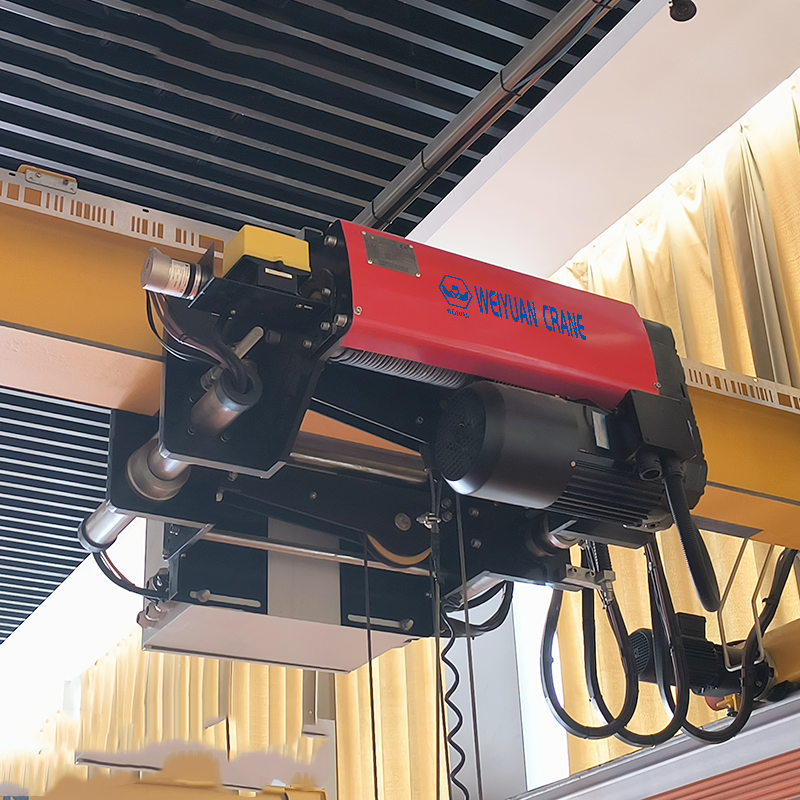
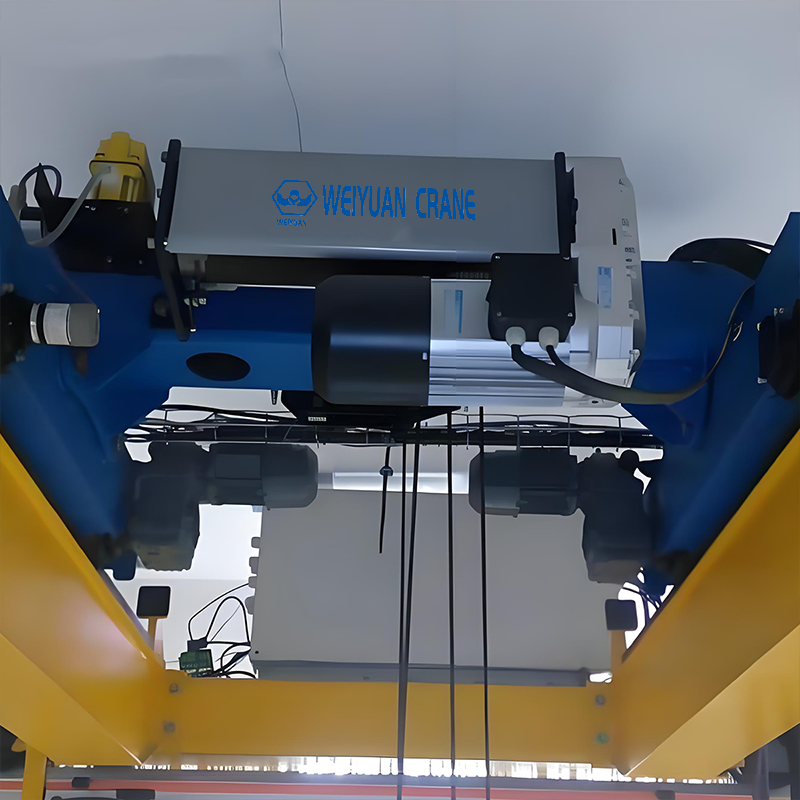
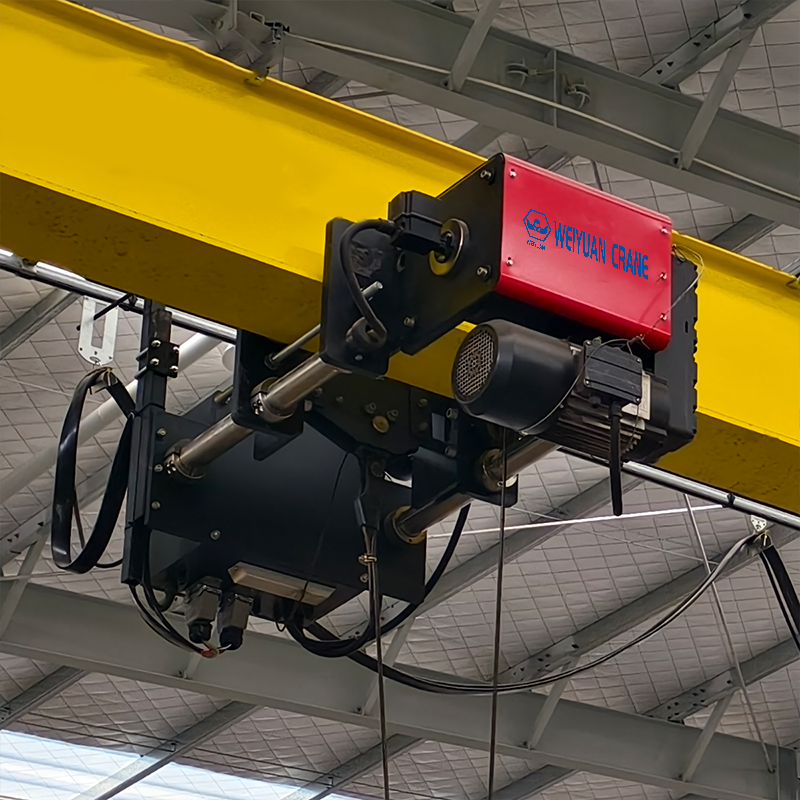
Weiyuan 1 Ton Remote Control Monorail Electric Hoist
The Weiyuan 1 Ton Remote Control Monorail Electric Hoist is designed for efficient material handling in workshops, warehouses, and light industrial environments. Equipped with wireless remote control and a monorail trolley system, it ensures precise load positioning, smooth travel, and safe lifting operations up to 1 ton.
View Product / Get QuoteDowntime during maintenance is unavoidable, but the duration is not. Traditional hoists were built as monolithic assemblies; repairing any single component often required full disassembly, specialist tools, and extended crane outages measured in days. Modern electric hoists are engineered around modular sub-assemblies that can be swapped in the field without specialised tooling.
The motor, gearbox, drum assembly, and control module each connect via standardised interfaces. When a gearbox oil seal fails, a technician removes the gearbox module, installs a pre-assembled replacement unit, and the hoist is back in service within hours. The failed module travels to the workshop for bench repair—which can happen during normal production without any additional crane downtime.
Maintenance planning that actually works
The shift to modular design also enables predictive maintenance strategies. Because each module has a defined service life and predictable wear rates, facilities can schedule swaps during planned shutdowns rather than reacting to unexpected failures. Applied across an entire fleet—including hoists fitted to bridge cranes and Gantry Crane installations—this approach can reduce unplanned downtime by 50% or more over a five-year period.
- Pre-staged spare modules eliminate long-lead supply chain delays
- Module-level condition monitoring flags degradation before failure
- Standard interfaces allow cross-fleet parts sharing, reducing inventory cost
5. Intelligent Control Systems Enable Remote Operation and Data Logging
The rise of Industry 4.0 has transformed what a hoist control system is expected to do. A decade ago, a hoist controller managed up and down commands. Today, advanced electric hoist controllers communicate via Ethernet, PROFIBUS, CANopen, and other industrial protocols, allowing seamless integration with facility-wide manufacturing execution systems (MES), enterprise resource planning (ERP) platforms, and predictive maintenance dashboards.
Radio remote controls with ergonomic pendants eliminate trailing cables that create trip hazards and limit operator positioning. Two-stage buttons give operators graduated control without requiring fine motor precision under PPE gloves. Emergency-stop functions are redundant, fail-safe, and tested according to EN 13849 functional safety standards.
Data Point: Facilities that log hoist cycle data report average utilisation rates 30% higher than their initial estimates—indicating substantial hidden capacity that can be recovered through scheduling optimisation alone.
For complex lifting environments—such as automotive body shops, aerospace component assembly, or heavy fabrication yards where a Gantry Crane handles irregular loads across a wide bay—remote operation with live load and speed telemetry allows supervisors to coordinate multiple hoists simultaneously from a single control station, dramatically improving throughput.
6. Low-Noise Drives Improve Workplace Safety and Operator Performance
Industrial noise is a frequently underestimated productivity and safety issue. NIOSH data indicates that sustained noise above 85 dB causes cumulative hearing damage, but cognitive impairment—reduced concentration, slower reaction times, and miscommunication—begins at levels well below that threshold. A workshop where every hoist screams during travel is a workshop where errors accumulate invisibly.
Modern electric hoists use helical-cut gears rather than straight-cut spur gears. Helical gearing generates significantly lower noise and vibration because the tooth engagement is gradual rather than abrupt. Combined with precision-balanced motor rotors and vibration-isolating motor mounts, the result is a hoist that operates at conversation-level noise in many applications.
- Helical gearboxes: typically 6–10 dB quieter than spur gear equivalents
- Vibration isolation mounts: reduce structural noise transmission to runway beams
- Enclosed motor housings: contain fan noise and prevent ingress of conductive dust
Operator performance under quieter conditions
Beyond hearing protection compliance, quieter hoists produce measurable productivity benefits. Operators communicate more accurately, respond faster to alarms, and sustain attention over longer shifts. In facilities where a Gantry Crane works alongside other overhead equipment in a shared bay, reducing cumulative noise load significantly improves the overall working environment and reduces error rates during complex multi-lift operations.
7. Explosion-Proof Configurations Unlock Hazardous-Area Deployment
Standard electric hoists cannot be safely deployed in environments where flammable gases, vapours, or dusts may be present. Petrochemical plants, paint spray booths, flour mills, and lithium battery manufacturing facilities all require lifting equipment certified to ATEX (Europe) or NEC/UL (North America) hazardous-area standards. Without this certification, a standard hoist’s motor brushes, contactors, or braking resistors can ignite an explosive atmosphere.
Explosion-proof electric hoists address this through three principal engineering measures: fully enclosed and sealed motor housings that prevent sparks from escaping, non-sparking materials on all exterior surfaces, and thermally protected windings that prevent external surface temperatures from reaching ignition threshold. Control systems are housed in certified Ex-rated enclosures with pressure-purged interiors.
The operational benefit is not merely safety compliance—it is access to environments where rope hoists are the only practical lifting solution. Integrating an ATEX-rated hoist with a corresponding explosion-proof Gantry Crane system allows a petrochemical facility to achieve the same material handling productivity as a conventional industrial site, without compromising the stringent safety margins that hazardous-area operations demand.
Compliance Note: Always verify that both the hoist and the crane structure—including runway, drives, and electrical panels—carry matching ATEX or UL hazardous-area certification. A single non-compliant component invalidates the protection of the entire system.
Choosing the Right Electric Hoist: A Practical Decision Framework
The seven factors above apply across a wide range of applications, but their relative importance shifts depending on your environment. The following table summarises how to weight each factor based on your operational context:
| Factor | Warehouse / Logistics | Heavy Fabrication | Chemical / ATEX |
| Variable speed | High | Critical | High |
| Load monitoring | Medium | Critical | Critical |
| Rope quality | Medium | Critical | Critical |
| Modular maintenance | High | High | Medium |
| Smart controls | High | High | Medium |
| Low noise | Medium | Low | Low |
| ATEX rated | Not required | Not required | Critical |
Conclusion: From Component Choice to System Excellence
Electric hoists are not a commodity purchase. The seven dimensions explored in this article—speed control, load monitoring, rope engineering, modular maintenance, intelligent connectivity, acoustic design, and hazardous-area compliance—each represent a genuine choice between performance and compromise. The facilities that consistently outperform their peers in lifting throughput and safety record are those that treat hoist selection as a strategic decision rather than a line-item cost.
When an electric hoist is integrated with a well-engineered overhead crane—whether a lightweight KBK system for an assembly cell, a bridge crane for a fabrication hall, or a Gantry Crane for a yard or shipbuilding facility—the combined system becomes greater than the sum of its parts. The hoist provides precision, safety intelligence, and maintainability. The crane structure provides reach, coverage, and structural capacity. Together, they enable material flow that is fast, safe, and continuously measurable.
If you are evaluating electric hoists for a new installation or upgrading an existing system, begin with a load profile analysis and a duty cycle calculation. From there, match the seven criteria above to your specific operational requirements. The investment in the right equipment pays back through reduced downtime, lower total cost of ownership, and a safety record that protects both your people and your business reputation.
Frequently Asked Questions
What is the average lifespan of an electric hoist?
A properly maintained electric hoist in an M4 or M5 duty class application can exceed 20 years of service. Lifespan is primarily determined by duty cycle accuracy (never exceeding the rated class), rope inspection and replacement intervals, and lubrication of the gearbox and rope drum bearings.
Can an electric hoist be fitted to any Gantry Crane?
Not automatically. The hoist trolley must match the runway beam flange width, and the rated capacity of the hoist must fall within the Gantry Crane’s design envelope for the relevant span and duty class. Always consult the crane manufacturer before specifying a hoist for an existing structure, as retrofitting an undersized runway with an oversized hoist can cause premature fatigue in the crane legs and runway beams.
How often should wire rope be inspected?
Under FEM 1.001 and ISO 4309 guidelines, wire rope should receive a formal inspection at least quarterly under normal conditions and monthly under arduous conditions. Visual inspection before each operational shift is also recommended. Key indicators for replacement include broken wires per lay length, reduction in rope diameter greater than 10% of nominal, and evidence of kinking or bird-caging.
What is the difference between a chain hoist and a wire rope hoist for heavy applications?
For loads above approximately 5 tonnes or lift heights beyond 6 metres, wire rope hoists are generally preferred because rope drums enable much greater rope storage than chain pockets, and rope fatigue is more predictable and inspectable than chain pitch elongation. Chain hoists retain advantages in lower capacity applications where compact dimensions, corrosion resistance, and simpler maintenance are priorities.