


Gantry Cranes: The Procurement Case for Smarter Lifting Infrastructure
When you’re evaluating capital equipment purchases, the pressure is real. Leadership wants hard numbers. Operations wants minimal disruption. Finance wants a defensible ROI timeline. And somewhere in the middle of those competing demands, you’re trying to make a sound decision about lifting infrastructure that will shape your facility’s productivity for the next decade or more.
Gantry cranes don’t always get the attention they deserve in procurement conversations. They sit in that uncomfortable middle ground — significant enough to require serious budget justification, yet often overshadowed by sexier capital investments like automated conveyor systems or robotics. But for facilities handling heavy components on a daily basis, the right gantry crane configuration quietly delivers some of the most consistent cost savings in the building.
This article walks through what procurement professionals specifically need to evaluate before signing off on a gantry crane investment — covering total cost of ownership, vendor selection criteria, specification pitfalls, and the contractual details that often get overlooked until it’s too late.
Why Procurement Gets Gantry Crane Decisions Wrong
Most purchasing errors with industrial lifting equipment trace back to one root cause: evaluating the purchase price instead of the ownership cost.
A gantry crane that costs $15,000 less upfront but requires quarterly external service visits, proprietary replacement parts, and an extended lead time on hoist motor replacements will cost you far more over a five-year period. The difference between a sharp procurement decision and an expensive one rarely lives in the initial quote — it lives in the service agreement, the parts supply chain, and the build quality you often can’t assess from a spec sheet alone.
Before you even send out an RFQ, define what your facility actually needs from this equipment. What is the maximum rated load? What span width does your workspace require? Will the crane need to move between stations, or is it a fixed installation? These specifics dictate which configurations are genuinely suitable — and they protect you from vendors who will happily spec up a unit that technically meets your requirements while being wildly oversized for your actual application.
Reading a Gantry Crane Specification Sheet Like a Buyer
Manufacturers publish impressive-looking specification sheets. Knowing how to read them critically is a core procurement skill for this category.
Duty cycle classification is the first thing to verify. Industrial cranes are rated across multiple duty classes — from light occasional use through continuous heavy-duty operation. A crane spec’d for a lighter duty class will wear out faster and void its warranty if you’re running it in a demanding production environment. Always match the duty rating to your actual daily cycle count, not your estimated average.
Structural steel grade matters more than most buyers appreciate. Vendors occasionally substitute lower-grade steel in standard configurations to hit a price point. Ask specifically what steel specification the main beam and legs are fabricated from, and request the mill certification if you have any reason to doubt the answer.
Hoist motor sourcing is another point of vulnerability. Some manufacturers build around proprietary hoist motors that only they can service. Others integrate industry-standard components from established hoist manufacturers with broad global service networks. The latter is almost always the better procurement decision, because it preserves your negotiating leverage on future service contracts and keeps your parts lead times predictable.

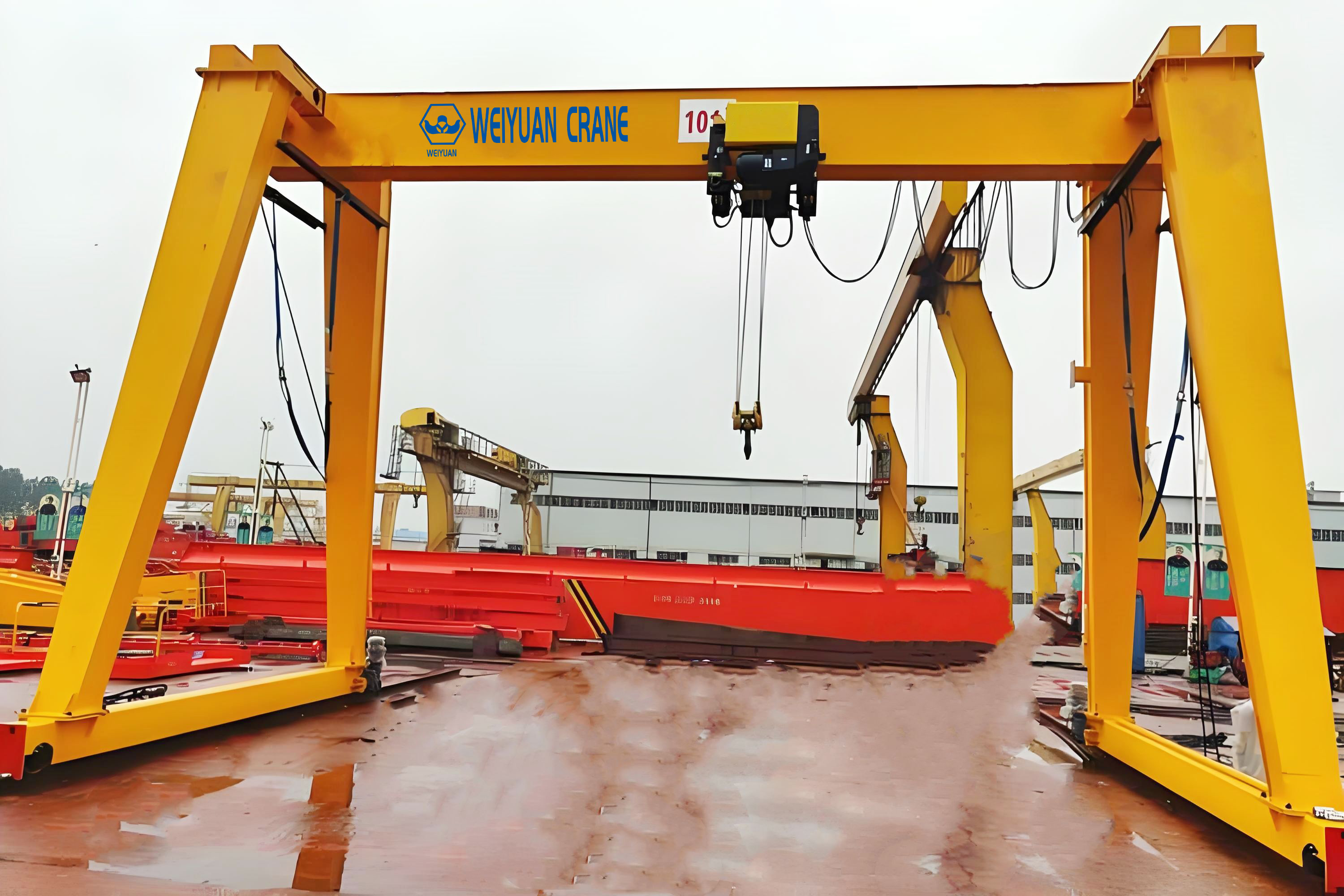
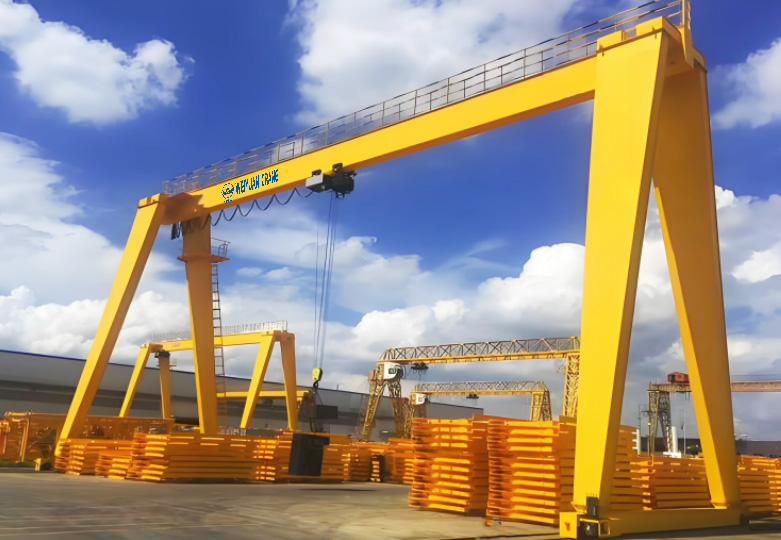
Weiyuan Heavy Duty MG Type Gantry Crane for Outside Lifting
The Weiyuan Heavy Duty MG Type Gantry Crane is a powerful and resilient outdoor lifting solution engineered for demanding outside lifting operations, combining a robust A-frame double-girder structure with weatherproof components for reliable performance in outdoor stockyards, construction and industrial environments. :contentReference
View Product / Get QuoteThe Build vs. Buy vs. Lease Question
Procurement teams serving capital-intensive manufacturers increasingly face a three-way decision on lifting equipment — outright purchase, operating lease, or a managed service arrangement where the vendor owns the asset and you pay per operational period.
Outright purchase makes the most financial sense when the application is stable, the crane will stay in one facility for its expected lifespan, and your organization has favorable capital allocation for depreciable assets. Gantry cranes hold residual value reasonably well compared to mobile equipment, so the balance sheet treatment is generally clean.
Operating leases are worth serious consideration when your production volumes are variable, your facility footprint may change in the next three to five years, or you want to avoid carrying maintenance liability internally. The monthly cost is higher, but you transfer equipment risk to the vendor and preserve capital flexibility.
Managed service arrangements are still relatively uncommon in the gantry crane category but are growing, particularly among larger manufacturers who have consolidated their lifting equipment spend under single-source contracts. If your organization runs multiple facilities with significant lifting requirements, it’s worth asking vendors whether they offer portfolio-level commercial arrangements.
Vendor Evaluation: What Separates Serious Suppliers from Catalog Houses
The gantry crane market has a wide supplier spectrum. At one end, you have manufacturers who engineer, fabricate, test, and service their own equipment with dedicated technical teams. At the other end, you have catalog resellers who import standard configurations and add a local margin without meaningful engineering support.
For procurement teams making a considered capital investment, the difference matters in practice, not just in principle.
Ask about in-house engineering capacity. If your application has any non-standard requirements — unusual span widths, specific environmental ratings, integration with existing rail systems — you need a supplier with genuine engineering capability, not a sales team that sends your question to an overseas factory and relays the answer three days later.
Request reference accounts in your industry. A vendor who has installed and serviced lifting equipment in your specific sector understands the compliance requirements, the operational rhythms, and the failure modes that matter to you. A reference call with a peer facility is worth more than any amount of marketing material.
Evaluate their parts and service infrastructure honestly. Ask for the average lead time on your top five replacement components. Ask where their nearest certified service technician is located. Ask what their typical response time is for an unplanned breakdown. These answers reveal far more about long-term ownership experience than any upfront pricing conversation.
Specification Pitfalls That Cost Procurement Teams Later
Several common specification errors surface repeatedly in post-purchase reviews of gantry crane procurement decisions.
Under-specifying the span. Facilities often spec the minimum span that accommodates their current workpiece, without leaving working clearance for rigging, slings, and the physical space operators need to work safely. A span that looks sufficient on paper creates daily workflow friction in practice. Build in margin.
Ignoring floor condition requirements. Freestanding gantry cranes transfer their load directly to the floor through their legs. This is one of their core advantages over overhead bridge systems, but it does require that your existing concrete slab meets the load-bearing requirements for the specific crane configuration. Get the floor rating confirmed before you finalize the specification, not after delivery.
Overlooking electrical infrastructure costs. The crane itself is one line item. The electrical supply to power the hoist, the pendant cable management, and any integration with facility control systems represent additional costs that should be scoped before the budget is set. Facilities that skip this step routinely face unpleasant surprises during installation.
Forgetting about vertical clearance. Hook height in the raised position needs to accommodate your tallest workpiece with the rigging attached. Hook height in the lowered position needs to reach the floor or the working surface, depending on your application. Both numbers need explicit confirmation against your facility drawings.
Building the Internal Business Case
Procurement professionals rarely have the luxury of simply deciding that a crane purchase makes sense — you need to build the business case and move it through an approval process. A few practical notes on that exercise.
Ground your financial model in actual operational data rather than industry averages. Pull your maintenance invoices for current material handling equipment, document your actual forklift operating costs including fuel and tires and service, and estimate the labor hours currently consumed by inefficient lifting workflows. These numbers make your case tangible and defensible in a way that generic ROI ranges simply cannot.
Most facilities that conduct this analysis honestly find that the payback period on a well-specified gantry crane is somewhere between one and two years. The driver is usually a combination of reduced fleet operating costs, recovered labor productivity, and the elimination of inventory damage incidents — which are chronically underreported but add up quickly when you account for replacement costs, rework, and customer relationship impacts.
Present the flexibility value explicitly. Unlike a fixed overhead bridge crane installation, a freestanding gantry crane is a relocatable, redeployable asset. If your production layout changes, the crane moves with it. If your company relocates, the crane goes with you. This optionality has real value that should appear in your business case, even if it’s presented qualitatively rather than as a hard number.
Negotiating the Purchase: Key Commercial Terms to Nail Down
Once you’ve identified your preferred supplier and configuration, the commercial negotiation deserves the same rigor you’d bring to any significant capital purchase.
Warranty scope and duration should be explicit about what’s covered, what voids coverage, and who bears the cost of travel and labor for warranty service visits — not just parts. A warranty that covers parts but not labor can still produce significant costs for field repairs.
Delivery and installation terms need clear milestones and accountability. Specify who is responsible for unloading, assembly, and commissioning. Define what constitutes acceptance and what happens if the equipment fails to perform to specification on arrival.
Training obligations should be included in the contract, not treated as an optional add-on. Operator training and supervisor training are both important, and you want the vendor delivering it, not an internal employee working from a manual.
Spare parts pricing is worth negotiating at the time of purchase, while you have leverage. Request a priced spare parts list for the first three years of operation and see if the vendor will hold pricing on critical components. Some will, and it removes a significant uncertainty from your long-term ownership cost model.
Frequently Asked Questions
What load capacity range should a standard industrial facility consider?
Most general manufacturing and fabrication environments work with gantry cranes in the one-to-ten-ton range. Heavy steel fabrication, shipbuilding, and large-component assembly operations often require fifteen tons and above. The key is to spec for your actual maximum lift with an appropriate safety factor, not your average lift — you need the crane to handle your worst-case workpiece safely, every time.
How should procurement compare single-girder versus double-girder configurations?
Single-girder configurations carry lower upfront cost and suit the majority of standard industrial lifting applications. Double-girder designs provide greater hook height in the raised position and better load stability for very heavy or precision-critical lifts. If your application involves lifts above ten tons or requires maximum hook height in a space-constrained facility, double-girder is typically worth the additional investment.
What certifications should a gantry crane supplier hold?
At minimum, look for compliance with ASME B30.2 (overhead and gantry cranes) and CMAA specifications relevant to your crane class. For regulated industries, you may need additional certifications — ATEX ratings for explosive environments, clean-room compliance for pharmaceutical or semiconductor applications, or specific Lloyd’s or DNV certification for marine and offshore contexts. Confirm that the supplier can provide full documentation, not just a verbal assurance.
How do lead times typically run for custom-configured units?
Standard catalog configurations from established manufacturers generally ship within four to eight weeks. Custom configurations — non-standard spans, special coatings, integrated controls — typically run ten to sixteen weeks from order confirmation. Factor this into your project timeline and avoid the temptation to rush specification decisions in order to compress delivery time.
What ongoing maintenance does procurement need to budget for?
Annual maintenance costs for a well-specified gantry crane running in a typical industrial environment generally run between two and four percent of the original purchase price. This covers scheduled inspections, wire rope replacement on the appropriate cycle, brake pad service, and hoist motor maintenance. Budget separately for unplanned repairs, though a quality unit in a correctly spec’d application should require minimal reactive maintenance.
Is it worth paying for an extended service contract at the time of purchase?
For facilities without strong in-house mechanical maintenance capability, a multi-year service contract negotiated at the time of purchase often delivers better value than reactive service agreements arranged later. You have the most commercial leverage at the point of sale — use it to lock in favorable labor rates and response time commitments while the vendor is still motivated to win your business.