


The Jib Crane Mistakes That Cost Facilities More Than They Expect
Buying a jib crane should be a straightforward procurement decision. You have a lifting problem, you buy equipment that solves it, and your operation runs more smoothly. In practice, though, a surprising number of facilities end up with a system that underperforms, requires expensive retrofits within a few years, or — worst of all — creates liability exposure on the shop floor.
The mistakes that lead to those outcomes are rarely dramatic. Nobody skips a safety check on purpose. Instead, problems tend to creep in through small oversights during the planning phase: a calculation that didn’t account for all the variables, a structural assumption that was never verified, or a purchasing decision driven by upfront cost rather than lifecycle value.
This article walks through the most common of those missteps — and what to do differently.
Mistake #1: Calculating Capacity Based on the Load Alone
This is probably the most frequent error in the buying process, and it happens because the math seems obvious. You know your heaviest component weighs 800 pounds, so you look for a one-ton system and call it done.
The problem is that your load is never the only thing hanging from that hook. Once you factor in the hoist itself, the trolley, and any rigging hardware — spreader beams, lifting magnets, custom fixtures — the actual suspended weight climbs fast. On heavier applications, those accessories alone can add 200 to 400 pounds.
Then there’s the operational reality. A system running at or near its maximum rated capacity every day is one that wears faster, stresses the structural components continuously, and leaves no margin when something unexpected happens. Industry practice is to treat your calculated maximum as a floor, not a ceiling, and then add 15 to 25 percent on top of that before selecting a capacity rating. That buffer costs relatively little upfront and buys you significant protection over the life of the equipment.

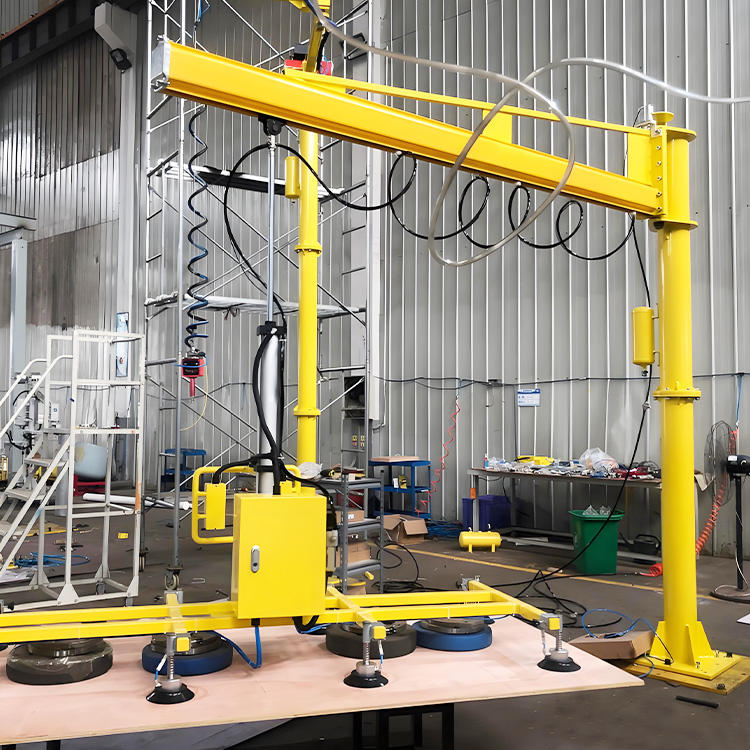
Weiyuan Column Jib Crane
The Weiyuan Column Jib Crane is a versatile and cost-effective freestanding lifting solution designed for precise material handling in workshops, assembly lines, and maintenance areas. With a full 360-degree slewing range and robust steel structure, this crane delivers smooth rotation, dependable performance and enhanced operational flexibility in confined workspaces. :contentReference
View Product / Get QuoteMistake #2: Ignoring the Building Before Specifying the Mount
Walk into enough facilities and you’ll find wall-mounted jib cranes that have shifted, cracked the surrounding masonry, or required expensive reinforcement after the fact — all because no one verified the structural capacity of the wall or column before installation.
A wall-mounted system transfers enormous pulling forces into your building structure every time a load is lifted or the boom swings. Whether your existing columns can handle that depends on how they were originally designed, the age of the building, any prior modifications, and what else they’re already carrying. None of that is visible to the eye.
A licensed structural engineer needs to evaluate the attachment points before you purchase anything. This isn’t a formality — it’s the step that determines whether a wall-mounted system is even viable for your space. If the building can’t support it, you’ll need a freestanding pillar design, which requires a different foundation analysis entirely.
Skipping this step to save a few weeks in the planning phase is one of the more expensive shortcuts a facility can take.
Mistake #3: Buying for Today Instead of 36 Months from Now
Equipment purchasing decisions tend to be reactive. A workstation has a bottleneck, someone finds a product that solves the immediate problem, and an order goes through. The question of what production looks like in three to five years rarely gets a seat at the table.
That’s a problem because jib cranes are not modular in the ways that matter most. Swapping out a hoist for a higher-capacity model is straightforward. Replacing a mast or a foundation because the structural capacity is too low is a construction project — with all the associated cost, downtime, and disruption.
Before specifying a system, take a hard look at the production roadmap. Are you likely to be handling larger components or heavier raw materials in the next few years? Is the facility planning to expand the workspace that this crane will serve? If there’s any reasonable chance the answer to either question is yes, the smarter investment is a higher-capacity system now, even if today’s loads don’t demand it.
Mistake #4: Treating Rotation as an Afterthought
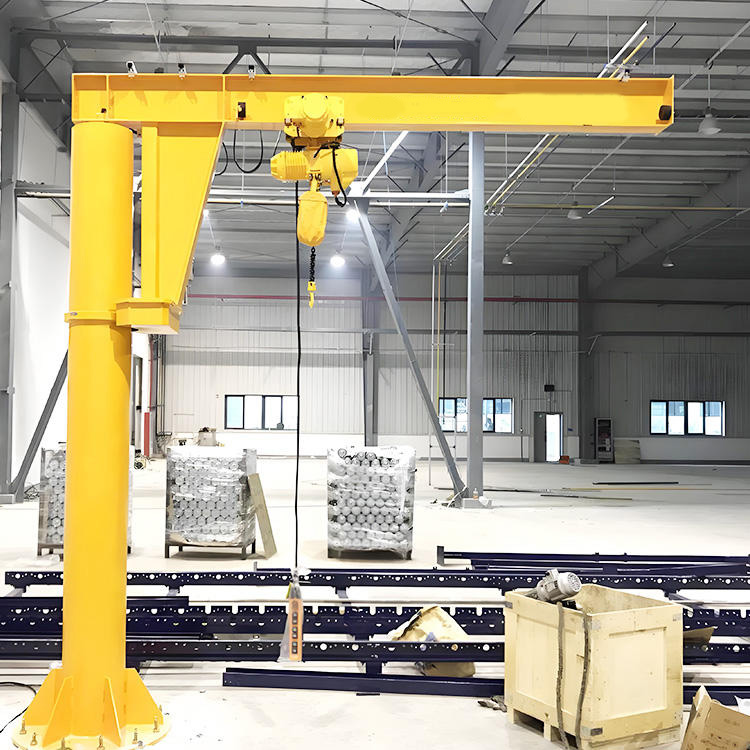
The rotation arc of a jib crane determines where it can actually reach within your workspace — and it’s far more consequential than people assume when drawing up specifications.
A full 360-degree arc works well when the equipment is positioned in open floor space and needs to serve multiple surrounding workstations. But the moment you place the same system near a wall, a support column, overhead ductwork, or existing machinery, part of that arc becomes unusable. If the pickup point and the drop-off point both fall within the blocked range, the equipment doesn’t solve the problem you bought it to solve.
This requires physical layout mapping before you finalize a mounting position — not a sketch on a whiteboard, but actual measurements of where loads originate, where they need to go, and what obstructions exist between those points. Wall-mounted systems are typically limited to around 200 degrees of rotation, which is often sufficient, but only if the geometry of your workspace has been worked out in advance.
Mistake #5: Dismissing Motorized Swing Too Quickly
Manual rotation is the default choice for most lighter-duty applications, and it works well in those contexts. But the decision gets made reflexively on heavy-capacity systems, too, usually in the interest of keeping costs down.
Manually swinging a multi-ton load on a long boom is a physically demanding task that’s also hard to control precisely. The load has momentum. Stopping it cleanly at the right position takes effort and practice, and the ergonomic strain on operators over the course of a full shift is real. On heavier and longer configurations, a motorized drive isn’t a luxury — it’s the difference between a system that’s practical to use and one that operators find ways to work around.
Pendant-controlled motorized rotation gives operators precise, repeatable positioning with considerably less physical strain. For high-frequency lifting tasks or boom lengths beyond 12 to 14 feet on heavier capacities, it’s worth pricing into the initial specification rather than adding it later as a retrofit.
Mistake #6: Underspecifying for the Environment
Standard indoor lifting equipment is built for standard indoor conditions: moderate temperatures, relatively clean air, and no moisture exposure. Take that equipment into a harsh environment and the degradation is not gradual — it accelerates in ways that compromise both performance and safety.
Outdoor fabrication yards, marine environments, chemical processing facilities, and operations with heavy airborne particulates all require equipment that’s been specifically engineered for those conditions. That means hot-dip galvanized structural components, weather-sealed electrical enclosures, specialized coatings, and — in environments with combustible dust or flammable vapors — explosion-proof components that meet the relevant regulatory requirements.
The specification sheet for a standard system may technically list it as capable of handling a given load. What it won’t handle is prolonged exposure to salt air or corrosive fumes. The cost difference between a standard system and an appropriately specified one is far smaller than the cost of replacing corroded equipment or addressing a safety incident.
Mistake #7: Prioritizing Purchase Price Over Lifecycle Cost
The initial purchase price of lifting equipment is the number that gets compared across suppliers, and it’s the one that most directly influences a procurement decision. It’s also, arguably, the least useful number for evaluating long-term value.
A system from a supplier with no spare parts inventory, limited technical support, and a short warranty might look competitive on paper. But when a bearing fails six months into production and the replacement lead time is measured in weeks, the cost of that downtime will dwarf whatever you saved at purchase.
Evaluate suppliers on parts availability, warranty terms, and responsiveness of their technical support. Ask specifically about lead times for common wear components. A supplier with a strong service infrastructure is worth a price premium that, in practice, tends to pay for itself the first time something needs attention.
Mistake #8: Skipping the Post-Installation Compliance Steps
Purchasing a high-quality, properly specified system doesn’t mean the safety work is done. There are documented requirements for what happens after installation — and skipping them creates real legal and operational exposure.
Before any worker uses a newly installed system, it must undergo a formal load test with documentation. From that point forward, operators are required to perform visual inspections at the start of each shift, and the system must receive a comprehensive inspection by a certified technician on an annual basis. These aren’t optional best practices; they’re regulatory requirements under OSHA guidelines, alongside standards from organizations like the Crane Manufacturers Association of America.
Establish the inspection schedule and documentation process before the equipment goes into service, not after. It’s the kind of administrative step that’s easy to defer in the rush to get a new workstation operational, and consistently one of the first things that comes up in enforcement actions when something goes wrong.
The Common Thread
Most of these mistakes come down to the same underlying issue: the planning phase gets compressed. Someone identifies a need, a product gets specified quickly, and the deeper evaluation — structural analysis, layout mapping, lifecycle cost comparison — either doesn’t happen or happens too late to change anything.
The remedy isn’t complicated. It’s taking the time to measure your workspace, document your full load requirements, consult a structural engineer about your building, and ask your supplier the questions that matter beyond the spec sheet. Lifting equipment that’s correctly specified from the start will outperform a cheaper, faster choice on every metric that actually matters over the years you’ll be using it.
Frequently Asked Questions
What’s the real difference between rated capacity and safe working load? They’re often used interchangeably, but Safe Working Load (SWL) is the figure you should design around. It represents the maximum load the equipment is approved to carry under normal operating conditions, accounting for appropriate safety factors. Always ensure your total suspended weight — load, hoist, rigging, and attachments — stays within the SWL, not just the bare component weight.
How deep does a concrete foundation need to be for a freestanding jib crane? It varies significantly based on capacity, boom length, and local soil conditions, and it must be engineered specifically for your installation. Trying to anchor a heavy-duty freestanding system to an existing general-purpose slab without an engineering review is one of the more common — and expensive — mistakes in the industry.
Can one jib crane cover multiple workstations? Sometimes, depending on the layout. A freestanding system with full 360-degree rotation can serve several adjacent stations if they all fall within the boom’s reach. For workstations that are spread further apart, separate dedicated units are usually more practical and safer than trying to extend coverage beyond what the boom radius allows.
Is there a meaningful difference between a chain hoist and a wire rope hoist? Yes, and the right choice depends on your application. Chain hoists are simpler, more compact, and lower cost — well-suited for lighter loads or infrequent use. Wire rope hoists are better for higher capacities and high duty-cycle operations, offering faster lift speeds and smoother performance over sustained use. For heavy manufacturing environments with frequent lifts, wire rope is typically the right call.
What should I ask a supplier before purchasing? Beyond the spec sheet, ask about lead times for replacement parts, what their warranty covers and for how long, whether they provide engineering drawings and load test documentation, and who handles technical support if something goes wrong after installation. A supplier that hesitates on those questions is worth pausing on.