


Best Electric Chain Hoists vs. Wire Rope Hoists: Which One Fits Your Lifting Needs?
Purchasing the wrong hoist type can lead to premature component failure, unnecessary downtime, and — in the worst case — a serious workplace accident. Two technologies dominate the market: electric chain hoists and wire rope hoists. Both are mature, well-engineered product families, but they excel in different scenarios. This in-depth comparison gives you the technical detail and practical insight to make the right call for your specific lifting challenge.
A Closer Look at Electric Chain Hoists
Electric chain hoists represent the most widely deployed category of powered lifting equipment worldwide. Their defining characteristic is the load chain — a high-alloy steel chain, typically Grade 80 or Grade 100, that passes over a hardened pocket wheel inside the hoist body. The chain stores neatly in a galvanised or stainless steel chain container beneath the motor housing, which makes the overall unit extremely compact.
Modern electric chain hoists typically weigh between 15 kg (for a 250 kg WLL unit) and around 120 kg (for a 5-tonne model), making them easy to install on existing monorails or bridge crane girders without requiring structural upgrades. Variable-frequency drives (VFDs) are now standard on mid-range and premium models, offering smooth start/stop, micro-speed creep functions, and significant energy savings compared with older two-speed contactors.
The operating temperature range of most electric chain hoists spans −20 °C to +40 °C for standard units, with specialised variants extending to +60 °C for steelworks and foundry environments. Suppliers such as Kito, Demag, CM, and Yale publish detailed environmental ratings in their technical catalogues — always cross-check these against your site conditions before specifying.
A Closer Look at Wire Rope Hoists
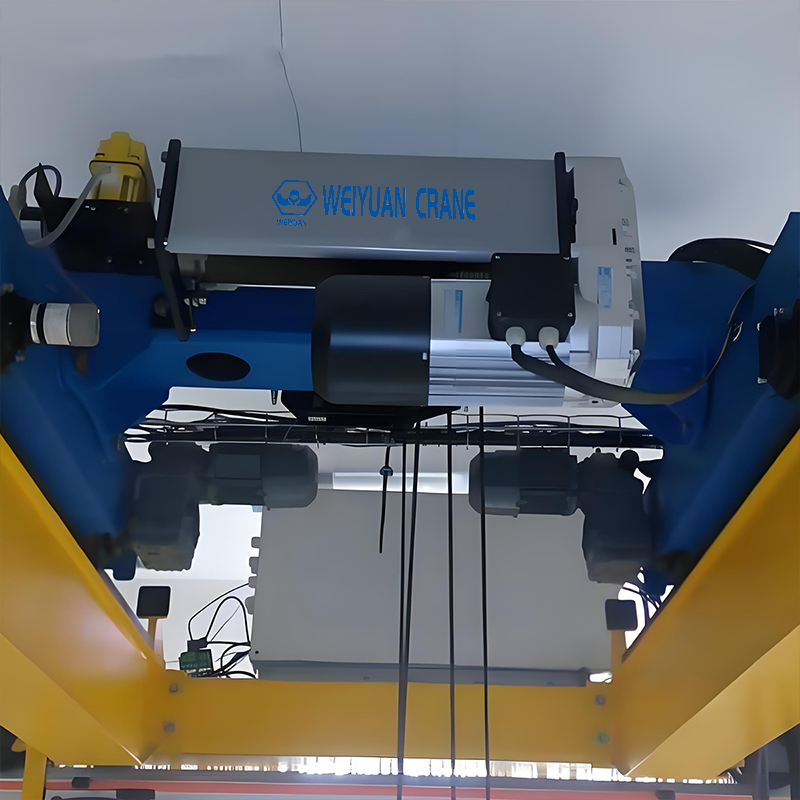
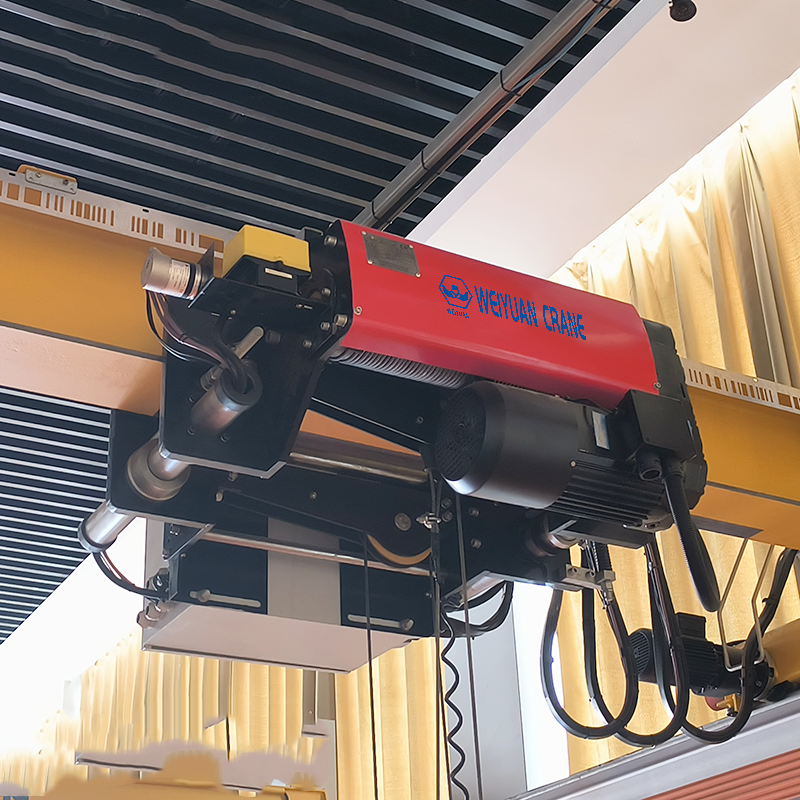
Wire rope hoists store their load medium — a multi-strand galvanised or ungalvanised steel rope, typically 6×19 or 6×37 construction — on a grooved drum mounted inside or alongside the motor-gearbox assembly. Because rope can be supplied in lengths of hundreds of metres, wire rope hoists are the default choice wherever lift height exceeds 6–8 m.
Wire rope hoists are rated at higher speeds than comparable chain models; single-speed units typically lift at 4–8 m/min, while VFD-equipped models can achieve 16–32 m/min or faster. This speed advantage is decisive in applications where cycle time is a throughput bottleneck, such as port container handling, press-line feeding, or automated storage and retrieval systems.
Head-to-Head Comparison
The table below summarises the most important performance and application differences between the two technologies:
| Factor | Electric Chain Hoists | Wire Rope Hoists |
| Typical Capacity Range | 125 kg – 20 t | 500 kg – 100+ t |
| Standard Lift Height | Up to 6–12 m | Up to 100+ m |
| Lifting Speed | 1–8 m/min (standard) | 4–32 m/min (VFD) |
| Unit Weight | Lightweight (15–120 kg) | Heavier (50–800+ kg) |
| Headroom Requirement | Low (compact body) | Higher (drum assembly) |
| Maintenance Complexity | Low – chain is visible | Medium – rope inspection |
| Typical Duty Class | M3–M6 (FEM) | M5–M8 (FEM) |
| Typical Applications | Assembly, fab, workshop | Port, mill, mining |
When to Choose Electric Chain Hoists
Electric chain hoists are the optimal choice in the following scenarios:
- Capacity requirement is 5 tonnes or below and lift height stays within 10 metres.
- Headroom is limited — the compact chain hoist body sits closer to the overhead structure than a wire rope drum assembly.
- The working environment involves elevated temperatures, weld spatter, or abrasive dust, where chain outperforms wire rope in terms of durability and ease of inspection.
- Budget is a key constraint: electric chain hoists typically cost 30–50% less than equivalent-capacity wire rope units at lower capacity ranges.
- The installation is on an existing runway beam that has limited load capacity — the lighter hoist body places less dead load on the structure.
Industries that rely heavily on electric chain hoists include automotive manufacturing, steel fabrication, ship repair, toolroom operations, and general mechanical workshops. Their simplicity also makes them the preferred choice for maintenance departments that may not have specialist rigging personnel on staff.
When to Choose Wire Rope Hoists
Wire rope hoists become the superior choice when:
- Lift height exceeds 10–12 m, where wire rope’s compact drum winding is far more space-efficient than storing equivalent lengths of chain.
- Operating speeds above 8 m/min are required to meet production cycle times.
- Capacity requirements exceed 10 tonnes, where wire rope technology scales more economically than chain alternatives.
- The hoist will run at high duty cycles (M7–M8 class), where the rope drum dissipates heat more effectively than a chain sprocket assembly.
- The application involves long-term continuous operation, such as 24/7 process industries, where wire rope hoists offer lower total cost of ownership at scale.
Total Cost of Ownership: A Practical Perspective
Purchase price is only one component of total cost of ownership (TCO). When evaluating electric chain hoists against wire rope models, procurement teams should model the following cost categories over a 10-year horizon: initial purchase, installation (including any structural upgrades), energy consumption, planned maintenance intervals, unplanned downtime, and end-of-life disposal.
At capacities below 5 tonnes and moderate duty cycles, electric chain hoists consistently deliver a lower TCO than wire rope equivalents because their simpler architecture requires fewer scheduled maintenance interventions and replacement parts are widely available at competitive prices. Above 10 tonnes and at high duty cycles, wire rope hoists often become more cost-effective despite the higher initial outlay, because the rope and drum system absorbs the demanding cycle load more gracefully.
Safety Considerations Specific to Each Type
Both technologies are subject to the same overarching safety standards — ASME B30.16, EN 14492-2, and the relevant ISO classifications — but their specific inspection regimes differ. Chain hoists require regular visual inspection of each chain link for stretch, wear, nicks, and corrosion. The chain should be replaced when it has elongated by more than 2% from its nominal pitch length, per most manufacturer guidelines.
Wire rope inspection focuses on broken wires, kinking, core protrusion, and lubrication. Most standards require replacement when a defined number of broken wires per rope lay length is reached — typically six or more broken wires in one lay, or three or more in one strand. Ropes must also be discarded after any shock load event, regardless of visual condition.
Frequently Asked Questions
Q: Can I convert a wire rope hoist to a chain hoist?
A: No. The two technologies use fundamentally different mechanical architectures and motor-gearbox ratios. If your requirements change, you will need to purchase a new unit.
Q: Which type is better for outdoor use?
A: Both are available in weatherproof IP55 or IP65 variants. However, electric chain hoists with stainless or galvanised chain are generally more corrosion-resistant than wire rope hoists in marine or high-humidity environments.Q: Are electric chain hoists suitable for hazardous locations?
A: Yes — ATEX-certified and IECEx-certified versions are manufactured by most major brands. These require additional inspection intervals and must only be serviced by certified technicians.