


Gantry Crane for Sale | Portable, Adjustable & Heavy-Duty Options
Introduction
Whether you’re outfitting a small machine shop or managing a large industrial yard, finding the right gantry crane for sale can feel overwhelming. The market is flooded with options — different capacities, heights, materials, and price tags — and making the wrong choice can cost you both money and downtime.
This guide is built for buyers who want a clear, expert breakdown of the portable, adjustable, and heavy-duty gantry crane options available today. We’ll walk you through each category, what makes them different, what to look for before you buy, and how to match the right crane to your specific lifting needs.
What Makes a Gantry Crane Different from Other Lifting Systems?
Before diving into product categories, it helps to understand why a gantry crane stands apart from overhead bridge cranes, jib cranes, and forklifts.
A gantry crane is a free-standing structure that supports a hoist or trolley along a horizontal beam (the bridge). Unlike overhead cranes that require fixed runway rails bolted to your building’s structural columns, a gantry crane is self-supporting — meaning it can be placed anywhere a level surface exists, moved between facilities, or reconfigured as your workflow changes.
This versatility is the core reason why gantry cranes are among the most popular lifting solutions in workshops, warehouses, steel fabrication yards, construction sites, and outdoor staging areas.
Category 1: Portable Gantry Cranes
What They Are
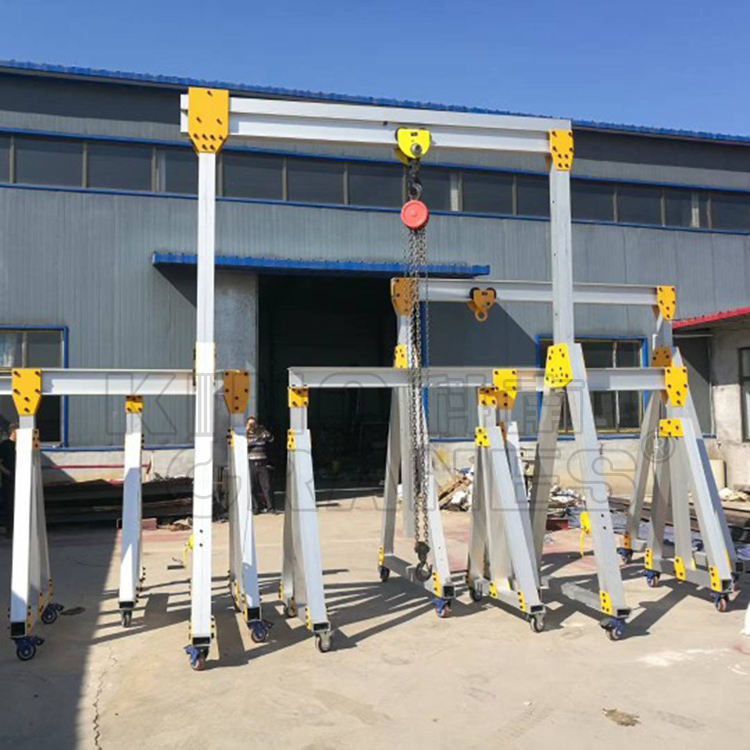
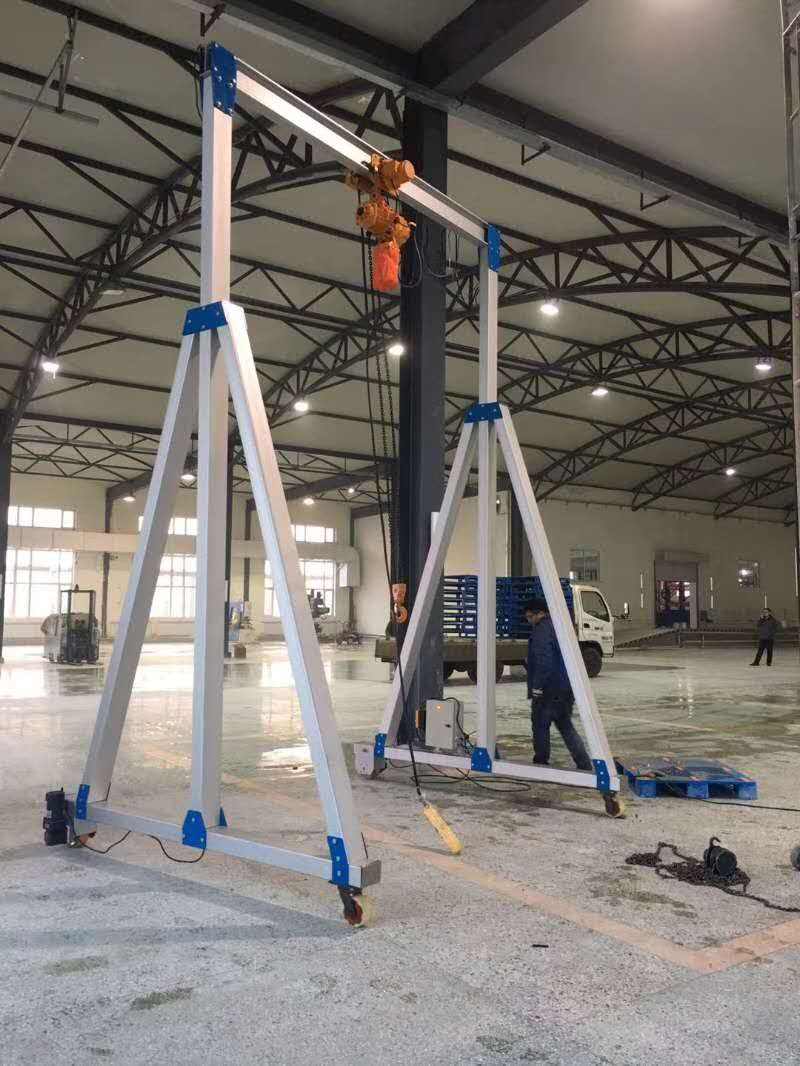
Portable gantry cranes are lightweight, modular A-frame structures designed for frequent repositioning. Most models feature locking caster wheels that allow a single operator to roll the entire assembly across a concrete floor.
Typical Capacity Range
- 250 lbs to 4 tons (lightweight aluminum models to steel mid-duty units)
Best For
- Small machine shops and fabrication bays
- Maintenance teams that move equipment between workstations
- Facilities without permanent crane infrastructure
- Rental use cases and temporary job sites
Key Features to Look For
Frame Material:
- Aluminum frames are corrosion-resistant and easy to move but are limited to lighter loads (typically up to 1 ton).
- Steel frames are more robust, handle heavier loads, and are better suited for long-term fixed or semi-fixed positioning.
Caster Wheel Quality: Look for heavy-duty polyurethane or steel casters rated well above the crane’s listed capacity. Cheap casters on a loaded crane are a serious safety risk. The locking mechanism should engage firmly and hold under side load.
Beam Style: Most portable units use either a solid I-beam or an enclosed box-beam for the bridge. Box beams resist twisting and are preferred for longer spans. I-beams are lighter and fine for shorter lifts.
Assembly Time: Quality portable cranes should assemble in 30–60 minutes with basic hand tools. If a manufacturer can’t supply a clear assembly guide, look elsewhere.
Price Range
- Budget portable (1-ton aluminum): $400–$900
- Mid-range steel portable (2-ton): $900–$2,000
- Higher capacity portable (3–4 ton): $2,000–$4,500
Category 2: Adjustable Height Gantry Cranes
What They Are
Adjustable gantry cranes feature telescoping legs or pin-lock height adjustment mechanisms, allowing operators to modify the working height of the bridge beam. This is critical in facilities where overhead clearances vary, or where the crane needs to work over equipment of different heights.
Typical Capacity Range
- 1 ton to 5 tons
Best For
- Maintenance bays servicing different vehicle or equipment types
- Facilities with varying floor-to-ceiling clearances in different areas
- Operations where the load type changes regularly
Key Features to Look For
Height Adjustment Mechanism:
- Pin-lock systems are the most common — simply pull the pin, extend or retract the leg, realign the hole, and reinsert. They’re reliable but require the crane to be unloaded during adjustment.
- Crank-operated systems allow finer adjustment but add mechanical complexity.
Load Ratings at Different Heights: This is crucial and often overlooked. A crane rated at 2 tons at its minimum height may only be rated at 1.5 tons at maximum extension because the structural geometry changes. Always verify the rated capacity at your intended working height before purchase.
Leg Stability: Wider leg bases provide better lateral stability, especially at full height extension. Look for outrigger-style legs or a wide A-frame spread on models you plan to use at maximum height.
Price Range
- 1-ton adjustable: $700–$1,500
- 3-ton adjustable: $1,800–$4,000
- 5-ton adjustable: $4,000–$8,500

Weiyuan Heavy Duty MG Type Gantry Crane for Outside Lifting
The Weiyuan Heavy Duty MG Type Gantry Crane is a powerful and resilient outdoor lifting solution engineered for demanding outside lifting operations, combining a robust A-frame double-girder structure with weatherproof components for reliable performance in outdoor stockyards, construction and industrial environments. :contentReference
View Product / Get QuoteCategory 3: Heavy-Duty Fixed Gantry Cranes
What They Are
Heavy-duty gantry cranes are engineered for sustained, repetitive lifting in demanding industrial environments. These are not shop cranes that get used occasionally — they’re designed for daily production workloads, shift-after-shift reliability, and loads measured in multiple tons.
Typical Capacity Range
- 5 tons to 100+ tons (industrial and port-scale units)
Best For
- Steel fabrication plants
- Precast concrete manufacturers
- Shipyards and port facilities
- Rail maintenance depots
- Large warehouse distribution centers
Key Features to Look For
Duty Cycle Rating: Heavy-duty cranes should carry an ASME H4 or H5 duty rating (heavy to severe service). This defines how many lifts per hour and what percentage of the rated load the crane is designed to handle in continuous operation. Never install a light-duty crane in a heavy-duty application — the consequences can be catastrophic.
Drive System: Most heavy-duty gantry cranes are electrically powered with motorized end trucks that move the entire structure along floor-mounted rails. Confirm motor ratings, variable frequency drive (VFD) capability for smooth start/stop, and brake system quality.
Span and Hook Height: These two dimensions define the crane’s working envelope. Heavy-duty cranes can be engineered with spans from 20 feet to well over 100 feet and hook heights to match facility requirements. Always involve a structural engineer in specifying these parameters.
Certification and Compliance: Any heavy-duty crane purchased for a U.S. facility must comply with ASME B30.2 (overhead and gantry cranes) and should be manufactured to CMAA Specification 70 or 74 standards. Reputable manufacturers provide full documentation; non-compliant cranes expose your facility to liability and OSHA violations.
Price Range
- 5–10 ton industrial: $15,000–$60,000
- 20–40 ton: $60,000–$200,000+
- Port-scale (50+ ton): Custom quote required
How to Choose the Right Gantry Crane for Your Application
Step 1: Define Your Maximum Load
Always size your crane to your heaviest anticipated load, not your average load. A crane routinely used at or near its rated capacity wears out far faster and poses greater risk. As a rule of thumb, select a crane rated at 25–33% above your heaviest load.
Step 2: Measure Your Working Space
Key dimensions to capture:
- Span needed (distance between legs, measured at the base)
- Required hook height (clearance from floor to the bottom of the hoist hook at maximum lift)
- Available floor area for legs and any travel path
Step 3: Assess Your Usage Frequency
- Occasional use (a few lifts per week): A light-duty or standard crane is sufficient.
- Daily use (multiple lifts per day): Invest in a medium-duty unit with a robust hoist.
- Production-line use: Heavy-duty with appropriate CMAA duty cycle rating.
Step 4: Evaluate Your Site Conditions
- Indoors on concrete: Almost any configuration works.
- Outdoors: Consider galvanized or painted steel for corrosion resistance; check wind load requirements for your region.
- On uneven ground: Fixed-rail or rubberized gantry systems may be required.
Step 5: Budget for the Total Cost of Ownership
The purchase price is only one part of the equation. Factor in:
- Installation and commissioning costs
- Annual inspection and certification (required by OSHA for most industrial cranes)
- Hoist maintenance and rope/chain replacement intervals
- Operator training
Red Flags When Shopping for a Gantry Crane
- No load test documentation: Any crane sold for industrial use should come with a factory load test certificate.
- Vague compliance claims: Look for specific ASME, CMAA, or CE certifications, not generic “safety compliant” language.
- Unusually low pricing on high-capacity cranes: If a 10-ton crane is priced like a 2-ton crane, the ratings may be inflated or the materials underspec’d.
- No after-sales support: Ongoing technical support and parts availability are critical for any crane that will be in production use.
Frequently Asked Questions
Q: Do I need a permit to install a gantry crane? A: For portable shop cranes, typically no. For fixed, rail-mounted, or high-capacity cranes, many jurisdictions require a building permit and a registered engineer’s sign-off on the installation. Always check with your local authority having jurisdiction (AHJ).
Q: How often does a gantry crane need to be inspected? A: Per OSHA 1910.179, cranes must receive a frequent inspection (operator visual check before each shift) and a periodic inspection (thorough inspection by a qualified person at least annually). High-usage cranes may require quarterly periodic inspections.
Q: Can a gantry crane be used outdoors? A: Yes, but outdoor units require appropriate corrosion protection, and any motorized system must be rated for outdoor electrical use. Wind loading must also be calculated if the crane will be left outdoors during storms.
Q: What’s the difference between a gantry crane and a jib crane? A: A jib crane rotates around a fixed vertical mast and covers a circular or semi-circular area. A gantry crane travels in a straight line along its span and is better suited for moving loads horizontally over longer distances or larger floor areas.