


What Is a Gantry Crane? Types, Capacities & How to Choose the Right One
Introduction
If you’ve ever watched a massive load — a concrete slab, a steel coil, a ship’s hull section — glide smoothly through the air in a shipyard or manufacturing plant, there’s a good chance a gantry crane was doing the work. Yet despite being one of the most widely used lifting systems in industry, many people outside the field remain uncertain about exactly what gantry cranes are, how they differ from other crane types, and what determines whether one is the right fit for a given application.
This guide answers all of those questions. Whether you’re an engineer evaluating lifting equipment for a new facility, a safety officer trying to understand what’s installed in your plant, or a procurement professional comparing options, this article gives you the complete picture — types, capacities, selection criteria, and the engineering principles that make gantry cranes uniquely valuable.
What Is a Gantry Crane? (Definition)
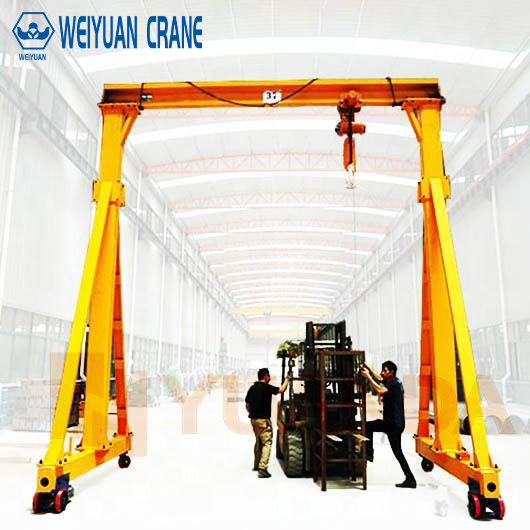
A gantry crane is a type of overhead crane in which the bridge beam — the horizontal member that carries the hoist and trolley — is supported by two or more freestanding legs rather than by runway rails mounted to a building’s structural columns.
The term “gantry” refers to the portal or A-frame structure formed by the bridge and its supporting legs. The entire assembly may be stationary, or it may travel along floor-level rails (or on rubber-tired wheels) to cover a larger work area.
The Core Components of a Gantry Crane
Component | Function
Bridge Beam | Horizontal structural member spanning between the two legs; carries the hoist and trolley
Legs | Vertical structural columns supporting each end of the bridge beam
End Trucks / Bogies | Assemblies at the base of each leg that allow the crane to travel along rails or floor
Hoist | The lifting mechanism (electric chain hoist, wire rope hoist, or manual)
Trolley | The carriage that moves the hoist horizontally along the bridge beam
Drive System | Electric motors (or manual for light-duty) powering bridge travel and trolley movement
Gantry Crane vs. Overhead Bridge Crane: What’s the Difference?
This is the question that confuses most newcomers. Here’s the key distinction:
- An overhead bridge crane (also called an EOT crane — Electric Overhead Traveling crane) runs along elevated runway rails that are bolted to the building’s structural framework. The crane derives its support from the building itself.
- A gantry crane supports its own bridge on freestanding legs. It is structurally independent of the building.
Practical implications of this difference:
- Gantry cranes can be installed in buildings that lack the structural capacity to support overhead runways, or outdoors where no building structure exists.
- Gantry cranes can be relocated, while overhead cranes are permanently fixed to the building’s runway system.
- Overhead cranes typically provide greater hook coverage (since the runway rails can span the full building width), while gantry cranes are limited to the span between their legs.
Types of Gantry Cranes
Gantry cranes come in several configurations, each designed for specific operational contexts. Understanding these types is the first step toward selecting the right system.
1. Full Gantry Cranes (Double-Leg Gantry)
The most common configuration — both ends of the bridge beam are supported by full-height legs that run along floor-level rails. This creates a completely self-supporting portal structure.
Best for: Outdoor storage yards, precast concrete plants, steel service centers, rail maintenance facilities.
Key characteristics:
- Complete independence from any building structure
- Suitable for very large spans (20 feet to 100+ feet)
- Can be designed for extremely heavy loads (up to hundreds of tons for port applications)
- Typically electrically driven with motorized rail travel
2. Semi-Gantry Cranes (Single-Leg Gantry)
A semi-gantry crane has one leg running on a floor-level rail while the opposite end of the bridge runs on an elevated runway rail mounted to a wall or column. This hybrid configuration saves floor space on one side.
Best for: Facilities with limited floor space where one wall can support a runway rail; loading docks; facilities transitioning from overhead cranes.
Key characteristics:
- One side remains fixed to building structure
- Efficient use of floor area near walls
- Lower cost than full gantry for equivalent span coverage
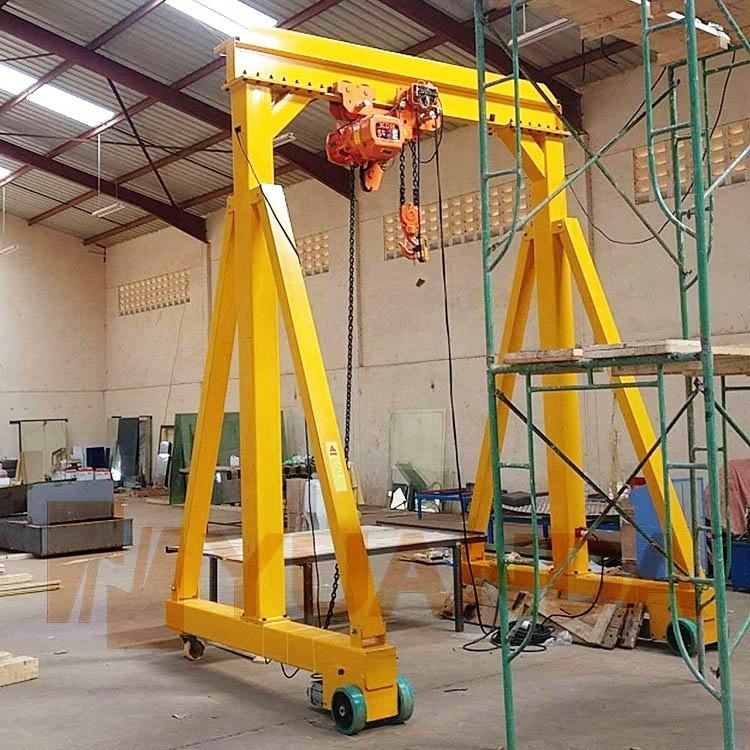
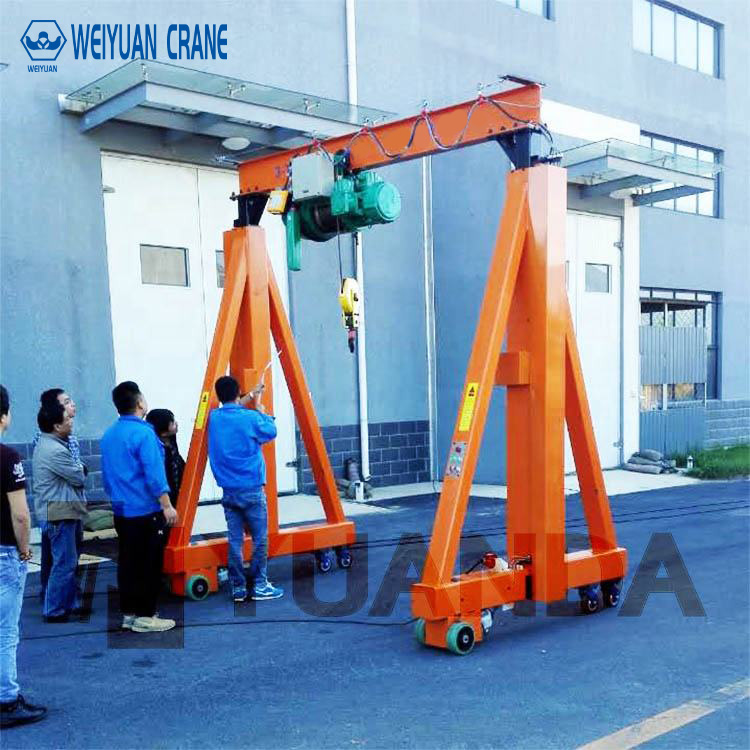
3. Portable / Shop Gantry Cranes (A-Frame Gantry)
These are the compact, wheeled A-frame structures common in workshops, maintenance bays, and small fabrication shops. They roll freely on caster wheels and require no rail installation.
Best for: Machine shops, auto repair facilities, maintenance teams needing mobility, light manufacturing.
Capacity range: Typically 250 lbs to 4 tons.
4. Adjustable Height Gantry Cranes
A variation of the portable shop gantry, these units feature telescoping legs with pin-lock or crank adjustment systems. The bridge height can be modified to accommodate different load sizes or overhead clearance constraints.
Best for: Facilities serving varied equipment types; multi-use maintenance bays.
5. Rubber-Tired Gantry Cranes (RTG Cranes)
RTG cranes travel on large rubber tires rather than steel rails, giving them exceptional mobility across large paved yards. They’re powered by diesel-electric or fully electric drive systems and are steered by onboard operators.
Best for: Container terminals, intermodal logistics yards, large outdoor storage operations.
Capacity range: Typically 30 to 65 tons per lift, stacking containers up to five high.
6. Rail-Mounted Gantry Cranes (RMG Cranes)
Larger, more precise, and more powerful than RTG cranes, RMG cranes travel on steel rails for superior positional accuracy. Commonly found in automated container terminals and heavy industrial yards.
Best for: Automated port operations, intermodal rail terminals, high-precision industrial applications.
Capacity range: 40 to 100+ tons; custom configurations available.
7. Launching Gantry Cranes (Bridge Construction)
A specialized application: launching gantries are used in bridge construction to place precast concrete segments. They cantilever out from completed sections of the bridge to handle and position the next span segment.

Weiyuan Heavy Duty MG Type Gantry Crane for Outside Lifting
The Weiyuan Heavy Duty MG Type Gantry Crane is a powerful and resilient outdoor lifting solution engineered for demanding outside lifting operations, combining a robust A-frame double-girder structure with weatherproof components for reliable performance in outdoor stockyards, construction and industrial environments. :contentReference
View Product / Get QuoteGantry Crane Capacities: What the Numbers Mean
Crane capacity is expressed as the rated load — the maximum load the crane is designed to lift under specified conditions. This includes the weight of the hoist, lifting attachments (hooks, shackles, slings), and the load itself.
Capacity Classifications
Class | Typical Capacity | Common Applications
Light Duty | 250 lbs – 1 ton | Machine shops, automotive, DIY
Medium Duty | 1 ton – 5 tons | General manufacturing, fabrication, HVAC
Heavy Duty | 5 tons – 20 tons | Steel processing, precast concrete, heavy industry
Extra Heavy / Industrial | 20 tons – 100+ tons | Shipbuilding, port operations, power generation
The Importance of Duty Cycle
Capacity alone doesn’t tell the full story. The duty cycle — how frequently the crane operates and at what percentage of rated capacity — is equally important. The Crane Manufacturers Association of America (CMAA) defines duty cycle classes from A (standby/infrequent) to F (continuous severe service).
A crane rated at 5 tons under CMAA Class D (heavy service) is a fundamentally different and more robust machine than a 5-ton crane rated for Class B (light service). Using a Class B crane in a Class D application accelerates wear, increases failure risk, and may void the manufacturer’s warranty.
How to Choose the Right Gantry Crane: 6 Key Decisions
Decision 1: Fixed Installation or Mobility Required?
If the crane will stay in one area, a rail-mounted or fixed-base unit offers better performance and higher capacity. If mobility is essential, choose a portable/wheeled model or an RTG crane for large yard applications.
Decision 2: What Is Your Actual Lifting Capacity Need?
Calculate the total lifted weight, including:
- The load itself
- All lifting hardware (hooks, shackles, chains, slings, spreader bars)
- Any below-hook devices
Add a safety margin of at least 25% to this total to select your minimum rated crane capacity.
Decision 3: What Span and Hook Height Do You Need?
- Span: The horizontal distance between the crane’s legs (or between a leg and the wall-mounted runway for semi-gantry). This must be wide enough to straddle your widest load or work area.
- Hook height: The vertical distance from the floor to the bottom of the hook at maximum lift. This must clear your tallest load plus any required lifting headroom.
Decision 4: What Is Your Duty Cycle?
Honestly assess how often the crane will operate:
- Infrequent (A/B class): A few lifts per day, light loads relative to rated capacity.
- Moderate (C class): Regular production use, average loads.
- Heavy (D/E class): Constant use, loads near rated capacity.
- Severe (F class): Near-continuous production, maximum loads.
Decision 5: Indoor or Outdoor?
Outdoor applications require:
- Corrosion-resistant coatings or galvanizing
- Weatherproof electrical components
- Wind load engineering (especially for tall or wide-span cranes)
- Consideration of ground conditions for rail foundations
Decision 6: What Standards and Certifications Apply?
In the United States:
- ASME B30.2: Safety standard for overhead and gantry cranes
- CMAA Spec 70 or 74: Engineering specifications for top-running and underhung cranes
- OSHA 29 CFR 1910.179: Workplace safety regulations for overhead and gantry cranes
- ANSI/ASME B30.17: Portable cranes and hoists (for shop gantry cranes)
In the European Union:
- Machinery Directive 2006/42/EC
- EN 15011: Standard for bridge and gantry cranes
Non-compliant cranes expose operators to OSHA citations, insurance complications, and serious liability in the event of an incident.
Gantry Crane Safety: What Every User Must Know
Safety is non-negotiable in crane operation. These are the foundational practices that apply to all gantry crane types:
Pre-operation inspection: Before every use, visually inspect the hoist, hook, chain or wire rope, structural welds on the bridge and legs, and all casters or rail wheels. Check that the hook latch is functional and that no cracks or deformations are present.
Load verification: Never lift a load whose weight is unknown. Weigh loads or obtain weight from shipping documentation before attaching the hoist.
Sling angle awareness: As the angle of a sling from vertical increases, the tension in each sling leg increases dramatically. A sling at 60° from vertical carries approximately double the load compared to vertical. Always use sling angle correction factors.
Operator training: OSHA requires that gantry crane operators be qualified and trained. In many states, crane operators must be certified by an accredited third-party program (NCCCO, Qualified Rigger certification).
Annual inspection: OSHA mandates a formal periodic inspection by a qualified person at least annually. High-usage cranes should be inspected quarterly.
Frequently Asked Questions
Q: How long does a gantry crane last?
A: A well-maintained, correctly specified gantry crane can operate reliably for 20–30 years or more. Component wear items (hoists, wheels, electrical systems) will require periodic replacement, but properly built structural frames have extremely long service lives.
Q: Can I build my own gantry crane?
A: DIY gantry cranes are sometimes built for very light workshop use, but this practice carries significant risks. Any structural failure during a lift can cause severe injury or death. Homemade cranes are unlikely to meet OSHA standards and may create major liability exposure. For anything beyond the lightest personal use, purchase a certified commercial unit.
Q: What is the difference between a gantry crane and a portal crane?
A: In practice, the terms are often used interchangeably. “Portal crane” sometimes refers specifically to large waterfront or shipyard cranes with a portal (arched or A-frame) structure, while “gantry crane” is the broader term encompassing all configurations. Usage varies by region and industry.
Q: How much does a gantry crane cost to operate annually?
A: Annual operating costs depend heavily on usage intensity. For a typical 2-ton shop crane, annual inspection and maintenance might run $300–$800. For a heavy industrial gantry crane in continuous production, annual maintenance (inspections, lubrication, hoist servicing, wheel replacement) can run $5,000–$30,000 or more.