


What Is a Jib Crane? Types, Capacities & How to Choose the Right One for Your Facility
Introduction
A jib crane is one of the most versatile and widely deployed lifting solutions in industrial and commercial facilities worldwide — yet it remains one of the least understood categories of material handling equipment outside the engineering profession. Many facility managers and operations leaders know what a jib crane looks like but are uncertain about which type is right for their application, what capacities are available, or how a jib crane compares to alternatives like overhead cranes, gantry cranes, and hoists.
This guide answers all of those questions. Whether you are evaluating your first jib crane installation, expanding an existing system, or simply trying to understand what your options are, this article provides the complete, engineering-grounded overview you need. We cover the definition, all major types, how capacity is classified, what specifications to define before purchasing, and how to match the right jib crane to your specific facility requirements.
What Is a Jib Crane? (Definition)
A jib crane is a type of fixed lifting device in which a horizontal arm — called the boom or jib — extends from a vertical mast or wall mount and supports a hoist and trolley that travel along the length of the boom. The entire assembly rotates around the vertical pivot axis, sweeping a circular or semicircular work area beneath the boom’s arc.
The term “jib” refers specifically to the horizontal projecting arm. The jib crane’s defining characteristic is its rotation around a fixed vertical axis, which creates a working envelope shaped like a sector of a circle (for wall-mounted units) or a full circle (for floor-mounted units). This makes a jib crane fundamentally different from an overhead crane (which covers a rectangular area) or a gantry crane (which travels linearly along a floor-level track).
A jib crane does not replace overhead cranes or gantry cranes in most facilities — it complements them, providing precise, localized lifting capability at individual workstations, loading positions, and maintenance bays that would be impractical to serve efficiently with a bay-spanning overhead system.
The Core Components of a Jib Crane
Understanding the components clarifies how a jib crane works and what to specify:
Mast (Vertical Column): The vertical structural element around which the boom rotates. In floor-mounted units, the mast is anchored in a concrete foundation or to a prepared anchor bolt pattern. In wall-mounted units, the mast function is performed by the wall or column itself.
Boom (Jib Arm): The horizontal projecting arm that carries the hoist trolley. Boom length determines the crane’s working radius (reach). Booms are typically I-beam or box-beam sections, sized for the crane’s rated capacity and boom length.
Pivot / Slewing Mechanism: The bearing assembly that allows the boom to rotate around the mast. Quality pivot bearings are critical for smooth rotation under load and determine how long the crane operates without major maintenance.
Hoist: The lifting mechanism — electric chain hoist, wire rope hoist, or manual chain hoist — that raises and lowers the load.
Trolley: The carriage that travels along the boom, allowing the hoist to be positioned at different points along the boom’s length. Manual push trolleys are standard; motorized trolleys are used for higher capacities or high-frequency applications.
End Stop: A physical limit at the end of the boom that prevents the trolley from traveling off the end of the beam.
Types of Jib Cranes
1. Floor Mounted Jib Cranes (Pillar / Freestanding Jib Cranes)
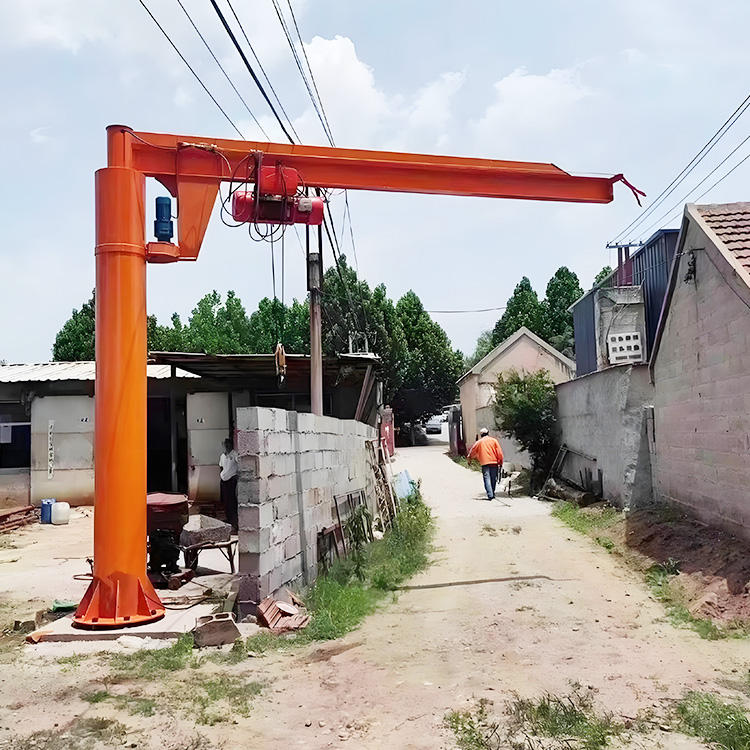
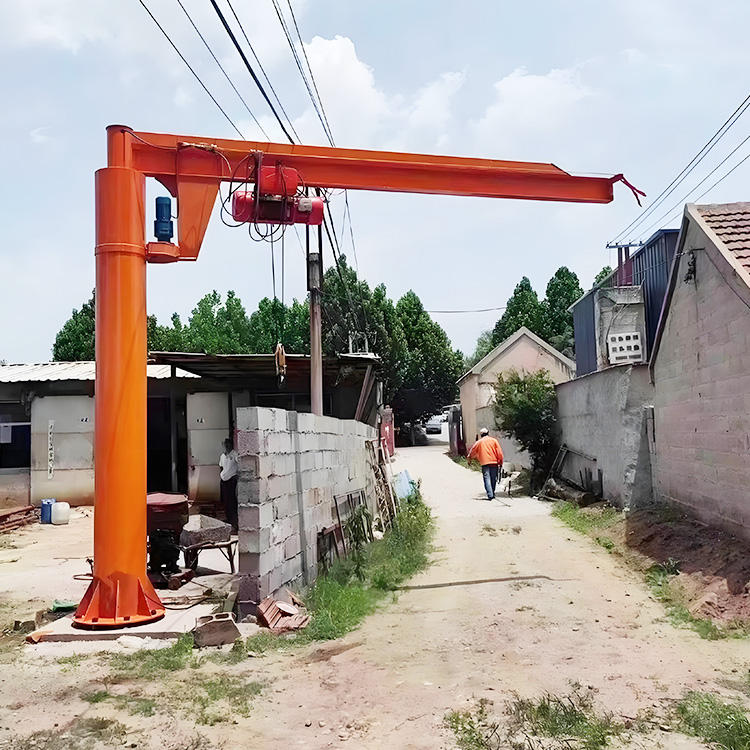
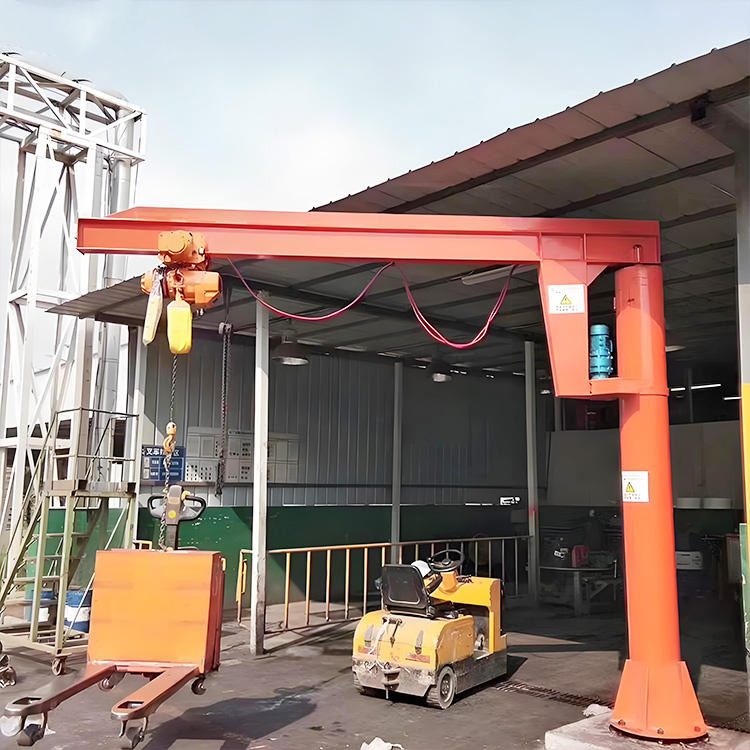
The most common type for open shop floor applications. A vertical mast anchored to a concrete foundation supports a rotating boom that can sweep a full 360-degree circle in open areas, or a limited arc where structural obstructions exist.
Key characteristics:
- Full 360-degree rotation capability in clear areas
- Freestanding — no wall or column attachment required
- Requires a concrete foundation sized to the crane’s rated moment load
- Capacities from 250 lbs to 10 tons in standard configurations
Best for: Open production cells, machine tending stations, assembly areas, outdoor yard applications on concrete pads.
Foundation is critical: The poured concrete foundation or anchor bolt system must be engineered to resist the overturning moment the crane imposes. Undersized foundations are the leading cause of floor mounted jib crane failures. Always require written foundation specifications from the crane manufacturer and have them reviewed by a structural engineer.
2. Wall Mounted Jib Cranes (Wall Bracket / Wall Cantilever Cranes)
A wall mounted jib crane attaches directly to a building wall or structural column via brackets, eliminating the need for a floor-mounted mast and foundation. The trade-off is that the rotation arc is limited to approximately 180 to 200 degrees.
Key characteristics:
- No floor foundation required — mounting is to existing wall or column
- Rotation limited to approximately 180-200 degrees (semicircular coverage)
- Requires structural analysis of the mounting wall or column
- Capacities from 250 lbs to 5 tons in standard configurations
Best for: Loading dock positions, wall-adjacent workstations, facilities where floor space is at a premium, production lines along building walls.
Structural consideration: Wall mounted cranes impose substantial bending (moment) forces on their mounting structure. The wall or column must be assessed by a structural engineer to confirm it can carry these loads — both the vertical load from the rated capacity and the horizontal moment from the boom’s reach.
3. Mast-Style Wall Bracket Jib Cranes
A variation of the wall mounted design in which a full-height mast is braced at the top and bottom against a column or wall, rather than cantilevering from a single bracket. This configuration allows greater capacity and reach than a cantilevered wall mount.
Key characteristics:
- Top and bottom brackets distribute loads more effectively than single-bracket cantilever designs
- Capable of higher capacities and longer reaches than pure cantilever designs
- Still limited to approximately 200 degrees of rotation
Best for: Higher-capacity wall-adjacent applications where a cantilever design would be insufficient.
4. Articulating (Knuckle Boom) Jib Cranes
An articulating jib crane features a jointed arm with two or more pivot points, allowing the boom to fold and reach around obstacles that a straight-boom crane cannot access. The inner boom rotates from the mast and the outer boom pivots independently from the inner boom’s tip.
Key characteristics:
- Two or more articulation points provide complex working envelope
- Can reach over machinery, around guarding, and into confined spaces
- Typically limited to lower capacities (under 2 tons for most catalog designs)
- Higher cost than equivalent straight-boom configurations
Best for: Machine loading where the hoist must reach over equipment guarding, tight production cells, maintenance applications requiring access around fixed structures.
5. Davit Cranes
A davit crane is a small, specialized jib crane typically used for lifting operations over hatches, pits, tanks, and confined space entries. The boom is curved or offset to project over the opening, allowing loads to be raised and lowered straight down through the access point.
Key characteristics:
- Compact design for limited-space applications
- Common in marine, utility, and confined-space entry applications
- Capacities typically from 150 lbs to 2 tons
Best for: Manhole and pit access, confined space entry equipment, small-scale precise lowering operations.
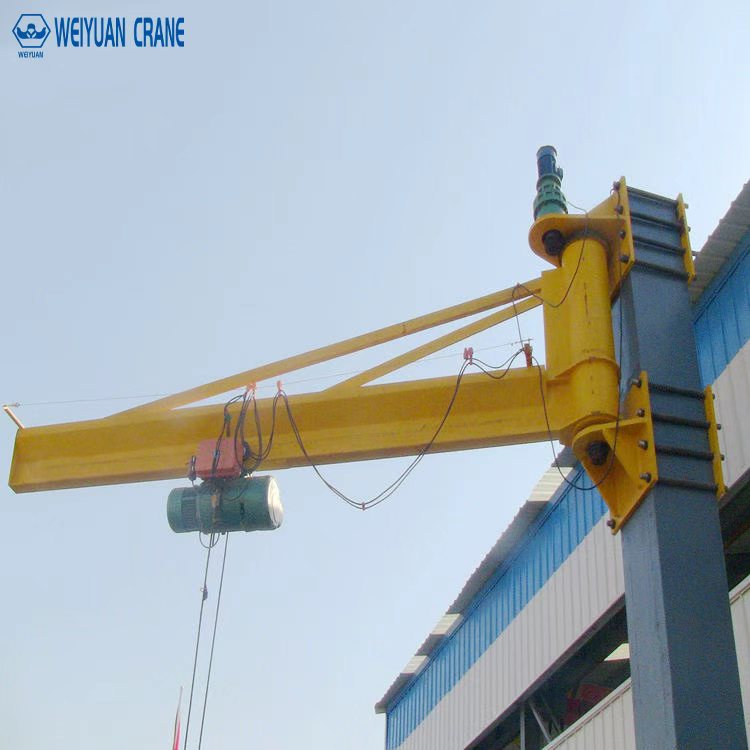
Weiyuan 500kg Wall Mounted Jib Crane
The Weiyuan 500kg Wall Mounted Jib Crane is a compact and efficient lifting solution designed for workshops, assembly lines, and warehouse operations. Mounted directly to a structural wall or column, it saves valuable floor space while providing smooth 180° slewing coverage for precise material handling up to 500 kg.
View Product / Get QuoteJib Crane Capacities: What You Need to Know
Jib cranes are available across a wide capacity range, but capacity must be understood in the context of the boom length, because the two are inseparable in structural terms.
Why boom length affects rated capacity:
A 1-ton load at a 15-foot reach creates nearly twice the overturning moment on the mast as the same load at an 8-foot reach. This is why jib crane manufacturers always specify capacity at a particular boom length — or publish capacity reduction tables that show how the rated capacity decreases as boom length increases for a given mast size.
Never assume that a crane rated at 1 ton can lift 1 ton at any point along its boom. Verify the rated capacity at your specific required reach with the manufacturer before ordering.
Standard capacity ranges by type:
Wall mounted jib cranes: 250 lbs to 5 tons (standard), up to 10 tons in engineered configurations
Floor mounted jib cranes: 250 lbs to 10 tons (standard), above 10 tons with custom engineering
Articulating jib cranes: 150 lbs to 2 tons (most standard catalog units)
Davit cranes: 150 lbs to 2 tons
Duty class:
Like all lifting equipment, jib cranes should be specified with a duty class that reflects actual usage intensity. ASME B30.12 and CMAA standards define duty classes based on lifts per day and the percentage of rated capacity typically lifted. A jib crane used dozens of times per shift at near-rated capacity requires significantly heavier construction than one used occasionally for maintenance. Matching duty class to actual application is as important as matching rated capacity.
How to Choose the Right Jib Crane for Your Facility
Step 1: Define the Coverage Area Required
Sketch the work area you need the jib crane to serve. Measure the maximum distance from the mounting point to the farthest load position — this is your required boom reach. Determine what rotation arc is needed to cover all positions. If 360-degree coverage is required in an open area, a floor mounted unit is necessary. If the application is against a wall and 180-degree coverage suffices, a wall mounted unit avoids the need for a foundation.
Step 2: Determine Your Lifting Capacity
Identify the heaviest load you will ever lift, including all below-hook hardware. Apply a minimum 25% safety margin. This gives your minimum rated capacity. Then verify that this capacity is achievable at your required boom reach — not just at the boom’s base position.
Step 3: Specify Hook Height
Confirm that your required hook height (the distance from the floor to the hook at maximum lift) is achievable given your building’s overhead clearance and the jib crane’s geometry (boom elevation plus hoist headroom).
Step 4: Assess Your Duty Cycle
A jib crane used for occasional maintenance lifting requires lighter construction and lower cost than one serving a high-frequency production station. Be honest about how often the crane will be used and at what load level. Underspecifying duty class is one of the most common — and expensive — errors in crane purchasing.
Step 5: Evaluate Site Constraints
Is the installation indoor or outdoor? Is the environment corrosive, high-temperature, or explosive? These conditions require special materials, coatings, or electrical ratings. Outdoor floor mounted units typically require galvanized or painted steel and weatherproof electrical components.
Step 6: Confirm Structural Requirements
For wall mounted units: obtain a structural assessment of the mounting wall or column.
For floor mounted units: obtain foundation specifications from the manufacturer and confirm suitability for your floor conditions.
For both: verify that the building’s overhead clearance accommodates the crane’s geometry at all positions.
Safety and Compliance Requirements
Jib cranes in the United States are governed by ASME B30.12 (Handling Loads Suspended from Rotary Cranes and Monorails) and are subject to OSHA inspection requirements under 29 CFR 1910.179 for applicable configurations.
Key compliance requirements:
- Load test at 125% of rated capacity before placing in service (ASME B30.12)
- Operator pre-use visual inspection before each shift
- Formal periodic inspection by a qualified person annually (or more frequently for heavy-service units)
- Structural documentation for mounting and foundation
Any jib crane that lacks compliance documentation or a load test certificate should not be accepted for installation in a production or commercial facility.
Frequently Asked Questions
Q: How long does a jib crane last?
A: A properly specified and maintained jib crane typically has a structural service life of 20 to 25 years or more. Hoist components and pivot bearings will require periodic replacement, but the boom and mast structure outlast multiple hoist generations when properly maintained.
Q: Can I use a jib crane outdoors?
A: Yes, but outdoor installations require corrosion-resistant coatings (galvanizing or industrial paint system), weatherproof electrical components, and foundation design that accounts for local frost depth and wind loads. Consult with the manufacturer and a structural engineer for outdoor applications.
Q: What is the typical lead time for a jib crane?
A: Standard catalog configurations (common capacities and boom lengths) typically ship in 4 to 8 weeks from order confirmation. Custom-engineered units or special environmental ratings can require 10 to 20 weeks.
Q: Can a jib crane be used with a chain block instead of an electric hoist?
A: Yes. Manual chain hoists (chain blocks) are commonly used with jib cranes for infrequent lifting or where electrical power is not available. The crane’s rated capacity applies regardless of whether the hoist is manual or electric.