


What Is an Electric Hoist? Types, Capacities & Key Features Explained
Introduction
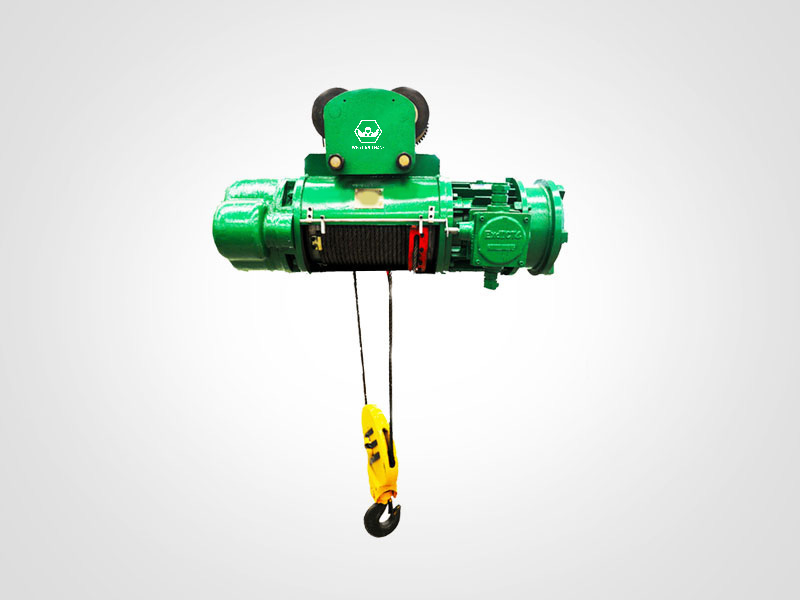
The electric hoist is one of the most fundamental pieces of equipment in modern industrial material handling — and one of the most frequently misunderstood. Walk through any manufacturing plant, warehouse, construction site, or maintenance facility and you’ll find electric hoists doing the work that would otherwise require teams of workers, specialized rigging, or far more expensive lifting systems.
Yet despite their ubiquity, many facility managers, procurement professionals, and even experienced engineers have incomplete knowledge of how electric hoists work, what types are available, how to classify them correctly for a given application, and what separates a reliable industrial-grade unit from an undersized or poorly designed one.
This guide provides the complete answer. We cover the definition of an electric hoist, all major types, capacity and duty classifications, the critical safety features that must be present on any industrial unit, and exactly how to match the right electric hoist to your specific lifting requirements. Whether you’re specifying a hoist for the first time or evaluating existing equipment, this article gives you the engineering foundation you need.
What Is an Electric Hoist? (Definition)
An electric hoist is a powered lifting device that uses an electric motor to raise and lower a load suspended from a hook. The motor drives a mechanical system — either a chain-and-sheave mechanism or a wire rope drum — that converts rotational motor output into vertical load movement.
Unlike manual chain hoists (which require the operator to pull a hand chain) or pneumatic hoists (which use compressed air as the power source), an electric hoist uses electrical power to perform the lifting work. The operator controls the hoist through a push-button pendant, wireless remote, or cabin control panel, directing the hoist to lift, lower, or stop as needed.
An electric hoist may be used as a standalone lifting device (suspended from a fixed hook or trolley beam) or as the hoisting mechanism integrated into a larger crane system — the hoist is the component that does the actual lifting on overhead cranes, gantry cranes, jib cranes, and monorail systems.
How an Electric Hoist Works
The operating sequence of an electric hoist, step by step:
- The operator presses the “up” button on the pendant or remote control.
- Power is delivered to the hoist motor (typically 3-phase AC in industrial units).
- The motor drives a gearbox that reduces speed and increases torque.
- The gearbox output drives either a load sheave (chain hoist) or a drum (wire rope hoist).
- The chain or rope winds through the mechanism, lifting the hook and suspended load.
- When the operator releases the button, the electromagnetic brake engages automatically, holding the load stationary with no motor power required.
- The operator presses “down” to lower the load in a controlled, powered manner.
Upper and lower limit switches interrupt power to the motor automatically when the hook reaches the uppermost or lowermost travel position, preventing mechanical damage and ensuring the chain or rope cannot run off the lifting mechanism.
Types of Electric Hoists
1. Electric Chain Hoists
The most widely used type of electric hoist across industrial, commercial, and construction applications. An electric chain hoist uses a precision-machined alloy steel load chain as its lifting medium, with the hook attached to the chain’s lower end via a hook block.
Key characteristics:
- Compact and lightweight compared to wire rope hoists
- Lower headroom requirement (chain stores in a bag, not on a drum)
- Capacities from 1/8 ton to approximately 10 tons in standard configurations
- Typical lift heights from 10 to 30 feet for most catalog units
- Single-phase models available for lighter-duty or portable applications
- Three-phase models standard for industrial production use
Best for: Jib cranes, light-to-medium overhead crane systems, maintenance bays, loading docks, assembly workstations, and any application with moderate duty cycle and capacity up to 5 to 10 tons.
2. Electric Wire Rope Hoists
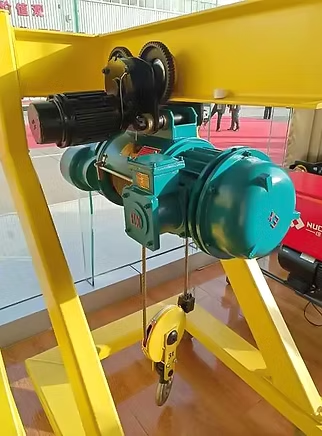
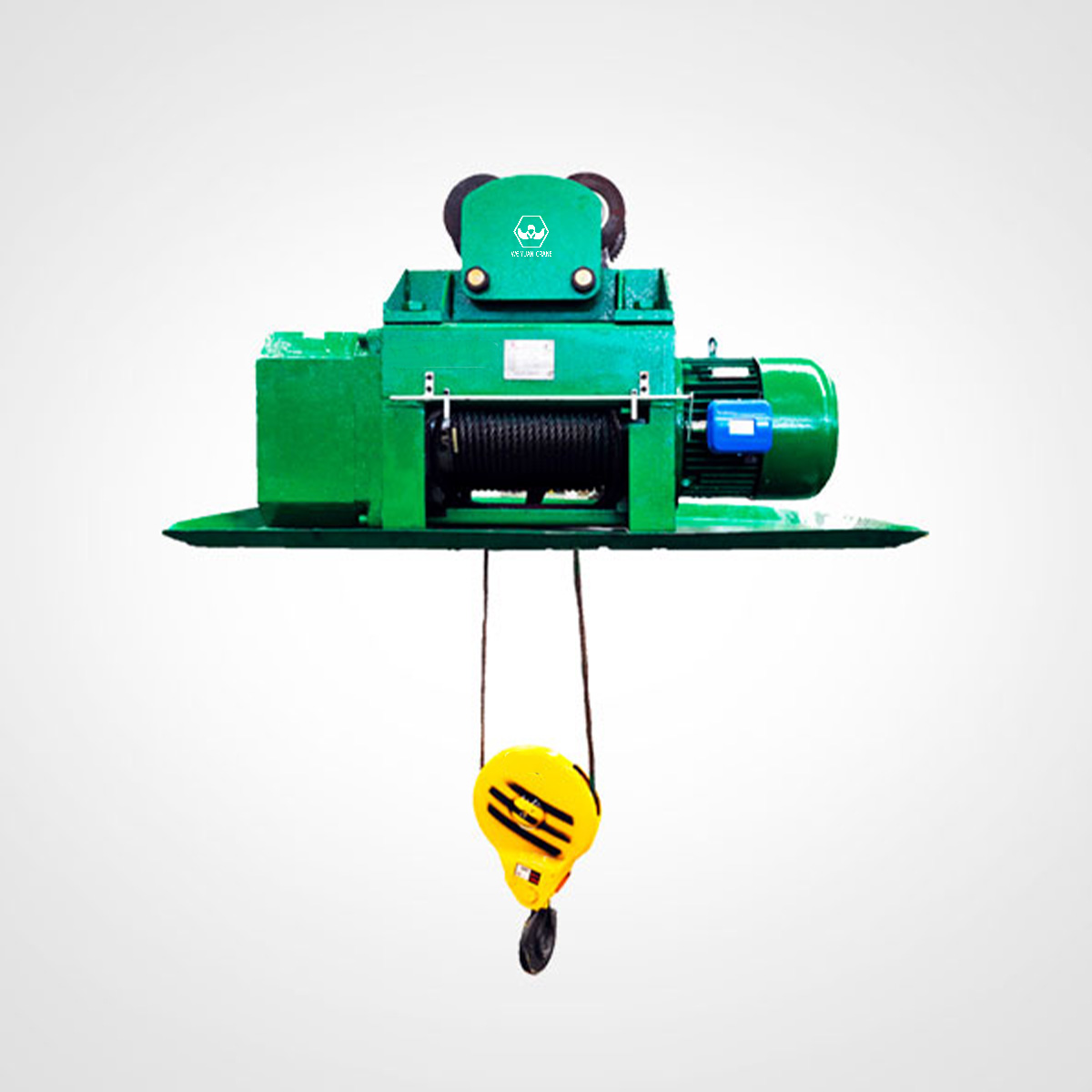
Wire rope hoists use a multi-strand galvanized steel wire rope wound onto a precision-machined drum as the lifting medium. The rope connects to the hook block via a sheave system, with single-reeving for higher speed and double or multiple reeving for higher capacity and slower speed.
Key characteristics:
- Greater capacity range (from 1/4 ton to hundreds of tons in engineered configurations)
- Higher lift heights practical (drum accommodates much more rope than a chain bag holds chain)
- Generally faster lifting speeds than chain hoists at equivalent capacity
- Higher duty cycle capability (H4 and H5 ratings standard in heavy industrial designs)
- Larger and heavier than chain hoists at lower capacity ranges
Best for: Heavy overhead cranes above 5 to 10 tons, applications with long lift heights, high-throughput production environments with demanding duty cycles, steel mills, shipyards, heavy fabrication.
3. Low-Headroom Electric Hoists
A specialized variant of both chain and wire rope hoist designs that minimizes the vertical distance between the top of the hoist body and the bottom of the hook at maximum lift. Low-headroom hoists are essential in buildings with limited ceiling clearance where every inch of hook height matters.
Key characteristics:
- Offset or folded hoist geometry to reduce headroom requirement
- Available in both chain and wire rope configurations
- Critical for crane systems in low-clearance facilities
4. Explosion-Proof Electric Hoists
Designed for use in hazardous locations where flammable gases, vapors, dusts, or fibers may be present in the atmosphere. All electrical components are enclosed in housings that prevent ignition of the surrounding atmosphere.
Key characteristics:
- UL listed or ATEX certified for specific hazard classifications (Class I, II, III, Division 1 or 2)
- Higher cost and longer lead times than standard industrial hoists
- Required by OSHA and NFPA 70 (NEC) for work in classified hazardous locations
Best for: Chemical plants, refineries, grain elevators, painting facilities, ammunition storage.
5. Stainless Steel and Cleanroom Electric Hoists
Constructed from stainless steel or food-grade materials to resist corrosion and contamination. Used in food processing, pharmaceutical manufacturing, semiconductor fabrication, and other clean or sanitary environments.
Key characteristics:
- All product-contact and housing surfaces in stainless steel or approved food-grade materials
- Special lubricants and sealed bearings to prevent contamination
- Often IP65 or IP67 rated for washdown resistance
6. Variable Frequency Drive (VFD) Electric Hoists
A control technology applied to both chain and wire rope hoists that allows smooth, stepless speed control from near-zero to full speed. VFD hoists provide shock-free starts and stops, precise load positioning, reduced mechanical wear, and significantly lower dynamic loads on the crane structure during acceleration and braking.
Key characteristics:
- Stepless speed control from near-zero to full speed in both lift and lower directions
- Smooth, jolt-free starts eliminate load swing and structural shock
- Precise positioning capability critical for assembly, machine loading, and inspection operations
- VFD also extends motor and gearbox service life by eliminating across-the-line starting transients
Best for: Any application where load precision, operator safety, or component longevity justifies the premium over standard single-speed or two-speed hoists.

Weiyuan 1 Ton Remote Control Monorail Electric Hoist
The Weiyuan 1 Ton Remote Control Monorail Electric Hoist is designed for efficient material handling in workshops, warehouses, and light industrial environments. Equipped with wireless remote control and a monorail trolley system, it ensures precise load positioning, smooth travel, and safe lifting operations up to 1 ton.
View Product / Get QuoteElectric Hoist Capacity Classifications
Understanding capacity ratings requires understanding two separate dimensions: the rated load and the duty class.
Rated Load
The rated load (or rated capacity) is the maximum load the hoist is designed to lift under the conditions for which it was designed. This includes the weight of the hook block and any below-hook hardware attached to the hoist.
Never specify a hoist at exactly your maximum load — always apply a minimum safety margin of 25% above your heaviest anticipated lift, including all below-hook devices.
Duty Class
Duty class defines how intensively the hoist is designed to work. It is expressed in terms of:
- Lifting capacity as a percentage of rated load (the average load per lift)
- Number of lifts per hour or per day
- Total expected service life in operating hours
FEM (Federation Europeenne de la Manutention) duty classes used in European-standard hoists:
M1 (FEM 1Am): Very infrequent, very light loads. Rarely used in industrial settings.
M2 (FEM 1Bm): Infrequent use, light loads. Occasional maintenance or storage work.
M3 (FEM 2m): Light industrial use. A few lifts per hour at moderate loads.
M4 (FEM 3m): Standard industrial use. Moderate frequency, loads averaging 50% of rated capacity.
M5 (FEM 4m): Heavy industrial use. Frequent lifts, loads averaging 63% of rated capacity.
M6 (FEM 5m): Very heavy industrial use. Continuous operation near rated capacity.
M7-M8: Special heavy-duty applications including steel mill ladle cranes.
Using a hoist at a higher duty class than it is rated for accelerates wear exponentially. A hoist rated for M3 service used in an M5 application will fail in a fraction of its designed service life — and may fail unsafely before obvious wear is visible.
Critical Safety Features of an Industrial Electric Hoist
These features are non-negotiable for any electric hoist used in a professional or industrial setting:
Electromagnetic brake: The brake must hold the rated load stationary without motor power. It must engage automatically on power loss. Any hoist that relies solely on motor friction to hold a load is not safe for industrial use.
Upper limit switch: Automatically cuts motor power when the hook reaches maximum lift height, preventing the chain or rope from running off the lifting mechanism.
Lower limit switch: Automatically cuts motor power when the hook reaches the lowest position. Prevents rope or chain runoff in the lower direction.
Thermal motor protection: Cuts power to the motor if it overheats from excessive duty, preventing motor burnout and fire risk.
Overload protection: Either a friction slip clutch (chain hoists) or an electronic overload relay (wire rope hoists) that prevents lifting of loads exceeding the rated capacity. Critical for both hoist protection and operator safety.
Hook safety latch: The hook must have a functional spring-loaded safety latch to prevent accidental load release during lifting and positioning.
Compliance and Inspection Requirements
Electric hoists in U.S. industrial facilities are governed by:
ASME B30.16: Safety standard for overhead hoists (underhung). Covers design, installation, inspection, testing, maintenance, and operation.
OSHA 29 CFR 1910.179 and 1910.180: Applicable to hoists used as part of overhead crane and gantry crane systems.
Required inspections per ASME B30.16:
- Pre-use visual inspection by the operator before each shift
- Frequent inspection by a qualified person at 1 to 3-month intervals
- Periodic inspection (thorough) by a qualified person annually
Inspection records must be maintained and available for OSHA review. A load test at 125% of rated capacity is required before placing a new hoist in service and after major repairs or modifications.
Frequently Asked Questions
Q: What is the difference between an electric hoist and an electric winch?
A: An electric hoist is specifically engineered for vertical lifting of suspended loads. It incorporates a rated electromagnetic brake to hold loads stationary and is designed to ASME B30.16 lifting standards. An electric winch is designed for horizontal pulling and is not rated or tested for vertical load suspension. Never substitute a winch for a hoist in a vertical lifting application.
Q: Can an electric hoist be used on a jib crane?
A: Yes — in fact, the electric chain hoist is the most common hoisting mechanism on jib cranes in industrial facilities. When selecting a hoist for a jib crane, confirm that the hoist’s weight does not exceed the jib crane’s rated capacity when added to the maximum load, and verify that the hoist’s headroom requirement is compatible with the jib crane’s boom elevation.
Q: How do I know if my electric hoist needs replacement versus repair?
A: A qualified person should assess: chain or rope condition (number of broken wires, stretch, wear), brake performance, limit switch function, hook deformation, hook latch condition, and structural integrity of the hoist body. If the hoist has reached its design service life (in operating hours) or shows signs of fatigue cracking in structural components, replacement is the safer option.
Q: What does IP rating mean on an electric hoist?
A: IP (Ingress Protection) rating describes the hoist’s resistance to solid particles (first digit) and water (second digit). IP54 means protected against dust ingress and water splashing from any direction — adequate for most indoor industrial environments. IP65 is fully dust-tight and protected against water jets — required for washdown applications. IP67 indicates protection against temporary immersion