


Gantry Crane Cost Guide: How Much Does a Gantry Crane Really Cost in 2026?
Introduction
“How much does a gantry crane cost?” is one of the most searched questions in the industrial lifting market — and one of the hardest to answer without context. A portable aluminum shop crane and a full-span shipyard gantry crane are both technically gantry cranes, yet their costs differ by a factor of 50 or more.
The honest answer is this: gantry crane costs in 2026 range from approximately $1,500 for a lightweight portable unit to well over $1,000,000 for a custom-engineered heavy industrial system. What determines where your project falls on that spectrum comes down to six primary variables — and understanding those variables is the difference between a realistic budget and a costly surprise.
This guide breaks down gantry crane pricing by type and capacity, explains every cost driver in plain terms, covers the total installed cost (not just the crane-only price), and gives you the practical framework to evaluate quotes intelligently before you commit to a purchase.
Why Gantry Crane Prices Vary So Dramatically
Before looking at specific numbers, it is worth understanding the fundamental variables that drive gantry crane pricing. Every dollar in a crane quote traces back to one or more of these factors:
Lifting capacity: The most significant single driver of cost. A 1-ton gantry crane and a 50-ton gantry crane are engineering-wise completely different machines. Every structural member, weld, wheel, motor, gearbox, and hoist component must scale to the load — and that scaling is not linear. Doubling the capacity typically increases crane cost by 60 to 120%, not 100%, because engineering complexity grows alongside raw material quantity.
Span: The horizontal distance between the crane’s legs defines how long and heavy the bridge beam must be. A 10-foot span beam is a very different structural proposition from a 60-foot span beam at the same capacity. Longer spans require deeper, heavier bridge sections and more robust end truck assemblies.
Hook height: Greater lift height demands taller legs, which increases the structural moment at the leg base and requires heavier mast sections and more robust rail foundations.
Configuration type: A portable shop gantry with casters is an off-the-shelf product. A full fixed-rail industrial gantry with engineered foundations, motorized drives, and a VFD-controlled wire rope hoist is a custom-engineered system. The two exist on entirely different cost levels.
Duty class: A gantry crane designed for CMAA Class A (occasional maintenance lifting) uses significantly lighter components throughout than a Class D or E crane designed for continuous heavy production — even at the same rated capacity.
Special requirements: Outdoor exposure, corrosive environments, explosive atmospheres, extreme temperatures, and automation requirements all add meaningful cost premiums.
Gantry Crane Prices by Type: 2026 Reference Ranges
Portable / Shop Gantry Cranes (Crane Only)
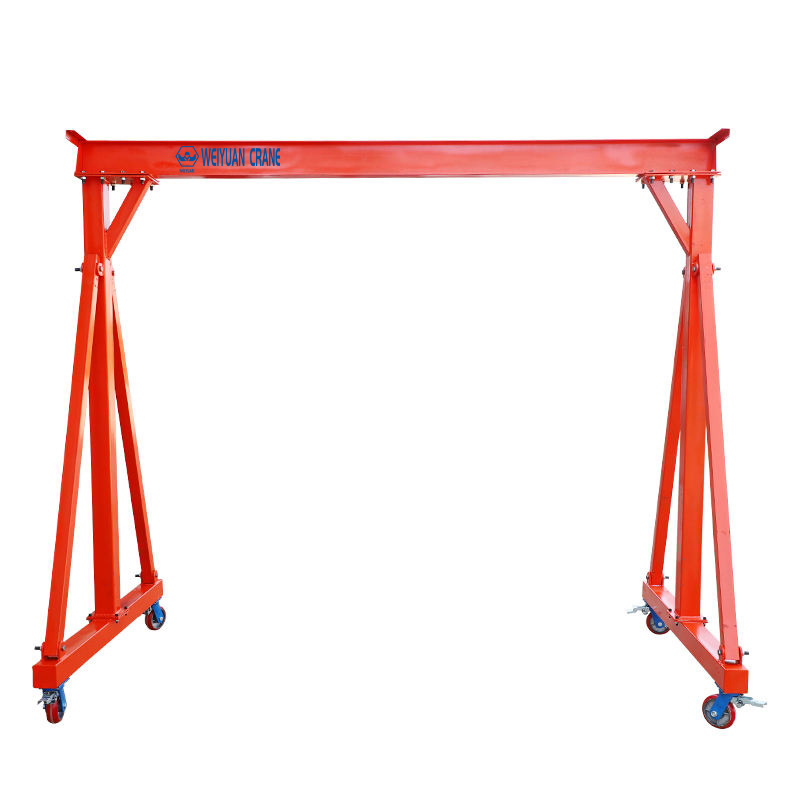
Portable gantry cranes are the most affordable entry point. These A-frame units roll on caster wheels, require no foundation or rail installation, and are available from numerous manufacturers in standard configurations.
- 1/2 ton (1,000 lb), 8-foot span: $1,500 – $3,200
- 1 ton (2,000 lb), 10-foot span: $2,500 – $5,500
- 2 ton (4,000 lb), 12-foot span: $4,500 – $9,000
- 3 ton (6,000 lb), 14-foot span: $8,000 – $16,000
These prices are crane-only. Add $500 to $2,500 for an electric chain hoist depending on capacity and brand. Portable cranes require no installation cost beyond assembly, which can typically be completed in one to two hours.
Adjustable Height Gantry Cranes (Crane Only)
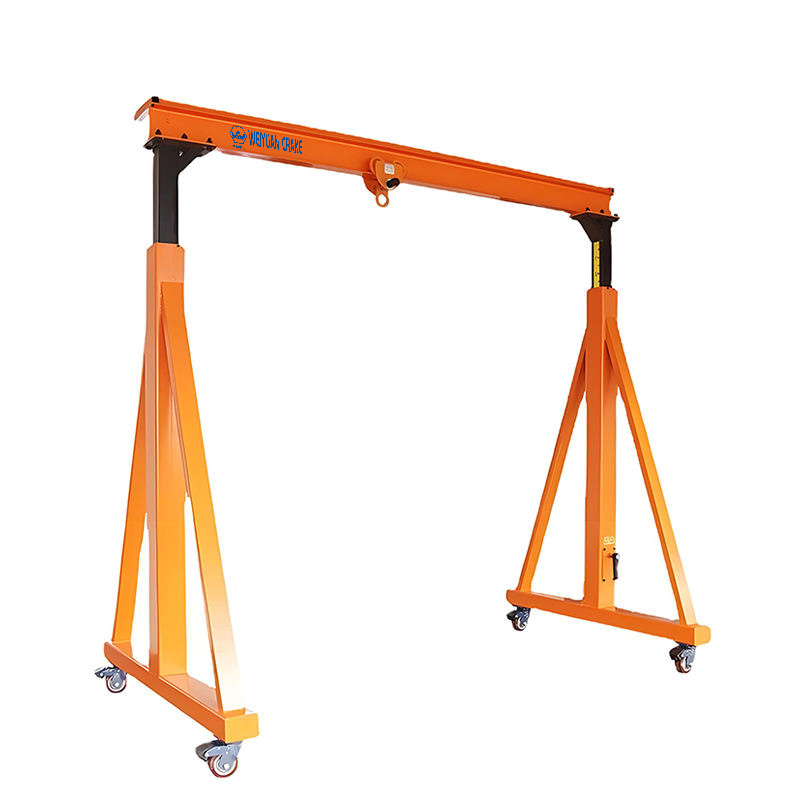
Adjustable height variants — with telescoping legs that allow the bridge elevation to be changed — cost 15 to 30% more than fixed-height portable cranes at equivalent capacity due to the added mechanical components.
- 1 ton adjustable: $3,500 – $7,000
- 2 ton adjustable: $6,500 – $13,000
- 5 ton adjustable: $14,000 – $28,000
Fixed Rail Single Girder Gantry Cranes (Crane Only)
Fixed-rail gantry cranes are permanent industrial installations. The crane rides on floor-embedded rails and provides coverage over a defined linear travel path. Single girder designs use one bridge beam and are standard for capacities up to approximately 20 tons.
- 1 ton, 15-foot span: $8,000 – $18,000
- 3 ton, 20-foot span: $15,000 – $32,000
- 5 ton, 25-foot span: $22,000 – $50,000
- 10 ton, 30-foot span: $38,000 – $80,000
- 20 ton, 40-foot span: $70,000 – $160,000
Fixed Rail Double Girder Gantry Cranes (Crane Only)
Double girder designs use two parallel bridge beams with the hoist running between them. This configuration provides greater hook height, higher capacity capability, better headroom utilization, and integrated maintenance walkways. It is the standard configuration for heavy industrial applications above 10 to 20 tons.
- 10 ton, 30-foot span: $55,000 – $120,000
- 20 ton, 40-foot span: $100,000 – $220,000
- 50 ton, 60-foot span: $300,000 – $800,000
- 100 ton and above: Custom quote — typically $500,000 to several million dollars
Rubber-Tired Gantry Cranes (RTG Cranes)
RTG cranes travel on rubber tires rather than rails, providing exceptional yard mobility for container terminals and large outdoor operations. Their cost reflects the complexity of the drive and steering systems.
- 30 to 40-ton RTG (container handling): $150,000 – $350,000
- 50 to 60-ton RTG: $300,000 – $600,000
- 70-ton and above: $500,000 – $1,200,000+
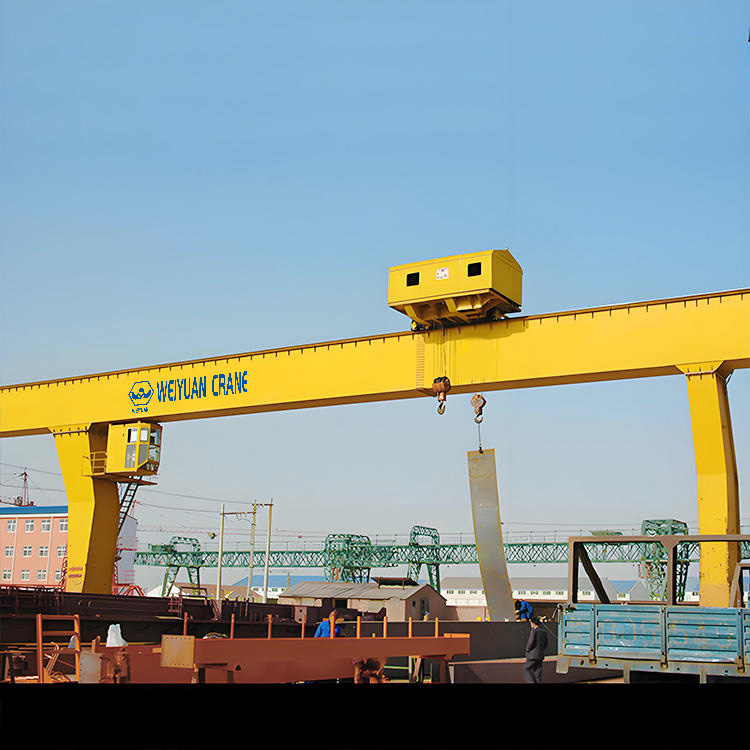
Weiyuan L-Shape Leg Walk Gantry Crane | Manufacturer Direct, Enhanced Mobility
The Weiyuan L-Shape Leg Walk Gantry Crane is a high-performance single-girder gantry crane with a distinctive L-shaped leg design that offers superior clearance for long and oversized loads, and smooth “walk” travel on ground rails — direct from the manufacturer for competitive pricing and reliable quality. :contentReference
View Product / Get QuoteThe Real Cost: Crane Only vs. Total Installed Cost
This is where most budgets go wrong. The crane-only price is only one component of the total project investment for fixed-rail gantry cranes. Here is what a complete installed system actually involves:
Rail foundation engineering and installation:
Fixed-rail gantry cranes require floor-embedded or surface-mounted crane rails on engineered foundations. For outdoor installations, foundations must extend below frost depth (which varies from inches in warm climates to several feet in northern regions). Rail foundation costs for a mid-range industrial gantry typically run $15,000 to $60,000 depending on rail length, foundation depth, concrete volume, and site access.
Rail material and installation:
Crane rail is a specialized product — not standard structural steel — sized to the crane’s wheel loads. Rail, clips, joints, end stops, and buffer assemblies: budget $5,000 to $25,000 for a typical installation depending on rail length and rail size.
Electrical service and controls:
Motorized gantry cranes require 3-phase 480V electrical service (in North America), a dedicated panel, and conductor bars or festoon cable along the rail length for power delivery to the traveling crane. Electrical work typically adds $6,000 to $30,000 to project cost depending on distance from the main panel and service complexity.
Hoist (if not included in crane price):
If the crane is quoted without a hoist, add the appropriate electric chain hoist or wire rope hoist cost. For a 5-ton fixed gantry, a suitable industrial wire rope hoist runs $7,000 to $18,000.
Installation labor:
Erecting and aligning a fixed-rail industrial gantry crane requires skilled ironworkers and millwrights. Labor for a typical 5-ton single girder system: $8,000 to $25,000. For a 20-ton double girder system: $30,000 to $80,000.
Load testing and commissioning:
ASME B30.2 requires a load test at 125% of rated capacity before service. Load test weights must be arranged, and a qualified person must witness and document the test: $1,500 to $5,000 typically.
Total installed cost examples:
1-ton portable gantry crane (no installation needed): $3,000 – $8,000 all-in
5-ton fixed rail single girder (complete installed system): $60,000 – $140,000
20-ton fixed rail double girder (complete installed system): $200,000 – $500,000
Key Cost Drivers You Can Control
Not all cost factors are fixed. Here are the ones where specification decisions meaningfully affect budget:
Single girder vs. double girder: At capacities from 5 to 15 tons where both configurations are viable, a single girder crane typically costs 20 to 35% less than a double girder of equivalent rated capacity. Choose double girder only when maximum hook height is critical or when the duty class and span truly demand it.
Motorized vs. manual travel: For a gantry crane that moves infrequently or serves a small area, manual push travel (the operator moves the crane by hand) eliminates the cost of drive motors, VFDs, and conductor systems — potentially saving $8,000 to $25,000 on a mid-size installation. For high-frequency production use, motorized travel is a productivity investment that pays for itself.
Standard vs. custom span: Standard catalog spans (typically 10, 15, 20, 25, and 30 feet) are less expensive than custom-engineered spans because structural calculations, drawings, and manufacturing tooling are already in place. If your required span falls close to a standard option, designing the facility layout around a standard span can produce meaningful savings.
Duty class precision: Overspecifying duty class is common and expensive. An honest assessment of actual lift frequency and load percentage — not a theoretical worst case — can allow you to specify Class C instead of Class D, which reduces component costs throughout the crane. Work with a qualified engineer to verify the appropriate duty class for your application.
New vs. Used Gantry Cranes: Cost Comparison
Used gantry cranes are available at 30 to 50% below equivalent new crane prices, making them an attractive option for budget-constrained projects. However, several critical considerations apply:
Inspection requirement: Any used crane must be inspected by a qualified person before purchase and before placement in service. ASME B30.2 and OSHA 1910.179 require thorough inspection of all structural, mechanical, and electrical components. Budget $500 to $2,000 for a qualified inspector’s assessment.
Refurbishment costs: Used cranes frequently require hoist rope or chain replacement, wheel replacement, brake servicing, and electrical system updating. These costs can run $3,000 to $15,000 on a medium-duty used crane and must be factored into the total acquisition cost.
Missing documentation: New cranes come with load test certificates, maintenance manuals, and compliance documentation. Used cranes frequently lack complete documentation, which creates compliance gaps and can be an OSHA issue.
Compatibility: Used crane runway gauge (distance between rails) must match your existing rail installation exactly, or runway modifications are required — which can eliminate much of the cost advantage.
Renting a gantry crane: For project-specific or temporary lifting needs, rental is a viable alternative. Short-term rental rates typically run $1,000 to $5,000 per month for portable and light industrial gantry cranes, and $5,000 to $15,000+ per month for heavier industrial units. For projects lasting less than six months, rental is often more economical than purchase.
Cost-Saving Tips When Purchasing a Gantry Crane
Get at least three competitive quotes: Gantry crane pricing varies significantly between suppliers for equivalent specifications. Three competitive quotes on the same written specification will reveal the realistic market price range.
Specify in writing before quoting: Verbal or loosely described specifications lead to quotes that are difficult to compare and often miss critical scope items. A written specification covering capacity, span, hook height, duty class, rail system, controls, and compliance requirements ensures all suppliers quote the same scope.
Bundle crane and runway: Some suppliers offer better total pricing when the crane and runway system are purchased together versus separately sourced. This also simplifies responsibility for system integration and commissioning.
Consider a phased approach: For facilities that may need higher capacity in the future, specifying a runway system engineered for the future load (but installing a lighter crane initially) can avoid costly runway replacement later.
Frequently Asked Questions
Q: Does the gantry crane price include the hoist?
A: Not always. Many crane quotes include the structural components (bridge, legs, end trucks, rails) but treat the hoist as a separate line item. Always confirm what is and is not included in any quote before comparing prices.
Q: How much does it cost to maintain a gantry crane annually?
A: For a typical 5-ton fixed-rail gantry crane in moderate industrial service, annual maintenance (OSHA-required inspections, lubrication, hoist servicing, wheel inspection) typically runs $2,000 to $6,000. Heavy-duty systems with higher duty cycles cost proportionally more to maintain.
Q: Is a gantry crane more expensive than an overhead crane of the same capacity?
A: Yes, typically. A gantry crane must support its own weight on freestanding legs and a runway foundation, while an overhead crane uses the building’s structural columns as runway supports. For equivalent capacity and span, an engineered gantry crane typically costs 1.5 to 2 times the price of an equivalent overhead crane system. However, in buildings that cannot support an overhead crane runway, the gantry crane may be the only practical option.
Q: What is the lead time for a gantry crane in 2026?
A: Standard portable gantry cranes ship within 2 to 4 weeks. Fixed-rail single girder cranes in standard configurations: 8 to 14 weeks. Custom-engineered double girder systems: 16 to 30 weeks. Factor these timelines into any construction or production project schedule.