


Gantry Crane Maintenance Guide: Inspection Schedule, Common Faults & Service Tips
Introduction
A gantry crane is one of the most durable pieces of equipment in any industrial facility — but only if it receives consistent, properly structured maintenance. A well-maintained gantry crane reliably delivers 20 to 30 years of productive service. A neglected one develops faults that escalate from minor inconveniences to costly structural failures, and in the worst cases, to serious safety incidents that injure workers and expose facilities to significant liability.
The challenge is that gantry crane maintenance is often treated reactively — addressed only when a visible problem appears — rather than proactively, on a structured schedule that catches developing issues before they become failures. This guide provides the complete maintenance framework that every gantry crane operator and facilities manager needs: the OSHA-required inspection schedule, what to look for at each inspection level, the most common fault patterns and their root causes, and the service practices that maximize crane lifespan and minimize unplanned downtime.
Whether you operate a portable shop gantry or a heavy-duty fixed-rail industrial system, the principles in this guide apply directly to your equipment.
Why Gantry Crane Maintenance Cannot Be Deferred
Before diving into the specific maintenance tasks, it is worth understanding why deferring crane maintenance is a false economy.
The cost of proactive maintenance — routine inspections, lubrication, hoist rope or chain replacement on schedule, periodic wheel and rail inspection — is predictable and modest relative to the crane’s value. The cost of reactive maintenance — unplanned downtime, emergency hoist replacement, runway rail damage from worn wheels, structural fatigue from missed cracking — is unpredictable, often urgent, and typically several times the cost of the proactive maintenance that would have prevented it.
Beyond the financial argument, deferred crane maintenance creates legal and compliance exposure. OSHA 1910.179 explicitly requires specific inspection intervals for overhead and gantry cranes. Facilities found to be operating cranes outside these requirements face citations, fines, and in the event of an incident, substantially elevated liability. OSHA inspection records for cranes are among the first documents requested following any material handling incident.
The math is straightforward: proactive maintenance is not a cost — it is a return on the investment in the crane itself.
The Three Levels of Gantry Crane Inspection
ASME B30.2 and OSHA 1910.179 define three distinct levels of gantry crane inspection, each with its own scope, frequency, and qualification requirements.
Level 1: Operator Pre-Use Inspection (Before Every Shift)
Who performs it: The crane operator, before the first lift of each shift.
Qualification required: The operator must be trained and designated as qualified to operate the crane.
Documentation: A written log of pre-use inspections is strongly recommended, though OSHA does not explicitly mandate written records at this level.
What to check at pre-use inspection:
Hook condition: Inspect for cracks, deformation, twisting, or any opening of the hook throat beyond 15% of the original dimension. Verify that the hook safety latch is present, spring-loaded, and closes fully. A hook that fails any of these checks must be taken out of service immediately.
Hoist chain or wire rope: For chain hoists, inspect the chain for bent or cracked links, corrosion, or visible wear. For wire rope hoists, check for broken wires (more than two broken wires in any 6-diameter rope length is grounds for replacement), kinking, crushing, or bird-caging of the rope. Inspect the rope drum for proper spooling — rope should wind evenly without overlapping in an uncontrolled manner.
Limit switches: With no load on the hook, slowly operate the hoist to confirm that the upper limit switch cuts motor power before the hook block contacts the hoist body. Test the lower limit switch similarly. Both must function correctly — if either fails, the hoist must be taken out of service until repaired.
Hoist brake: With no load, lift the hook approximately one foot off the ground, then release the pendant. The load should hold position without drifting. Any downward drift under no load indicates a brake problem requiring immediate service.
Controls: Verify that all pendant push-buttons are clearly labeled, respond correctly to input, and return to neutral position when released. Check that the emergency stop (if equipped) functions correctly.
Structural visual inspection: Walk around the crane and visually inspect the bridge beam, legs, and end trucks for any visible cracks, deformation, unusual corrosion, or loose hardware. Pay particular attention to welded connections at the leg-to-bridge junction and at the end truck attachment points.
Casters or wheels (for portable cranes): Verify that all caster locks engage fully and hold the crane stationary under test pressure. Inspect wheel surfaces for flat spots or unusual wear.
Rail wheels (for fixed-rail cranes): Check for visible flat spots, unusual wear patterns, or debris on the rails that could cause wheel climbing.
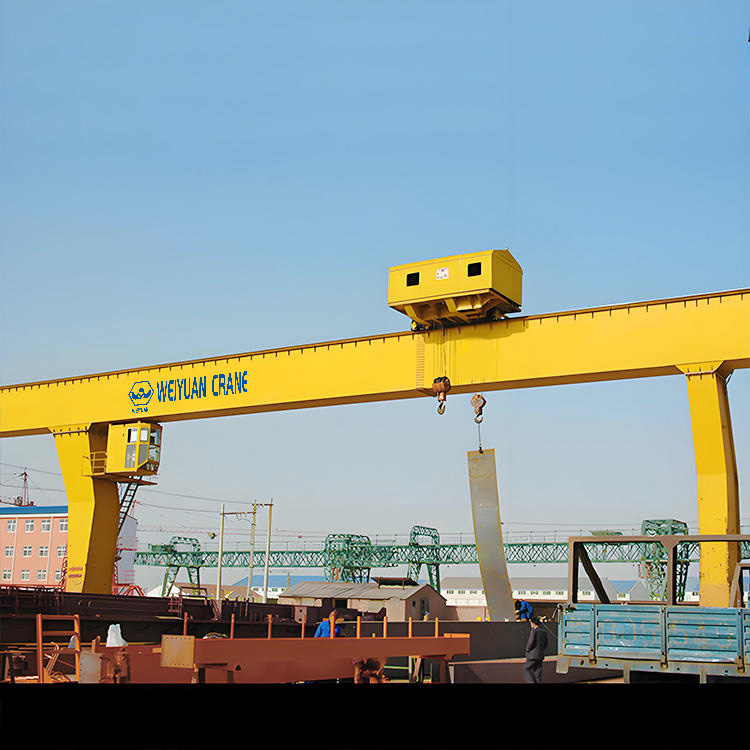
Weiyuan L-Shape Leg Walk Gantry Crane | Manufacturer Direct, Enhanced Mobility
The Weiyuan L-Shape Leg Walk Gantry Crane is a high-performance single-girder gantry crane with a distinctive L-shaped leg design that offers superior clearance for long and oversized loads, and smooth “walk” travel on ground rails — direct from the manufacturer for competitive pricing and reliable quality. :contentReference
View Product / Get QuoteLevel 2: Frequent Inspection (Every 1 to 3 Months)
Who performs it: A qualified person — defined by OSHA as someone with specific training, knowledge, and experience to identify hazardous conditions.
Frequency: Monthly for cranes in heavy service (CMAA Class D and above); quarterly for moderate service cranes (Class B and C); more frequently if operating conditions warrant.
Documentation: Written records required per OSHA 1910.179(j)(2).
The frequent inspection covers everything in the pre-use inspection plus the following additional items:
All functional operating mechanisms: Test all crane motions (bridge travel, trolley travel, hoist) under load. Note any unusual sounds, jerky motion, or hesitation. These are early indicators of developing mechanical issues.
Hoist chain wear: Measure chain stretch using a chain wear gauge. Chain stretched beyond 2% of the original pitch length must be replaced. Inspect pockets of the load sheave for visible wear — asymmetric wear patterns indicate misalignment that must be corrected.
Wire rope inspection (for wire rope hoists): Examine the full rope length for broken wires, corrosion, lubrication condition, diameter reduction, and evidence of kinking or crushing. Document any broken wires and compare to previous inspection records — a sudden increase in broken wire count signals accelerated deterioration.
Hooks: Use a hook gauge to measure throat opening and compare to the manufacturer’s published rejection criteria. Any hook deformed beyond these limits must be replaced — hooks cannot be repaired by welding, heating, or reshaping.
Sheaves and drums: Inspect for groove wear, cracks, and proper alignment. Rope sheave grooves should be smooth and free of ridges that would abrade the rope.
Brakes: Inspect brake lining thickness (compare to manufacturer’s minimum specification), verify brake spring condition, and test brake holding capacity under a test load of at least 50% of rated capacity.
End trucks: Inspect wheels for tread wear, flange wear, and flat spots. Check wheel bearings for noise and play. Inspect end truck structural members for cracks at welded joints.
Rail condition (for fixed-rail cranes): Walk the full rail length and inspect for wear, joint gaps, loose rail clips, misalignment between rail sections, and debris accumulation. Rail wear should be measured and compared to previous readings to track wear rate.
Electrical components: Inspect pendant cord and connectors for damage, conductor bars or festoon cable for wear, and control panel enclosures for moisture or debris ingress.
Level 3: Periodic (Annual) Inspection
Who performs it: A qualified person with crane inspection expertise — often a third-party crane inspection service.
Frequency: Annually for all cranes in service; more frequently for cranes in severe duty (CMAA Class E and F).
Documentation: Detailed written inspection report required; records must be retained.
The annual inspection covers all items in the frequent inspection plus a comprehensive structural and mechanical review:
Complete structural examination: All welded connections inspected for cracks using visual and, where indicated, non-destructive testing (magnetic particle or dye penetrant testing for suspected fatigue cracks). Bridge beam deflection measured under load and compared to allowable limits. Leg-to-bridge connections and gussets inspected for fatigue cracking.
Full electrical system inspection: All motor wiring, contactor condition, VFD parameter verification (if equipped), limit switch setpoints, and grounding continuity.
Runway rail and foundation inspection (fixed-rail cranes): Rail alignment surveyed across full length, anchor bolt torque checked, foundation condition assessed for cracking or settlement.
Load test review: If significant repairs or modifications have been made since the previous load test, a new load test at 125% of rated capacity may be required per ASME B30.2.
Most Common Gantry Crane Faults and Their Root Causes
Understanding the most frequent failure patterns allows maintenance teams to catch them earlier and target inspection effort appropriately.
Hoist brake drift (load lowering slowly under no-power):
Root cause: Worn brake lining, contaminated brake surfaces (oil or grease), weak or broken brake spring, incorrect brake adjustment.
Action: Immediate out-of-service. Inspect brake assembly, replace lining if worn, clean contaminated surfaces, adjust or replace spring. Never operate a crane with a drifting hoist brake.
Hoist chain or rope wear beyond limits:
Root cause: Operating at or above rated capacity, inadequate lubrication, operating in corrosive or abrasive environment, running rope over damaged sheave grooves.
Action: Replace chain or rope immediately. Inspect sheaves and drums for the damage that caused accelerated wear. Address the root cause before installing new rope.
Rail wheel flat spots (fixed-rail cranes):
Root cause: Brake lockup during travel (emergency stop while crane is moving), overloading that causes wheel skidding, inadequate runway alignment.
Action: Replace affected wheels. Investigate cause — if braking pattern, review operator procedures and VFD acceleration/deceleration settings. If alignment, survey and correct runway.
Bridge beam cracking at end truck connections:
Root cause: Fatigue from repetitive dynamic loading, often accelerated by hard stops, rail misalignment causing impact loading, or underspecified duty class.
Action: Immediate out-of-service. Structural assessment by a qualified engineer required before return to service. Repair by qualified welding procedure. Review whether the crane has been used beyond its rated duty class.
Limit switch failure:
Root cause: Mechanical wear of the actuator, corrosion of contacts, cable damage to the limit switch circuit.
Action: Out-of-service until repaired. Limit switches are primary safety devices — never bypass or disable them.
Trolley skewing on the bridge beam:
Root cause: Worn or mis-matched trolley wheels, debris on the lower flange of the beam, beam flange wear from trolley travel.
Action: Inspect and replace trolley wheels if worn. Clean beam flange. Measure flange wear and consult manufacturer if wear exceeds limits.
Gantry Crane Lubrication Schedule
Lubrication is the single most cost-effective maintenance activity for any crane system. The following is a general lubrication schedule — always verify specific requirements with the manufacturer’s maintenance manual for your crane:
Hoist chain (electric chain hoists): Lubricate with manufacturer-approved chain lubricant every 3 months under normal operating conditions; monthly in dusty, wet, or high-cycle environments.
Wire rope (wire rope hoists): Apply wire rope lubricant to the full rope length every 3 months; monthly in high-duty or outdoor applications. Use a lubricant that penetrates the rope’s core, not just the outer strands.
Hook swivel bearing: Grease every 3 months. Inspect for binding — the hook should rotate freely.
Trolley wheels and bearings: Grease every 3 months (sealed bearings may be grease-packed for life — check manufacturer specification).
Bridge end truck wheels and bearings: Grease every 3 months for unsealed bearings. Inspect for unusual noise or play.
Rail wheel flanges (fixed-rail cranes): Inspect for flange lubrication every 3 months; apply rail flange lubricant where required to reduce flange wear against rail head.
Gearbox oil (wire rope hoists and motorized drives): Check oil level every 6 months; change per manufacturer’s recommendation (typically every 2 to 4 years depending on duty and oil type).
When to Call a Professional vs. In-House Service
In-house maintenance is appropriate for:
- Routine lubrication and cleaning
- Pre-use and frequent visual inspections
- Simple hoist chain replacement on light-duty chain hoists
- Pendant cord replacement on wired controls
Professional (qualified crane service technician) required for:
- Hoist brake adjustment, lining replacement, or brake assembly rebuild
- Wire rope replacement on wire rope hoists
- End truck wheel replacement
- Runway rail alignment correction
- Any structural repair (welding, plate replacement)
- Electrical system troubleshooting and repair
- Annual periodic inspection and load test
Frequently Asked Questions
Q: How often does a gantry crane need a load test?
A: A load test at 125% of rated capacity is required before a crane is placed in service for the first time, and after any significant structural repair or modification. Routine operation does not require periodic load testing, but the annual inspection should include a functional test under a representative load.
Q: Can I perform gantry crane inspections myself?
A: Pre-use operator inspections can be performed by a trained, designated operator. Frequent and periodic inspections must be performed by a “qualified person” as defined by OSHA — someone with specific training and experience to identify hazardous conditions. For most operations, frequent inspections can be performed by a trained in-house maintenance person; periodic annual inspections are typically handled by a qualified third-party crane inspection service.
Q: How long should a gantry crane last with proper maintenance?
A: The structural frame of a well-maintained gantry crane can last 25 to 30 years or more. Wear components — hoist rope or chain, wheels, brake linings, bearings — have shorter service lives and are expected to be replaced on a scheduled basis. The overall system’s productive life is effectively unlimited with proper maintenance and timely component replacement.