


Jib Crane for Warehouse & Manufacturing: Top Applications, Productivity Benefits & Best Practices
Published by: [Your Brand] Engineering Team | Last Updated: March 2026 | Reading Time: 9 min
Introduction
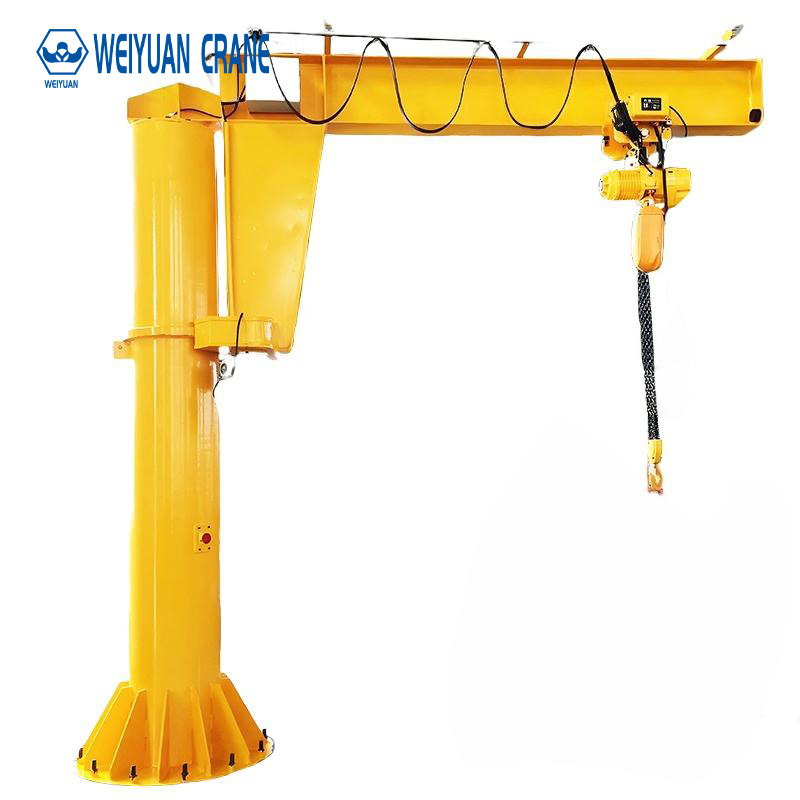
Warehouses and manufacturing plants represent the two largest application environments for jib cranes in industry. Yet despite their common use, jib cranes are frequently underutilized — deployed at a single loading dock or machine station without a broader strategy for where they can deliver the most productivity improvement, safety benefit, and return on investment across the facility.
This guide takes a practical, application-focused approach. We cover the specific warehouse and manufacturing scenarios where a jib crane delivers its greatest value, explain the productivity and safety benefits that are achievable with properly specified systems, compare jib crane configurations for different production environments, and provide the best practices that separate high-performing jib crane installations from underutilized ones.
Whether you are planning your first jib crane installation or optimizing a facility that already has multiple units in service, this guide gives you the application knowledge and best practices to get maximum value from every crane in your system.
Part 1: Jib Crane Applications in Warehouses
Application 1: Receiving Dock Material Handling
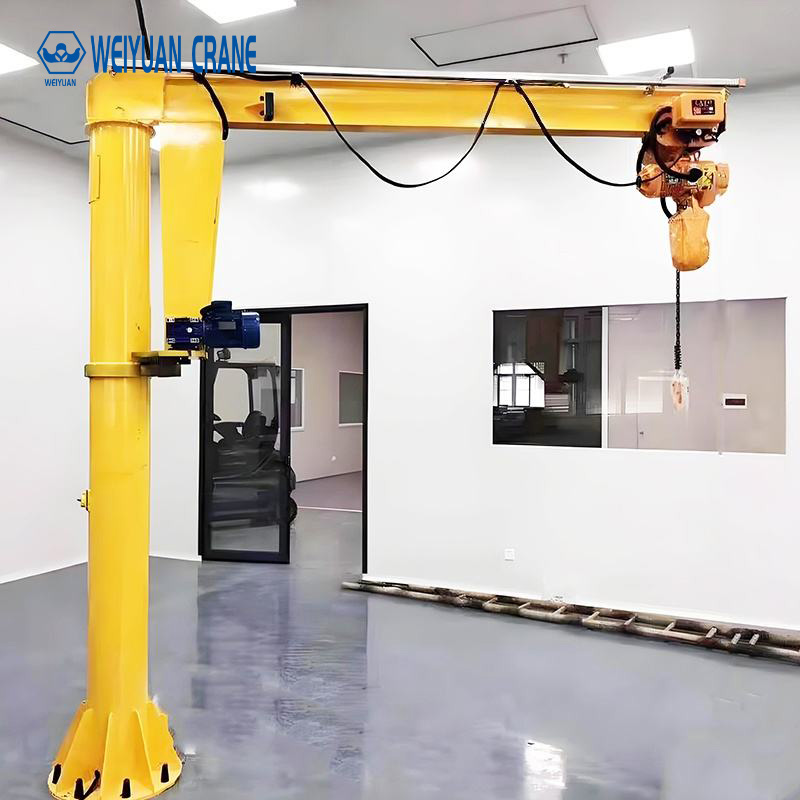
Loading dock receiving is one of the highest-value jib crane applications in warehouse facilities. Incoming shipments frequently include machinery, equipment components, and packaged goods that exceed safe manual handling limits — yet the frequency and variety of these loads often doesn’t justify the infrastructure investment of a full overhead crane system.
A 1 to 3-ton floor-mounted or wall-mounted jib crane positioned at the receiving dock provides:
- Safe, controlled lowering of heavy machinery and equipment from truck beds to dock level
- Ergonomic transfer of heavy components from pallets to inspection tables or staging areas
- Reduced reliance on forklifts for close-quarters unloading where forklift access is limited
Best configuration for dock receiving: Wall-mounted jib crane (180-degree rotation) where the dock wall provides a suitable mounting structure, or floor-mounted pillar crane where 360-degree coverage of the dock area is needed. Capacity typically 1 to 3 tons depending on the heaviest incoming items. Electric chain hoist with pendant control provides the speed and ease of use that dock operations require.
Application 2: Aisle and Zone Material Transfer
In warehouses with narrow storage aisles or tall racking systems, moving heavy items from storage locations to processing or staging areas is a common ergonomic and safety challenge. Jib cranes positioned at the end of storage zones allow operators to lift items from racking levels that cannot be safely reached manually.
A wall-traveling jib crane — a jib crane mounted on a trolley that travels along a wall-mounted runway — provides coverage over an extended linear zone at a fraction of the cost of a full overhead bridge crane. These systems are particularly effective in warehouses where a 15 to 30-foot linear coverage zone along one wall covers the primary material movement pathway.
Best configuration for zone transfer: Wall-traveling jib crane with 3 to 10-meter travel distance, 1 to 2 ton capacity, and powered trolley travel for smooth repositioning along the wall. Provides flexibility that a fixed-position jib crane cannot match for variable-position material movement.
Application 3: Outbound Shipping Preparation
Preparing heavy items for outbound shipment — placing products into packaging, lifting finished goods onto pallets or shipping skids, and positioning assemblies for wrapping or crating — is a high-frequency, ergonomically demanding task in distribution operations. Jib cranes at packing stations reduce manual handling injury risk and improve throughput on heavy-item packing lines.
A 500-lb to 1-ton jib crane at each high-volume packing station, equipped with a vacuum lifter, sheet metal handler, or fabric sling, transforms a two-person manual operation into a single-operator ergonomic process. The productivity improvement on heavy-item packing lines is often measurable within the first month of operation.
Application 4: Equipment Maintenance in Warehouse Facilities
Warehouse operations involve regular maintenance of material handling equipment — conveyor systems, sortation equipment, automated storage and retrieval systems (ASRS), and building mechanical systems. A portable or mast-type jib crane positioned in the maintenance bay provides lift capability for replacing heavy components (motors, gearboxes, conveyor rollers) without requiring the main production floor overhead crane to be pulled from service.
A 1 to 2-ton mast-type jib crane is typically sufficient for warehouse equipment maintenance applications. The mast-type design’s advantage here is its ability to be installed without a deep concrete foundation, making it a fast and lower-cost solution for maintenance bay applications.
Part 2: Jib Crane Applications in Manufacturing
Application 1: Machine Tool Tending (CNC, Lathe, Press)
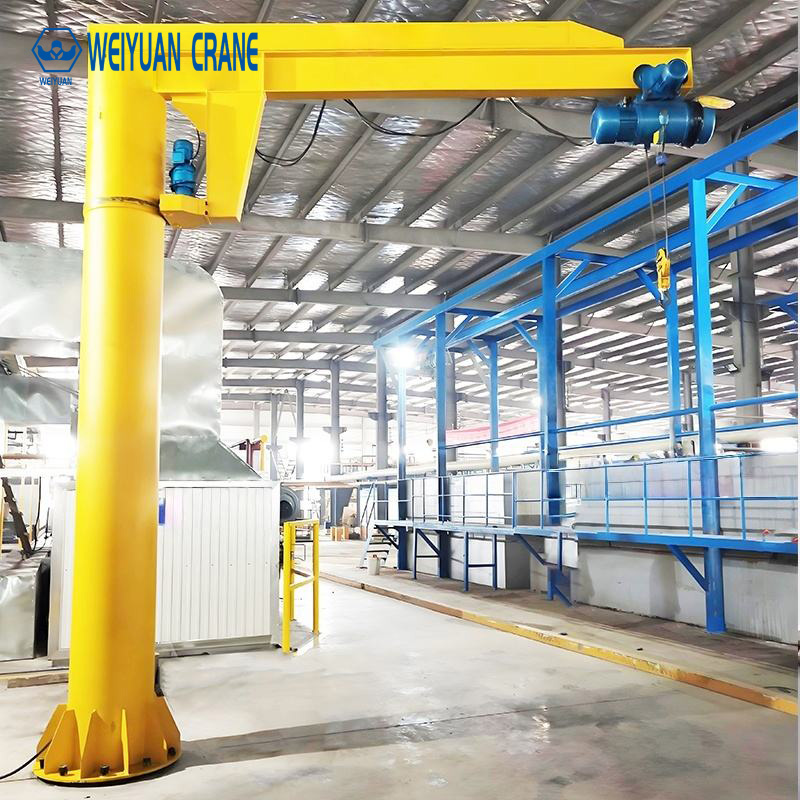
Machine tool tending — loading raw material into CNC machining centers, lathes, mills, and stamping presses, and unloading finished parts — is one of the highest-cycle jib crane applications in manufacturing. A jib crane positioned at each machine tool station provides:
- Ergonomic loading of billets, castings, and raw stock that exceed manual handling limits
- Precise positioning of parts into fixturing and tooling without the swing and positioning challenges of a floor-level forklift
- Reduced cycle time versus waiting for a shared overhead bridge crane
The critical specification requirement for machine tool tending is precision: the operator must be able to position the load with accuracy of fractions of an inch into machining fixturing. Articulating jib cranes are preferred for CNC applications where the hoist must reach over machine guarding — the jointed arm allows the hoist to clear the guarding and position the part directly over the work envelope without the arm fouling on the machine structure.
For this application: 500-lb to 2-ton capacity, articulating or standard boom depending on machine guarding height, VFD-controlled electric chain hoist for smooth, precise positioning, 360-degree floor-mounted configuration to serve both the infeed material staging and the machine itself.
Application 2: Assembly Line Component Feeding
Assembly lines handling heavy sub-assemblies — engine assembly, gearbox assembly, large electrical cabinet assembly, structural frame assembly — benefit enormously from dedicated workstation jib cranes. Each assembly station receives its own jib crane sized to the heaviest component handled at that station, eliminating the need to coordinate with a shared overhead crane for every assembly step.
The productivity benefit is quantifiable: an assembly process that requires the overhead crane for 10 lifts per shift, each requiring 3 minutes of coordination and positioning time, loses 30 minutes per shift to crane access coordination. Ten dedicated workstation jib cranes eliminate this coordination entirely and return that productive time to the process.
For assembly line feeding: 250-lb to 2-ton capacity depending on component weights, fixed straight boom sized to reach from the component staging position to the assembly fixture, motorized rotation for smooth boom positioning between multiple assembly positions, and — critically for precision assembly — VFD-controlled hoist for micro-positioning of components into tight-tolerance assemblies.
Application 3: Welding and Fabrication Work Cells
Welding and fabrication work cells involve frequent repositioning of weldments during the fabrication process — turning assemblies, positioning subcomponents for tacking, and moving completed weldments to the next operation. A jib crane at each welding cell provides lift capability that allows one operator to manipulate heavy weldments that would otherwise require two or three workers to position safely.
The specific requirements for welding work cell jib cranes include:
- Spark-resistant or stainless steel chain and below-hook equipment to resist damage from weld spatter
- Hoist duty class appropriate for the high lift frequency typical of fabrication cells (FEM M4 or M5 minimum for production welding)
- Hook approach that allows the hook to reach into the weldment’s center of gravity, which may be partially enclosed by the weld fixture
For welding work cells: 500-lb to 5-ton capacity depending on the heaviest weldment in the product mix, floor-mounted for 360-degree coverage of the welding fixture, standard straight or articulating boom depending on whether the hook needs to reach over fixture structures, and M4 to M5 class hoist for production duty.
Application 4: Mold and Die Handling
Injection molding and stamping press die changes are among the most demanding jib crane applications in manufacturing. Dies and molds are precision-machined, high-value tooling components that can weigh from 500 lbs to several tons and must be handled without impact or shock to prevent damage to the machined surfaces.
The jib crane for mold and die handling must provide:
- Smooth, controlled lift and lower motions — VFD hoist control is non-negotiable for any die-handling application
- Adequate boom reach to clear the machine platen and position the die precisely over the mold seat or press bed
- A hook approach that can pick the die from its storage rack and position it in the machine without the boom or hoist body fouling on machine structure
For mold and die handling: 1 to 5-ton capacity (sized to the heaviest die in the product mix plus 25%), VFD electric wire rope hoist for smooth control, articulating boom where machine guarding or platen structure requires the hoist to reach over an obstruction, and floor-mounted configuration positioned to serve both the die storage rack and the molding or stamping machine.
Part 3: Productivity Benefits — What the Numbers Show
The productivity argument for jib cranes in both warehouse and manufacturing settings is supported by consistent data from facilities that have deployed them systematically.
Reduced cycle time: Studies conducted in automotive assembly environments consistently show 15 to 35% cycle time reduction at individual workstations when a dedicated workstation jib crane replaces shared overhead crane access. The elimination of crane queuing and coordination time drives the majority of this improvement.
Ergonomic injury reduction: OSHA data indicates that material handling injuries account for approximately 32% of all workplace injuries. Facilities that replace manual lifting of loads above 35 lbs with jib crane-assisted handling at workstations typically report 40 to 70% reduction in material handling-related musculoskeletal injury rates within two to three years of deployment.
Labor efficiency: In operations where two workers are required to manually handle heavy components, introducing a jib crane at the workstation often allows the same task to be completed by one operator — doubling effective throughput per worker at that station.
Return on investment: For a $15,000 total installed 1-ton workstation jib crane that eliminates one worker-day of shared crane time per day (valued at $400 to $600 in labor and overhead), the simple payback period is 25 to 38 working days. Even conservative ROI calculations for production-cell jib cranes routinely show payback periods under 12 months.
Part 4: Best Practices for Jib Crane Deployment
These practices separate high-performing jib crane installations from underutilized ones:
Map lifting needs before specifying: Before purchasing, map every manual and crane-assisted lift in the target facility area for one full production week. Count frequency, weight, and reach requirements. This data drives correct capacity, configuration, and rotation specifications for each position — and often reveals additional positions that would benefit from jib cranes that were not initially obvious.
Size for actual duty cycle, not theoretical maximum: A jib crane that will lift 50 times per day at loads averaging 60% of rated capacity needs a very different hoist and structural specification than one that lifts twice per day. Over-specifying wastes money; under-specifying creates premature failures. Build the specification from real production data.
Integrate jib cranes into workflow design: A jib crane that is installed but not incorporated into the standard work procedure becomes a piece of equipment that operators walk past rather than use. Include jib crane use in standard work documentation, operator training, and workstation layout so that using the crane is the default path — not the exception.
Establish a preventive maintenance schedule from day one: Create the inspection and maintenance schedule before the crane lifts its first production load. Include pre-use operator inspection in the daily startup procedure, quarterly lubrication in the maintenance calendar, and annual qualified-person inspection in the service contract. A jib crane that is maintained from the beginning of its service life will still be operating reliably 25 years later.
Consider complementary systems: Jib cranes work best as part of a comprehensive material handling strategy. A jib crane at each workstation, combined with an overhead bridge crane for inter-station transfers, creates a lifting system where both types of equipment operate within their optimal performance envelope — rather than one type trying to do everything.
Frequently Asked Questions
Q: How many jib cranes can share the same work area?
A: Multiple jib cranes can operate in the same facility area provided their boom rotation arcs do not overlap in a way that creates collision risk. Adjacent jib cranes should be positioned so that their maximum boom reach does not allow simultaneous contact between booms or loads. Rotation stops can be added to limit each crane’s arc to prevent overlap where positioning constraints require cranes to be placed close together.
Q: What is the maximum useful boom reach for a production workstation jib crane?
A: Most production workstation jib cranes use boom reaches of 8 to 15 feet. Beyond 15 feet, the structural weight of the boom increases significantly, the crane cost rises substantially, and a floor-mounted overhead workstation crane often becomes more cost-effective for the coverage required. The 10 to 12-foot range covers the majority of machine tool and assembly workstation applications.
Q: Can a jib crane be used to tilt or rotate a load as well as lift it?
A: Not with a standard jib crane alone. Tilting and rotating functions require specialized below-hook devices — load positioners, tilt tables, or manipulators — attached between the hoist hook and the load. These devices are available from material handling specialists and can dramatically expand the functionality of a jib crane workstation for assembly and welding applications.