


Jib Crane Safety Guide: OSHA Standards, Load Rating Rules.
Published by: [Your Brand] Engineering Team | Last Updated: March 2026 | Reading Time: 8 min
Introduction
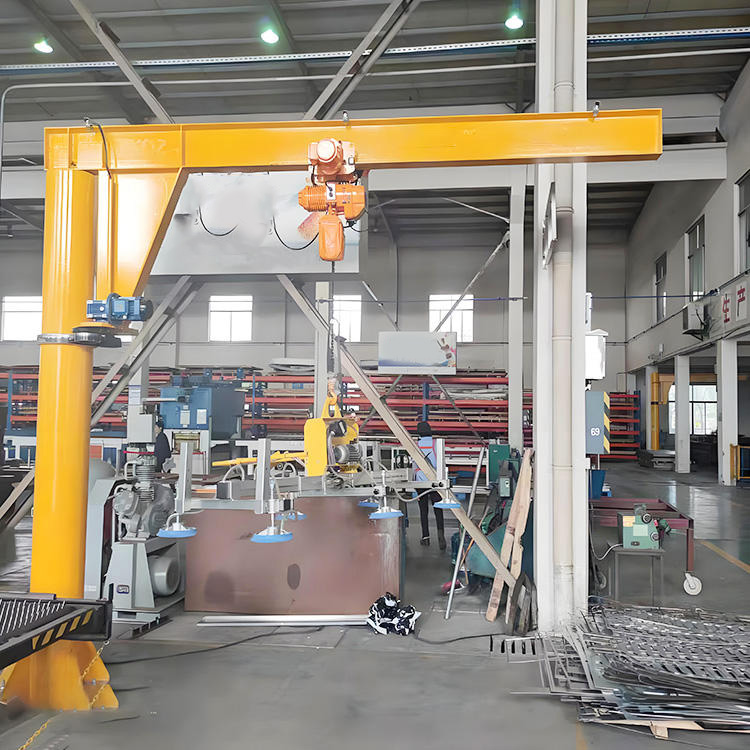
Jib cranes occupy a unique regulatory position in the U.S. workplace safety framework that creates genuine confusion for facility managers, safety officers, and maintenance personnel. Unlike large overhead bridge cranes — which fall clearly under OSHA 29 CFR 1910.179 — most jib cranes are specifically excluded from that standard and instead governed by a combination of ASME B30.12, the OSHA General Duty Clause, and the manufacturer’s instructions. This regulatory ambiguity does not reduce the safety risk — jib cranes are involved in serious workplace incidents every year — but it does mean that many facilities operate jib cranes without the structured safety program that the risk level warrants.
This guide resolves the regulatory confusion and provides the practical safety framework for jib crane operations: the exact OSHA standards and ASME standards that apply and how they interact, the load rating rules that are most frequently misunderstood, what effective operator training must cover, the five hazard categories that account for the majority of jib crane incidents, and the operational safety practices that prevent those incidents.
Part 1: The Regulatory Framework — What Actually Governs Jib Crane Safety
OSHA 29 CFR 1910.179 — Does It Apply to Jib Cranes?
OSHA 1910.179 is the primary federal standard for overhead and gantry cranes in general industry. However, it specifically applies to “overhead and gantry cranes, including semi-gantry, cantilever gantry, wall cranes, storage bridge cranes, and others having the same fundamental characteristics.”
Most interpretations of 1910.179 — including OSHA’s own compliance guidance — hold that standard pillar-type and wall-mounted jib cranes do not fall under 1910.179 because they do not travel on a runway system and their fundamental operating characteristics differ from the traveling bridge crane category the standard was written to address.
Single-exception: Wall cranes that travel on a runway attached to a building wall are specifically listed in 1910.179 and do fall under its requirements.
The General Duty Clause — The Primary Jib Crane Safety Obligation
For jib cranes not covered by 1910.179, the employer’s safety obligation is established by Section 5(a)(1) of the OSH Act — the General Duty Clause — which requires employers to provide a workplace “free from recognized hazards that are causing or are likely to cause death or serious physical harm.”
In practice, OSHA enforces jib crane safety under the General Duty Clause by citing violations when equipment conditions or operating practices create recognized hazards. The standard against which OSHA measures adequacy under the General Duty Clause is ASME B30.12 — the engineering standard of care for jib cranes. Operating a jib crane without meeting ASME B30.12 requirements is operating with recognized hazards, which is a General Duty Clause violation regardless of the absence of a specific 1910.179 citation.
ASME B30.12 — The Controlling Technical Standard
ASME B30.12 (Handling Loads Suspended from Rotary Cranes and Monorails) is the engineering standard that establishes the technical requirements for jib crane design, installation, inspection, maintenance, and operation. Its requirements cover:
- Rated load capacity marking and capacity verification
- Initial inspection and load test before first use
- Frequent inspection intervals based on service class
- Periodic annual inspection requirements
- Operator qualification requirements
- Safe operating practices and prohibited operations
ASME B30.12 is referenced in virtually every legal proceeding involving jib crane incidents. Compliance with B30.12 is the professional standard for jib crane safety programs.
ASME B30.16 — The Hoist Standard
The hoist mounted on the jib crane is governed by ASME B30.16 (Overhead Underhung and Stationary Hoists), which establishes specific inspection, maintenance, and operating requirements for chain and wire rope hoists used on jib cranes, monorails, and single-girder cranes.
Part 2: Load Rating Rules — The Most Frequently Misunderstood Aspect of Jib Crane Safety
Rated Capacity Is the Maximum — Not a Target
ASME B30.12 requires that the jib crane’s rated capacity be clearly marked on the crane and visible to the operator. The rated capacity is the maximum load the crane is designed to lift under the most favorable conditions of its operating range — typically at the minimum (shortest) hook radius.
What many operators and supervisors do not understand is that the rated capacity on the nameplate may be reduced at longer reach positions. This is particularly common with wall-mounted jib cranes, where the cantilever moment increases significantly as the hoist is positioned further out the boom, and with articulating cranes where the double moment arm at full outer arm extension creates loading conditions different from single-arm designs.
Always obtain and post the crane’s rated load diagram (load vs hook radius chart) from the manufacturer. Operating at the nameplate capacity when the hoist is at a position where the actual allowable load is lower is overloading — even if the nameplate number is not exceeded.
The Total Lifted Weight Includes Everything Below the Hook
A common and dangerous misunderstanding: the crane’s rated capacity applies to the total weight of everything suspended from the hook — the load itself plus the weight of all below-hook lifting devices (slings, shackles, spreader beams, vacuum cups, magnetic lifters, chain hooks, and any other rigging hardware).
Example: A jib crane rated at 1,000 pounds with a 200-pound below-hook vacuum lifter and a 750-pound panel. Total suspended weight = 200 + 750 = 950 pounds — within rated capacity. Replacing the panel with an 850-pound panel: total = 200 + 850 = 1,050 pounds — 5% over rated capacity. This seemingly small overload creates a structural overload condition that accelerates fatigue damage to the crane structure, the anchor system, and the hoist.
Post a sign at the crane specifying: (1) crane rated capacity, (2) weight of below-hook device (if a dedicated device is assigned to the crane), and (3) maximum net load allowed (rated capacity minus below-hook device weight).
The Side-Pull Prohibition
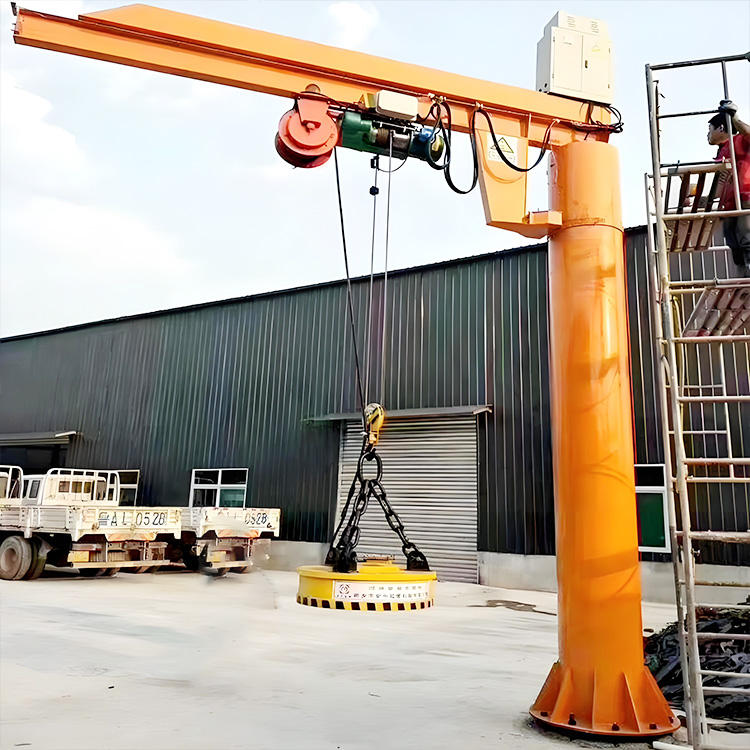
ASME B30.12 explicitly prohibits side-pulling — using the jib crane to drag, pull, or slide a load horizontally rather than lifting it vertically. Side-pulling imposes lateral forces on the boom and mast that these structures are not designed to resist. The forces can cause boom deflection, anchor loosening, structural yielding, and in severe cases, crane collapse.
Side-pulling occurs accidentally when operators attempt to retrieve a load that is not directly below the hook — swinging the boom to travel with the hoist lowered and the rigging taut to an off-center load, pulling a load off a shelf by moving the boom, or attempting to “drag” the load by traveling with the hook engaged at an angle.
Training must explicitly cover the side-pull prohibition with concrete examples of what it looks like in practice.
Part 3: Operator Training Requirements
Who Must Be Trained?
ASME B30.12 requires that jib crane operators be qualified persons — individuals who, by virtue of training, experience, or instruction, have demonstrated the knowledge and skills to operate the specific crane safely. The standard does not mandate third-party certification for jib crane operators (unlike construction cranes under OSHA 1926 Subpart CC), but qualification must be demonstrated and documented.
Every person who operates a jib crane — including supervisors who occasionally make lifts, maintenance technicians who use the crane to position equipment, and production operators assigned to the crane’s workstation — must be trained and designated as a qualified operator.
What Operator Training Must Cover
A complete jib crane operator training program must address:
The crane itself: Rated capacity and the load-radius relationship; control operation and expected response; hoist speed capabilities; rotation limits and physical stops; emergency stop procedures; and the specific hoist’s pre-use inspection procedure.
Safe operating practices from ASME B30.12:
- Never exceed rated capacity at any hook radius position
- Never side-pull or use the crane to drag loads
- Never travel with a load suspended at unnecessary height
- Never leave a suspended load unattended
- Always use a tag line to control load swing when appropriate
- Always establish and maintain the exclusion zone beneath the suspended load
- Never operate a crane with a deficiency noted during pre-use inspection without corrective action
Rigging fundamentals: How to attach loads safely using appropriate slings, shackles, and below-hook hardware; the rated capacities of slings at various angles; recognition of sling and hardware rejection conditions.
Emergency procedures: Power failure (load stays suspended — do not attempt to lower manually except with manufacturer-specified emergency lowering procedure); brake failure (immediate emergency stop, evacuation of load area, maintenance notification); dropped load (evacuation, incident reporting).
Documentation of Training
Maintain a signed training record for every designated jib crane operator. The record must include: the operator’s name, the specific crane(s) they are qualified to operate (by asset number or description), the date of training, the topics covered, and the name and qualifications of the trainer.
Refresher training is required: when new jib cranes are added to the facility, when unsafe operations are observed, when an incident or near-miss occurs involving the crane or operator, and on a periodic basis (annually is the industry best practice).
Part 4: The Five Most Common Jib Crane Hazard Categories
Hazard 1: Struck by Swinging Load
The most frequent cause of jib crane injuries. A load that is set in motion — either by initial acceleration when the operator starts swinging the boom, by brake engagement that creates a pendulum, or by an operator walking with a load — strikes personnel in the work area.
Prevention: Establish a physical exclusion zone beneath and around the load’s swing path before any lift. Use a tag line to control load orientation and dampen swing. Never accelerate or decelerate the boom rotation abruptly with a load suspended.
Hazard 2: Overloading and Structural Failure
Lifting beyond the crane’s rated capacity at the hoist’s position on the boom. May occur through miscalculation of load weight, failure to account for below-hook hardware weight, or operating the hoist at a boom position where the allowable load is reduced from the nameplate rating.
Prevention: Post the load-radius diagram at the crane. Require load weight to be verified against the lifting plan before any non-routine lift. Install a load monitoring device on high-usage cranes to alert operators to near-capacity or over-capacity conditions.
Hazard 3: Foundation and Mounting Failure
The jib crane anchor system — whether floor-mounted anchor bolts or wall-mounting brackets — fails under load. This is most commonly caused by inadequate foundation depth or concrete strength for floor-mounted cranes, or by mounting to a wall structure that was not evaluated for the crane’s moment loads.
Prevention: Install and maintain the crane strictly per the manufacturer’s foundation specification. Inspect anchor bolt torque and wall bracket fasteners at every periodic inspection. Any sign of anchor movement — a visible gap between the base plate and the floor, or visible tilting of the mast — requires immediate out-of-service and engineering assessment before any further use.
Hazard 4: Hoist Brake Failure (Load Drift)
The hoist brake fails to hold the load when the control is released, and the load descends onto personnel or equipment below.
Prevention: Pre-use hoist brake test before every shift (raise a test load, release control, verify no drift). Immediate out-of-service for any load drift. Scheduled brake inspection and lining measurement per ASME B30.16 maintenance requirements.
Hazard 5: Electrical Contact — Hoist Cord and Festoon Damage
The festoon cable or pendant cord that supplies power to the hoist is damaged by mechanical contact (boom rotation wraps the cord around an obstruction; the cord is cut by a sharp edge; the pendant is dragged across a rough surface), creating an exposed energized conductor that creates electrocution risk.
Prevention: Inspect pendant cord and festoon cable at every frequent inspection for cuts, abrasion, and exposed conductors. Ensure festoon travel range is adequate for the full boom rotation arc before installation — a festoon system that runs out of travel length before the boom reaches its stop will pull the cord taut and cause damage. Replace damaged cords immediately; do not attempt field repairs with tape.
Part 5: Building a Jib Crane Safety Program That Holds Up
A jib crane safety program that will withstand OSHA scrutiny, reduce incidents, and protect the facility from liability consists of four elements:
Written crane-specific operating procedures: A one-page document for each jib crane covering: rated capacity and load-radius limits, pre-use inspection checklist, approved below-hook devices and their weights, prohibited operations (side-pull, tandem lifts unless specifically evaluated), and emergency procedures. Post at the crane and reference in operator training.
Documented operator qualification: Signed qualification records for every designated operator, updated when assignments change or when refresher training occurs.
Inspection and maintenance records: Pre-use inspection log, frequent inspection records, and annual periodic inspection reports maintained and accessible. Missing records = missing inspections in any regulatory or legal context.
Out-of-service protocol: A standardized out-of-service tag, training for all operators on the conditions that require it, and a management commitment that out-of-service cranes are repaired before production pressure brings them back to use.
Frequently Asked Questions
Q: Does OSHA require jib crane operator certification?
A: OSHA does not require third-party certification for jib crane operators in general industry (unlike construction cranes). However, OSHA does require that operators be trained, qualified, and designated by the employer — and this must be documented. ASME B30.12 provides the technical framework for what “qualified” means in this context.
Q: How often do jib cranes need to be formally inspected?
A: ASME B30.12 requires: pre-use inspection before every shift, frequent inspections at monthly intervals for normal service (weekly to daily for heavy service), and annual periodic inspection by a qualified person. The annual inspection must produce a written report. Many facilities fail to distinguish between the frequent inspection (which the designated operator can perform) and the annual periodic inspection (which requires a qualified crane inspector and a written report).
Q: What are the signs that a jib crane needs immediate out-of-service?
A: Immediate out-of-service is required for: any hoist brake drift under load, any crack visible in the boom, mast, or mounting hardware, any visible movement of the base plate or mounting brackets, any damaged festoon or pendant cord with exposed conductors, any hook throat opening exceeding manufacturer’s rejection criterion, and any hoist upper limit switch that fails to operate correctly. These conditions represent immediate safety hazards — not deferred maintenance items.