


Electric Hoist Load Capacity Guide: How to Calculate the Right Tonnage for Your Application
Introduction
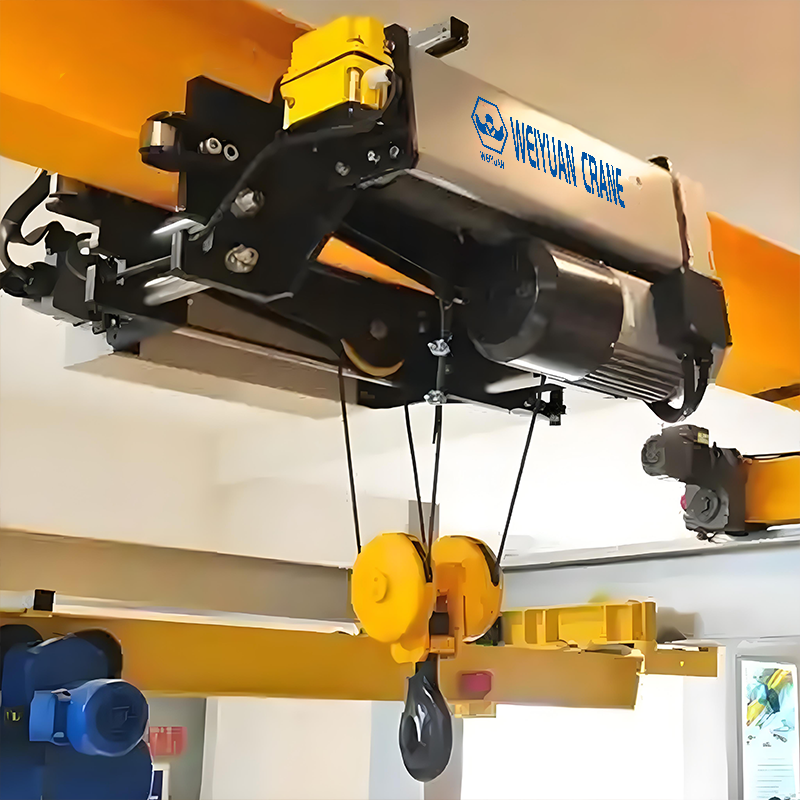
“What capacity hoist do I need?” is the most fundamental question in hoist selection — and it is more complex than simply looking up the weight of the heaviest load you plan to lift. The rated capacity of an electric hoist is a specific engineering value that must account for multiple load contributions, safety factors, and environmental variables that are frequently overlooked in the purchasing process.
Hoists that are underspecified in capacity create obvious and immediate safety risks. But hoists that are overspecified — purchased at unnecessarily high capacity — waste capital, require larger structural support systems, have larger physical dimensions that may not fit the available headroom, and consume more energy per lift cycle than correctly sized units. The goal of capacity selection is to specify exactly the right tonnage: sufficient safety margin for safe, reliable operation over the hoist’s design life, without the cost and physical penalties of unnecessary overcapacity.
This guide provides the complete technical framework for electric hoist capacity selection: the correct calculation methodology that accounts for all load components, how to apply safety factors correctly, the impact of reeving configuration on available capacity and speed, the special considerations for dynamic and impact loading applications, and the practical specification rules that produce a defensible, optimized capacity selection.
Part 1: What “Rated Capacity” Actually Means
The rated capacity of an electric hoist is the maximum load the hoist is designed to lift under its most favorable operating conditions — with a new rope or chain in good condition, at the minimum specified hook radius, with adequate electrical supply voltage, and within its specified duty cycle.
This definition has several important implications that buyers frequently miss:
Rated capacity is not a continuous capability. A hoist rated at 2 tons can lift 2 tons — but only within its duty class limitations. Operating a 2-ton H3-rated hoist at 2 tons continuously for 4 hours per shift is beyond its design envelope, even though the load does not exceed the nameplate.
Rated capacity applies to the load at the hook — not the net payload. Everything suspended below the hook contributes to the load the hoist must support: the hook block itself, slings, shackles, spreader beams, vacuum cups, magnetic lifters, below-hook fixtures, and the load. All of these must be added to determine whether the hoist’s rated capacity is being respected.
Rated capacity may vary with reeving. Single-part reeving (rope goes directly from drum to hook block) provides the full rated lift speed but may limit the maximum capacity on some hoist designs. Two-part or four-part reeving reduces lift speed by the reeving ratio but allows the hoist to lift heavier loads than single-part reeving by distributing the load across multiple rope segments. This is discussed in detail in Part 4.
Part 2: The Complete Load Calculation
Determining the required hoist capacity requires calculating the total suspended load under the worst-case conditions the hoist will encounter in service.
Step 1: Determine the Maximum Net Load Weight
The net load is the actual weight of the heaviest object the hoist will ever be required to lift. This sounds straightforward but requires care in practice:
Use actual measured weights, not nominal or design weights. A structural steel fabrication that is nominally designed at 800 kg may actually weigh 850 to 900 kg depending on welding consumables, attachments, and dimensional variations. If actual weights are not known, add a 10 to 15% margin to the design weight.
Account for the heaviest reasonably foreseeable lift — not just the typical lift. If a workstation typically lifts 500 kg parts but occasionally needs to handle 750 kg tooling for setup, the hoist must be sized for 750 kg.
For lifting liquids (molten metal ladles, tank vessels with liquid contents), account for the full weight of the container plus its maximum liquid contents.
Step 2: Add Below-Hook Hardware Weight
Weigh or obtain the manufacturer’s specification weight for all below-hook lifting hardware that will be used with this hoist:
- Hook block (the hoist’s own hook and pulley assembly — often 10 to 50 kg depending on capacity)
- Lifting slings (wire rope, chain, or synthetic slings — 2 to 30 kg depending on size and length)
- Shackles and connecting hardware (1 to 10 kg per shackle for typical industrial sizes)
- Spreader beam (if used — 20 to 200 kg depending on span and construction)
- Vacuum lifter or magnetic lifter (50 to 300 kg depending on capacity)
- Custom below-hook fixtures (obtain actual weight from designer)
Total below-hook hardware weight for a typical 1-ton industrial lift: 15 to 50 kg. For a heavy structural lift using a large spreader beam: 100 to 400 kg. This hardware weight is not negligible and must be included.
Step 3: Apply the Dynamic Load Factor
Static weight calculations assume the load is in equilibrium — no acceleration, no deceleration, no shock loading. Real hoist operations involve:
- Hoist motor starting current creating a jerk as the load leaves its resting surface
- Hoist brake engagement creating a sudden deceleration force when lowering stops
- Slack rope being taken up suddenly when a hanging load is picked up after rope goes slack
These dynamic effects amplify the instantaneous load on the hoist above the static weight. ASME B30.2 and hoist design standards address this through an impact factor applied to the static load:
- Lift speed below 50 FPM (0.25 m/s): Impact factor 1.15
- Lift speed 50 to 100 FPM: Impact factor 1.25
- Lift speed above 100 FPM: Impact factor per manufacturer’s specification
For a 1,000 kg static load lifted at 20 FPM: Design load = 1,000 × 1.15 = 1,150 kg.
Step 4: Apply the Design Safety Factor
ASME HST-1 (electric chain hoists) and ASME HST-4 (wire rope hoists) specify minimum safety factors for hoist structural components. These safety factors are incorporated into the hoist’s rated capacity by the manufacturer — a hoist rated at 2,000 kg has structural components designed to withstand loads of 4,000 to 6,000 kg without failure (safety factors of 2:1 to 3:1 are typical for structural components).
The buyer does not typically need to apply an additional safety factor on top of the hoist’s rated capacity — the safety factors are already built into the rating. However, there are situations where a prudent specifier adds a margin above the calculated design load:
- When actual load weights are uncertain (estimated rather than measured): add 10 to 25% margin
- When the application will expand in the future (anticipated heavier loads): size for the future maximum
- When the hoist is difficult to replace (remote location, long lead time): add a margin to reduce the probability of needing premature replacement
Step 5: Round Up to the Next Standard Capacity
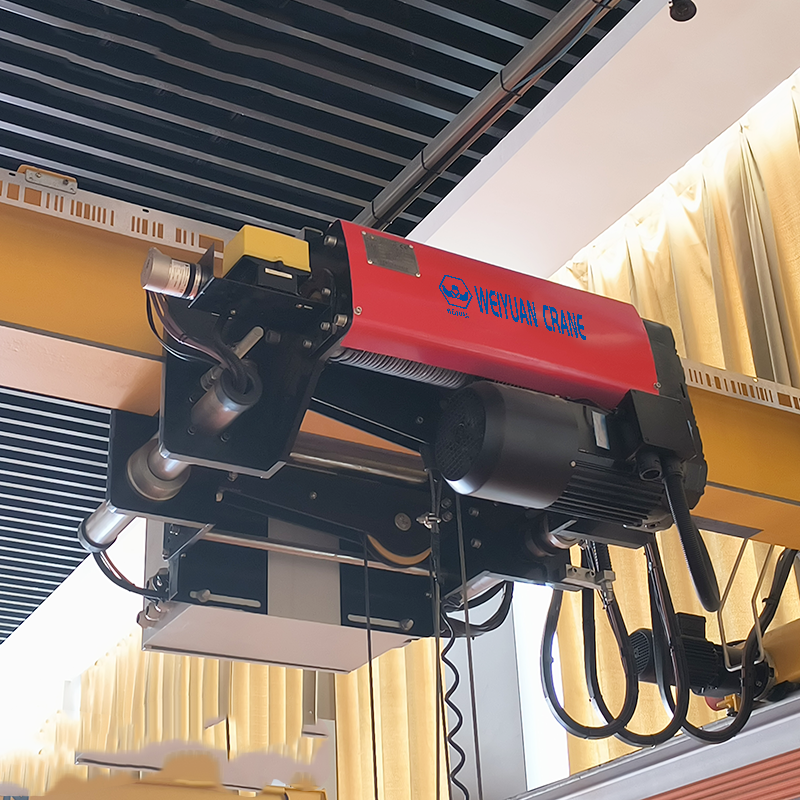
After completing the load calculation, compare the result to standard hoist capacity ratings. Electric hoists are available in standard capacity increments: 250 kg, 500 kg, 1,000 kg (1 ton), 1,600 kg, 2,000 kg (2 ton), 3,200 kg, 5,000 kg (5 ton), 6,300 kg, 8,000 kg, 10,000 kg (10 ton), and so on.
Always round up to the next standard capacity above your calculated design load. Never round down. A calculated design load of 1,050 kg rounds up to a 1,600 kg rated hoist — not down to a 1,000 kg hoist that is already below the required design load.
Worked Example
Application: Lifting steel fabrication assemblies at an automotive component plant. Heaviest assembly: nominally 800 kg (add 10% uncertainty = 880 kg). Below-hook hardware (spreader beam + slings + shackles): 95 kg. Total static load: 880 + 95 = 975 kg. Hoist lift speed: 8 m/min (26 FPM). Impact factor: 1.15. Design load: 975 × 1.15 = 1,121 kg.
Next standard capacity above 1,121 kg: 1,600 kg (1.6 ton).
Specified capacity: 1,600 kg (1.6 ton) electric chain hoist.
Part 3: How Duty Class Interacts with Capacity Selection
A common misconception is that duty class and capacity are independent specifications that can be chosen independently. They are not — they interact in a way that affects the hoist’s actual usable capacity in production service.
A 2-ton hoist rated at H2 (light service) can lift 2 tons — but only occasionally, at low frequency, with adequate cool-down time between lifts. If the application requires lifting 1.8-ton loads 15 times per hour across an 8-hour shift, the H2 hoist will overheat its motor and experience accelerated brake wear even though no individual lift exceeds 2 tons.
The correct approach: determine the required duty class from the application’s lift frequency and average load percentage, and then select the capacity for the application. Do not use duty class as a substitute for correct capacity selection or vice versa.
For applications where the average load percentage is very high (90% or more of rated capacity on most lifts), moving up one duty class OR selecting the next higher capacity (both of which reduce the average load percentage as a fraction of rated capacity) are both valid approaches to extending hoist service life. Your hoist manufacturer’s application engineers can help optimize this tradeoff.
Part 4: Reeving Configuration and Its Effect on Capacity and Speed
What Is Reeving?
Reeving describes how the wire rope is threaded between the hoist drum and the hook block. In single-part reeving, the rope runs from the drum directly to the hook block — one strand of rope supports the load. In two-part reeving, the rope runs from the drum, down to a bottom sheave in the hook block, back up to a fixed sheave at the top, and then to the dead end — two strands of rope support the load.
How Reeving Affects Capacity and Speed
Single-part reeving (1/1): The hoist drum directly supports the full load. Maximum lift speed is the drum line speed.
Two-part reeving (2/1): Two rope strands support the load, halving the tension per rope strand. The hoist can lift twice the single-part capacity with the same drum and motor — but lift speed is halved because the hook moves half the distance for each revolution of the drum.
Four-part reeving (4/1): Four rope strands support the load — capacity is quadrupled relative to single-part, but speed is quartered.
This relationship is the key to understanding capacity-speed tradeoffs in wire rope hoist selection:
If you need high capacity but lower lift speed is acceptable: Use more parts of reeving with a smaller motor.
If you need high lift speed and lower capacity is acceptable: Use fewer parts of reeving with a larger motor.
If you need both high capacity and high lift speed: You need a larger hoist with a larger motor — reeving cannot solve this tradeoff.
Practical example: A wire rope hoist with a 5-ton single-part capacity and 10 m/min lift speed, rigged to two-part reeving, becomes a 10-ton, 5 m/min hoist. The same drum, motor, and rope serve a different capacity and speed profile depending on reeving configuration.
Part 5: Special Capacity Considerations for Specific Applications
Molten Metal and High-Temperature Applications
Hoists handling ladles or crucibles of molten metal require additional capacity margin beyond the calculated design load to account for:
- Residual skull weight (solidified metal remaining in the ladle that adds to the empty ladle weight unpredictably)
- Thermal expansion of the ladle structure under repeated heating and cooling cycles that changes actual weight
- The safety-critical nature of a dropped load — molten metal spillage is a catastrophic event that justifies conservative capacity selection
Industry practice: specify hoist capacity at a minimum of 150% of the maximum calculated design load for molten metal applications.
Long Lift Height Applications
In mine shaft hoists, tower cranes, and deep-pit industrial hoists, the weight of the rope or chain itself becomes a significant fraction of the rated capacity. For a wire rope hoist with a 100-meter lift height, 6mm wire rope weighs approximately 13 kg per 100 meters — a small fraction of a 5-ton capacity. But for a 1,000-meter mine hoist, the rope weight alone can exceed the payload weight.
For lift heights above approximately 30 meters for chain hoists and 50 meters for wire rope hoists, calculate the weight of the full deployed rope or chain length and add it to the design load calculation.
Tandem Lifting (Two Hoists Sharing a Load)
When two hoists are used together to lift a single load, the load distribution between the two hoists is theoretically equal — but in practice, structural flexibility, rigging geometry, and hook position variations mean the load distribution is never perfectly equal. Industry practice is to specify each hoist for at least 60% of the total load when used in a planned tandem configuration — meaning two 5-ton hoists are used for a maximum load of 8.3 tons (2 × 5 × 0.6 = 6 tons per hoist… actually it means each hoist handles up to 60% = 3 tons each, total = 5 tons). Do not use two hoists rated at exactly half the total load — the unequal distribution will overload one hoist.
Frequently Asked Questions
Q: Can I use a hoist rated at exactly my maximum load, or do I need a margin?
A: ASME standards require that the hoist’s rated capacity not be exceeded, including all below-hook hardware weight. If your maximum load (net payload + below-hook hardware + dynamic factor) exactly equals a standard capacity, the next higher standard capacity is the correct selection. Always have margin — never operate at exactly rated capacity as a routine matter.
Q: Does a higher capacity hoist always lift more slowly?
A: Not necessarily. Lift speed is determined by the motor power and reeving configuration, not directly by capacity. A high-capacity hoist with a powerful motor and single-part reeving can lift faster than a lower-capacity hoist with a smaller motor. When comparing hoists, always compare both capacity and lift speed together.
Q: How does ambient temperature affect hoist capacity?
A: Extreme ambient temperatures affect motor thermal capacity (the duty cycle the motor can sustain without overheating) rather than the structural rated capacity. In high-ambient-temperature environments (above 40°C), the motor’s effective duty class is reduced — meaning the hoist cannot sustain the same number of lifts per hour at rated load without overheating as it can in a standard 20°C ambient. Consult the manufacturer for motor derating factors at elevated ambient temperatures when sizing for high-duty-cycle applications in hot environments.