


Overhead Crane for Automotive Manufacturing: Die Handling, Stamping Press Support & Assembly Line Integration
Introduction
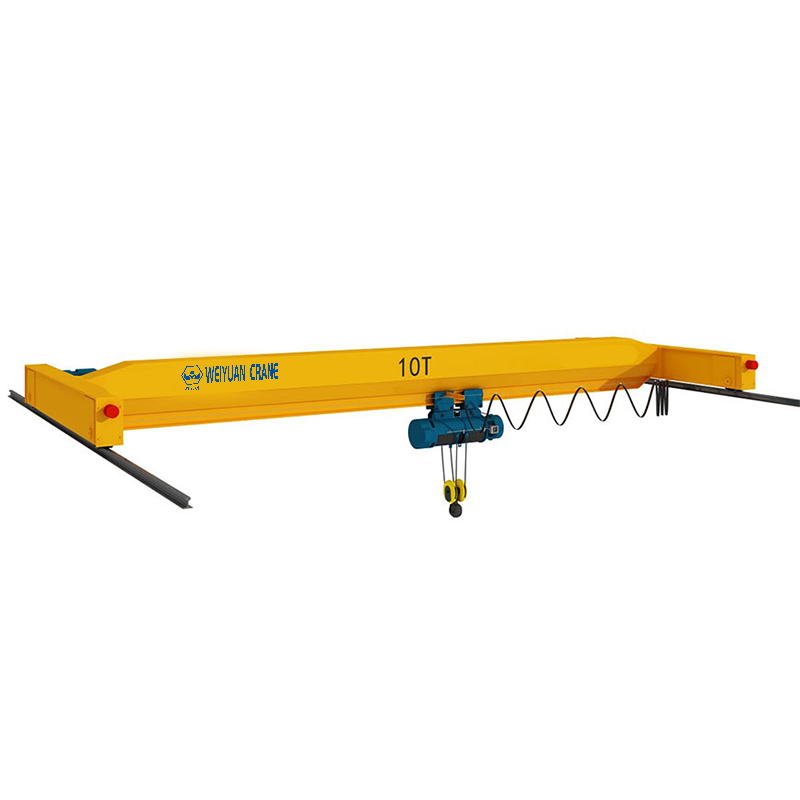
Automotive manufacturing plants are among the most crane-intensive production environments in global industry. A typical full-scale automotive assembly plant — from stamping through body shop, paint shop, and final assembly — may operate 50 to 200 overhead cranes across its various production areas, each serving a specific function in the vehicle manufacturing workflow. These cranes collectively perform millions of lift cycles per year, handling everything from 50-gram wiring harness bundles to 50-ton stamping dies.
The overhead crane requirements in automotive manufacturing are not generic. Each production zone — stamping, body welding, paint, powertrain assembly, chassis, trim, and final assembly — has specific load characteristics, precision requirements, duty cycle demands, and environmental conditions that drive materially different crane specifications. A crane correctly specified for the stamping press room, where it handles 30-ton dies in continuous multi-shift operation, is fundamentally different from a crane correctly specified for the trim assembly line, where it handles 200-pound door assemblies with operators working at floor level.
This guide provides the application-specific crane specification framework for each major zone of automotive manufacturing: the load characteristics and duty requirements in each zone, the crane configurations that best serve automotive production workflows, the precision and control specifications that automotive quality demands, and the integration requirements that connect crane systems to the broader automation and production management infrastructure of a modern automotive plant.
Part 1: Stamping Press Room — The Most Demanding Overhead Crane Application in Automotive
The Die Handling Challenge
The stamping press room is where flat steel coils are formed into body panels — hoods, doors, fenders, roof panels, and structural floor pans. Each press stroke produces one panel; each panel requires a precision-machined die set that may weigh 15 to 60 tons and cost $500,000 to $3,000,000 to manufacture.
Die changes — swapping one die set for another to switch from one panel design to another — are among the most demanding crane operations in any manufacturing environment. The sequence requires:
- Lifting the die set from the press bed (typically at floor level or slightly above)
- Transporting to the die storage rack (positions may be 30 to 60 meters from the press)
- Precisely setting the die in its storage position without impact that could damage the precision-ground die faces
- Retrieving the next die set and reversing the sequence
The overhead crane for die handling must provide:
- Capacity adequate for the heaviest die in the press room (typically 1.25× maximum die weight minimum)
- VFD hoist control: smooth, shock-free lifting and lowering — a die set dropped even 2 to 3mm onto a hard surface can chip a die face that costs $50,000 to $200,000 to regrind
- Precise cross-travel positioning: die storage rack positions are fixed, and the crane must position the die within ±5mm of the storage saddle centerline
- High travel speed: die change time is a key production metric in stamping — faster travel reduces die change time, which directly increases press available time
Recommended specification for stamping press room die handling:
- Configuration: Double girder overhead crane (for hook height and structural stiffness required)
- Capacity: 20 to 80 tons depending on press room die weights; most medium-large press rooms require 30 to 50 tons
- Duty class: CMAA Class D minimum; Class E for high-volume plants running 20+ die changes per shift
- Hoist: Wire rope crab with VFD, high-speed travel (200+ FPM bridge travel for large press rooms)
- Control: Wireless radio remote for operator positioning freedom; load monitoring with overload cutout
Tandem Die Lifting
Very large die sets — particularly the large outer body panel dies for SUVs and pickup trucks — exceed the rated capacity of a single crane. Tandem lifting using two cranes on the same runway, with synchronized control that maintains equal load distribution, is the standard approach for lifts above approximately 50 tons in automotive press rooms.
Tandem lift control systems use load cells at each crane hoist to continuously monitor load sharing and adjust hoist speed to maintain balance within ±3% of equal distribution. Any imbalance beyond the programmed limit triggers an automatic stop — preventing one crane from carrying a disproportionate share of the load that would overload its structure.
Part 2: Body Shop — Welding and Assembly Overhead Cranes
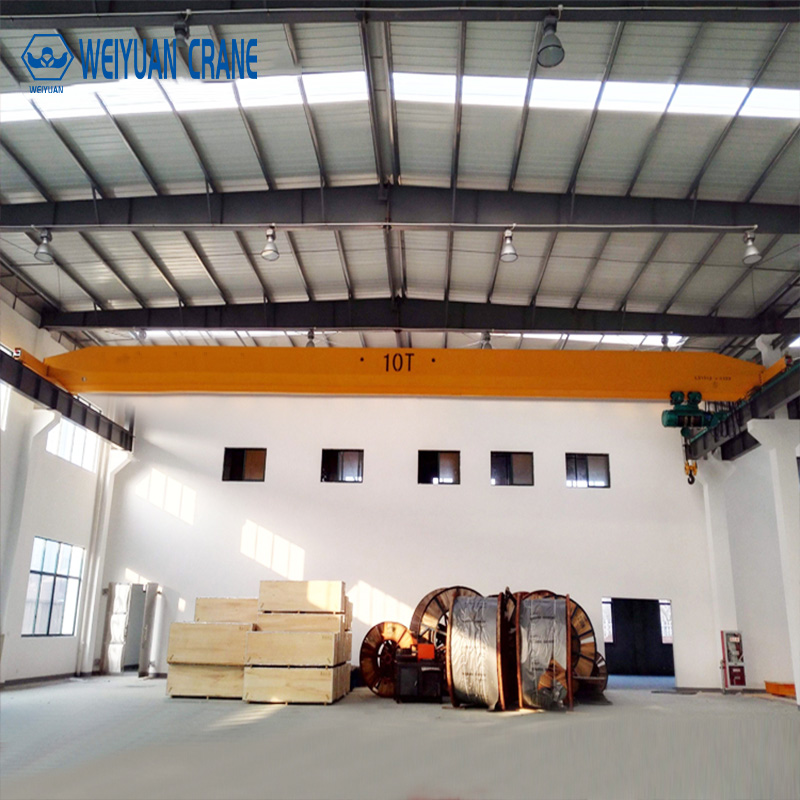
The body shop is where stamped panels are joined into the vehicle body structure through resistance spot welding, laser welding, and structural adhesive bonding. Overhead cranes in the body shop serve multiple functions with very different characteristics from the stamping press room.
Fixture and Tooling Handling
Body shop welding fixtures — the precision-machined assemblies that locate body panels during welding — weigh 2 to 15 tons and require periodic maintenance, changeover, and replacement. Overhead cranes handling fixtures must provide:
- Adequate capacity for the heaviest fixture in the body shop (typically 5 to 15 tons)
- Hook height adequate to lift fixtures over the top of the welding cells and adjacent equipment
- Precise positioning for setting fixtures back onto their locating pins after maintenance — typically ±5mm accuracy required
Body-in-White (BIW) Transfer Cranes
In some body shop configurations, partially assembled body structures must be transferred between welding stations using overhead cranes rather than conveyor systems. BIW transfer cranes handle assembled body structures weighing 300 to 600 kg and must move them quickly between stations without damaging the partially assembled panels.
For BIW transfer, monorail systems with individually powered carriers are often preferred over a single large overhead crane — providing simultaneous transfer of multiple bodies between stations without the traffic conflict of a single crane serving multiple pickup and delivery points.
Robotic Welding Cell Support Cranes
Automated robotic welding cells require periodic fixture change and robot arm replacement. Column-mounted jib cranes or short-span overhead cranes positioned at each robot cell provide the localized lifting capability for these maintenance operations without requiring the plant-wide crane to navigate to each cell.
Part 3: Powertrain Assembly — Precision Engine and Transmission Handling
The powertrain assembly area handles engines, transmissions, and drive axles — components that weigh 100 to 500 kg individually and are assembled from subcomponents at individual workstations before being merged with the vehicle chassis in the final assembly line.
Ergonomic Assist Cranes for Powertrain Assembly
Ergonomic material handling is a critical requirement in powertrain assembly. Engine blocks, cylinder heads, crankshafts, and transmission cases all weigh more than the NIOSH recommended weight limit for manual handling, and they must be positioned with precision into assembly fixtures where alignment tolerances are measured in tenths of a millimeter.
The overhead crane specification for powertrain assembly zones differs fundamentally from heavy production cranes in the stamping room:
- Capacity: 250 kg to 2 tons (ergonomic assist range rather than heavy production)
- Duty class: CMAA Class C to D for continuous assembly line use
- Control: Intelligent assist (load-sensing) control that allows operators to guide components with minimal applied force — the operator directs the load’s movement; the crane provides the lifting force
- Precision: Sub-centimeter positioning accuracy for engine-to-transmission coupling and crankshaft-to-block installation
- Hook approach: Minimum hook approach to maximize the height at which components can be positioned above the assembly fixture
Engine and Transmission Line Maintenance Cranes
For major powertrain maintenance (engine removal and replacement, transmission R&R), overhead cranes serving the maintenance bays require 2 to 5 ton capacity with adequate hook height to clear the vehicle body during engine extraction and installation.
Part 4: Final Assembly — Overhead Handling at the Moving Line
Final assembly is the most complex crane environment in the automotive plant — hundreds of components are installed on each vehicle as it moves through the assembly line, and cranes must accommodate the continuously moving line while serving individual assembly operations.
Chassis Drop and Marriage Operations
The most critical final assembly lifting operation is the “marriage” — the simultaneous lowering of the vehicle body onto the chassis assembly (including engine, transmission, suspension, and axles). This operation requires:
- Precise synchronization between the body carrier and the chassis carrier moving on separate lines at the same speed
- Accurate vertical positioning to engage body-to-chassis attachment points simultaneously
- Zero shock loading — the first contact between body and chassis must be smooth to prevent damage to either assembly
Automated marriage operations in modern plants use precision-controlled lifting systems — servo-driven rather than conventional VFD-hoist designs — that achieve positioning accuracy of ±1mm at the merge point.
Door and Glass Installation Assist Cranes
Door panels, windshields, and rear glass are heavy and fragile — too heavy for repetitive manual handling and too fragile for conventional crane hooks. Vacuum lifter systems mounted on workstation bridge cranes or monorail carriers handle these components.
The crane specification for door and glass handling:
- Capacity: 50 to 200 kg (door panels and glass sheets)
- Configuration: Lightweight aluminum track and carrier systems that minimize the weight operators must move to position the crane
- Below-hook: Vacuum lifter with multiple suction cups sized for the specific glass or door panel dimensions
- Control: Ergonomic push-handle with integrated lift control — operator guides the load by pushing on a handle that senses force and commands the crane accordingly
Part 5: Integration with Automotive Plant Automation Systems
Modern automotive plants operate with highly integrated digital production management systems — Manufacturing Execution Systems (MES), Andon alert systems, and real-time production tracking that monitor every major piece of production equipment. Overhead cranes are increasingly integrated into these systems.
Crane Data Integration
Every crane in a modern automotive plant can provide data that is valuable for production management:
- Load weight per lift (from load monitoring system): Provides actual die and tooling weight for inventory management
- Lift cycle count and timing: Provides input for crane maintenance scheduling and production cycle time analysis
- Position data: Confirms that dies are returned to their correct storage positions after die changes
- Fault codes and alarm history: Provides advance warning of developing maintenance needs
Crane control systems equipped with OPC-UA or EtherNet/IP industrial communication protocols can transmit this data to the plant’s MES in real time — enabling condition-based maintenance scheduling and production reporting that is impossible with standalone crane systems.
Anti-Collision in Multi-Crane Runways
Press rooms, body shops, and paint shops often have two or more cranes sharing the same runway. Without anti-collision systems, two cranes approaching each other from opposite ends of the runway can collide — a serious safety and equipment damage event.
Modern anti-collision systems use laser distance measurement between adjacent cranes and zone control logic in each crane’s PLC to automatically decelerate and stop the crane before a collision zone is entered. The system maintains minimum safe separation between cranes at all times, regardless of operator inputs.
Frequently Asked Questions
Q: What is the most important crane specification in a stamping press room?
A: For die handling, the single most important specification is VFD hoist control providing smooth, controlled acceleration and deceleration. The consequences of die damage from rough handling — grinding costs, die rework, production downtime — consistently exceed the cost difference between a VFD-equipped crane and one without it. This is not optional in a modern press room.
Q: How many overhead cranes does a typical automotive assembly plant need?
A: A full-scale automotive assembly plant producing 250,000 to 500,000 vehicles per year typically operates 100 to 250 overhead cranes across all production areas — including stamping, body shop, paint shop, powertrain, chassis, and final assembly. The exact number depends heavily on the plant layout, the degree of automation, and whether ergonomic assist cranes are used at individual workstations throughout the assembly areas.
Q: Can automotive overhead cranes be connected to the plant’s production management system?
A: Yes, and this is increasingly the standard for new automotive plant installations. Crane control PLCs with standard industrial communication protocols (OPC-UA, EtherNet/IP, or PROFINET depending on the plant’s automation standard) provide real-time data to the MES on crane status, load cycles, and fault conditions. Crane suppliers should confirm their control system’s communication protocol compatibility with the plant’s automation infrastructure at the specification stage.