


Electric Wire Rope Hoist vs Electric Chain Hoist: Complete Technical Comparison for Heavy Industrial Use
Introduction
Walk through the procurement process at most industrial facilities, and you will find the same pattern repeated: the buyer identifies the maximum load to be lifted, selects the cheapest hoist that carries that load, and moves on. The result — in steel mills, foundries, mining operations, and shipyards — is a recurring cycle of premature hoist failure, accelerating maintenance costs, and unplanned production downtime that began with a decision made entirely on purchase price.
In heavy industrial environments, the choice between an electric wire rope hoist and an electric chain hoist is not a minor equipment detail. It determines whether the hoist delivers reliable service for 15 to 20 years or requires major component replacement in 3 to 5. It affects lifting speed, available lift height, headroom consumption, the cost and frequency of consumable replacement, and the safety profile under failure conditions. Getting it wrong in a continuous production environment costs far more than getting it right from the start.
This guide provides the technical framework that heavy industrial buyers need: the mechanical differences between the two types, how they compare across every performance dimension, which industries have standardized on which type and why, and the decision framework that identifies the correct specification for any application.
Part 1: Mechanical Differences — How Each Type Works
Electric Wire Rope Hoist: Drum and Rope System
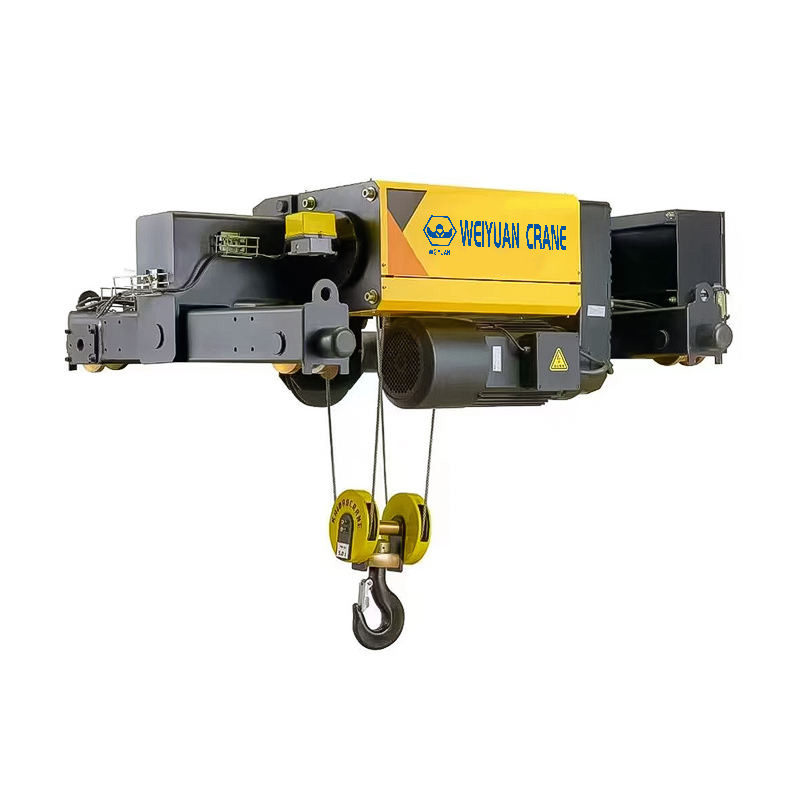
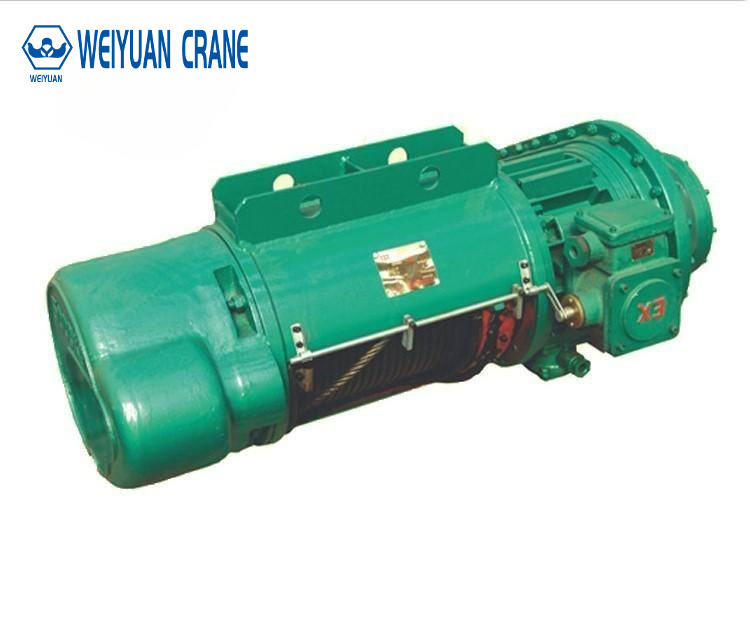
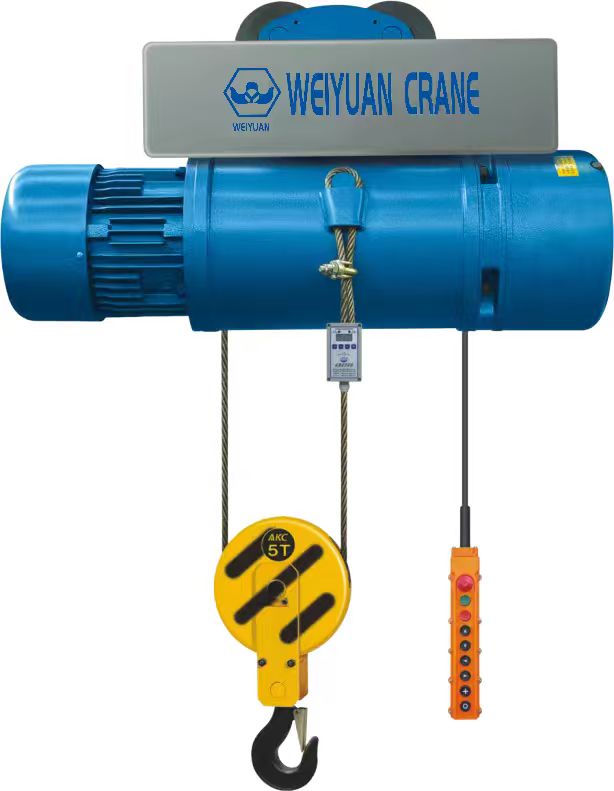
An electric wire rope hoist raises and lowers the hook by winding and unwinding a steel wire rope on a grooved cylindrical drum. The drum is driven by an electric motor through a gear reduction unit. The wire rope departs the drum, passes over a sheave in the hook block (single-part reeving) or through a multi-sheave system for heavier capacities, and suspends the hook assembly.
This drum-and-rope architecture has two defining mechanical consequences. First, the drum can store long rope lengths in multiple wraps — enabling lift heights of 6 meters to 100 meters or more, limited only by drum length and rope diameter. Second, steel wire rope is a flexible structural member that stores elastic energy under tension. When the load is set down and tension is released, the rope recoils slightly — the characteristic “bounce” that requires VFD control and careful operating technique in precision placement applications.
The drum-and-rope system is mechanically more complex than the chain hoist equivalent: more moving surfaces, more lubrication requirements, and a drum sealing system that must prevent rope lubricant from contaminating the working environment.
Electric Chain Hoist: Load Chain and Pocket Wheel System
An electric chain hoist raises and lowers the hook by driving a hardened steel pocket wheel (load wheel) that positively engages each link of a precision alloy steel load chain. The motor drives the pocket wheel through a gear reduction. As the chain runs over the pocket wheel, the lower portion drops into a chain container — a bag or box below the hoist body — while the upper portion lifts the hook.
The pocket wheel’s machined pockets grip each chain link mechanically, providing positive engagement with no slip. Load chain is a rigid structural member: it does not store elastic energy under tension, so chain hoists hold loads with essentially zero bounce — a handling advantage in precision applications and in the many workstation applications where the load must remain stable at height while the operator works.
The chain system is mechanically simpler than the drum-rope equivalent at light capacities, which is why electric chain hoists consistently have lower purchase prices up to approximately 3 to 5 tons.
Part 2: Capacity Range Comparison
Wire Rope Hoist: The Only Option Above 10 Tons
Electric wire rope hoists cover the full industrial capacity spectrum:
- Light capacity: 500 kg to 2,000 kg — overlap zone with chain hoists
- Standard industrial: 2,000 kg to 20,000 kg (2 to 20 tons)
- Heavy industrial: 20,000 kg to 100,000 kg (20 to 100 tons)
- Specialized custom: Above 100 tons for purpose-engineered units
Above 10 tons, wire rope hoists are virtually the only commercially available option. The physics of load chain imposes an inherent upper capacity limit: the chain link cross-section required to carry 10+ tons becomes so large and heavy that the chain container weight itself approaches the payload weight, and the pocket wheel required to drive it becomes impractically large. This physical scaling constraint — not any regulatory or preference factor — makes chain hoists uneconomical above approximately 10 tons in standard designs.
Electric Chain Hoist: Light to Medium Capacity
Electric chain hoists are practical and cost-effective within the following range:
- Light duty: 125 kg to 500 kg — the most cost-effective hoist option available
- Standard industrial: 500 kg to 5,000 kg — the core commercial market segment
- Heavy chain: 5,000 kg to 10,000 kg — available but progressively less competitive with rope
The 2-ton to 5-ton range is the specification crossover zone where both types are technically viable. In this range, the duty class, lift height, and speed requirements of the application — not capacity alone — determine the correct type.
Part 3: Lift Height Comparison
Wire Rope Hoist: No Practical Limit
Because the wire rope winds onto a drum, lift height is determined by drum length and rope diameter — not by any fundamental mechanical constraint. Standard wire rope hoists are commercially available with lift heights from 6 meters to 30 meters as catalog products, and extended-lift versions are available to 100 meters or beyond for mine shaft service, deep industrial pits, and tall warehouse or process tower applications.
For any application requiring more than 15 to 20 meters of lift height, the wire rope hoist is the only practical specification. No chain hoist product can match this capability at equivalent capacity.
Electric Chain Hoist: Constrained by Chain Container
The chain hoist’s lift height is fundamentally limited by the capacity of the chain container below the hoist body. Standard electric chain hoists provide 3 to 6 meters of standard lift height as catalog products. Extended-lift versions — with larger chain containers or external chain bags — can achieve 10 to 30 meters, but the chain container becomes bulky and the hoist substantially heavier at the upper end of this range, eliminating the compactness advantage that makes chain hoists attractive.
For standard workstation applications with lift heights below 6 meters, chain hoists provide fully adequate lift height at lower cost than rope equivalents. This is the application segment the chain hoist is designed to serve — and where it excels.
Part 4: Lift Speed Comparison
Wire Rope Hoist Speed Advantage at Higher Capacities
Lift speed is where the wire rope hoist’s performance advantage becomes most pronounced in production environments. At equivalent capacity, wire rope hoists consistently achieve higher standard lift speeds than chain equivalents:
1-ton comparison: Wire rope standard 8–16 m/min vs chain standard 4–8 m/min
5-ton comparison: Wire rope standard 4–8 m/min vs chain standard 2–4 m/min
10-ton: Wire rope standard 3–6 m/min vs chain (rarely practical at this capacity)
In production environments where hoist cycle time directly determines throughput, the wire rope hoist’s speed advantage at 5 tons and above delivers measurable productivity value that compounds across thousands of cycles per shift.
VFD Speed Control on Both Types
Both wire rope and chain hoists can be equipped with VFD (Variable Frequency Drive) control for variable speed operation. However, wire rope hoists with VFD are more commonly and effectively deployed in production automation because the rope hoist’s higher baseline speed provides a more useful overall speed range.
A VFD wire rope hoist traveling from 0.5 to 12 m/min provides meaningfully faster transit and meaningfully slower micro-positioning than a VFD chain hoist traveling from 0.3 to 4 m/min. For applications involving both rapid transit and precision placement — die changes, machine loading, automated positioning — this wider speed range is operationally significant.
Part 5: Consumable Replacement — Wire Rope vs Load Chain
Consumable replacement cost and frequency is one of the most practically important comparison dimensions for facilities maintenance teams and is consistently underweighted in the initial purchase decision.
Wire Rope Replacement
Steel wire rope wears through three primary mechanisms: fatigue cycling at drum-rope and sheave-rope contact points, abrasive wear on outer wires from contact with drum grooves, and corrosion in humid or chemically active environments.
Rejection criteria per ASME B30.16: Two or more broken wires in any 6-rope-diameter length; rope diameter reduction exceeding one-third of nominal; kinking, crushing, or heat damage.
In heavy industrial service (CMAA Class D, 5-ton wire rope hoist, production environment): typical replacement interval 12 to 24 months. Replacement cost: $300 to $1,500 depending on rope length, diameter, and construction grade. Replacement requires de-reeving the old rope and threading and anchoring the new rope — achievable by trained maintenance personnel in 2 to 4 hours.
Load Chain Replacement
Load chain wears primarily through accumulated plastic deformation at the link bearing surfaces where chain links contact the pocket wheel and each other, producing measurable chain elongation over service life.
Rejection criteria per ASME B30.16: Elongation exceeding 2% of original pitch length over an 11-link sample; wear at link bearing points exceeding 10% of original bar diameter; any cracked link.
In heavy industrial service at 5-ton capacity: typical replacement interval 24 to 48 months — somewhat longer than equivalent rope because chain elongation is gradual and measurable through periodic stretch gauging. Replacement cost: $200 to $800 for Grade 80 (T8) alloy chain; Grade 100 (T10) chain extends intervals approximately 25% at similar dimensions. Chain replacement is straightforward for trained maintenance personnel.
Relative assessment: At light to moderate duty, chain replacement is somewhat simpler and cheaper than rope replacement. At heavy duty (CMAA Class D and above), the wire rope hoist’s design optimization for continuous high-cycle service gives it a slight lifetime cost advantage due to its heavier structural specification and more robust gearbox design.
Part 6: Heavy Industrial Application Analysis
Steel Mills and Foundries — Wire Rope is the Undisputed Standard
Steel mill and foundry environments define heavy-duty electric hoist service: continuous production at or near rated capacity, extreme ambient temperatures (40°C to 80°C in many areas), abrasive metal dust, and the catastrophic safety consequences of a hoist failure during molten metal handling. Wire rope hoists are universally specified in these environments above 2 to 3 tons because:
CMAA Class E and F duty ratings — required for continuous production operations — are only available in wire rope designs at capacities above 5 tons. Chain hoist manufacturers do not offer Class E or F rated products above this capacity because the chain system’s mechanical architecture is not optimized for the cumulative fatigue loading these duty classes impose.
Additionally, the high ambient temperatures in steel and foundry environments accelerate chain lubricant degradation significantly. Wire rope hoists with oil-bath sealed gearboxes and drum bearings maintain lubrication integrity better in sustained high-temperature service than the chain and pocket wheel interface.
Mining and Tunneling — Rope for Deep Shafts, Chain for Maintenance
Underground mining and tunnel boring require lift heights of 20 to 500+ meters in shaft applications — only achievable with wire rope hoists. These shaft winder applications are addressed separately in the mining hoist guide.
Within the underground working environment, maintenance hoists serving equipment repair workshops, pump chambers, and crusher chambers at capacities of 1 to 10 tons are the primary wire rope hoist application. For lighter maintenance tasks and ergonomic support at capacities below 2 tons, explosion-proof chain hoists in MA or ATEX-certified configurations serve the application at lower cost.
Shipbuilding — Wire Rope for All Production Cranes
Shipbuilding hall cranes handle hull sections, engine components, and outfitting items from 5 to 500+ tons in a persistent salt-air environment. All production cranes are wire rope hoists, typically in double-girder bridge crane crab configurations with marine-grade corrosion protection. Individual workstation jib cranes at welding stations and outfitting positions at capacities below 1 to 2 tons may use marine-grade chain hoists at lower first cost.
Power Generation — Wire Rope for Maintenance Cranes
Power plant maintenance cranes handle turbines, generators, and transformers ranging from 5 to 600+ tons. Wire rope hoists in high-capacity double-girder crab configurations are universal. The CMAA Class A (standby) duty class of power plant maintenance cranes means duty cycle considerations are secondary — the critical specifications are capacity, hook height for the deepest pit or tallest component, and absolute reliability for the infrequent but safety-critical lifts performed during planned outages.
Part 7: Decision Framework — 7 Selection Criteria
- Capacity above 5 tons → Wire rope hoist. Capacity below 2 tons → Chain hoist optimal. Capacity 2 to 5 tons: apply the remaining criteria.
- Lift height above 10 to 15 meters → Wire rope required. Lift height below 6 meters → Chain hoist adequate.
- Duty class CMAA D, E, or F → Wire rope specified. Duty class A, B, or C → Chain hoist acceptable within capacity limits.
- Continuous production application with 20+ lifts per hour → Wire rope for all capacities above 2 tons.
- High lift speed required for production throughput → Wire rope (consistently higher baseline speed at equivalent capacity above 2 tons).
- Application in steel mill, foundry, mine (above 2 tons), shipbuilding, or power plant → Wire rope standard.
- Budget minimization for light-duty workstation, maintenance bay, or warehouse below 3 tons and CMAA Class C or lower → Chain hoist delivers best value.
Frequently Asked Questions
Q: Can a chain hoist be converted to a wire rope hoist later?
A: No. The two hoist types use fundamentally different motor mounting, gear configurations, frame dimensions, and mounting hardware. They are not interchangeable. Converting from chain to rope requires replacing the entire hoist unit — which is why specifying the correct type from the outset is essential.
Q: Which holds a suspended load better under power failure?
A: Both types use electromagnetic disc brakes that engage mechanically when power is removed. The brake springs hold the load without electrical power. Performance is essentially equivalent — the critical variable is that the brake is correctly sized for the application and properly maintained, not the hoist type itself.
Q: Is wire rope or load chain more susceptible to corrosion in marine environments?
A: Both require appropriate material specification for corrosive environments. Wire rope with galvanized outer wires or stainless steel construction provides effective marine corrosion resistance. Stainless steel load chain is available for chemical environments where carbon steel would corrode rapidly. Specifying the correct corrosion protection — not choosing one hoist type over another based on corrosion — is the correct approach.