


Gantry Crane Buying Guide 2026: Capacity, Span, Budget & 5 Questions to Ask Before You Order
Introduction
The gantry crane procurement process fails more often than buyers expect — and the failures almost never happen because the wrong crane was chosen from a technically adequate shortlist. They happen because the buyer did not have a clear enough specification before entering the market, because the supplier’s quote assumed conditions that did not match the actual site, or because the hidden costs of foundation, installation, and commissioning were not included in the budget comparison.
A gantry crane is not a commodity purchase. It is a custom or semi-custom industrial system whose fitness for purpose depends on a set of site-specific parameters — capacity, span, hook height, working frequency, environmental conditions — that no catalog specification can substitute for. A gantry crane specified for the wrong span cannot serve the facility it was built for. A crane specified at the wrong duty class will fail prematurely in production service regardless of how well it was manufactured. Getting the specification right before the procurement starts is the single most valuable investment of time in the entire buying process.
This guide provides the complete 2026 buying framework: the five questions that must be answered before any inquiry is sent, the key technical specifications and what they mean for total cost, realistic price ranges for major configuration categories, the five questions that expose inadequate suppliers before a purchase is committed, and the timeline planning that prevents the delivery delays that are among the most common and most expensive outcomes of gantry crane procurement.
Part 1: Five Questions to Answer Before You Inquire
These questions are not information for the supplier — they are clarity for the buyer. Answering them honestly and completely before any specification is written eliminates the majority of procurement mistakes.
Q1: What Is the Maximum Load, Including All Below-Hook Hardware?
The answer is not the heaviest product or workpiece you plan to lift. It is the total weight of everything suspended from the hook at maximum load: the product weight plus the weight of all slings, shackles, spreader beams, lifting fixtures, magnets, vacuum cups, and any other below-hook device used in the lift.
For a facility planning to lift 5-ton steel plates with a spreader beam and wire rope slings, the total suspended weight may be 5.4 to 5.8 tons. A crane specified at exactly 5 tons is technically overloaded on every lift. The correct specification is 6.3 tons or 8 tons — the next standard capacity above the actual maximum suspended weight with an appropriate margin.
Add 10 to 25% uncertainty margin to the calculated maximum if the actual weights are estimated rather than measured. And always consider whether the maximum load may increase in the next 5 to 10 years as the facility’s production requirements grow.
Q2: What Span and Runway Length Are Required?
The crane’s span determines the width of the working area covered; the runway length determines the longitudinal coverage. Both must be derived from the actual facility layout — not estimated.
Span: The minimum span equals the width of the area that needs to be covered, plus the approach distances at each side (the minimum distance from the runway rail centerline to the nearest obstruction — typically 200 to 400mm per side for most crane configurations). Add the two approach distances to the working area width and round up to the next standard span.
Runway length: The minimum runway length equals the length of the area requiring coverage, plus overrun at each end (500 to 1,500mm depending on bridge travel speed) for the bridge to stop clear of the work area boundary. If two cranes will share the runway, add minimum separation distance (typically 1,500 to 3,000mm between bridges).
Draw the crane layout to scale on a floor plan before finalizing span and runway dimensions. Surprises discovered on paper cost nothing; surprises discovered during installation cost significantly more.
Q3: What Hook Height Is Required?
The required hook height is the vertical distance from the floor to the hook at its highest position needed to perform the most demanding lift in the facility — typically a lift that must clear the highest obstacle in the load’s travel path.
Calculate it as: maximum lifted load height + maximum deposit position elevation + rigging height above load top + safety clearance above the load at its highest travel position.
The crane’s leg height must then provide this hook height, accounting for the hoist’s minimum headroom (the distance from the hook at maximum height to the bottom of the crane bridge). Every meter of leg height adds structural weight, foundation load, and crane cost. Specify the minimum leg height that delivers the required hook height — not the maximum available.
Q4: What Is the Required Working Frequency?
Working frequency determines the crane’s duty class — and duty class is the specification variable that most directly determines how long the crane will last and how much it will cost to maintain.
Estimate the number of complete lift cycles (one raise plus one lower) the crane will perform per hour during peak production, and the number of hours per day it will be in active use. Use these estimates to identify the applicable duty class:
FEM M3 / CMAA Class B: 2 to 5 lifts per hour, 1 to 2 hours per shift — light maintenance and occasional production use.
FEM M4-M5 / CMAA Class C: 5 to 15 lifts per hour, 2 to 4 hours per shift — standard production manufacturing.
FEM M5-M6 / CMAA Class D: 15 to 30 lifts per hour, 4 to 6 hours per shift — heavy continuous production.
FEM M7-M8 / CMAA Class E-F: Above 30 lifts per hour, near-continuous multi-shift — severe service steel mill and process industry applications.
Specifying a duty class lower than the actual application requires is the most common and most expensive specification error in gantry crane procurement. The purchase price saving from a lower duty class is trivial compared to the accelerated maintenance cost and premature replacement that results from operating an under-specified crane in heavy service.
Q5: What Are the Environmental and Special Requirements?
Standard industrial gantry cranes are designed for covered indoor environments with moderate humidity, no corrosive atmosphere, and no explosive gas or dust. Any deviation from this baseline requires specification adjustments:
Outdoor installation: ISO 12944 C3 to C5-M corrosion protection, IP65 electrical enclosures, seismic restraint provisions for storm wind, hot-dip galvanized fasteners.
Hazardous area: ATEX Zone 1 or NEC Class I Division 1 explosion-proof certification for all electrical components.
High-temperature environment (foundry, furnace area): Class H motor insulation, heat-shielded electrical enclosures, high-temperature lubricants.
Cleanroom or food processing: Stainless steel construction, NSF H1 food-grade lubricants, IP65+ enclosures, smooth-surface hygienic design.
Seismic zone: Structural analysis to the applicable seismic design code (ASCE 7 in the U.S.; GB 50011 in China; EN 1998 in Europe).
Part 2: Key Technical Specifications and What They Mean
Single Girder vs Double Girder
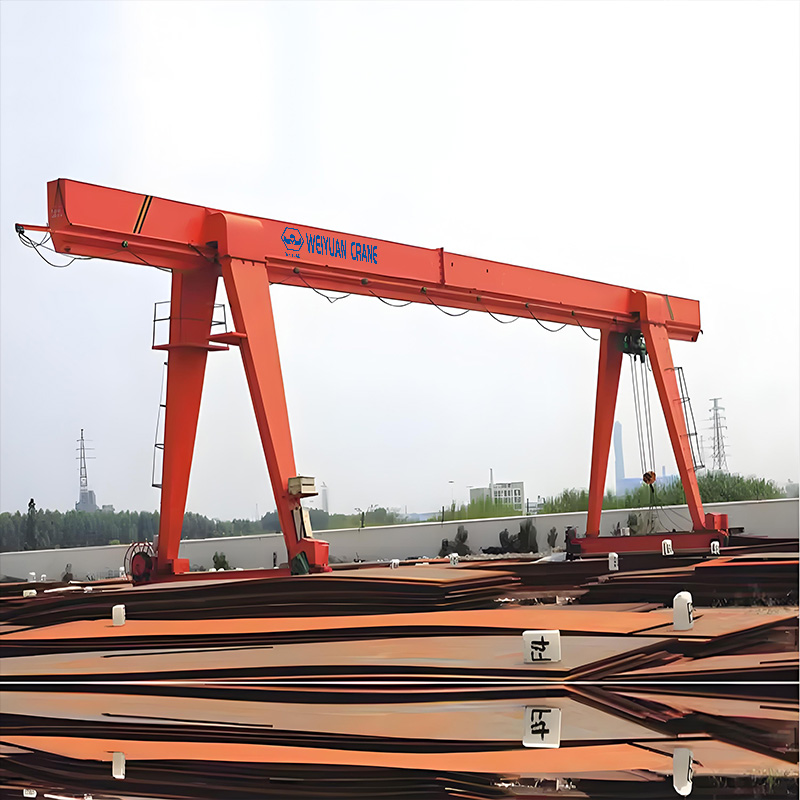
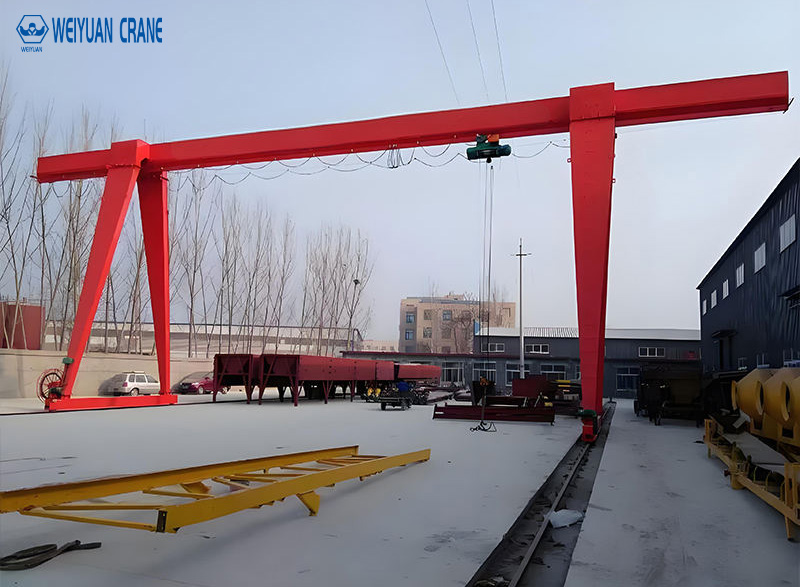
Single girder gantry cranes use one bridge beam and an underhung hoist. They are the correct choice for capacities up to 20 tons with moderate spans and standard hook height requirements. They cost 40 to 60% less than equivalent double girder configurations at the same capacity.
Double girder gantry cranes use two parallel bridge beams with a top-running crab. They are required for capacities above 20 tons, long spans, heavy duty cycles, and applications where maximum hook height is critical. The top-running crab provides 200 to 400mm more usable hook height than an equivalent single girder crane in the same building.
Rail-Mounted vs Rubber-Tired
Rail-mounted gantry cranes travel on precision steel rails embedded in or mounted on the floor. They provide precise travel alignment, fully electric power, and the highest structural stiffness — but require permanent civil infrastructure (rail foundations) that limits future repositioning.
Rubber-tired gantry cranes travel on rubber tires across a paved surface. They can be repositioned between areas without infrastructure changes — the defining flexibility advantage for facilities with variable workflow patterns or staged development plans.
Duty Class and Service Life
The relationship between duty class and expected service life is direct and proportional: a crane correctly specified at FEM M5 for its application will reach its design service life of 10 to 20 years; a crane under-specified at FEM M3 for the same application will exhaust its design fatigue life in 3 to 5 years, requiring structural refurbishment or replacement.
Certification Standards by Market
CE marking (EU Machinery Directive): Required for all cranes sold into the European Union. Requires conformity with EN 13001 (crane design) and EN 15011 (bridge and gantry cranes), third-party notified body review for safety components.
GB standards (China): GB/T 3811 (crane design) and related product standards. Required for cranes operating in China.
CMAA Specifications 70/74 (North America): The primary engineering standard of care for overhead and gantry cranes in U.S. and Canadian industrial applications. CMAA compliance is not legally mandatory but is the professional standard referenced by OSHA and in liability proceedings.
Part 3: Budget Planning — 2026 Price Reference
The following ranges represent FOB manufacturer pricing for standard industrial configurations. They do not include freight, foundation, installation, electrical supply, or commissioning.
Light Duty Gantry Cranes (1 to 5 tons)
Single girder, rail-mounted, FEM M3-M4, standard pendant control:
- 1 ton, 10-meter span: $8,000 to $18,000
- 3 ton, 12-meter span: $14,000 to $28,000
- 5 ton, 15-meter span: $20,000 to $42,000
Standard Industrial Gantry Cranes (10 to 32 tons)
Single or double girder, rail-mounted, FEM M4-M5, VFD control:
- 10 ton, 20-meter span: $45,000 to $90,000
- 20 ton, 25-meter span: $85,000 to $160,000
- 32 ton, 25-meter span: $130,000 to $240,000
Heavy Industrial Gantry Cranes (50 tons and above)
Double girder, rail-mounted, FEM M5-M6, VFD with anti-sway:
- 50 ton, 30-meter span: $200,000 to $380,000
- 100 ton, 35-meter span: $400,000 to $750,000+
Hidden Cost Checklist
Every gantry crane project has costs beyond the crane purchase price that are frequently omitted from initial budgets:
Rail foundation (concrete, reinforcement, rail, clips): $15,000 to $80,000 depending on rail length, span, and soil conditions.
Crane installation and erection: $8,000 to $50,000 depending on crane size and site access.
Electrical supply (branch circuit, conductor bar, festoon): $5,000 to $25,000.
Load testing and commissioning: $2,000 to $8,000.
Operator training: $1,000 to $3,000.
Total installed cost is typically 150 to 250% of the crane-only purchase price for most standard industrial gantry crane installations.
Part 4: Supplier Evaluation — Five Questions That Expose Inadequate Suppliers
Question 1: Can You Provide a Complete Foundation Load Data Package?
A reputable supplier provides, with every quote, the complete set of loads the crane imposes on its support structure: maximum wheel loads, rail lateral forces, end stop impact forces, and out-of-service wind loads (for outdoor cranes). This data is what a structural engineer needs to design the foundation.
A supplier who cannot provide foundation load data, or who says “the foundation is the customer’s responsibility” without providing load data, has not completed the engineering required for a safe installation. Do not accept a quote from any supplier who cannot provide foundation loads.
Question 2: What Is the Lead Time for Both Standard and Custom Components?
Standard catalog components (hoists, electrical panels, standard beam sections) typically have 4 to 8-week lead times. Custom-fabricated bridge girders, special-length runways, and non-standard hoist configurations add 8 to 16 weeks of fabrication time. Total project duration from order to site commissioning is typically 14 to 30 weeks for most industrial gantry crane projects.
Any supplier quoting less than 10 weeks for a custom gantry crane should be questioned carefully — either the scope is simpler than expected or the delivery promise is optimistic.
Question 3: What Does the Warranty Cover and What Is Excluded?
Standard manufacturer warranties for gantry cranes are 12 months from commissioning and cover manufacturing defects in materials and workmanship. They typically exclude: wear components (rope, chain, brake linings, trolley wheels), damage from overloading or misuse, and consumable electrical components subject to normal wear.
Confirm the warranty scope in writing before order placement, particularly for any components specified as “customer-supplied” or “third-party” — these are often excluded from the manufacturer’s warranty entirely.
Question 4: Can You Provide References for Similar Installations?
A supplier who has successfully delivered gantry cranes for applications similar to yours — similar capacity, span, duty class, and industry — can demonstrate the application understanding and project execution capability that reduces delivery risk. Request two to three references with contact information and follow up with the reference customers directly.
Question 5: What Certification and Test Documentation Is Provided?
As a minimum, expect: the crane’s design calculation report or reference to applicable standards compliance, the factory acceptance test records including the 125% load test results, the CE Declaration of Conformity (for EU supply) or equivalent, and the crane’s operation and maintenance manual.
For nuclear, offshore, or other safety-critical applications, the documentation requirements are substantially more extensive — as covered in the nuclear crane guide. Confirm the specific documentation package scope with the supplier before order placement.
Part 5: Procurement Timeline Planning
Understanding the typical project timeline prevents the delivery expectations that cause procurement decisions to be rushed — and rushed gantry crane procurement is a reliable path to specification errors and supplier selection mistakes.
Standard Configuration Gantry Crane (Catalog Design)
Week 1–2: Inquiry, preliminary specification, and quote receipt.
Week 3–4: Technical clarification, foundation load data review, structural engineering assessment of site.
Week 5–6: Commercial negotiation and purchase order placement.
Week 6–14: Manufacturing (standard components 4–6 weeks; custom fabrication 8–12 weeks).
Week 14–18: Shipping, site preparation, foundation completion.
Week 18–22: Crane erection, electrical connection, commissioning, load test.
Week 22–24: Operator training, documentation handover.
Total: 22 to 24 weeks from first inquiry to productive operation for a standard industrial gantry crane.
Custom or Heavy-Duty Gantry Crane
For cranes above 50 tons, with special certifications, or for projects requiring detailed engineering review before fabrication:
Add 4 to 8 weeks for engineering review, design freeze, and customer approval before fabrication begins. Total project duration: 30 to 52 weeks.
Three Critical Path Milestones
Foundation completion before crane arrival: The crane cannot be erected until the rail foundations are complete and the concrete has reached design strength (minimum 28 days cure). Foundation work must begin well before the crane ships — typically during the manufacturing period.
Electrical supply availability before commissioning: The crane’s power supply must be installed, terminated, and energized before commissioning can begin. Electrical contractors must be scheduled during the manufacturing period.
Operator qualification before first production use: CMAA and ASME B30.2 require that operators be trained and designated as qualified before operating the crane in production. Training must be scheduled as part of the commissioning event — not as an afterthought.
Frequently Asked Questions
Q: Should I buy a Chinese-manufactured or European/American-manufactured gantry crane?
A: The quality gap between established Chinese crane manufacturers producing to CE and FEM standards and equivalent European manufacturers has narrowed substantially for standard industrial applications. Chinese-manufactured cranes at equivalent specifications typically cost 25 to 45% less than European equivalents. The relevant evaluation criteria are not the country of manufacture but whether the specific manufacturer has a documented quality system, provides complete foundation load data and design calculations, has verifiable references for similar applications, and offers adequate local service support. Both categories include excellent and poor manufacturers — evaluate the specific supplier, not the origin.
Q: What happens if the gantry crane I order does not fit the installation site?
A: Dimensional mismatches between the ordered crane and the installation site — span too narrow, leg height insufficient, runway too short — are expensive to correct after manufacture. The crane must be either modified (at substantial cost and delay), replaced, or the site reconfigured. Prevention requires verified dimensional survey of the site before the order is placed, with the crane’s dimensional data confirmed against the survey before design freeze. Never finalize a gantry crane order based on estimated dimensions.
Q: Is it better to buy the crane and install it ourselves or use a turnkey supplier?
A: Self-installation by qualified maintenance personnel is viable for lighter gantry cranes (up to 10 to 15 tons) where the installation is straightforward and the team has relevant lifting equipment experience. For larger cranes, complex sites, or projects requiring structural engineering sign-off, turnkey supply (crane plus foundation engineering, installation, and commissioning from a single source) reduces coordination complexity and clearly assigns responsibility for the complete system’s performance. The premium for turnkey supply is typically 15 to 25% over crane-only supply.