


Electric Hoist on a Monorail System: How to Design, Size & Integrate a Complete Overhead Transport Solution
Introduction
The choice between a monorail hoist system and an overhead bridge crane is one of the most consequential material handling decisions in facility design — and it is frequently made by default rather than by analysis. Bridge cranes are specified because they are familiar; monorail systems are overlooked because they require more upfront layout thinking. The result, in many production facilities, is a bridge crane installed where a monorail system would have delivered better throughput, lower cost, and more precise integration with the production flow.
A monorail electric hoist system — a single overhead rail carrying a traveling hoist that moves along the rail’s path — is the correct solution for any application where material must travel a defined path from Point A to Point B (or from A through B, C, and D) rather than needing access to any point within a rectangular area. Assembly lines, process production sequences, foundry ladle transfer routes, food processing conveyance, and surgical device manufacturing cells are all applications where the defined path of a monorail system delivers better throughput per capital dollar than the rectangular coverage of a bridge crane.
This guide provides the complete engineering framework for specifying and integrating an electric hoist on a monorail system: the four track layout configurations and when each is appropriate, the calculation methodology for matching hoist and rail specifications, the electrical integration options from simple pendants to full automation, the five application sectors where monorail systems most consistently outperform bridge cranes, and the installation and commissioning requirements that ensure reliable long-term operation.
Part 1: Four Track Layout Configurations
Configuration 1: Straight Linear Track
The simplest monorail configuration — a single straight I-beam or enclosed track running from a pickup station to a deposit station. The electric hoist travels back and forth along this straight path.
Best for: Dedicated point-to-point transfer where the same material always moves between the same two positions. Loading a CNC machine from a material staging area, transferring weldments between a welding station and a grinding station, or moving finished goods from a production cell to an outbound inspection area.
Design considerations: The track must be long enough to position the hoist hook directly above both the pickup and deposit positions — verify that the hoist trolley’s travel range covers both positions with adequate end-stop clearance (minimum 500mm per end). Single-direction travel means the hoist must always return empty after each transfer — account for return travel time in the cycle time calculation.
Configuration 2: Closed Loop Track
A complete circuit track — oval, rectangular, or custom-shaped — that allows a hoist to travel continuously around the loop visiting multiple stations in sequence without reversing direction.
Best for: Assembly line material feeding where components must be delivered to multiple sequential workstations in a defined order. A closed loop hoist system above an assembly line can pick parts from a central staging area, deliver them sequentially to Stations 1 through 6, and return to the staging area in a single continuous circuit.
Design considerations: Closed loop tracks require curve sections at each corner. The minimum curve radius is determined by the hoist trolley’s wheel spacing — a trolley with 200mm wheel-to-wheel spacing requires a minimum curve radius of approximately 500 to 800mm depending on the specific trolley design. Always confirm minimum curve radius from the hoist manufacturer’s dimensional data before designing a loop layout.
Configuration 3: Curved Track with Direction Changes
A non-loop track that incorporates one or more curved sections to change the direction of travel — allowing the monorail to navigate around building columns, follow the contour of a production line, or connect two areas that are not in a straight line.
Best for: Facilities where the production flow path is not straight — L-shaped production areas, U-shaped cells, or layouts where obstacles require the monorail path to deviate from a straight line. A curved monorail track can thread through an existing facility between machine tools, around columns, and through doorways in a way that a bridge crane cannot replicate.
Design considerations: Each curve section creates a minimum turning radius constraint and imposes lateral forces on the hoist trolley as it navigates the curve. These lateral forces create wear on the trolley wheel flanges and the rail side surfaces — specify hardened wheel flanges and verify rail section adequacy for the combined vertical and lateral loads in the curve zone.
Configuration 4: Branched Track with Switch Points
Multiple track lines connected by switch points (also called turnouts or transfers) that allow the hoist trolley to be diverted from the main track to any of several branch tracks. A single hoist can serve multiple destinations by switching between branches as the production schedule requires.
Best for: Production environments where a single hoist must serve multiple machines or workstations at different positions, but full rectangular bridge crane coverage is not needed. A machine shop where one hoist must load four different CNC machines along two parallel branches can be served by a branched monorail system at significantly lower cost than a bridge crane spanning all four machines.
Design considerations: Switch points require the trolley to slow to very low speed before entering the switch — high-speed trolley travel through a switch creates lateral impact loads on the switch mechanism and wheel flanges. VFD-controlled electric travel drives with automatic speed reduction zones before each switch are essential for reliable long-term switch operation. Manual switches (operator-repositioned by hand) are appropriate for low-frequency applications; motorized switches (remotely controlled) are required for automated or high-frequency systems.
Part 2: Hoist and Rail Matching Calculations
Track Section Selection
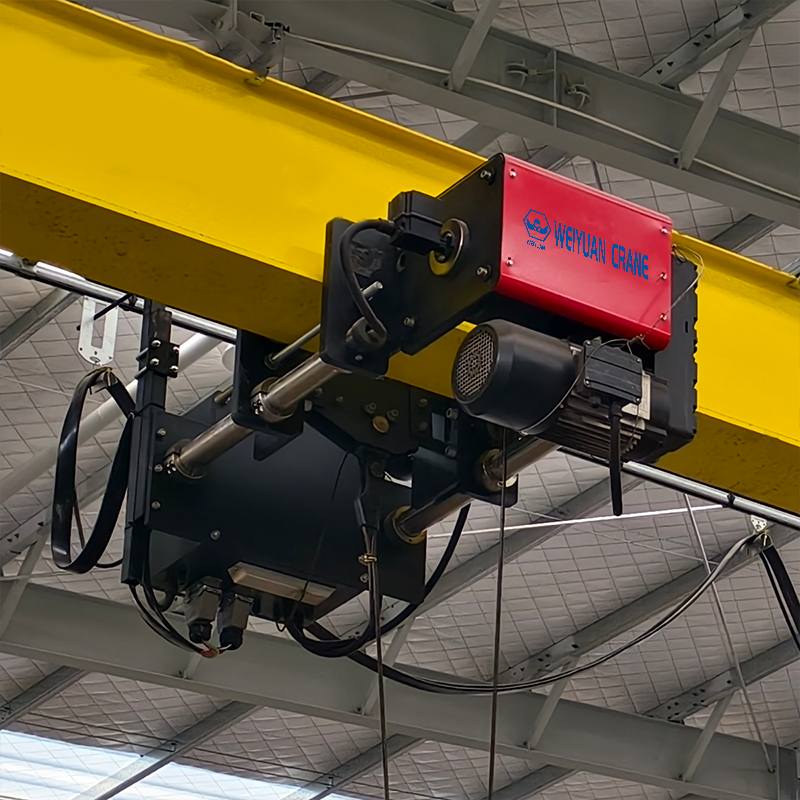
Electric hoists designed for monorail service specify a compatible beam section range — typically defined as a range of bottom flange widths that the trolley wheels can straddle and a range of flange thickness that the wheel flanges can engage. The track section must fall within the hoist’s compatible range.
For standard industrial I-beam monorail tracks, beam section selection is driven by the maximum wheel load the beam must carry at the critical span between support points. The beam must limit deflection to L/500 of the span length under the maximum wheel load — a more stringent limit than typical structural beams because excessive deflection causes trolley resistance and, in severe cases, wheel derailment.
Worked example: A 2-ton electric chain hoist with its own body weight of 80 kg on a 6-meter span between ceiling suspension points. Total maximum load on the beam = (2,000 + 80 + rigging hardware 50) × 1.15 impact factor = 2,392 kg. With a 6-meter span and L/500 = 12mm maximum deflection, a standard W10×39 (metric HEB 120 equivalent) beam section is typically adequate — always verify with the beam’s moment of inertia calculation or with structural analysis software.
Minimum Curve Radius Determination
For tracked hoists in curved sections, the geometric relationship between trolley wheel spacing and minimum curve radius must be verified to prevent wheel binding in the curve.
The minimum curve radius is approximately: R_min = (L² / (2 × maximum permissible lateral clearance)) + d/2
Where L is the trolley wheelbase (distance between wheel contact points) and d is the flange width of the track.
In practice, consult the hoist manufacturer’s published minimum curve radius for the specific trolley model — theoretical calculations provide a check but the manufacturer’s tested value governs the design.
Hoist Speed and Production Cycle Time
The electric hoist’s travel speed (both hoisting speed and trolley travel speed) must be adequate to complete each transfer cycle within the available time budget defined by the production rate.
Cycle time calculation:
- Lower hook to load height: (Hook height) ÷ hoist lifting speed
- Attach load (manual) or engage automatically: fixed time
- Raise load to travel clearance height: (travel clearance − load height) ÷ hoist lifting speed
- Travel along track to destination: (track distance) ÷ trolley travel speed
- Lower load to deposit position: (travel height − deposit height) ÷ hoist lower speed
- Detach and return empty: similar calculation in reverse
If the calculated cycle time exceeds the available production time, the system requires a faster hoist, an additional hoist on the same track, or a split-track configuration with dedicated hoists for different zones.
Part 3: Electrical System Integration
Power Delivery: Conductor Bar vs Festoon Cable
Conductor bar (busbar) systems: A multi-pole conductor rail runs alongside the monorail track. Current collectors on the hoist trolley make sliding contact with the conductor bars, providing continuous power regardless of trolley position. Conductor bars are the standard choice for long runways, high-cycle applications, and any layout involving curves or loops where cable management becomes impractical.
Festoon cable systems: The power cable is suspended from a series of cable trolleys that travel with the hoist along a parallel track. As the hoist trolley moves, the cable bunches and extends along the festoon track. Festoon systems are simpler and lower-cost than conductor bars for straight, short-distance applications but become difficult to manage with curves, long travel distances, or high cycle rates.
Selection guideline: Use conductor bars for track lengths above 15 meters, any curved or loop track, and any application where cycle rate exceeds 10 per hour. Use festoon systems for straight tracks below 15 meters with lower cycle rates.
Curve Section Conductor Bar Design
Standard conductor bar systems designed for straight track require special transition sections at curve entries and exits to maintain continuous collector-to-bar contact through the curve. These transitions must be engineered for the specific curve radius and trolley speed — collector contact loss during curve negotiation causes motor control interruptions that, at high speed, can trip the hoist’s drive protection.
Consult the conductor bar manufacturer’s curve section catalog before finalizing any curved monorail layout — not all conductor bar systems support curved sections, and those that do have minimum radius requirements that must be respected.
Control Options: Pendant to Full Automation
Wired pendant: The operator walks alongside the load, controlling hoist and travel motions via a push-button pendant hanging from the hoist body. Simplest and lowest-cost control option. Appropriate for low-frequency, operator-paced applications.
Wireless radio remote: The operator controls from any position within the radio range — not tethered to a cable. Allows the operator to stand in the optimal position relative to the load during pickup and placement rather than beside the hoist.
PLC-automated travel with operator hoist control: The hoist travels automatically to programmed positions (Station 1, Station 2, etc.) when the operator selects a destination, but the operator controls hoisting speed and height manually. This hybrid approach eliminates most of the operator’s travel-direction decisions while retaining manual control over the precision placement phase.
Full PLC automation with work order integration: The hoist receives travel commands directly from the facility’s production management system (MES/WMS) and executes complete transfer cycles — travel, lower, engage, raise, travel, lower, release, return — without operator input. The operator’s role is exception handling and oversight. This level of automation is economically justified when cycle rates exceed 20 to 30 transfers per hour and the transfer path and load geometry are sufficiently standardized for consistent automated engagement.
Part 4: Five Application Scenarios Where Monorail Systems Excel
Scenario 1: Automotive Assembly Line Engine and Transmission Installation
Vehicle assembly lines require engines and transmissions to be married to the vehicle chassis at a specific station. A monorail track running above the assembly line — parallel to the line’s direction of travel — carries electric hoists that move engines from a staging area to the marriage station, lower them into position, and return for the next engine while the assembly line continues moving. The defined path and repetitive cycle make this application ideal for monorail systems, and the automation potential allows a single operator to supervise multiple transfer cycles simultaneously.
Scenario 2: Foundry Ladle Transfer
In a foundry, molten metal must be transferred from a furnace to pouring stations along a defined path. An overhead monorail carrying a ladle hoist allows precise, controlled transfer of the ladle between specific furnace and pouring positions. The defined, repeated path of ladle transfer — always from the same furnace to the same set of pouring stations — matches the monorail’s strength perfectly. Bridge crane alternatives exist but introduce the risk of unintended lateral movement that creates spillage hazard.
Scenario 3: Food Processing Carcass Line
In meat processing facilities, animal carcasses are moved along overhead rail systems through different processing stages — evisceration, splitting, grading, chilling. This is the original monorail material handling application, and stainless steel food-grade monorail hoist systems continue to serve this function in modern processing facilities. The defined sequential processing path, the need for continuous material flow without floor-level handling, and the demanding washdown environment all make food processing one of the most specification-demanding but also most productivity-rewarding monorail hoist applications.
Scenario 4: Semiconductor Wafer Fab AMHS (Automated Material Handling)
Semiconductor wafer fabrication facilities use automated material handling systems (AMHS) — essentially sophisticated monorail systems — to transport wafer carriers (FOUPs) between processing equipment without human handling. The ultra-cleanroom environment requirement (ISO Class 1 to 3), the extreme precision requirements for load placement at equipment ports, and the fully automated operation make semiconductor AMHS the most technically demanding monorail electric hoist application. Purpose-designed AMHS systems are specialized products — but they demonstrate the upper performance boundary of what overhead monorail transport can achieve.
Scenario 5: Multi-Machine CNC Workshop Material Flow
A precision machining workshop with 6 to 12 CNC machines can benefit from a branched monorail system that carries workpieces from a central raw material storage area to individual machine loading positions and back to an inspection area after processing. The monorail system eliminates forklift traffic between machine tools, reduces material handling labor, and enables one-piece flow processing where individual workpieces move through the machine sequence without accumulating in inter-machine queues.
Part 5: Installation and Commissioning Requirements
Track Levelness Tolerance
Monorail tracks must be installed level to within ±2mm per 5 meters of track length. Tracks that deviate beyond this tolerance cause the unloaded hoist trolley to drift toward the low end of the track under its own weight — a safety hazard when the operator releases the trolley. More seriously, a consistently out-of-level track creates asymmetric loading on the trolley wheels and bearings that accelerates wear beyond design rates.
Verify track levelness with a precision laser level during installation, and re-check after the first month of operation — support settlement during initial loading can shift track elevation by several millimeters.
Switch and Curve Joint Alignment
At switch points and curved section joints, the transition between track sections must be smooth — the running surface of adjacent sections must be coplanar to within ±0.5mm at the joint. Any step at a track joint creates an impact force as the trolley wheel transitions between sections. At standard travel speeds (20 to 60 m/min), even a 1mm step creates a significant impact that accelerates wheel and joint wear and, at high speeds, can cause trolley bounce.
Check joint alignment at every support point during installation using a straight edge across the joint. Adjust support hanger heights until all joints meet the ±0.5mm coplanarity requirement.
Trolley Curve Passage Testing
Before the system is placed in production service, verify that each hoist trolley can navigate every curve in the track layout without binding, wheel climbing, or excessive resistance. The test procedure:
- Travel the empty (no load) hoist through each curve at 25% of rated travel speed. Verify smooth passage without unusual noise or resistance.
- Repeat at 50% of rated travel speed.
- Repeat at 100% of rated travel speed.
- Travel with 50% of rated load through each curve at 50% of rated travel speed.
- Verify no unusual noise, vibration, or resistance at any speed or load combination.
Any resistance or noise during curve passage that was not present in straight-track operation indicates a geometric mismatch between the trolley and the curve radius that must be corrected before production use.
ASME B30.11 Compliance
ASME B30.11 (Monorails and Underhung Cranes) governs the design, installation, inspection, and operation of monorail crane systems in North American facilities. Key requirements applicable to electric hoist monorail installations:
Pre-service load test at 125% of rated capacity before the system is placed in productive use. All motions (hoist and travel) tested at rated load. All safety devices (limit switches, overload protection, travel end stops) verified functional under load.
Qualified operator designation and training — operators must be trained on the specific system’s controls, capacity, and safe operating practices before operating the system in production.
Annual periodic inspection by a qualified inspector, with documentation of findings and corrective actions.
Frequently Asked Questions
Q: Can any electric hoist be used on a monorail, or do I need a specific monorail hoist?
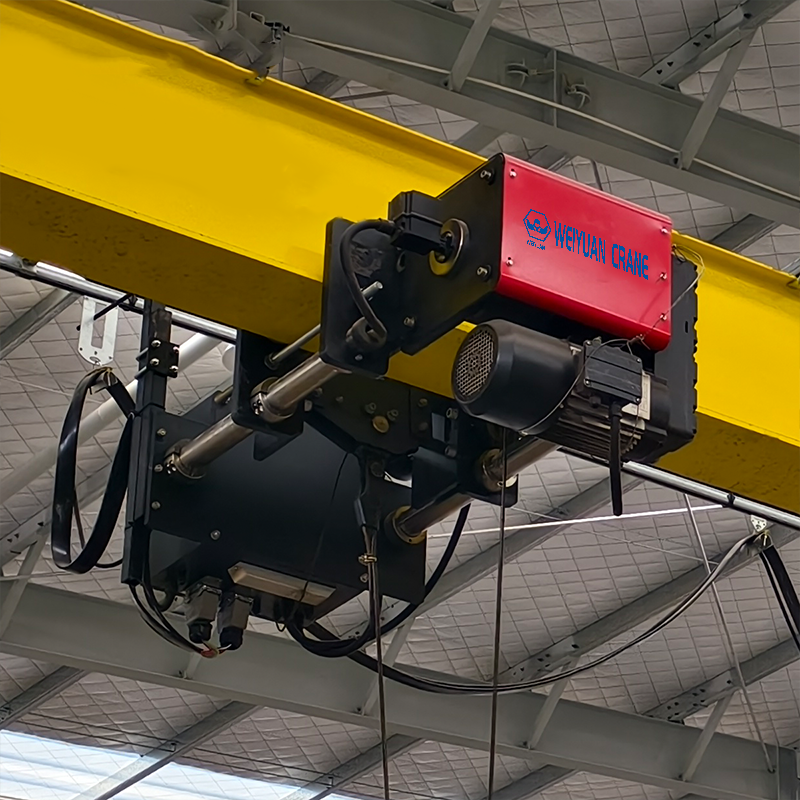
A: Standard electric chain and wire rope hoists are available in both hook-mount (fixed suspension) and trolley-mount configurations. For monorail service, you need a trolley-mounted hoist where the trolley wheels are matched to the specific beam section used in your monorail track. Verify the trolley’s compatible beam flange width range against the actual beam section before ordering — an incompatible trolley will either not fit on the beam or will have insufficient wheel-to-flange engagement for safe operation.
Q: What is the maximum speed for electric hoist trolley travel on a monorail?
A: Standard push-pull manual trolleys: operator-paced, typically 0 to 20 m/min comfortable walking speed. Motorized chain-driven trolleys: typically 10 to 30 m/min. Electric variable-speed trolley drives: typically 5 to 60 m/min depending on the drive rating and track design. For curved sections and switch approaches, maximum speed is limited by the curve radius and switch design — reduce to 10 to 15 m/min minimum for curve and switch passage regardless of the rated maximum straight-track speed.
Q: What is the maximum capacity available for monorail electric hoist systems?
A: Standard monorail systems using I-beam or wide-flange beam track are typically practical up to 5 to 10 tons — above this capacity, the beam size required for adequate stiffness becomes very large and heavy. For heavier capacities, patented enclosed track systems (which distribute loads through the track profile more efficiently) are available up to 40 to 60 tons. Above these capacities, overhead bridge cranes are typically the more cost-effective solution.