


Gantry Crane for Aerospace & Defense Manufacturing: Clean Assembly Environments, Precision Load Control & DCMA Requirements
Introduction
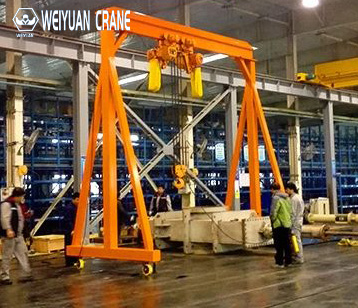
The gantry cranes that serve aerospace and defense manufacturing are among the most precisely specified and most heavily documented lifting systems in the industrial world — second only to nuclear power plant cranes in the depth of their quality assurance requirements. An aircraft fuselage section being positioned onto its assembly fixture, a satellite being transferred to its launch fairing, or a submarine section being mated to its pressure hull all represent lifting operations where a contamination event, a positioning error, or a load control failure can damage components costing tens to hundreds of millions of dollars and, in some cases, compromise the safety of systems that human lives depend on.
Standard industrial gantry cranes — even well-specified, high-quality units — are inadequate for these applications not because of capacity or structural shortcomings, but because they lack the contamination control, precision positioning, quality documentation, and compliance framework that aerospace and defense manufacturing programs require. Aerospace-grade gantry cranes are purpose-specified systems where every material choice, every control function, and every documentation requirement reflects a specific identified risk in the manufacturing or assembly operation they serve.
This guide provides the complete specification framework for gantry cranes in aerospace and defense manufacturing: the unique load characteristics of aerospace components, the contamination control specifications that protect precision hardware, the DCMA and AS9100D quality requirements, the precision positioning technologies that enable sub-millimeter load placement, and the procurement and qualification process appropriate for defense-contracted facilities.
Part 1: Aerospace Manufacturing’s Unique Lifting Requirements
Component Weight and Dimensional Characteristics
Aerospace lifting requirements span an extraordinary range — from 50 kg avionics boxes that must be handled without impact or vibration to 150-ton aircraft fuselage sections that must be positioned with millimeter precision onto assembly fixtures. The dimensional characteristics are equally varied: a 30-meter wing box section presents handling challenges very different from a compact engine nacelle at the same weight.
Typical weight ranges by component category:
- Aircraft engine (turbofan, medium thrust class): 2 to 8 tons
- Aircraft fuselage section (single aisle, one frame bay): 3 to 12 tons
- Wide-body fuselage barrel: 15 to 40 tons
- Aircraft wing box (complete wing structure): 8 to 25 tons
- Launch vehicle propellant tank section: 1 to 15 tons
- Satellite bus (fully integrated): 500 kg to 8 tons
- Military vehicle hull section: 5 to 30 tons
These weights fall well within standard gantry crane capacity ranges — the technical challenges in aerospace lifting are not primarily about capacity but about precision, surface protection, contamination control, and documentation.
Surface Sensitivity of Aerospace Components
Aerospace composite and metallic structures have surface finish and damage tolerance requirements that standard industrial material handling equipment cannot meet without specific adaptation:
Carbon fiber reinforced polymer (CFRP) structures: The resin matrix on the surface of CFRP panels and structures is susceptible to indentation damage from concentrated contact forces — a sling choker that creates a point load on a CFRP panel can create a barely visible but structurally significant delamination beneath the surface contact point. All below-hook hardware for CFRP components must distribute contact forces over the full contact area using custom-fitted foam-padded interface material.
Machined aluminum precision surfaces: Finished machined surfaces on aircraft structures have dimensional tolerances of ±0.05 to ±0.25mm that must be protected from any contact that could create a ding, scratch, or dimensional distortion. Gantry crane lifting fixtures must be designed to engage only designated lifting surfaces or purpose-installed lifting provisions.
Optical and electronic systems: Satellites and precision guidance systems contain optical benches, sensor arrays, and electronic assemblies that cannot tolerate vibration above specified levels during handling. The gantry crane hoist must provide shock-free starts and stops — VFD control with programmable acceleration profiles is mandatory.
Positional Accuracy Requirements
Assembly mating operations in aerospace manufacturing require positional accuracy that standard crane positioning techniques cannot achieve reliably:
Aircraft fuselage section joining: Joining adjacent fuselage sections requires alignment of the structural frame stations to within ±1.5mm in all three axes simultaneously. The crane must deliver the section to within this tolerance and hold it stationary while the alignment is verified and the joining operations begin.
Engine installation: Positioning an aircraft engine onto its pylon mount requires simultaneous alignment of four to six mounting hard points with the pylon interface structure — tolerances of ±2 to ±5mm in the vertical direction and ±3 to ±8mm laterally.
Satellite integration: Mating a satellite bus to its payload fairing requires positional accuracy of ±5mm in all axes, with the crane supporting the full satellite weight while the mating operation is completed.
These requirements cannot be reliably met with standard jog-and-position crane control — they require laser-assisted positioning systems, precision low-speed VFD hoist control, and in many cases, computer-controlled coordinate positioning systems integrated with the crane’s drive system.
Part 2: Defense Manufacturing Compliance Requirements
DCMA Quality Assurance
The Defense Contract Management Agency (DCMA) is the U.S. federal agency responsible for ensuring that defense contractors fulfill the terms of their defense contracts — including quality assurance requirements for manufacturing equipment and processes. For lifting equipment used in the fabrication of defense articles, DCMA quality assurance requirements impose obligations that go substantially beyond normal industrial crane procurement.
Key DCMA-relevant requirements for lifting equipment:
Lifting device design qualification: Any special lifting device (custom below-hook tooling, lifting fixtures, spreader beams) must be designed, fabricated, and tested in accordance with a documented engineering design process. The design must be reviewed and approved before the device is placed in service.
Inspection and certification program: DCMA requires that lifting equipment used on Government contracts be included in a documented periodic inspection and certification program. The inspection intervals, inspection criteria, and certification documentation must be consistent with applicable standards (ASME B30.2 as minimum; contract-specific requirements may be more demanding).
Calibration of load testing equipment: Load cells and dynamometers used to verify rated capacity during load testing must be calibrated to national standards and within their calibration validity period at the time of use.
Operator qualification records: All crane operators who operate lifting equipment on Government-contracted work must have documented qualification records demonstrating their training and competency for the specific equipment.
AS9100D Aerospace Quality Management System
AS9100D is the aerospace industry’s quality management system standard — it extends ISO 9001 with aerospace-specific requirements for the management of airworthiness risk, configuration control, and special processes. Facilities holding AS9100D registration must manage their lifting equipment as “infrastructure” within the quality system.
Relevant AS9100D requirements for gantry cranes:
Equipment control: Gantry cranes must be included in the facility’s equipment register, with maintenance records, calibration records (for load-measuring devices), and inspection certifications maintained and accessible.
Special process qualification: If the crane is used in lifting operations designated as special processes (operations whose results cannot be fully verified by subsequent inspection — for example, certain composite component handling operations where hidden damage could result from improper handling), the lifting process must be validated.
Configuration control: Any modification to a crane used in AS9100D scope work must be documented and assessed for impact on the crane’s qualification status before the modification is implemented.
MIL-SPEC Applications
Military specifications (MIL-SPEC) may be imposed on lifting equipment specifications for specific defense programs through the contract’s Statement of Work (SOW) or applicable Data Item Descriptions (DIDs). The most commonly applicable MIL-SPECs for crane equipment include:
MIL-HDBK-1038 (Weight Handling Equipment): Provides design, inspection, and testing criteria for weight handling equipment on military installations.
NAVFAC (Naval Facilities Engineering Command) standards: For Navy facilities and shipyard crane applications, NAVFAC P-307 (Management of Weight Handling Equipment) establishes the inspection, certification, and operator training requirements for weight handling equipment on Navy installations.
Part 3: Contamination Control Specifications
Anti-Static (ESD) Surface Treatment
Electronic assemblies, avionics components, and certain composite structures are sensitive to electrostatic discharge (ESD) that can damage electronic components or, in some cases, ignite energetic materials. Gantry cranes operating in areas where ESD-sensitive components are handled require:
Anti-static bridge and trolley structure: Conductive paint or coating on all crane structural surfaces, with surface resistivity below 10⁹ ohms, provides a path for electrostatic charge to drain from the crane surface rather than accumulating to damaging discharge levels.
Continuous electrical grounding: All metallic crane components must be continuously bonded to facility ground — the grounding system must be verified complete with no breaks in the bonding chain from the lifted load through the hoist, bridge, runway, and building to earth ground.
ESD footwear and garment requirements for operators: In the most sensitive areas, operators who work near ESD-sensitive components must wear ESD-protective footwear and garments — the crane grounding provides protection for the crane structure but operators must also be grounded.
Low-Particle Coating Systems
Standard industrial epoxy paint systems chip, flake, and shed particles during the vibration of crane operation — particularly at moving parts, contact surfaces, and areas subject to mechanical impact. In aerospace assembly environments, these paint particles are potential FOD (Foreign Object Debris/Damage) — objects that can become lodged in aircraft structures, engine inlets, or control surfaces with potentially fatal consequences during aircraft operation.
Low-particle coating systems for aerospace-grade cranes use:
- Two-component polyurethane topcoats with high adhesion and abrasion resistance that minimize particle shedding under vibration
- Powder-coat finishes on hoist bodies and structural components where the fused-in-place coating is more durable than liquid-applied systems
- Stainless steel or anodized aluminum components where painting is impractical and corrosion would otherwise generate metallic particles
- Rigorous surface preparation (commercial blast minimum Sa 2.0) before any coating application to maximize adhesion life
IP54 Minimum Enclosure Protection
All electrical enclosures on aerospace-grade gantry cranes are specified at IP54 minimum — protection against dust ingress that could create metallic particulate contamination and against splashing water from the cleaning operations that aerospace facilities conduct regularly. In more sensitive assembly areas (satellite integration, composite layup areas), IP65 is the minimum specification.
Part 4: Precision Load Control Technologies
VFD Micro-Speed Control
Variable frequency drives programmed for aerospace assembly operations provide a three-zone speed profile:
Transit speed: Full rated speed for moving the empty hook and for traveling the loaded crane from the pick-up position to the assembly area — typically 8 to 16 m/min for the hoist, 20 to 40 m/min for bridge and trolley travel.
Approach speed: Approximately 10 to 15% of transit speed for the approach to the target assembly position — typically 1 to 2 m/min hoist speed, 3 to 6 m/min travel speed.
Micro-positioning speed: 0.5 to 2% of transit speed for the final positioning phase — typically 0.05 to 0.3 m/min hoist speed and equivalent for travel. At this speed, the operator has precise control over load position with millimeter-per-second movement resolution.
This three-zone speed control, programmed in the VFD drive parameters, is achievable with standard industrial VFD technology but requires the programming and commissioning expertise specific to aerospace precision positioning applications.
Anti-Sway Systems for Large Aerospace Structures
Large aircraft structures — wing boxes, fuselage barrels, tail sections — have high moment of inertia and pendulum characteristics that create sustained load swing after any travel or hoist motion. In a confined assembly fixture environment, even small load swing creates risk of contact between the swinging component and adjacent tooling, support structures, or completed assemblies.
Active anti-sway systems that apply calculated counter-motions to the bridge and trolley travel drives — canceling the load’s pendulum oscillation before it develops — are standard equipment on gantry cranes used for large aerospace component assembly. The anti-sway system reduces load settling time from 15 to 30 seconds (waiting for natural swing to damp) to 2 to 4 seconds, improving production throughput and eliminating the operator fatigue of manually managing load swing during precision placement.
Multi-Point Synchronized Lifting
Large aerospace structures that cannot be supported at a single lift point — wing boxes, long fuselage sections, complete aircraft assemblies — require simultaneous lifting from multiple points (typically 4 to 8 lift points) at precisely equal loads and synchronized lift rates. Any imbalance in the multi-point lift creates structural loads in the component that its design does not account for — potentially distorting the structure or damaging its alignment.
Synchronized multi-point lifting systems use load cells at each lift point with real-time load monitoring and automatic speed adjustment of each individual hoist to maintain load distribution within the programmed tolerance (typically ±3 to ±5% of equal distribution). Any point that exceeds the tolerance triggers an automatic controlled stop and operator alert.
Part 5: Typical Aerospace and Defense Crane Applications
Commercial Aircraft Final Assembly Lines
Boeing 737 MAX, 787 Dreamliner, Airbus A320, A350, and similar commercial aircraft are assembled in large assembly halls where gantry crane systems — typically heavy-duty double-girder gantry cranes with spans of 30 to 80 meters — handle fuselage sections, wings, and major subassemblies throughout the assembly sequence. These cranes are among the largest and most precisely specified gantry cranes in the industrial world, combining payload capacities of 20 to 100 tons with positioning systems accurate to ±5mm and full VFD variable speed control.
Engine Test Facility Cranes
Aircraft engine test cells require cranes to install and remove engines weighing 2 to 15 tons from test fixtures. These cranes operate in environments with extreme vibration during test runs and elevated temperatures near the engine exhaust. Vibration-resistant electrical connections, high-temperature lubricants, and reinforced structural joints at vibration-prone locations distinguish engine test facility cranes from standard assembly hall equipment.
Satellite and Spacecraft Integration Facilities
Cleanroom facilities for satellite integration — ISO Class 7 and cleaner environments where satellites are assembled, tested, and prepared for launch — use overhead and gantry cranes with stainless steel or anodized aluminum construction, PFPE lubricants, cleanroom-grade below-hook tooling, and particle generation performance validated by laser particle counter testing. Capacities range from 500 kg for small satellite busses to 15 tons for large geostationary platforms.
Naval Shipyard Module Lifting
Submarine and surface ship construction uses modular construction methods where large hull sections (modules) weighing 50 to 500 tons are fabricated separately and then lifted into position for joining. Shipyard gantry cranes for naval construction are typically Goliath (full portal) cranes with spans of 30 to 80 meters and the synchronized tandem lifting control systems required for balanced multi-crane lifts of asymmetric hull modules.
Part 6: Procurement and Qualification Requirements
First Article Inspection (FAI)
Defense and aerospace contracts typically require first article inspection — a detailed verification that the first production unit meets all specification requirements before the complete production order is accepted. For gantry cranes, FAI includes: dimensional verification against engineering drawings, material certification review, surface finish measurement, functional testing of all drive and control systems, and load test at rated capacity. FAI documentation becomes part of the permanent crane record.
Factory Acceptance Test (FAT) Requirements
The FAT for an aerospace-grade gantry crane is substantially more comprehensive than standard industrial crane factory testing:
Full rated load test at 125% rated capacity: All motions tested — hoist, bridge travel, trolley travel — under rated load plus 25% proof load.
Micro-speed performance verification: The crane must demonstrate specified micro-speed performance at the minimum programmed hoist and travel speeds under rated load — confirming the VFD control system provides the precision specified.
Anti-sway performance measurement: Where anti-sway systems are specified, the residual load swing after a standard travel and stop sequence is measured against the specified limit (typically less than ±20mm of swing at the hook at a defined rope length after a standard travel and stop cycle).
Multi-point synchronization verification: For synchronized lifting systems, the load distribution accuracy under dynamic lifting conditions is measured against the ±3 to ±5% synchronization tolerance.
Quality Documentation Package
The documentation package for an aerospace-grade gantry crane delivered to a defense or aerospace facility includes:
- Design calculation report referenced to applicable standards (CMAA 70, ASME B30.2, MIL-HDBK-1038 as applicable)
- Material certifications (CMTRs) for all structural steel
- Weld procedure qualification records and welder qualification records
- Non-destructive testing records for structural welds
- FAI report and FAT records
- Calibration certificates for all load-measuring devices
- Operating and maintenance manual with approved maintenance procedures
- Spare parts list with part numbers for all wear components and consumables, supporting a minimum 20-year service life
Frequently Asked Questions
Q: Does a gantry crane in an aerospace facility require AS9100D certification itself?
A: The crane itself is not certified to AS9100D — AS9100D certifies the quality management system of the organization that manufactures and uses the crane. The crane’s manufacturer should operate under a quality management system (ideally AS9100D registered) to produce the documentation and traceability that aerospace procurement requires. The facility using the crane must include it in their AS9100D quality management system as infrastructure and maintain it accordingly.
Q: What is the difference between DCMA-compliant lifting equipment and standard industrial cranes?
A: The cranes themselves may be structurally identical — DCMA compliance is primarily about the documentation, inspection program, operator qualification records, and quality assurance process surrounding the crane, rather than about a specific crane design. A standard industrial crane that is included in a documented periodic inspection program, with qualified operators, calibrated load testing equipment, and complete maintenance records, can satisfy DCMA oversight requirements. The crane specification, however, must also meet the program’s specific technical requirements.
Q: How are lifting operations involving classified defense hardware controlled?
A: Lifting operations involving classified hardware typically require: personnel with appropriate security clearances, physical security of the assembly area during operations, documentation control procedures that restrict access to lifting plans and inspection records to cleared personnel, and in some cases, specific procedures for managing foreign national personnel access to the lifting area. These access and documentation control requirements are specified by the facility’s security plan and the contract’s security classification guide — they are not part of the crane specification per se but must be accommodated in the facility’s lifting operation procedures.