



Cranes
Articulating vs Standard Jib Crane: The Critical Difference That Saves Your Workspace
Introduction
A standard jib crane covers a sector — a pie-slice area around the mast. Everything within the sector is reachable. Everything outside it is not. This is fine for most workstations. The crane is positioned correctly, the work area falls within the sector, and the crane works perfectly.
But some workstations have obstructions. A CNC machine with a fixed protective door. A welding fixture that blocks the direct boom path. A wall with a doorway that the load must pass through. For these layouts, the standard jib crane’s straight boom hits the obstruction before reaching the target. The operator cannot complete the lift.
The articulating jib crane — also called a knuckle boom crane or double-arm jib crane — was designed specifically for these situations. Its jointed boom can fold around obstacles, pass through narrow openings, and reach positions that a straight boom cannot approach. It solves the reach problem that forces some facilities into awkward manual workarounds or unnecessarily complex crane configurations.
This guide compares both types across six dimensions. It explains where the articulating design wins clearly, where the standard design wins clearly, and how to decide which one is right for your specific workstation geometry.
Part 1: The Standard Jib Crane — Strengths and Limitations
What It Does Well
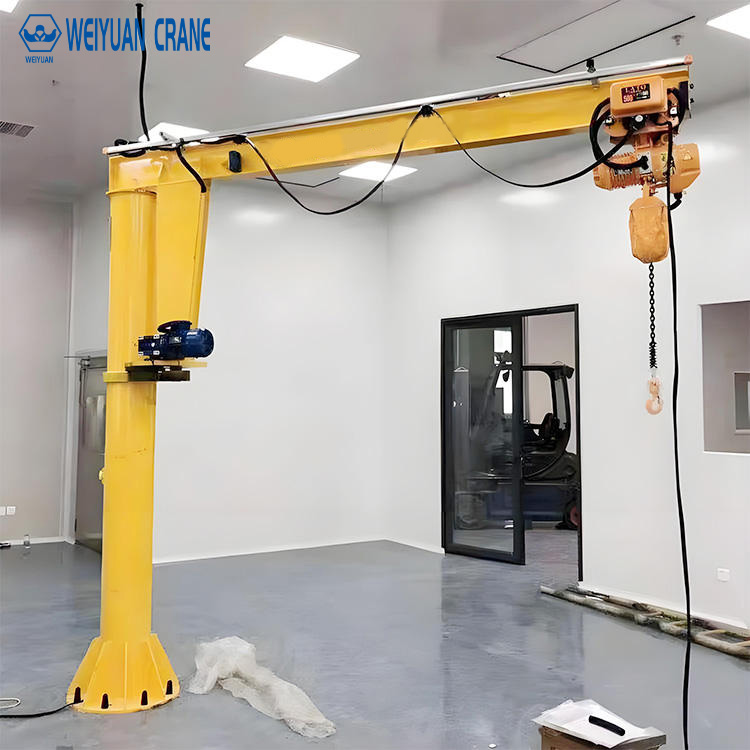
The standard jib crane is the workhorse of industrial workstation material handling. A single horizontal boom rotates around a mast. The hoist trolley travels along the boom. Together, these two motions can position a load anywhere within the crane’s working sector.
Standard jib cranes are simple. They have one slewing bearing, one hoist trolley, and one set of electrical controls. There are fewer moving parts than an articulating design. That means fewer maintenance points, lower inspection complexity, and lower failure frequency.
They also handle heavier loads. Standard pillar-mounted jib cranes are available in capacities from 125 kg to 16,000 kg (16 tonnes). Heavy industrial applications — lifting engines, castings, dies — use standard jib cranes because articulating designs cannot match this capacity range.
The One Limitation That Matters
The straight boom cannot navigate around obstacles. If the direct path from the mast to the required hook position is blocked — by a machine, a wall section, a column, or a fixed fixture — the standard jib crane cannot reach that position regardless of its capacity or boom length.
This limitation is non-negotiable. It is built into the straight-boom geometry. No amount of adjustment, repositioning, or operator skill can make a straight boom reach around an obstruction. If the workstation geometry includes an obstruction in the crane’s path to a required position, either the obstruction must move, the workstation must be redesigned, or an articulating jib crane is required.
Part 2: The Articulating Jib Crane — Structure and Operating Principle
Double-Arm Construction
An articulating jib crane has two boom sections connected by a pivot joint. The inner boom connects to the mast through a primary slewing bearing. The outer boom connects to the inner boom through a second pivot joint. Each joint can rotate independently.
This two-joint design creates a crane with two independent degrees of freedom in the horizontal plane. The operator can swing the inner boom to any angle. Then swing the outer boom to any angle relative to the inner boom. The hook’s final horizontal position is the combined result of both rotations.
The working area of an articulating jib crane is not a simple sector. It is a ring-shaped zone — the hook can reach positions that are close to the mast as well as positions that are far from it, and it can navigate around obstacles that block the direct path.
Folding for Obstacle Navigation
The defining capability of the articulating jib crane is folding the outer boom inward to reduce the crane’s overall footprint during approach. To reach a position behind an obstacle:
Step 1: Swing the inner boom to approach the obstacle from the side.
Step 2: Fold the outer boom inward — bringing the hook close to the inner boom.
Step 3: Navigate the folded outer boom past the edge of the obstacle.
Step 4: Extend the outer boom to position the hook over the target.
This sequence allows the crane to reach positions that a straight boom could not approach without contacting the obstacle. The maneuver requires operator practice — it is not as intuitive as a straight boom — but it becomes routine after a few sessions.
Capacity Limitations
The articulating design’s two pivot joints create structural constraints that limit maximum capacity. The outer boom operates as a cantilever from the inner boom pivot — creating bending moment in the inner boom that adds to the normal hoist load moment.
Standard commercial articulating jib cranes are available up to approximately 1,000 to 2,000 kg (1 to 2 tonnes) for most designs. Some heavy-duty articulating designs reach 3,000 kg. Above these capacities, the structural weight and foundation requirements of the articulating design become disproportionate relative to the reach benefit.
If the application requires more than 2 tonnes of capacity, the articulating design is likely not viable. The standard jib crane remains the only practical option.
Part 3: Six-Dimension Comparison
Dimension 1: Coverage Area
Standard jib crane: Sector-shaped coverage from the mast through the full boom length. Coverage is predictable and geometrically simple. Any position within the sector is reachable with a single, continuous motion.
Articulating jib crane: Ring-shaped coverage with obstacle navigation capability. The hook can reach positions at varying distances from the mast. It can navigate around obstacles within the reachable ring. Coverage area is more complex to visualize but more flexible in obstacle-rich environments.
Winner: Articulating for workstations with obstacles. Standard for open workstations.
Dimension 2: Maximum Capacity
Standard jib crane: Available from 125 kg to 16,000 kg (16 tonnes) as standard commercial products.
Articulating jib crane: Typically limited to 1,000 to 2,000 kg (1 to 2 tonnes) for standard commercial designs. Heavy-duty articulating designs to 3,000 kg are available but at significantly higher cost.
Winner: Standard jib crane for any application above 2 tonnes. No competition.
Dimension 3: Structural Complexity and Maintenance
Standard jib crane: One slewing bearing, one hoist track, one set of mounting bolts. Annual inspection covers one pivot point and the hoist mechanism.
Articulating jib crane: Two pivot joints, two sets of slewing bearings, two sets of bearing mounting bolts, and the additional structural connections between the inner and outer booms. Annual inspection scope is roughly double the standard crane’s.
Each slewing bearing requires lubrication on its own schedule. Either bearing can develop the wear, noise, or play that indicates approaching end-of-life. Two bearings means twice the probability of bearing service during any given inspection interval.
Winner: Standard jib crane for lowest maintenance burden.
Dimension 4: Foundation Requirements
Standard jib crane: Foundation sized for the crane’s rated capacity and boom length. Standard calculation from Part 3 of the Jib Crane Foundation Design guide.
Articulating jib crane: The articulating design creates higher mast base moments than an equivalent-capacity standard crane at the same total reach. The outer boom’s offset from the inner boom centerline creates an additional moment arm that the standard calculation does not account for. Foundation requirements for an articulating crane are typically 20 to 40% larger than a standard crane at the same rated capacity.
Winner: Standard jib crane for lower foundation cost.
Dimension 5: Purchase Price
Standard jib crane (1-tonne, 4-metre boom, electric chain hoist): $3,500 to $7,500 installed.
Articulating jib crane (1-tonne, 4+2-metre boom, electric chain hoist): $6,000 to $14,000 installed.
The articulating crane commands a 50 to 100% price premium over an equivalent-capacity standard crane. This premium reflects the additional mechanical complexity (second slewing bearing, more structural fabrication) and the lower production volumes for articulating designs compared to standard designs.
Winner: Standard jib crane for purchase cost.
Dimension 6: Application Flexibility
Standard jib crane: Excellent for open workstations with unobstructed sectors. Limited to installations where no obstacles interfere with the direct boom path to any required position.
Articulating jib crane: Uniquely suited for workstations with obstacles, narrow access points, or positions that must be reached from the side rather than directly. Can serve multiple workstations in an L-shaped or U-shaped layout that a single straight boom cannot cover.
Winner: Articulating for obstacle-rich and complex-geometry workstations.
Part 4: Five Application Scenarios Where Articulating Wins
Scenario 1: CNC Machining Center with Fixed Protective Enclosure
A CNC machining center has a fixed safety enclosure with a door opening on one side. The machine spindle is on the opposite side from the door. A standard jib crane positioned outside the enclosure cannot reach the spindle zone through the door opening — the straight boom would contact the enclosure frame.
An articulating jib crane positioned beside the enclosure can fold its outer boom to navigate through the door opening, then extend to position the hook over the spindle area. The operator can load and unload workpieces without removing the protective enclosure.
Scenario 2: Welding Station with Fixed Fixtures
A welding workstation has a large fixed positioner fixture in the center of the work area. The fixture is too heavy to move between welding operations. A straight jib boom approaching from any direction contacts the fixture before reaching the weld preparation area on the far side.
An articulating crane can approach from the side, fold the outer boom to clear the fixture edge, and extend to position parts on the far side of the fixture. The fixture stays in place. The crane serves the full workstation.
Scenario 3: Receiving Dock Through a Wall Opening
A receiving area has an exterior wall with a 1.2-metre-wide roll-up door. Incoming parts must be transferred from the truck platform outside to a staging area inside. A standard jib crane positioned inside cannot reach through the opening — the straight boom is too wide to pass through the opening at the required angle.
An articulating crane positioned inside folds the outer boom to a narrow footprint that passes through the opening. Once outside, the outer boom extends to reach the truck platform. The load is picked up, the boom retracts through the opening, and the part is deposited at the interior staging area.
Scenario 4: Laboratory with Multiple Precision Instruments
A research laboratory has 4 precision analytical instruments arranged in a U-shape along three walls. Each instrument requires occasional component handling (detector replacement, sample stage servicing). A bridge crane is impractical due to ceiling interference. Individual jib cranes for each instrument would require 4 foundations and 4 inspections.
One articulating jib crane positioned at the center of the U can serve all 4 instruments. Its ability to navigate around the instrument housings means it can reach service access points on all four units from a single mounting position. One crane replaces four.
Scenario 5: Ship Hold Maintenance
A shipboard service team must perform maintenance on equipment installed inside a ship’s hold. The hold hatch opening is 1.5 metres × 2 metres. Equipment inside the hold is offset from the hatch centerline. A standard jib crane positioned over the hatch cannot reach the offset equipment — the straight boom contacts the hatch coaming before the hook reaches the target.
A compact portable articulating jib crane set up over the hatch can fold its outer boom to navigate through the hatch opening and extend to the offset equipment position inside the hold.
Part 5: Three Questions to Answer Before Choosing
Question 1: Can the Obstruction Be Eliminated or Relocated?
Before specifying an articulating crane, ask whether the obstacle can be moved or removed. If the obstruction is a temporary fixture that can be repositioned during crane operations, a standard crane with a simple workstation procedure may be the more cost-effective solution. The articulating crane premium is justified only when the obstruction is genuinely fixed and cannot be addressed by layout adjustment.
Question 2: What Is the Maximum Required Capacity?
If the application ever requires handling loads above 2 tonnes, the articulating design is eliminated as an option. Confirm the maximum weight of all components the crane must handle — including below-hook tooling — before considering an articulating design.
Question 3: Is There Adequate Storage Space for the Folded Boom?
An articulating jib crane in its minimum-footprint folded position still occupies more floor space than a standard crane’s mast. Verify that the crane can be folded to its stored position without interfering with production machinery, personnel traffic, or material flow when the crane is not in active use.
Part 6: 2026 Price Reference
Standard jib crane (floor-mounted pillar, with electric chain hoist):
- 250 kg, 3m boom: $1,200 to $2,800
- 500 kg, 4m boom: $2,000 to $4,500
- 1,000 kg (1 tonne), 4m boom: $3,500 to $7,500
- 2,000 kg (2 tonne), 5m boom: $7,000 to $15,000
Articulating jib crane (floor-mounted pillar, with electric chain hoist):
- 250 kg, 3+1.5m total reach: $3,000 to $6,500
- 500 kg, 3+2m total reach: $5,000 to $10,000
- 1,000 kg (1 tonne), 4+2m total reach: $7,000 to $14,000
- 2,000 kg (2 tonne), 4+2m total reach: $13,000 to $28,000
Articulating crane premium over standard equivalent: 50 to 100% on crane price.
Foundation cost premium for articulating crane: 20 to 40% over standard crane at same capacity.
Annual maintenance cost premium: approximately 30 to 50% higher due to second slewing bearing inspection and lubrication requirements.
Frequently Asked Questions
Q: Can an articulating jib crane lift the same weight as a standard jib crane of the same model number?
A: The rated capacity applies at specific boom geometry positions. The rated capacity on an articulating crane is typically specified at a defined outer boom extension angle — often with the outer boom folded to a 90-degree angle relative to the inner boom. At different extension angles (particularly with the outer boom fully extended), the rated capacity may be reduced. Always confirm the capacity at the specific hook position geometry your application requires — not just the nameplate rated capacity.
Q: Is an articulating jib crane harder to operate than a standard crane?
A: Yes — initially. Coordinating two independent boom sections requires more spatial awareness than operating a single straight boom. Operators new to articulating cranes typically require 2 to 4 hours of practice before reaching comfortable proficiency with routine tasks. For applications involving frequent obstacle navigation, a wireless radio remote (allowing the operator to position themselves optimally during the maneuver) significantly reduces the learning curve compared to a fixed pendant.
Q: Can I add an articulating outer boom to an existing standard jib crane?
A: Not as a field modification. The inner boom of a standard crane is not designed to carry the additional bending moments from an articulating outer boom attachment. The slewing bearing mounting and mast connection are sized for the standard straight boom load case. Converting a standard crane to articulating configuration requires redesigning the boom structure and potentially the foundation — at which point purchasing a purpose-built articulating crane is more cost-effective.
++