


Jib Crane Cost Guide: What You Should Pay in 2026 for Every Size and Configuration
Introduction
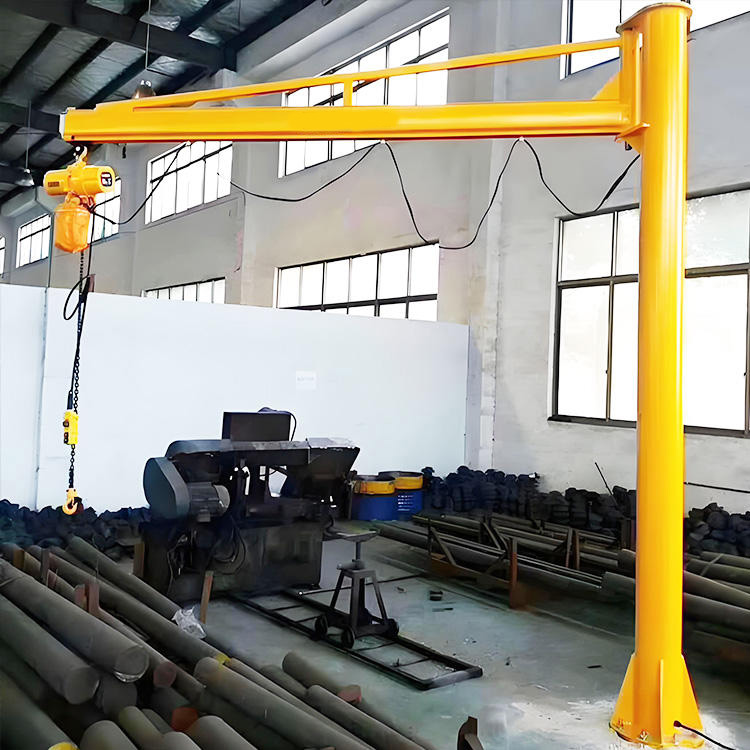
Jib crane prices range from $800 to over $50,000. That range is not vague. Every dollar within it reflects a specific combination of capacity, boom length, mounting type, hoist selection, and specification level.
The buyer who understands what drives jib crane pricing gets an accurate quote on the first call. The buyer who does not understands gets a confusing range of quotes — and no way to evaluate whether any of them is fair.
This guide explains the eight variables that determine jib crane price. It provides 2026 reference prices for every standard configuration — equipment only and fully installed. It covers the China vs European brand trade-off. And it identifies the four hidden costs that catch buyers off guard after the purchase order is placed.
Part 1: Eight Variables That Determine Jib Crane Price
Understanding these eight variables allows you to build a price estimate before contacting any supplier. Each variable is independent — changes in one do not require recalculating the others.
Variable 1: Rated Capacity
Capacity is the largest single price driver. Doubling the capacity from 500 kg to 1,000 kg does not double the price. But it increases it by approximately 40 to 70%.
The relationship is not linear because larger cranes require: thicker structural steel in the mast and boom, larger slewing bearings, heavier duty hoists, and larger foundation dimensions.
Variable 2: Boom Length
Longer booms are more expensive than shorter booms at the same capacity. Each additional metre of boom length increases the overturning moment at the mast base — requiring additional structural steel in the mast and the foundation.
Price increase per additional metre of boom: approximately 8 to 15% of the base boom price for standard capacities.
A 1-tonne crane with a 3-metre boom costs approximately 15 to 25% less than the same crane with a 5-metre boom.
Variable 3: Mounting Type
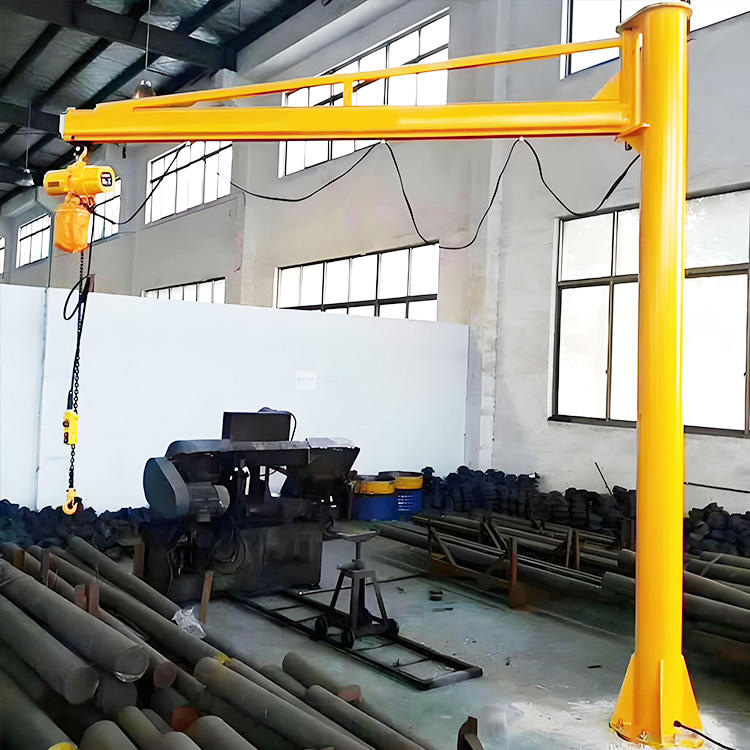
Pillar-mounted (floor-mounted freestanding): the most common type. Highest per-unit crane equipment price due to the full mast and foundation design.
Wall-mounted: lower crane equipment price (no mast — only brackets, pivot, and boom). But requires a structural assessment. Installation cost may be lower or higher than pillar-mounted depending on wall condition and foundation cost comparison.
Portable (caster base): similar equipment price to wall-mounted. No foundation cost. Useful for temporary or multi-position applications.
Articulating (knuckle boom): 50 to 100% premium over standard straight-boom designs at equivalent capacity. Justified only when obstacles prevent standard boom access.
Variable 4: Hoist Type
The hoist is the working mechanism of the crane. Its selection has a larger impact on practical utility than any other single component — and a significant impact on price.
Manual chain hoist: $200 to $1,200 depending on capacity. Lowest cost. Suitable for low-frequency applications under 10 to 15 lifts per shift.
Electric chain hoist (standard): $900 to $4,500 depending on capacity. The standard choice for production workstations.
VFD-controlled electric hoist: $2,500 to $8,000. Adds variable speed, smooth positioning, and extended component life. Justified for high-frequency or precision placement applications.
Wireless remote control addition: $500 to $2,000. Allows the operator to follow the load rather than staying at the pendant cable’s reach.
Variable 5: Rotation Type
Manual rotation (standard): the operator pushes the boom by hand. No additional cost over the base crane price. Standard for most light and medium-duty applications.
Motorized rotation: an electric drive rotates the boom. Adds $1,500 to $5,000 depending on boom length and required torque. Justified for heavy booms (5 tonnes and above) where manual rotation creates operator fatigue, or for semi-automated systems.
Variable 6: Duty Class (FEM/CMAA Work Class)
FEM M3 to M4 (CMAA Class B to C): standard specification for light production applications. Base price.
FEM M5 (CMAA Class D): required for continuous production workstations above 15 to 20 cycles per shift. Adds approximately 15 to 25% to the hoist price and 10 to 15% to the overall crane price.
FEM M6+ (CMAA Class E to F): heavy production, multi-shift, high-frequency. Significant premium — adds 30 to 50% to hoist price. Required for applications the manufacturer’s standard catalog may not cover without special order.
Variable 7: Special Environment Specification
Standard indoor specification: base price.
Outdoor specification (IP65, C4 coating, galvanized hardware): add 25 to 45% to crane equipment price.
Food processing (NSF H1, stainless, IP66): add 40 to 70%.
Pharmaceutical cleanroom (316L stainless, PFPE lubricants, electropolished): add 60 to 120%.
ATEX Zone 1 explosion-proof: add 80 to 150%.
Variable 8: Brand Origin
Chinese manufacturers: 30 to 50% lower equipment price than equivalent European or North American brands. Example: a 1-tonne, 4-metre electric jib crane from a Chinese manufacturer: $3,500 to $6,000. Same specification from a European manufacturer: $6,000 to $12,000.
European/North American brands (Gorbel, ABUS, Demag, Konecranes, Spanco): higher price, but include: CE certification with full technical file, global spare parts network, service centers in most major markets, standardized documentation.
The correct choice depends on: your market’s certification requirements, your maintenance team’s ability to source parts, and how much the crane’s downtime costs your production.
Part 2: Equipment Price Reference by Capacity (2026)
These prices cover the jib crane structure and hoist. They do not include installation, foundation, or electrical supply.
125 to 250 kg (Ultra-Light)
Manual wall-mounted, 2m boom, manual chain hoist: $800 to $1,800
Electric pillar-mounted, 2m boom, electric chain hoist: $1,500 to $3,500
500 kg (Light Duty)
Wall-mounted, 3m boom, electric chain hoist: $2,000 to $4,500
Pillar-mounted, 3m boom, electric chain hoist: $2,500 to $5,500
Portable caster base, 2m boom, electric chain hoist: $2,800 to $6,000
1,000 kg — 1 Tonne (Most Common)
Wall-mounted, 4m boom, standard electric hoist: $3,500 to $7,500
Pillar-mounted, 4m boom, standard electric hoist: $4,500 to $9,500
Pillar-mounted, 4m boom, VFD hoist: $6,500 to $13,000
Articulating, 4+2m reach, electric hoist: $7,000 to $15,000
2,000 kg — 2 Tonnes
Wall-mounted, 4m boom, electric hoist: $5,500 to $12,000
Pillar-mounted, 5m boom, standard electric hoist: $7,500 to $16,000
Pillar-mounted, 5m boom, VFD hoist + wireless remote: $11,000 to $22,000
5,000 kg — 5 Tonnes
Pillar-mounted, 5m boom, standard electric hoist: $13,000 to $28,000
Pillar-mounted, 6m boom, VFD hoist + motorized rotation: $20,000 to $42,000
10,000 kg — 10 Tonnes
Pillar-mounted, 6m boom, standard electric hoist: $25,000 to $55,000
Pillar-mounted, 8m boom, VFD hoist + motorized rotation: $38,000 to $75,000
16,000 kg — 16 Tonnes
Pillar-mounted, 6m boom, standard electric hoist: $45,000 to $90,000
Part 3: Installation Cost Breakdown
The crane equipment price is only part of the total investment. Installation costs are frequently underestimated — particularly for first-time buyers.
Foundation Cost (Pillar-Mounted)
Excavation and formwork: $400 to $1,200.
Concrete and reinforcement: $600 to $2,500 depending on foundation size.
Anchor bolt supply and setting: $200 to $600.
Labour (1 to 2 days): $500 to $1,500.
Total foundation cost: $1,700 to $5,800.
Foundation cost as a percentage of crane equipment price: typically 20 to 50% for small cranes (1 to 2 tonne). Proportionally smaller for large cranes (5 to 16 tonne) where the crane equipment price dominates.
Structural Assessment (Wall-Mounted)
A licensed structural engineer must assess the mounting wall or column before installation. Cost: $500 to $2,000 depending on whether original building drawings are available and the complexity of the assessment.
If reinforcement is required: add $1,000 to $5,000 for structural reinforcement work.
Mechanical Installation
Crane erection, mast levelling, boom installation, slewing bearing torquing: $600 to $2,500.
Electrical Connection
Branch circuit from nearest panel to crane installation point: $400 to $2,000 depending on distance and panel capacity.
Hoist electrical connection and testing: $200 to $600.
Total electrical: $600 to $2,600.
Load Testing
ASME B30.12 requires a load test at rated capacity before first use. Test weights or calibrated load cell plus inspector time: $300 to $800.
Total Installed Cost Summary
1-tonne pillar-mounted, 4m boom, standard electric hoist (all-in):
Equipment: $4,500 to $9,500
Foundation: $2,500 to $5,000
Installation + electrical + test: $1,500 to $4,000
Total installed: $8,500 to $18,500
2-tonne pillar-mounted, 5m boom, VFD hoist (all-in):
Equipment: $9,500 to $20,000
Foundation: $3,000 to $6,000
Installation + electrical + test: $2,000 to $5,000
Total installed: $14,500 to $31,000
5-tonne pillar-mounted, 6m boom, VFD + wireless remote (all-in):
Equipment: $18,000 to $40,000
Foundation: $4,000 to $8,000
Installation + electrical + test: $3,000 to $7,000
Total installed: $25,000 to $55,000
Part 4: Chinese vs European Brand Price Comparison
What the Price Difference Reflects
A 1-tonne, 4-metre pillar-mounted jib crane from a Chinese manufacturer: $4,500 to $7,000 installed.
The same specification from a European manufacturer: $9,000 to $16,000 installed.
The price difference is real. The reasons behind it are also real:
Manufacturing labor cost: Chinese manufacturing labor rates are lower than European rates. This directly reduces fabrication cost.
Overhead and compliance cost: European manufacturers carry higher overhead for their quality management systems, CE technical file preparation, and service network maintenance. These costs are built into the price.
Component sourcing: European manufacturers use European-sourced components (Schneider, ABB, SEW) as standard. Chinese manufacturers may use domestic components that are adequate but have limited international spare parts networks.
When Chinese Brands Are the Better Value
The Chinese brand is the better value choice when:
The crane is for domestic use in a market where CE certification is not required.
The operating environment is standard — no special certification (ATEX, food grade, nuclear) required.
Maintenance will be performed by in-house staff familiar with generic components.
Production downtime cost is modest — a parts wait of 2 to 4 weeks does not cost more than the purchase price difference.
When European Brands Justify the Premium
The European brand is worth the premium when:
CE certification is required by the buyer’s quality system, insurance, or regulatory framework.
The crane serves a safety-critical or regulated application (pharmaceutical, food processing, aerospace, nuclear).
Global spare parts availability is essential — the facility has multiple international locations.
The crane will be sold with machinery into an OEM product where the end customer requires traceable European certification.
Part 5: Four Hidden Costs That Catch Buyers Off Guard
Hidden Cost 1: Foundation Engineering
Many buyers receive a crane quote without foundation costs included. The quote looks attractive. The crane arrives. The foundation cost arrives as a separate invoice — sometimes larger than expected.
Prevention: always ask the supplier to provide foundation load data and an estimated foundation cost as part of the initial quote. If they cannot provide foundation data, they have not completed the engineering required for a safe installation.
Hidden Cost 2: Electrical Supply Upgrade
The branch circuit from the facility’s nearest electrical panel to the crane installation point is usually not included in crane quotes. In older facilities, the panel may not have spare circuit capacity — requiring a panel upgrade before the crane circuit can be added.
Prevention: have an electrician assess the nearest panel capacity and estimate the circuit installation cost before finalizing the crane budget.
Hidden Cost 3: Annual Inspection
ASME B30.12 requires an annual inspection by a qualified person. This is a recurring operational cost — not a one-time installation cost. Annual inspection by a qualified third-party inspector: $300 to $800 per crane per year.
Prevention: include annual inspection cost in the 10-year TCO calculation.
Hidden Cost 4: Operator Training and Certification
ASME B30.12 requires that crane operators be trained and qualified before operating the crane. Initial training for new operators: $200 to $600 per person. Refresher training every 1 to 3 years per employer’s safety program.
Prevention: budget operator training as part of the crane installation project — not as a separate future expense that gets forgotten.
Frequently Asked Questions
Q: Why do jib crane quotes vary so widely for the same specification?
A: Four factors create wide quote variation. First: duty class — two cranes with identical nominal capacity but different duty classes (M3 vs M5) can differ by 20 to 30% in price. Second: component brand — generic vs named brands (ABB, SEW) have 10 to 20% price difference. Third: certification scope — a CE-certified crane with full technical file costs more than an equivalent uncertified crane. Fourth: included scope — one quote may include foundation engineering, another may not. Always compare quotes on an identical specification including certification, components, and scope.
Q: Is it worth paying more for a VFD-controlled hoist over a standard on/off electric hoist?
A: For production workstations performing more than 15 to 20 lifts per shift: yes. The VFD extends brake lining life by 60 to 70% and motor life by 50 to 100% through smooth starting and stopping. The maintenance cost saving over 5 years typically exceeds the VFD premium by 2 to 3 times. For low-frequency maintenance applications: the VFD premium is not recovered and the standard hoist is the correct choice.
Q: What is included in “CE certified” for a jib crane?
A: CE marking for a jib crane (under the EU Machinery Directive 2006/42/EC) requires: design calculation in accordance with EN 13157 (cranes — safety) and related standards, a technical file including structural calculations, component specifications, risk assessment, and test reports, a Declaration of Conformity signed by the manufacturer, and a load test at rated capacity before delivery. A CE mark without a Declaration of Conformity and technical file is not a valid CE certification — it is a sticker. Require the full documentation package, not just the nameplate marking.