


Electric Hoist Price Guide: What You Should Pay in 2026 for Chain and Wire Rope Models
Introduction
Electric hoist prices range from $400 to $45,000 for standard industrial models. That range is not random. Every dollar within it reflects a specific combination of hoist type, capacity, duty class, control system, and specification level.
The buyer who understands the pricing structure gets an accurate quote on the first request and can evaluate whether any quote is reasonable. The buyer who does not understand it gets confused by a wide range of quotes — with no way to judge which is fair and which is excessive.
This guide provides 2026 reference prices for standard electric chain hoists and wire rope hoists across the full commercial capacity range. It explains the seven variables that drive price above the base level. It covers the China vs European brand comparison. And it identifies the total installed cost — not just the hoist purchase price — so the budget reflects the real investment.
Part 1: The Two Main Hoist Types and Their Price Relationship
Electric Chain Hoist
Chain hoists use a precision alloy steel load chain as the lifting medium. The chain engages a toothed pocket wheel driven by the motor and gearbox.
Chain hoists are the standard for: capacities up to 5 tonnes, applications requiring low headroom, food processing and cleanroom environments (where chain is easier to manage than rope for contamination control), and budget-conscious applications where the capacity is within the chain hoist’s practical range.
Price advantage: chain hoists are less expensive than wire rope hoists at equivalent capacity below 5 tonnes — typically 20 to 40% less expensive.
Electric Wire Rope Hoist
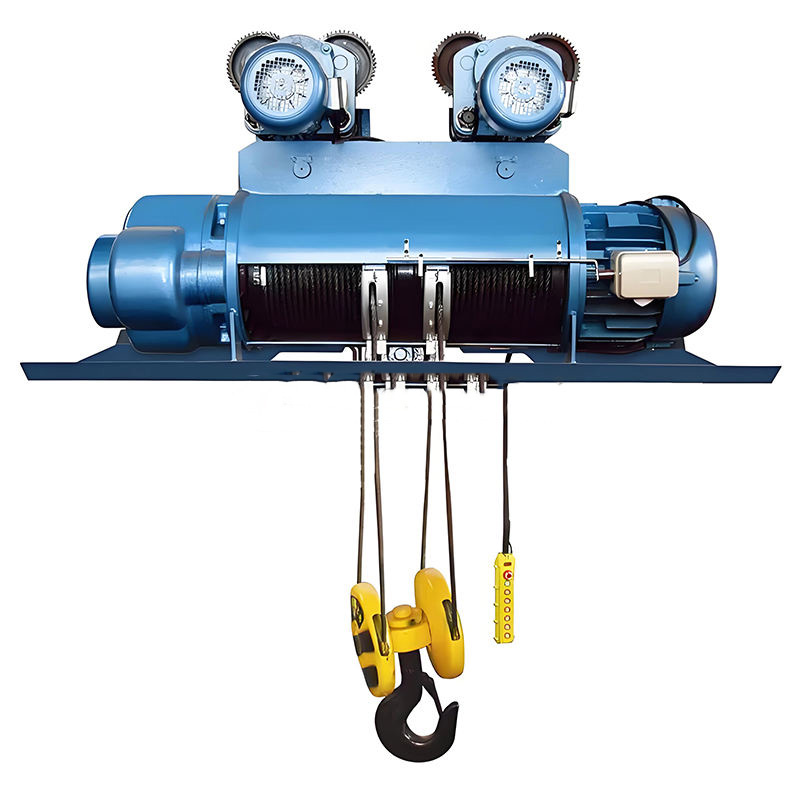
Wire rope hoists use a steel wire rope that winds onto a grooved drum. The drum is driven by the motor through a gearbox.
Wire rope hoists are the standard for: capacities above 5 tonnes, applications requiring higher lifting speeds, applications where rope length flexibility is important, and heavy-duty service (CMAA Class E and F) where wire rope’s fatigue characteristics are superior to chain.
Price premium: wire rope hoists cost 30 to 50% more than equivalent capacity chain hoists at the 2 to 5-tonne overlap range. Above 5 tonnes: wire rope hoists are the only practical option for most applications.
Part 2: 2026 Price Reference — Electric Chain Hoists
All prices are for the hoist unit only (no trolley, no installation). Prices are for FEM M4 to M5 (CMAA Class C to D) standard duty class, standard control (contactor), and standard environmental specification (indoor, IP54).
125 to 250 kg
Single phase, standard speed, hook suspension: $400 to $900
Three phase, standard speed, hook suspension: $500 to $1,100
Three phase, two-speed, hook suspension: $700 to $1,400
500 kg
Single phase, standard speed: $600 to $1,400
Three phase, standard speed: $750 to $1,600
Three phase, two-speed: $1,000 to $2,000
Three phase, VFD variable speed: $1,800 to $3,500
1,000 kg — 1 Tonne (Most Common Specification)
Single phase, standard speed: $900 to $2,200
Three phase, standard speed: $1,100 to $2,600
Three phase, two-speed: $1,500 to $3,200
Three phase, VFD: $2,500 to $5,000
Three phase, VFD + wireless remote: $3,200 to $6,500
2,000 kg — 2 Tonnes
Three phase, standard speed: $1,800 to $4,200
Three phase, two-speed: $2,400 to $5,500
Three phase, VFD: $4,000 to $8,500
3,000 kg — 3 Tonnes
Three phase, standard speed: $2,800 to $6,500
Three phase, VFD: $5,500 to $12,000
5,000 kg — 5 Tonnes
Three phase, standard speed: $4,500 to $10,000
Three phase, VFD: $8,000 to $18,000
Part 3: 2026 Price Reference — Electric Wire Rope Hoists
Same specification basis as chain hoist prices above.
500 kg to 1,000 kg
Standard speed: $900 to $2,500
Two-speed: $1,400 to $3,500
VFD: $2,500 to $5,500
2,000 kg — 2 Tonnes
Standard speed: $2,500 to $6,000
Two-speed: $3,500 to $8,000
VFD: $5,500 to $12,000
5,000 kg — 5 Tonnes
Standard speed: $5,500 to $13,000
VFD: $10,000 to $22,000
10,000 kg — 10 Tonnes
Standard speed: $10,000 to $25,000
VFD: $18,000 to $40,000
20,000 kg — 20 Tonnes
Standard speed: $20,000 to $45,000
VFD: $32,000 to $70,000
Part 4: Seven Variables That Add to the Base Price
Variable 1: Duty Class
Standard FEM M4 (base price): the reference for all prices above.
FEM M5 (CMAA Class D): +10 to +18% over M4 pricing.
FEM M6 (CMAA Class E): +25 to +40% over M4 pricing.
FEM M7 to M8 (CMAA Class F): +50 to +80% over M4 — may require special order.
Duty class is the most commonly under-specified variable. Under-specifying saves 10 to 25% at purchase and costs 2 to 5 times that amount in premature failure over 5 years.
Variable 2: Control System
Contactor (standard): base price.
Two-speed (pole-changing motor): +15 to +25%.
VFD variable speed: +35 to +60%.
VFD with wireless remote: +50 to +80%.
VFD with anti-sway and encoder positioning: +70 to +120%.
Variable 3: Suspension Type
Hook suspension (standard): base price. The hoist hooks directly onto the beam or a fixed point. No trolley.
Lug/plate suspension: +5 to +10%. The hoist body has mounting holes for bolted attachment to a trolley or fixed structure.
Built-in trolley (push): included with most production models at +10 to +20% over hook suspension.
Motorized trolley: priced separately — see trolley price reference in the companion trolley types article.
Variable 4: Lift Height
Standard lift height (3 to 6 metres for most models): base price.
Extended lift height beyond standard: add $0.50 to $3.00 per additional 100mm of lift height above standard, depending on hoist size and chain/rope weight. For a 10-metre lift height versus a standard 3-metre: add approximately $350 to $1,500 depending on hoist capacity.
Variable 5: Environmental Specification
Standard indoor IP54: base price.
Outdoor / IP65: +8 to +15%.
Washdown / IP66: +15 to +25%.
Steam cleaning / IP69K: +25 to +40%.
Food grade (NSF H1 lubricants, stainless hardware): +30 to +50%.
ATEX Zone 2 (Ex nA): +40 to +80%.
ATEX Zone 1 (Ex d): +80 to +150%.
Cold storage specification (-25°C): +20 to +35%.
Variable 6: Hoist Weight and Headroom Class
Standard headroom (conventional design): base price.
Low headroom design (European-style compact body): +15 to +30% premium. Saves 200 to 400mm of headroom compared to standard designs. Essential in height-constrained applications.
Ultra-low headroom: +25 to +45%.
Variable 7: Certification and Documentation
Standard supply (manufacturer’s test report): base price.
CE Declaration of Conformity with technical file: +5 to +12%. Required for EU market and many international buyers.
Third-party load test certificate (witnessed by notified body): +$300 to $800 per unit.
Full documentation package (wiring diagrams, maintenance manual, spare parts list): typically included at no extra charge by reputable manufacturers — request it explicitly if not mentioned.
Part 5: Chinese vs European Brand Pricing
The Price Difference
Chinese brand electric chain hoist, 1-tonne, 3-phase, standard speed: $1,100 to $2,200.
European brand (Konecranes, Demag, SWF, STAHL) equivalent: $2,500 to $5,500.
The price difference is approximately 2 to 2.5 times for equivalent nominal specifications.
What Drives the Difference
European brands carry higher costs for: in-house engineering and R&D, European manufacturing labour rates, comprehensive CE technical file preparation, global service network maintenance, and longer warranty support periods.
Chinese brands have lower manufacturing costs and typically source components domestically — reducing cost but sometimes reducing the international spare parts availability.
When Chinese Brands Deliver Good Value
Chinese brands are the correct choice when:
The application is standard — no special certification, no unusual environment, no precision automation requirement.
The maintenance team is capable of working with generic or locally-sourced components.
The crane serves a non-critical production role where a parts wait of 2 to 4 weeks is acceptable.
The buyer’s market does not impose CE or equivalent certification requirements.
Budget is constrained and the price difference is significant relative to the application value.
When European Brands Justify the Premium
European brands are worth the premium when:
CE certification with full technical file is required by the buyer’s quality system, insurance, or regulatory framework.
The crane serves a regulated application (pharmaceutical, food processing, nuclear, aerospace).
Global spare parts availability across multiple facility locations is a procurement requirement.
The production downtime cost makes a 2 to 4-week parts wait unacceptable — European brands typically have regional distribution centers reducing parts lead time to days.
The end customer (OEM application) specifies a named European brand.
Part 6: Total Installed Cost — Not Just the Hoist Price
Why the Hoist Price Is Not the Budget
The hoist is the visible purchase. Several other cost items typically are not included in the hoist quote:
Trolley: a production hoist almost always requires a trolley. A standard motorized trolley for a 1-tonne hoist: $600 to $1,500. Not included in the hoist price.
Electrical supply: running a 3-phase branch circuit from the facility’s nearest electrical panel to the hoist installation point: $400 to $2,000 depending on distance and panel capacity.
Installation labor: mounting the hoist on the crane or beam, connecting the electrical supply, and testing: $300 to $800.
Load test (if required by site or insurance): test weights plus inspector time: $200 to $600.
Annual inspection (recurring): ASME B30.16 requires annual inspection by a qualified person: $200 to $600 per year.
Complete Installed Cost Examples
1-tonne, 3-phase, standard speed chain hoist for production workstation:
Hoist: $1,500 to $2,600
Motorized trolley: $700 to $1,500
Electrical supply: $500 to $1,500
Installation and test: $500 to $1,000
Total first-year installed cost: $3,200 to $6,600
2-tonne, 3-phase, VFD chain hoist for precision assembly:
Hoist: $4,000 to $8,500
VFD motorized trolley: $2,000 to $5,000
Electrical supply: $600 to $1,800
Installation and test: $700 to $1,500
Total first-year installed cost: $7,300 to $16,800
5-tonne, 3-phase, VFD wire rope hoist for die handling:
Hoist: $10,000 to $22,000
VFD motorized trolley: $3,500 to $8,000
Electrical supply: $800 to $2,500
Installation and test: $1,000 to $2,000
Total first-year installed cost: $15,300 to $34,500
Frequently Asked Questions
Q: Why do some suppliers quote much lower prices than the ranges in this guide?
A: Lower quotes typically reflect one or more of: lower duty class than specified (M3 instead of M4 or M5), domestic-only components without international spare parts availability, reduced certification scope (no CE technical file), shorter warranty period, or higher-than-standard defect rates that emerge after delivery. Always ask suppliers to confirm the duty class, component brands, certification scope, and warranty terms before comparing prices. A quote 40% below market for an identical specification is a signal — not a bargain.
Q: Is the VFD hoist worth the premium for a maintenance workshop that lifts infrequently?
A: For fewer than 5 to 10 lifts per shift in a maintenance workshop: VFD is not cost-justified by cycle time or component life benefits alone. The VFD premium (35 to 60%) does not pay back through maintenance savings at low cycle rates. However: if the workshop handles fragile equipment, precision-machined components, or loads where swing creates a collision risk — VFD’s smooth positioning capability justifies the cost regardless of cycle rate.
Q: What is included in a “standard” hoist documentation package?
A: At minimum, a reputable manufacturer should include with every hoist: an operator’s manual with lifting capacity, duty class, and maintenance schedule; a wiring diagram; a factory test report showing the hoist was tested at rated capacity; and a parts list with manufacturer part numbers. For CE-marked hoists: a Declaration of Conformity referencing the applicable Machinery Directive and harmonized standards. Request this list explicitly when requesting quotes — the documentation is a proxy for the manufacturer’s overall quality program.