


Articulating Jib Crane Guide: When a Knuckle Boom Solves Problems a Straight Arm Cannot
Introduction
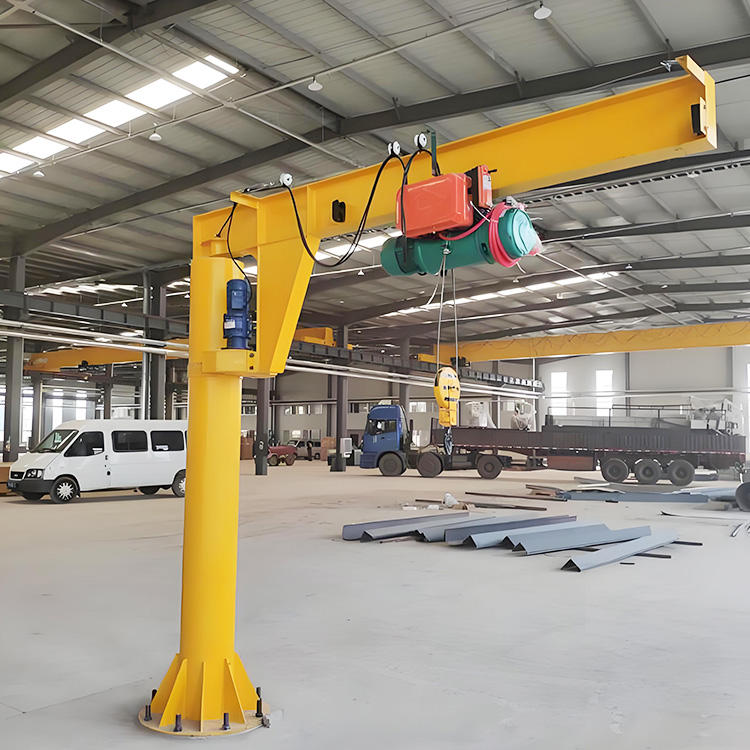
A standard jib crane has a straight boom. The hoist travels along the boom and the boom rotates about the mast. The hook can reach any point within the sector-shaped coverage area — as long as there are no obstacles.
The word “as long as” is where the articulating jib crane earns its place. Production facilities are full of obstacles. Machine columns. Conveyor frames. Fixture brackets. Safety fencing. The straight boom sweeps through its arc and contacts an obstacle before reaching the work position.
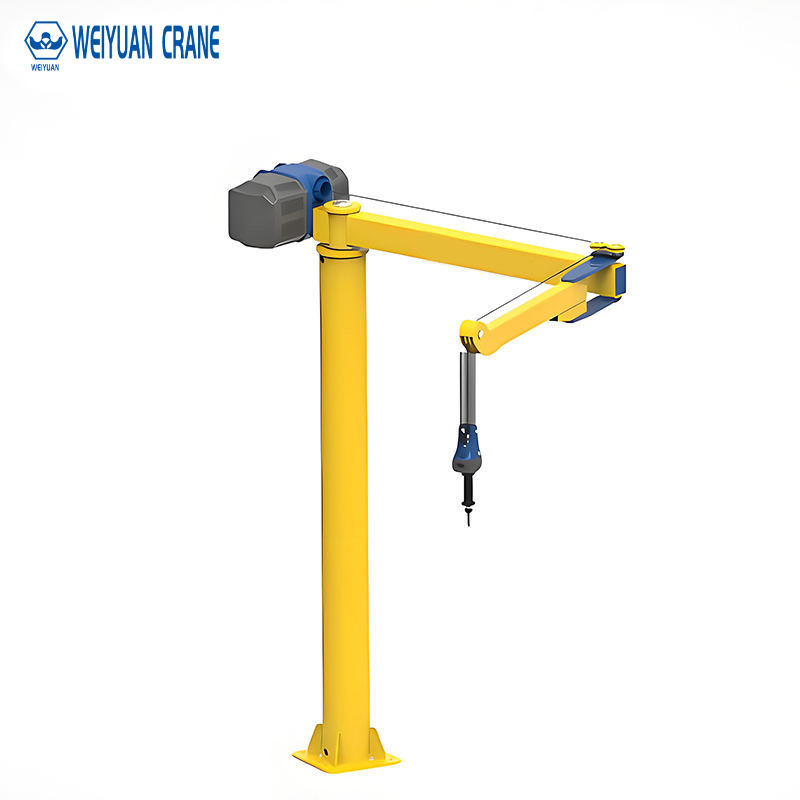
An articulating jib crane — also called a knuckle boom crane — has a two-section boom with a powered pivot joint at the “elbow.” The inner boom rotates about the mast. The outer boom rotates about the elbow. Together they allow the hook to reach positions that a straight boom can never access.
This guide explains when an articulating jib crane is the correct solution, how the two-section geometry creates the reach advantage, what the key specification differences are from a standard jib crane, and the applications where articulating jib cranes deliver their highest value.
Part 1: How the Articulating Geometry Works
Two-Section Boom Mechanics
A standard jib crane has one rotational degree of freedom: the boom rotates about the mast. The hook’s position is determined by the boom angle and the trolley position along the boom.
An articulating jib crane has two rotational degrees of freedom: the inner boom rotates about the mast (typically through 180° to 360°), and the outer boom rotates about the elbow joint (typically through 0° to 180° relative to the inner boom). The hoist travels along the outer boom, and the hook hangs from the hoist.
The combination creates a much more complex coverage area than a straight boom. The hook can reach positions directly behind the mast — not just in front. It can fold the outer boom parallel to the inner boom to navigate through narrow openings. And it can fold the outer boom backward to reach around obstacles that block a straight-boom path.
The Reach-Around Capability
This is the defining functional advantage of articulating jib cranes.
A straight boom cannot reach around a corner. If there is a machine column between the crane installation point and the work position, the straight boom contacts the column before the hook reaches the work position.
An articulating crane reaches around the column by: rotating the inner boom to a position adjacent to the obstacle, then rotating the outer boom around the obstacle to position the hook on the far side. The mast and inner boom stay on the safe side of the obstacle. The outer boom wraps around it. The hook arrives at the work position.
This capability opens crane service to positions that would otherwise require a separate crane installation, a manual materials handling solution, or a facility modification to remove the obstacle.
Part 2: Coverage Area vs Standard Jib Crane
Standard Jib Crane Coverage
A standard 360° pillar-mounted jib crane with a 4-metre boom covers a circular area with a 4-metre radius — approximately 50 m² of floor area.
The coverage is complete within this circle. No position within 4 metres of the mast is inaccessible, assuming no obstacles.
The limitation: positions outside the 4-metre radius are not served. And if any obstacle exists within the 4-metre circle — a machine, a column, a conveyor — the straight boom cannot swing past it. The obstacle creates a “shadow zone” that the crane cannot serve.
Articulating Jib Crane Coverage
An articulating crane with a 3-metre inner boom and a 3-metre outer boom has:
Maximum reach: 6 metres (inner + outer fully extended)
Minimum reach: 0 metres (outer folded back to the mast — the hook is directly above the mast)
The coverage is not a simple circle. It is a complex shape that extends from 0 to 6 metres from the mast in most directions — with specific positions requiring both boom sections to cooperate.
The critical advantage: the articulating crane can reach around a 0.5 to 1.0-metre-wide obstacle by folding the outer boom around it. A machine column occupying a 400mm-diameter footprint typically creates less than 200mm of shadow zone — rather than the full excluded arc that a straight boom creates.
Part 3: Key Applications for Articulating Jib Cranes
Application 1: Machine Tool Loading Around Column or Fixture
A CNC machining center has a hydraulic fixture clamping column positioned 1.5 metres from the machine table center. The column is 300mm in diameter and extends 2 metres above the table.
A standard jib crane serving this workstation must either: be positioned so the boom can swing to the table position without contacting the column (requires relocating the crane further from the machine), or the operator must manually guide the load around the column (ergonomic risk and precision difficulty).
An articulating jib crane: the outer boom folds around the column. The hoist lowers the workpiece directly onto the machine table with the column between the inner and outer boom sections. No relocation required. No manual guiding.
Application 2: Aerospace Engine Removal and Installation
Aircraft engine changes are performed in maintenance hangar bays. The engine is supported on a trolley or stand below the wing. The crane must position above the engine — between the fuselage, the wing leading edge, and potentially the nacelle cowling.
Standard jib cranes with straight booms cannot navigate the geometry of the space between the wing and fuselage. Articulating jib cranes fold the outer boom under the wing leading edge and then extend it inboard to position the hook above the engine attachment points.
This capability eliminates the need for mobile elevated work platforms (MEWPs) or overhead crane systems with complex runway configurations for many aircraft types.
Application 3: Wind Turbine Nacelle Internal Maintenance
Wind turbine nacelles contain the gearbox, generator, and main shaft assembly at heights of 80 to 140 metres in large onshore turbines. Internal maintenance — replacing bearings, generator brushes, hydraulic components — requires lifting heavy components (50 kg to 2,000 kg) inside the nacelle.
The nacelle interior is cramped. Structural members, cable runs, and the main shaft assembly occupy most of the available space. A straight jib crane inside the nacelle cannot reach most positions without interference.
A compact articulating jib crane mounted to the nacelle frame can fold the outer boom to navigate around the main shaft and reach component positions on both sides of the drivetrain.
Application 4: Ship Interior Outfitting — Access Through Hatch
Ship outfitting requires installing equipment through deck hatches into the spaces below. The hatch opening is typically 600 to 1,200mm in width. The space below may extend significantly beyond the hatch width in one or both directions.
A standard jib crane lowers through the hatch — the boom cannot pass through. Only the hoist and load descend through the hatch, limiting placement to positions directly below the hatch.
An articulating jib crane lowers the outer boom through the hatch and then rotates it to position the load away from the hatch centerline — reaching positions 1 to 3 metres away from the hatch that a standard crane cannot serve.
Application 5: Chemical Process Plant Valve and Equipment Access
Chemical process plants have densely packed piping, vessels, and structural steel. Replacing a pump, valve, or heat exchanger requires lifting through the available space between piping runs and structural members.
Standard jib cranes cannot navigate the geometry. Articulating cranes fold and extend their two sections to thread the hook through the available access path to the equipment requiring service.
Part 4: Specification Differences from Standard Jib Cranes
Elbow Joint Design
The elbow joint is the most critical structural element in an articulating jib crane. It carries the full bending moment from the outer boom plus load.
At full extension with the inner and outer boom in-line: the elbow joint carries no additional moment — the crane behaves like a straight boom.
At 90° elbow angle (outer boom perpendicular to inner boom): the elbow joint carries maximum bending moment = outer boom load × outer boom length perpendicular to the inner boom direction.
For a 1-tonne crane with a 3-metre outer boom at 90° elbow angle: elbow bending moment = 1,000 × 9.81 × 1.15 × 3.0 = 33.8 kN·m.
The elbow joint pin, bearings, and structural connection must be designed for this moment. Heavy-duty slewing bearings at the elbow — similar to those at the mast pivot — are the standard solution for articulating cranes above 500 kg capacity.
Drive System for the Outer Boom
Manual operation of the outer boom (the operator pushes it by hand) is practical for light loads up to approximately 500 kg. Above this capacity, the outer boom’s rotational resistance under load becomes significant.
Motorized outer boom rotation: an electric drive motor (typically 0.25 to 1.5 kW) rotates the outer boom about the elbow. The operator controls it from the same pendant as the inner boom rotation and hoist. VFD control provides smooth outer boom positioning.
Synchronized operation: some articulating crane systems allow the operator to command a straight-line path for the hook — the control system calculates and synchronizes the inner boom rotation, outer boom rotation, and trolley travel simultaneously to keep the hook on the commanded straight path. This dramatically simplifies operator training for precision placement tasks.
Structural Weight Penalty
An articulating jib crane is heavier than a standard jib crane at equivalent capacity and reach. The elbow joint, outer boom drive, and additional structural members add 20 to 40% to the crane weight.
The heavier crane imposes higher loads on the mast foundation. Foundation design must account for the articulating crane’s higher dead weight and the potentially higher dynamic loads from two-section boom operation.
Typical weight comparison (1-tonne capacity, 6-metre total reach):
Standard jib crane (single 6-metre boom): 280 to 450 kg
Articulating jib crane (3+3 metre boom): 380 to 650 kg
Part 5: Capacity and Reach Tradeoffs
Capacity Reduction at Extended Reach
All jib cranes have a reach-to-capacity relationship. At the maximum reach with the boom fully extended, the structural loads are at maximum. The crane is designed for rated capacity at this condition.
Articulating jib cranes have an additional constraint: when the outer boom is at a significant angle to the inner boom, the structural loads change compared to the fully extended condition. Some articulating crane manufacturers publish reduced capacity tables for specific inner/outer boom angle combinations.
Always obtain the complete capacity-versus-configuration table from the manufacturer. Verify the rated capacity at the specific angle combination that the most demanding job requires — not just at the nominal rated configuration.
Maximum Capacity for Articulating Jib Cranes
Commercial articulating jib cranes are available from 125 kg to approximately 5,000 kg (5 tonnes) as standard products. Above 5 tonnes: custom-engineered designs are available but become increasingly expensive relative to alternative solutions (overhead bridge crane, gantry crane).
The practical sweet spot for articulating jib cranes: 250 kg to 2,000 kg in precision manufacturing and maintenance applications. At these capacities, the articulating crane’s precision reach advantage is most valuable and the structural weight penalty is manageable.
Part 6: 2026 Price Reference
Standard straight-boom jib crane (1-tonne, 4m, pillar-mounted, electric hoist) for comparison:
$4,500 to $9,500 installed.
Articulating jib crane (without motorized outer boom):
500 kg, 2+2m reach: $6,000 to $13,000
1,000 kg, 3+3m reach: $10,000 to $22,000
2,000 kg, 3+3m reach: $18,000 to $38,000
Articulating jib crane with motorized outer boom (electric drive):
500 kg, 2+2m reach: $9,000 to $18,000
1,000 kg, 3+3m reach: $15,000 to $30,000
2,000 kg, 3+3m reach: $25,000 to $55,000
Articulating premium over standard straight-boom crane at equivalent capacity:
Manual outer boom: +60 to +120%
Motorized outer boom: +150 to +250%
The premium is justified when: the articulating crane eliminates the need for a facility modification to remove an obstacle, or when it replaces a higher-cost solution (overhead crane system, MEWP, additional crane installation) that a straight boom would require.
Frequently Asked Questions
Q: Can an articulating jib crane replace an overhead bridge crane in a small workshop?
A: In some cases — yes. If the workshop requires access to positions that a bridge crane runway would normally serve, and the loads are within the articulating crane’s capacity range (up to 5 tonnes), an articulating pillar-mounted jib crane can serve multiple positions within its reach envelope. The articulating crane’s advantage over a bridge crane: no runway structure required, lower cost, and the ability to reach around obstacles within its coverage area. Its disadvantage: coverage is limited to the mast’s reach radius — it cannot traverse the full building floor area as a bridge crane can.
Q: How does the operator control both boom sections simultaneously?
A: The pendant control for an articulating crane with motorized outer boom has additional buttons for outer boom left/right rotation. In basic systems: the operator independently controls inner boom, outer boom, trolley travel, and hoist — four independent axes. In advanced systems with path control: the operator commands the hook’s desired position and the control system coordinates all four axes automatically. Path control systems are significantly more expensive but greatly simplify operation for inexperienced users.
Q: Is the articulating jib crane harder to maintain than a standard jib crane?
A: Yes — modestly. The additional elbow joint adds an inspection point (bearing condition, bolt torque verification) and a lubrication point (elbow joint bearing grease). The outer boom drive adds a motor, gearbox, and control components. The total additional maintenance effort is approximately 20 to 30% above a standard jib crane of equivalent capacity. ASME B30.12 inspection requirements apply to articulating jib cranes as to all jib cranes — annual inspection by a qualified person, plus pre-shift inspection.