


Cantilever Gantry Crane Guide: When Extended Arms Solve Shipyard, Steel & Precast Loading Problems
Introduction
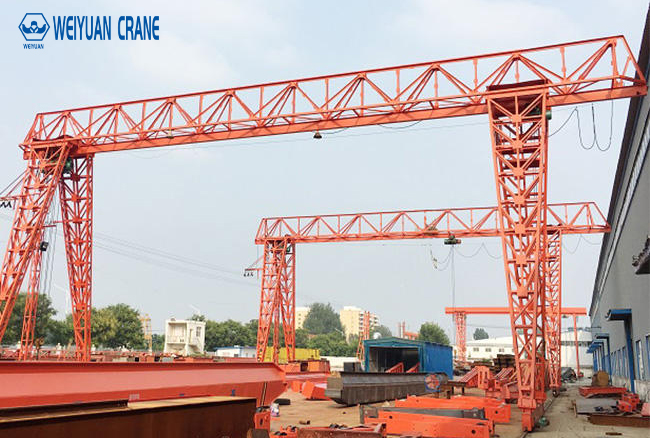
A standard gantry crane covers the area between its two legs. The bridge girder spans from leg to leg. Anything outside that span — beyond the legs — is unreachable.
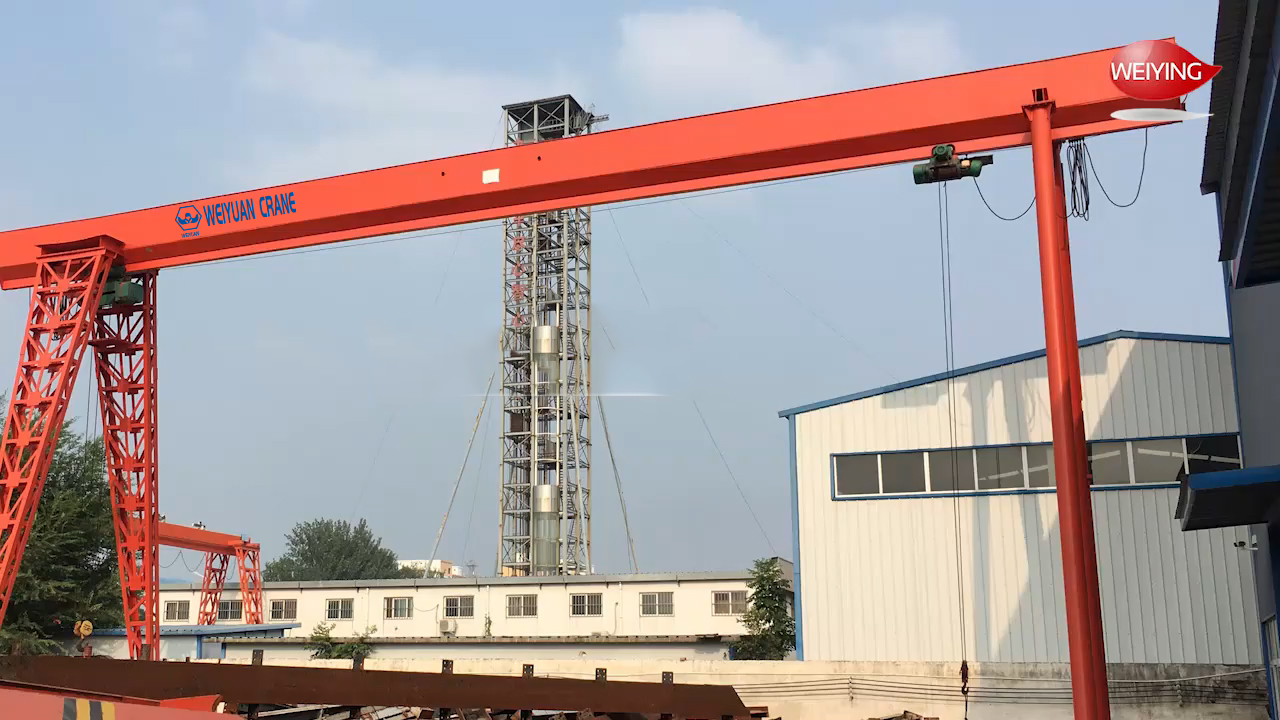
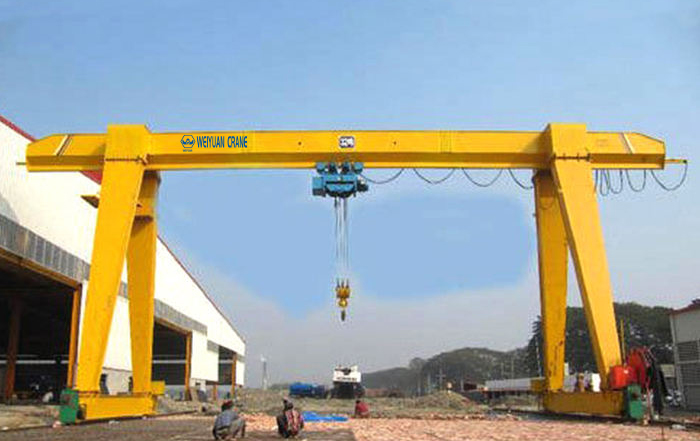
A cantilever gantry crane extends the bridge girder beyond the legs on one or both ends. The cantilevered sections project past the support structure, reaching loading areas, vehicle lanes, storage racks, or vessel hulls that the leg footprint itself does not cover.
This single structural modification — extending the girder past its supports — opens gantry crane coverage to applications where the load position and the crane’s structural footprint cannot occupy the same space. A truck loading lane that must remain clear of crane legs. A ship’s hull that the crane must reach over without legs standing in the water. A precast yard where finished elements load directly onto trailers parked outside the leg span.
This guide explains the cantilever gantry crane’s structural principles, the single versus double cantilever configurations, the load calculation for the cantilevered sections, and the three industries where cantilever gantry cranes solve problems that standard gantry cranes cannot.
Part 1: Cantilever Structure — How It Differs from Standard Gantry
Standard Gantry Girder
A standard gantry crane’s bridge girder is a simply supported beam. It spans between the two legs. The maximum bending moment occurs near mid-span. The girder ends are supported directly above the legs — zero moment at the supports.
Cantilever Extension
A cantilever gantry crane extends the girder beyond one or both leg positions. The extended section is a cantilever — supported at one end (where it connects to the main span over the legs) and free at the other end (the tip of the cantilever).
The structural behavior changes fundamentally at the cantilever. A load at the cantilever tip creates a bending moment at the leg support point that is in the opposite sense to the bending moment created by a load at mid-span. This creates a more complex bending moment diagram along the full girder length — with the maximum moments potentially occurring at the leg support points rather than at mid-span, depending on the relative load positions.
Single Cantilever vs Double Cantilever
Single cantilever: the girder extends beyond one leg only. The other end of the girder is supported directly above its leg with no extension. Used when only one side of the crane’s working area requires extended reach — for example, a loading dock on one side of a production bay.
Double cantilever: the girder extends beyond both legs. Used when both sides of the working area require extended reach — for example, a crane serving a central production area with material staging areas on both sides outside the leg footprint.
Part 2: Cantilever Load Calculation
The Fundamental Difference: Negative Moment at the Support
In a standard simply-supported girder, the bending moment is zero at the supports and maximum at mid-span — always positive (sagging) moment throughout.
In a cantilever girder, a load on the cantilever section creates a negative (hogging) bending moment at the leg support. This negative moment is superimposed on the positive moment from any load in the main span.
For design purposes, the girder must be checked for the worst-case combination:
Maximum positive moment: load at mid-span, no load on cantilever.
Maximum negative moment: load at cantilever tip, no load at mid-span (or minimum load at mid-span per the load combination rules).
Maximum combined stress: load at mid-span AND load on cantilever simultaneously — if the crane design allows simultaneous loading in both zones (some cantilever cranes have a single trolley that can only be in one position at a time; others have separate hoists for the cantilever and main span).
Cantilever Tip Deflection
The cantilever section deflects more than an equivalent length of simply-supported span under the same load — because the cantilever has no support at its free end.
Cantilever tip deflection = (Load × Cantilever length³) / (3 × E × I)
Where E = modulus of elasticity of steel (200,000 MPa) and I = moment of inertia of the girder cross-section.
For the same deflection limit (typically L/450 to L/600 per CMAA Specification No. 70), a cantilever section requires a significantly deeper or stiffer girder section than the main span — because the cantilever deflection formula has a cubic relationship to length versus the more favorable relationship for simply-supported spans.
Practical implication: cantilever sections are typically limited to 25 to 40% of the main span length for standard girder depths. Longer cantilevers require disproportionately deeper girders — increasing weight and cost significantly.
Reduced Capacity on the Cantilever
Many cantilever gantry crane designs specify a reduced rated capacity when the trolley operates on the cantilever section compared to the main span. This reduction reflects the higher stress state at the leg support connection when the cantilever is loaded.
Typical cantilever capacity reduction: 60 to 80% of main span rated capacity, depending on cantilever length and girder design.
Always obtain the manufacturer’s capacity table showing rated capacity by trolley position — main span versus cantilever sections — before specifying a cantilever gantry crane for an application where the cantilever will carry significant loads.
Part 3: Application 1 — Shipyard and Dry Dock Operations
The Hull Clearance Problem
A ship under construction or repair occupies the dry dock or building berth. The vessel’s hull extends outward and upward — sometimes well beyond the keel-block centerline where the gantry crane’s legs would naturally be positioned.
A standard gantry crane with legs positioned outside the hull’s maximum width would require an enormous span — most of which serves no purpose since the hull occupies only the central portion.
A cantilever gantry crane positions its legs at a practical span — close to the hull’s working width — and extends cantilever sections over the hull sides. The crane serves positions directly above the hull’s outer extremities without requiring legs positioned in the water or on the far side of the dry dock.
Section Joining and Block Lifting
Modern shipbuilding assembles vessels from prefabricated hull sections — “blocks” — that are lifted into position and welded together. Blocks can weigh from 50 to 1,000+ tonnes depending on vessel size and block subdivision strategy.
Cantilever gantry cranes in block assembly halls position the cantilever sections over the assembly berths. The main span (between the legs) handles general yard traffic and storage. The cantilevers reach directly over the vessel under construction — placing blocks with the precision required for hull section alignment.
Part 4: Application 2 — Steel Fabrication and Long Product Handling
Multi-Workstation Service
Steel fabrication shops process long products — beams, columns, pipes, and welded assemblies that can extend 12 to 30 metres in length. These long products are worked on at multiple sequential workstations: cutting, welding, fitting, painting.
A cantilever gantry crane with cantilevers extending over workstations positioned outside the leg span can service these workstations without the workstation equipment competing for floor space with the crane legs.
Loading Dock Integration
Finished steel products are loaded onto trucks for delivery. The truck loading lane must remain clear for vehicle access — truck cabs and trailers cannot share floor space with gantry crane legs.
A cantilever gantry crane positions its legs inside the fabrication shop, away from the loading lane, and extends a cantilever section over the loading lane. Finished products travel on the crane to the cantilever position and lower directly onto the waiting truck — without any crane structure obstructing the truck’s access or departure path.
Part 5: Application 3 — Precast Concrete Production
Casting Bed to Storage Yard Transfer
Precast concrete elements — wall panels, beams, columns, slabs — are cast in casting beds inside the production building and then moved to an outdoor storage yard for curing and eventual transport.
The casting beds are inside the building, served by the gantry crane’s main span. The storage yard is typically outside the building footprint — beyond where the crane legs would naturally be positioned if the crane were sized to cover only the casting bed area.
A cantilever gantry crane extends its cantilever section through an opening in the building wall (or beyond the building edge for an outdoor crane) to reach the storage yard. Cast elements move directly from the casting bed (main span) to the storage yard (cantilever) without requiring a separate crane or a transfer vehicle.
Direct Loading onto Transport Vehicles
Precast elements for delivery — beams, wall panels — often weigh 10 to 60 tonnes and require careful handling during loading onto specialized transport trailers (extendable flatbeds, beam trailers).
A cantilever gantry crane with a cantilever section over the vehicle loading area places elements directly onto the trailer with the crane’s full precision and control — without the trailer needing to maneuver into the crane’s main span where other production activity occurs.
Part 6: Specification Considerations
Determining Cantilever Length Requirements
The cantilever length is determined by the specific application’s reach requirement beyond the leg position:
Shipyard: cantilever length must reach from the leg position (set by practical span economics) to the outermost point of the hull requiring crane service.
Steel fabrication: cantilever length must reach from the leg position to the far edge of the loading dock or external workstation.
Precast: cantilever length must reach from the building wall (where the leg is typically positioned) to the storage position or vehicle loading position in the yard.
Capacity at Cantilever vs Main Span
Confirm with the manufacturer: what is the rated capacity at the cantilever tip, and does this match the actual maximum load the cantilever section must handle?
If the cantilever capacity (typically 60 to 80% of main span capacity) is below the required load for cantilever operations: either increase the overall crane capacity (increasing main span capacity correspondingly, which increases cost), or redesign the cantilever with a deeper girder section specifically to maintain full capacity on the cantilever (custom engineering, higher cost).
Trolley Travel Limits and Cantilever Access
Verify that the trolley can physically travel onto the cantilever section — some crane designs include mechanical end stops that prevent trolley travel beyond the leg position unless the cantilever-rated configuration is specifically ordered.
Part 7: 2026 Price Reference
Standard gantry crane (no cantilever, for comparison):
20-tonne, 25m span: $90,000 to $180,000
Single cantilever gantry crane (20-tonne main span capacity, one cantilever at 6m length, 70% cantilever capacity):
25m main span + 6m cantilever: $115,000 to $230,000
Double cantilever gantry crane (20-tonne main span, cantilevers at both ends, 6m each):
25m main span + 2×6m cantilevers: $140,000 to $280,000
Cantilever premium over standard gantry: single cantilever adds 25 to 30%. Double cantilever adds 50 to 60%.
Full-capacity cantilever (custom design maintaining 100% capacity on cantilever, rather than standard 60-80%): additional 15 to 25% premium over standard cantilever pricing due to the deeper girder section required.
Frequently Asked Questions
Q: Can an existing standard gantry crane be retrofitted with a cantilever extension?
A: Generally no — not as a simple addition. The girder’s structural design, including its connection to the legs and its overall stiffness, was designed for the simply-supported span configuration. Adding a cantilever extension changes the bending moment distribution throughout the entire girder — including in the main span, where the moment values change once a cantilever load is introduced. A structural engineer must reanalyze the complete girder for the new loading configuration. In most cases, retrofitting a cantilever requires either reinforcing the existing girder throughout its length or replacing the girder entirely — both substantial projects. New cantilever requirements are best addressed at the original crane design stage.
Q: Does the cantilever gantry crane need a different foundation design than a standard gantry crane?
A: The leg foundations for a cantilever gantry crane must account for the reaction forces created by cantilever loading — which can include uplift (upward) forces at the far leg when the cantilever is loaded at its tip, depending on the cantilever length relative to the main span. Standard gantry crane foundations are designed only for downward (compression) reactions. If the cantilever loading creates uplift conditions at any leg position, the foundation design must include tension anchors (hold-down bolts with adequate embedment) to resist the uplift force. This is a foundation design difference that must be addressed by the structural engineer during the foundation design phase — not discovered after construction.
Q: Is there a maximum practical cantilever length?
A: There is no fixed maximum, but practical economics limit cantilever length to approximately 25 to 40% of the main span for standard girder depths, as discussed in Part 2. Beyond this ratio, the girder depth required to control cantilever deflection becomes disproportionately large — at which point alternative solutions (a separate crane for the cantilever zone, or a different overall crane configuration such as an L-shaped or asymmetric span layout) become more cost-effective than an extreme cantilever.