


Electric Chain Hoist Types Guide: Hook Mount, Trolley & Fixed — Which Suits Your Application?
Introduction
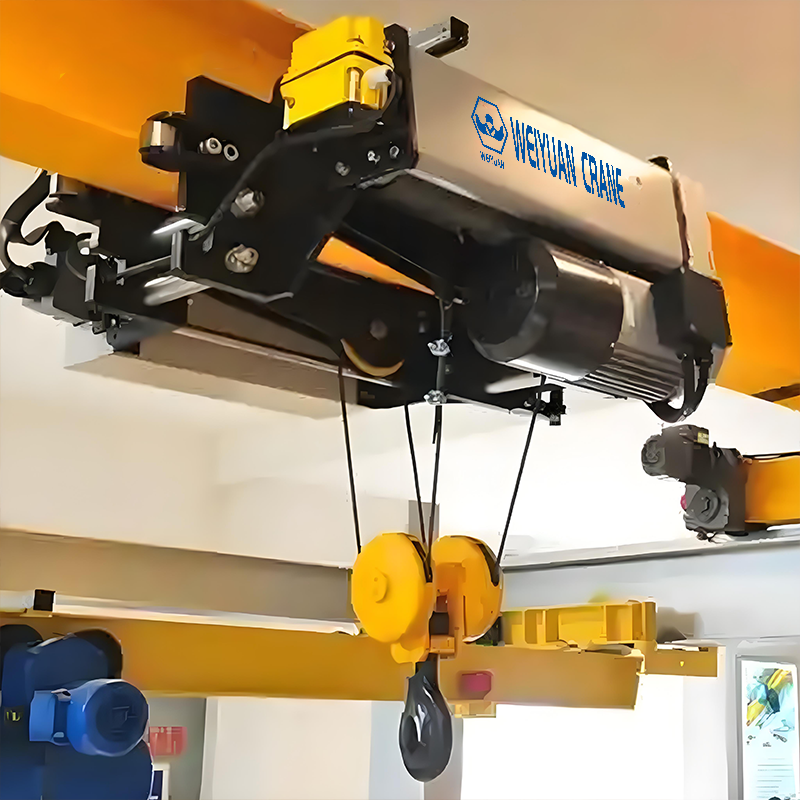
The mount type decides how an electric chain hoist connects to your structure. Most buyers focus all their attention on the lifting capacity and the hoist brand, then pick the mount type from whatever the supplier lists first.
That is a costly habit. The wrong mount type locks the hoist into a fixed spot when you needed it to travel, forces an operator to drag loads by hand when you needed motorized movement, or bolts the hoist to a structure that was never sized to carry it.
A hook-mounted hoist on a beam that needs horizontal coverage leaves the operator unable to reach half the work area. A fixed lug-mount hoist installed where the load must move along a line turns every lift into a re-rigging job. A trolley-mounted hoist specified for the wrong beam flange wears out its wheels years early and tracks poorly the whole time.
This guide explains the four main electric chain hoist mount types, where each one fits, and how to select the right one for your application — so the hoist you buy matches the way you actually work.
Part 1: What a Chain Hoist Mount Type Does
The mount type is the interface between the hoist and your building or crane structure. It determines two things: where the hoist can sit, and whether it can move.
An electric chain hoist lifts a load vertically with a motor-driven chain and sprocket. The mount type handles everything else — how the hoist hangs, what it hangs from, and whether the load can travel sideways once it is in the air.
The mount must:
- Carry the full hoist weight plus the rated load — with the dynamic impact factor applied.
- Transfer that load cleanly into the supporting structure, whether that is a hook anchor, a beam flange, or a fixed bracket.
- Hold the hoist at the correct position and orientation so the chain runs true and does not rub the guide.
- Suit the horizontal movement your application needs — none, manual, or motorized.
Every mount type carries the same rated capacity logic: the supporting point must hold the hoist dead weight plus the rated load, with margin. A 2-tonne hoist on a 2-tonne-rated hook point is already at full capacity before the first lift. The structure behind the mount must always exceed the combined load — this is the check buyers skip most often, and the one that causes the most expensive failures.
The four mount types in this guide differ entirely in this interface — not in how they lift, but in how they connect and whether they move.
Part 2: Mount Type 1 — Hook-Mounted Chain Hoist
How It Works
A hook-mounted chain hoist hangs from a top hook that latches onto a fixed anchor point — a beam clamp, a padeye, a lifting eye, or a structural attachment. The hook includes a safety latch that prevents the hoist from jumping off the anchor under shock load.
This is the most flexible mounting method. The hoist can be unhooked and moved to a different anchor point in minutes, with no tools and no structural work. It is the default configuration for general-purpose lifting.
When Hook-Mounted Hoists Are Correct
Single fixed lifting points: where the load is always picked up and set down in the same spot, a hook mount on an overhead anchor handles the job with no need for horizontal travel.
Applications needing portability: if the same hoist serves several work points across a facility, the hook mount lets you move it from one anchor to the next as work demands. One hoist covers multiple stations.
Temporary or short-term installations: maintenance jobs, project work, and seasonal tasks where a permanent mount is not justified. The hook mount installs and removes in minutes.
Lower budget, general-duty lifting: the hook mount is the simplest and cheapest configuration, ideal when the application does not require movement or permanent fixing.
Limitations of Hook-Mounted Hoists
No horizontal travel: the load can only be lifted and lowered at the anchor point. Moving it sideways means re-rigging to a different anchor — slow and impractical for repeat work.
Anchor point dependency: the hoist is only as safe as the anchor it hangs from. Each anchor point must be independently verified to carry the combined hoist and load weight — a check that is easy to overlook when moving the hoist around.
Potential for swing during use: because the top hook allows the hoist to pivot slightly, the load can swing more than with a rigidly mounted hoist.
2026 Price Reference (Hook-Mounted Chain Hoist)
- Capacity 250 kg to 1 tonne: $350 to $900
- Capacity 1 tonne to 3 tonnes: $700 to $2,000
- Capacity 3 tonnes to 5 tonnes: $1,800 to $4,500
Part 3: Mount Type 2 — Trolley-Mounted Chain Hoist (Manual Travel)
How It Works
A trolley-mounted chain hoist attaches to a manual trolley that runs along the bottom flange of a beam or monorail. The operator moves the hoist and load horizontally by pushing the load, or by pulling a hand chain on a geared trolley version. The hoist hangs below the trolley and travels with it.
This configuration turns a single lifting point into a line of coverage along the full length of the beam. The load can be picked up at one end and carried to the other without re-rigging.
When Trolley-Mounted Hoists Are Correct
Loads that move along a line: production flows, assembly sequences, and loading bays where material moves from one point to another along a defined path. The beam sets the travel line and the trolley follows it.
Moderate cycle frequency: manual trolley travel suits applications with occasional to moderate horizontal movement — the operator guides the load by hand without continuous heavy effort.
Short to medium travel distances: below roughly 10 metres, manual travel keeps operator effort reasonable. The geared trolley version handles heavier loads with a hand chain when pushing becomes difficult.
Applications where the operator follows the load: when precise placement requires the operator to walk with the load and make fine adjustments, manual trolley travel gives that direct, hands-on control.
Limitations of Trolley-Mounted Hoists
Operator effort on heavier loads: pushing or hand-chaining a heavy load across a long beam is physically demanding. Above 2 to 3 tonnes or beyond 10 metres, manual travel becomes a fatigue and safety concern.
No speed control: the operator sets the pace. Sudden starts and stops cause load swing that must be controlled by hand.
Beam compatibility is critical: the trolley wheels must match the beam’s flange width exactly. A mismatch causes rapid wheel and flange wear — covered in Part 6.
2026 Price Reference (Trolley-Mounted Chain Hoist, Manual)
- Capacity 500 kg to 1 tonne: $550 to $1,400
- Capacity 1 tonne to 3 tonnes: $1,000 to $2,800
- Capacity 3 tonnes to 5 tonnes: $2,400 to $5,500
Part 4: Mount Type 3 — Fixed / Lug-Mount Chain Hoist
How It Works
A fixed or lug-mount chain hoist bolts directly to a structure through mounting lugs or a bracket built into the hoist body. There is no hook and no trolley — the hoist is permanently fixed in one position and orientation.
The lug mount creates a rigid, secure connection with no pivot and no movement. The hoist becomes a permanent part of the installation, sized and positioned for one specific lifting task that repeats in the same place.
When Fixed / Lug-Mount Hoists Are Correct
Permanent single-position lifting: machine feeding, fixed workstation lifting, and dedicated lift points where the load is always handled in exactly the same spot. The fixed mount removes any swing or repositioning.
Built-in machinery and equipment: where the hoist is integrated into a larger machine or system — test rigs, production equipment, tensioning systems — and must stay locked in a defined position.
Tight or awkward spaces: where there is no room for a trolley or a swinging hook, the lug mount fits the hoist rigidly into a confined location.
Maximum stability under load: because the mount is rigid, the load does not swing on the mount itself. This suits precise, repeatable lifts and any application where load movement on the mount is unacceptable.
Limitations of Fixed / Lug-Mount Hoists
Zero flexibility: the hoist cannot move or be repositioned without unbolting and reinstalling. It serves one point only.
Structural design required up front: the mounting structure must be engineered to carry the load at that exact point before installation. Getting this wrong means redesigning the mount, not just moving the hoist.
Not suited to changing workflows: if the application or layout changes, a fixed hoist often has to be removed and remounted — far less adaptable than a hook or trolley mount.
2026 Price Reference (Fixed / Lug-Mount Chain Hoist)
- Capacity 500 kg to 1 tonne: $450 to $1,100
- Capacity 1 tonne to 3 tonnes: $900 to $2,400
- Capacity 3 tonnes to 5 tonnes: $2,000 to $5,000
Part 5: Mount Type 4 — Motorized Trolley Chain Hoist with VFD
How It Works
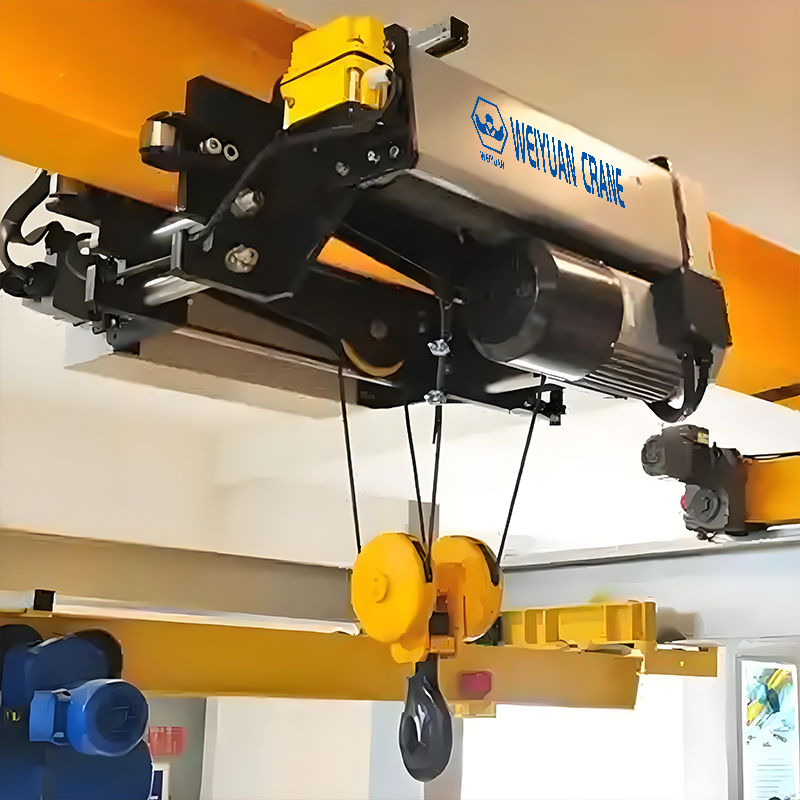
A motorized trolley chain hoist combines the hoist with an electric-drive trolley. A travel motor powers the trolley wheels, and the operator controls direction and speed from the pendant. Adding variable frequency drive (VFD) control makes the trolley accelerate and decelerate smoothly rather than snapping on and off.
The VFD removes the abrupt starts and stops that cause load swing. The trolley eases up to speed, holds a steady travel rate, and slows gently to a stop — so the load arrives without the pendulum oscillation a plain on/off drive produces. A slow-speed setting allows precise final positioning.
When Motorized Trolley Hoists Are Correct
High cycle frequency: where horizontal travel repeats many times per shift, the motorized trolley removes operator effort entirely. The operator presses a button instead of pushing the load.
Long travel distances: above roughly 10 metres, motorized travel covers the distance consistently without fatigue and at a repeatable speed every cycle — which makes material handling times predictable.
Heavier loads: for any load where manual travel would create ergonomic risk, motorized travel should be the default. The drive does the work the operator otherwise would.
Precision placement and reduced swing: the VFD’s smooth acceleration and slow-speed positioning suit die changing, machine loading, and assembly work where load swing prevents accurate placement. Less swing also means a safer load.
Consistent, plannable cycle times: because the trolley travels at a set speed every time, cycle times are repeatable — supporting predictable throughput and better production planning.
Limitations of Motorized Trolley Hoists
Higher cost: the travel motor, drive, and VFD add substantially to the price over a manual trolley or hook mount.
Power supply required: the trolley drive needs electrical power along the full travel length — a busbar or cable management system — which must be planned before installation.
More components to maintain: the travel motor, drive electronics, and controls add maintenance points a manual mount does not have.
2026 Price Reference (Motorized Trolley Chain Hoist with VFD)
- Single-speed motorized, 1 to 3 tonnes: $1,800 to $4,000
- VFD-controlled, 1 to 3 tonnes: $3,000 to $6,500
- VFD-controlled, 3 to 5 tonnes: $5,000 to $11,000
- VFD-controlled, 5 to 10 tonnes: $9,000 to $20,000
Part 6: Beam and Structure Compatibility — Critical Check Before Ordering
Flange Width and Wheel Tread Width (Trolley Mounts)
For any trolley-mounted hoist — manual or motorized — the trolley wheels must match the beam’s lower flange width. The wheel tread must be wider than the flange, typically by about 25mm per side.
Required wheel tread width = flange width + 50mm minimum.
Example: a beam with a 100mm flange needs a minimum wheel tread of 100 + 50 = 150mm.
If the wheel tread is too narrow, the wheel rides on the flange edge instead of the flat face. Contact stress concentrates at the edge, and both the wheel and the flange wear rapidly — turning a 10-year wheel life into 2.
Beam Section Must Be Specified Exactly
Different beam sections have different flange widths. A trolley sized for one beam will not automatically run correctly on another, even at the same beam depth. Always specify the exact beam section when ordering a trolley-mounted hoist — the flange width, not just the depth, is the parameter that matters.
Anchor and Bracket Capacity (Hook and Fixed Mounts)
For hook-mounted hoists, every anchor point must be independently verified to carry the combined hoist and rated load with the dynamic factor applied. A beam clamp or padeye rated below the combined load is the most common cause of mount failure.
For fixed lug-mount hoists, the mounting structure must be engineered for the load at that exact point before installation — including the bolt pattern, the bracket, and the structure behind it.
Headroom and Clearance
Confirm the hoist’s headroom dimension — the distance from the top mount to the hook at its highest position — fits within your available height. A trolley adds to this dimension compared with a hook mount. Check that the hoist at full lift clears the beam, the structure, and any obstructions before ordering.
Frequently Asked Questions
Q: Can I start with a hook-mounted hoist and switch to a trolley mount later?
A: Often yes, but plan it in advance. Many electric chain hoists accept either a hook mount or a trolley mount on the same hoist body, so the hoist itself can carry over. The catch is the beam: a trolley mount needs a beam with the correct flange width and adequate capacity for the rolling load, plus end stops. If you expect to add horizontal travel later, install a suitable beam from the start so the upgrade is a trolley swap rather than a structural project. Confirm with the manufacturer that a trolley version exists for your specific hoist model before buying.
Q: How do I choose between a fixed lug mount and a hook mount for a single lifting point?
A: It comes down to stability versus flexibility. A fixed lug mount holds the hoist rigidly with no swing, which suits a permanent, precise, repeatable lift integrated into machinery or a fixed workstation. A hook mount is far more flexible — you can move the hoist to another anchor in minutes — but it allows slight pivoting and swing. If the lifting point will never change and you want maximum stability, choose the lug mount. If there is any chance you will need the hoist elsewhere, the hook mount keeps your options open.
Q: Does the mount type affect how much overhead space the hoist needs?
A: Yes. The mount type changes the headroom — the distance from the supporting structure to the hook at its top position. A trolley mount sits the hoist below the trolley, adding to that dimension, while a hook or lug mount can position the hoist closer to the structure. In buildings with tight clear height, this difference directly affects your available hook height. Always check the manufacturer’s headroom figure for the specific mount type against your real overhead clearance before ordering.
Q: Which mount type gives the lowest total cost over the life of the hoist?
A: For a true single-point lift with no travel needed, a hook mount or fixed lug mount has the lowest purchase and maintenance cost — there is no trolley or drive to buy or service. For applications that need horizontal movement, the honest comparison is operational, not just upfront: a manual trolley costs less to buy but adds operator effort every cycle, while a motorized VFD trolley costs more but removes that labor and delivers repeatable cycle times. Match the mount to how often you actually move the load, and the lowest lifetime cost usually follows.