


Jib Crane Duty Cycle Calculator: Matching Work Class to Your Actual Lift Frequency
Introduction
Two facilities buy the same jib crane. Same capacity, same outreach, same hoist. Three years later, one crane is still running like new, and the other is on its second hoist motor and its second rotation bearing. Nothing was wrong with the crane. The difference was how hard each facility actually worked it — and whether anyone matched the crane to that reality before buying.
This is the specification mistake almost nobody talks about. Buyers scrutinize capacity and reach because those numbers are obvious: can it lift the load, and can it reach the spot? Duty cycle — how often the crane lifts — hides in plain sight, and it is the number that decides whether the crane lasts its full design life or wears out early on work it was never rated for.
Here is how it plays out on the floor. One facility puts a light-duty jib on a busy assembly cell making sixty lifts an hour, because the light-duty unit was cheaper and lifted the load fine on day one. The hoist, brake, and rotation bearing wear through years early, and the “cheap” crane costs more in downtime and rebuilds than the correct crane ever would have. Another facility counts the real lifts on a peak shift first, specs the jib to that duty class, and runs the same cell for its full service life on the original components. Same load. Same reach. The duty-cycle match decided which one paid off.
This final article in the series shows you how to match a jib crane’s work class to your real lift frequency. You will learn:
- What duty cycle actually means for a jib crane, and why it decides service life.
- The CMAA/FEM duty class system (A–F) and how to read it.
- How to calculate lifts per hour and translate that into a work class.
- A step-by-step calculator method you can run on your own station.
- The consequences of under-rating versus over-rating, the inspection intervals each class demands, and the 2026 cost premiums by duty class.
Part 1: What Duty Cycle Means for a Jib Crane
Duty cycle is a measure of how hard a crane works over time — not how heavy a single lift is, but how many lifts, at what average load, at what frequency, over the crane’s life. It is the difference between a crane that lifts occasionally and one that lifts constantly, and it is the input that decides how quickly the wear parts wear out.
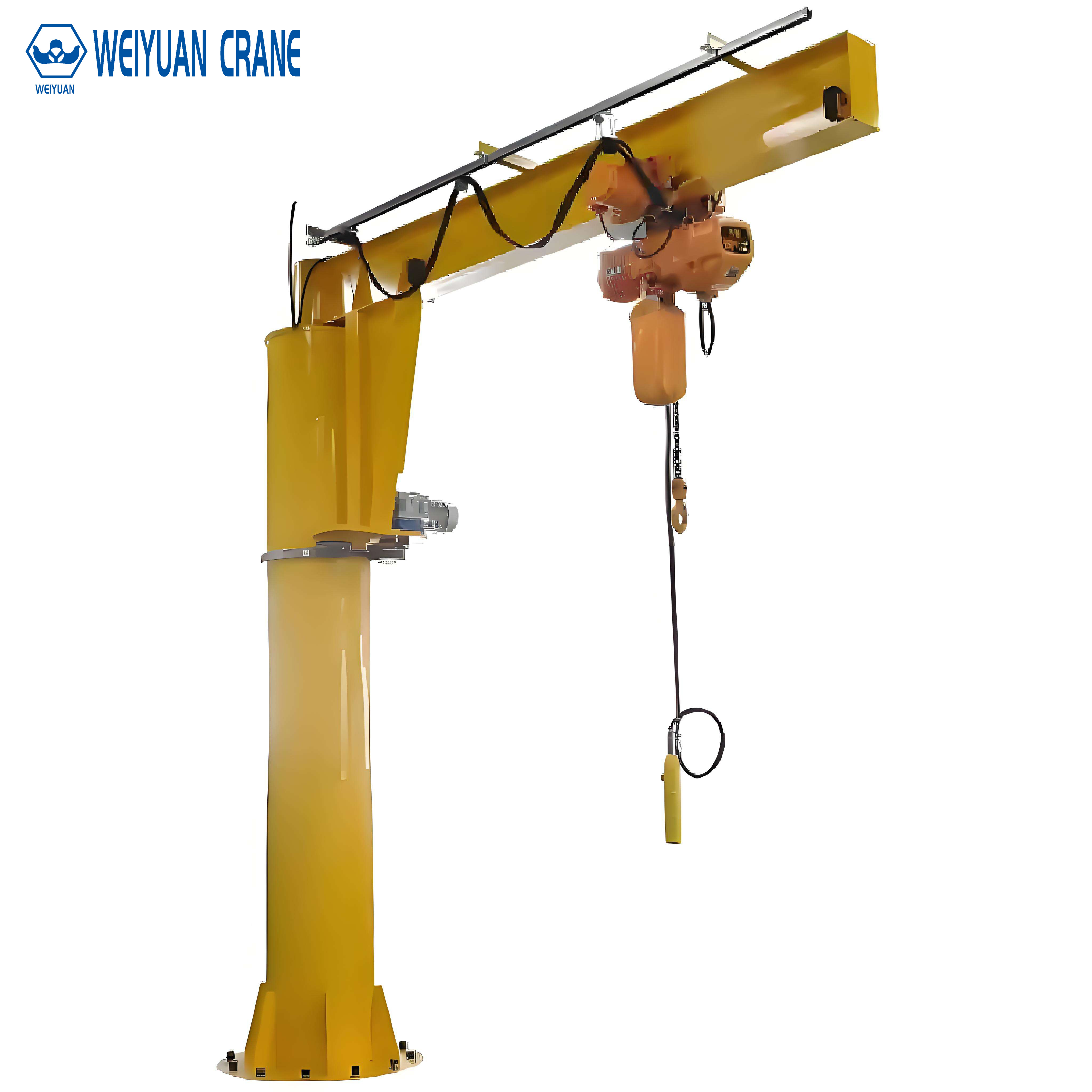
On a jib crane, duty cycle bites hardest at three components, because a jib concentrates its work in a way straight-line cranes do not.
The rotation bearing takes the punishment. A jib pivots its whole boom, hoist, and load around one slewing bearing, and it usually serves the same narrow arc dozens of times a shift. That concentrates wear on a small band of the bearing race, so high cycle counts fatigue it far faster than the modest coverage area suggests. The bearing has no backup — when it goes, the crane stops.
The hoist and brake wear on stops, not weight. Every lift and every stop sacrifices a little brake lining and a little hoist gear life. A jib doing sixty cycles an hour wears its hoist and brake ten times faster than one doing six — at the same load. Duty cycle, not capacity, sets how often you re-line and rebuild.
The motor fails on starts, not pulls. Each start draws an inrush current several times the running current, heating the winding faster than lifting does. A jib motor rarely burns out from one heavy load; it burns out from too many starts per hour on a busy cell — a duty-cycle failure, not a capacity one.
The practical takeaway: duty cycle is how often the jib works, and it governs the life of the rotation bearing, hoist, brake, and motor — the components that actually wear. Capacity decides whether the crane can lift the load; duty cycle decides how long it keeps doing it. Get the second number wrong and the first one stops mattering when the crane fails early.
Part 2: The CMAA/FEM Duty Class System (A–F)
Duty cycle is not guessed — it is classified. The CMAA (Crane Manufacturers Association of America) and FEM (European Materials Handling Federation) standards rate a crane’s service severity on a scale from light to severe, and that class tells the manufacturer how to build the mechanism, and tells you how long it will last. ASME B30.11, the standard governing jib crane construction, inspection, and use, works alongside this duty classification to set your inspection and maintenance obligations.
The class combines two things: the load spectrum (how heavy the loads are relative to rated capacity, on average) and the number of operating cycles over the crane’s design life. A crane that rarely lifts near capacity and cycles seldom sits at the light end; one that lifts near capacity constantly sits at the severe end.
Reading the Classes
| Duty class | Service character | Typical use | Load cycles (design life) |
|---|---|---|---|
| A – B | Light, infrequent | Occasional maintenance lifts, low-use workshops | Under ~100,000 |
| C | Moderate | General workshop and light production | ~100,000 – 500,000 |
| D | Heavy | Regular production, steady daily lifting | ~500,000 – 2,000,000 |
| E | Severe | Busy production, near-continuous lifting | ~2,000,000 – 4,000,000 |
| F | Severe continuous | High-cycle process work, multi-shift | Over ~4,000,000 |
The exact cycle boundaries vary between the CMAA and FEM tables, and the classes carry different labels in each system (FEM uses ratings such as 1Am, 2m, and so on), but the principle is identical: the harder and more often the crane works, the higher the class, and the more robust the mechanism must be to reach its design life.
Why Two Cranes at the Same Capacity Differ by Class
A 2-tonne jib rated Class B and a 2-tonne jib rated Class E lift the same load. The Class E crane costs more because its rotation bearing, hoist, brake, and motor are built for many times the cycles — heavier bearings, a hoist rated for a higher duty group, and a motor with a higher permissible starts-per-hour rating. Buy the Class B unit for Class E work and the load lifts fine; the mechanism simply wears out on a fraction of the life you expected.
The practical takeaway: the CMAA/FEM class is a shorthand for load severity plus cycle count, running A–B (light) through E–F (severe continuous). It is the single number that tells you whether a jib is built for your workload — so it belongs in your specification right beside capacity and outreach.
Part 3: Calculating Lifts Per Hour and Matching to Work Class
The whole duty-cycle decision rests on one number you have to measure rather than estimate: the real lifts per hour at your busiest, not your average. Get this honestly and the work class almost picks itself; guess it low and you buy the wrong crane.
Count Every Cycle, Not Every Load
A common mistake is counting only “complete jobs.” The crane does not wear on jobs — it wears on cycles. Count each of these as work:
- Every hoist start — each raise and each lower is a start on the motor and a wear event on the brake.
- Every rotation — each swing of the boom is a load on the rotation bearing.
- Every inch and re-position — small corrective moves still start the motor and load the bearing.
A single “lift” that raises a load, swings 90°, lowers, releases, and swings back is not one cycle — it is several starts and two rotations. Counting jobs instead of cycles is exactly how a busy cell gets under-rated.
Measure the Peak, Not the Average
Duty class must cover the busiest sustained hour, because that is when the mechanism runs hottest and wears fastest. A cell averaging twenty cycles an hour but peaking at seventy for a two-hour rush is a Class D–E cell, not a Class C one. Observe a real peak shift and tally the cycles over its busiest hour.
Match Cycles Per Hour to Class
Use this as a starting-point guide, then confirm against the manufacturer’s duty tables and your load spectrum.
| Observed cycles per busy hour | Typical shift pattern | Indicative duty class |
|---|---|---|
| Under ~10 | Occasional, single shift | A – B |
| ~10 – 30 | Steady, single shift | C |
| ~30 – 60 | Busy, one to two shifts | D |
| ~60 – 100 | Near-continuous, multi-shift | E |
| Over ~100 | High-cycle process, multi-shift | F |
Adjust for the Load Spectrum
Cycle count is half the picture; average load is the other half. If most lifts are near the rated capacity, push the class up a step, because the mechanism works harder on every cycle. If most lifts are light and only a few approach capacity, the class may hold or ease slightly. Two cells at fifty cycles an hour can land on different classes purely on how heavy their average lift is.
The practical takeaway: count every start and rotation, not just completed jobs; measure the busiest hour, not the average; translate cycles per hour into a class; then adjust for how heavy the average load is. That honest cycle count is the foundation of the whole specification.
Part 4: The Step-by-Step Duty Cycle Calculator Method
Here is a repeatable method to turn a shift observation into a defensible duty class. Run it on your actual station before you request a quote — it takes one busy shift to gather and a few minutes to work through.
Step 1 — Observe a Real Peak Shift
Pick the busiest shift the station runs, not a quiet one. Station someone (or a counter) to record activity through it, and note the busiest continuous hour within that shift. This is your measurement window.
Step 2 — Tally the Cycles in the Busiest Hour
Count within that peak hour:
- Number of hoist starts (each raise + each lower).
- Number of boom rotations.
- Number of corrective inches / re-positions.
Add them into a total operating cycles per peak hour. This is your headline duty number.
Step 3 — Record the Load Spectrum
For the same hour, estimate what fraction of lifts were:
- Heavy (near rated capacity),
- Moderate (around half capacity),
- Light (well below capacity).
A cell that is mostly heavy lifts is more severe than one at the same cycle count but mostly light lifts.
Step 4 — Match Cycles to a Base Class
Take your cycles-per-peak-hour from Step 2 and read the base class off the table in Part 3 (under 10 → A–B, 10–30 → C, 30–60 → D, 60–100 → E, over 100 → F).
Step 5 — Adjust for Load Spectrum and Shift Pattern
- Mostly heavy lifts? Move up one class.
- Multi-shift operation? Move up one class, because the design cycle count accumulates far faster.
- Mostly light, single shift? Hold the base class.
Step 6 — Confirm Against the Standard and the Manufacturer
Take your resulting class to the manufacturer and confirm it against the CMAA/FEM duty tables and the hoist’s own duty group, and confirm the inspection obligations under ASME B30.11 for that class. The manufacturer sizes the rotation bearing, hoist, brake, and motor to the class you specify — so this is the number that must be right.
Worked Example
An assembly cell runs two shifts. On the peak shift, the busiest hour shows 40 hoist starts, 20 rotations, and 10 re-positions — 70 operating cycles. Base class from the table: E. Most lifts are moderate, but the operation runs multi-shift, so it holds at E rather than easing down. Result: specify a Class E jib. A buyer who counted only the “20 finished jobs” that hour would have read Class C off the table and under-rated the crane by two full classes.
The practical takeaway: observe the peak shift, tally every cycle in the busiest hour, record the load spectrum, read the base class, adjust for load and shifts, and confirm with the manufacturer against CMAA/FEM and ASME B30.11. Six steps turn a guess into a specification.
Part 5: Under-Rating vs Over-Rating — The Consequences
The duty class decision has a cost either way, and understanding both errors keeps you from over-correcting. Under-rating is by far the more expensive mistake, but over-rating wastes capital too. The goal is to match, not to guess high or low.
The Cost of Under-Rating
Specifying a class below your real duty is the classic false economy — a lower purchase price that buys a much larger lifetime bill.
- Early bearing failure. The rotation bearing, sized for fewer cycles, fatigues years early on a busy cell — a major, crane-stopping repair.
- Repeated hoist and brake rebuilds. The hoist and brake wear through their life on a fraction of the expected calendar time, forcing re-lines and rebuilds you never budgeted.
- Motor burnout. A motor under-rated for the starts-per-hour overheats and burns out, sometimes more than once.
- Downtime that dwarfs the saving. Each failure stops the station it serves. For a busy cell, the lost output typically exceeds the entire price gap between the classes — many times over.
The Cost of Over-Rating
Specifying far above your real duty is safer but not free.
- Higher purchase price for a heavier bearing, hoist, and motor you will never fully use.
- Capital tied up in capability that sits idle on a light-duty station.
- No reliability penalty — an over-rated crane runs fine, it just cost more than it needed to.
The Match Is the Target
The right answer is a class that covers your real peak duty with a sensible margin — not two classes below to save money, and not two classes above out of caution. A modest step up for uncertainty or expected growth is prudent; a large one is wasted capital. The honest cycle count from Part 3 is what keeps you on target.
The practical takeaway: under-rating trades a small purchase saving for early bearing failure, repeated rebuilds, motor burnout, and downtime that costs many times the saving. Over-rating only wastes capital. Match the class to your measured duty with a small margin, and you avoid both.
Part 6: Inspection Intervals by Duty Class
Duty class does not just size the crane — it sets how often you must inspect it. A busier crane wears faster, so it needs more frequent checks to catch wear before it becomes failure. These intervals align with the periodic inspection required under ASME B30.11, tightened as the class rises.
| Inspection task | Class A–B (light) | Class C–D (moderate–heavy) | Class E–F (severe) |
|---|---|---|---|
| Visual check — hook, latch, rope/chain, structure | Monthly | Weekly | Each shift |
| Rotation bearing condition and play check | Annually | Every 6 months | Quarterly |
| Hoist brake lining and drift test | Annually | Every 6 months | Monthly |
| Hoist gear and motor condition | Annually | Every 6 months | Quarterly |
| Structural and mount connection inspection | Annually | Every 6 months | Quarterly |
| Full mechanism service / rebuild review | On evidence | Every 2–3 years | Annually or on evidence |
Two points make these intervals work in practice. First, bring any check forward the moment a warning sign appears — a rotation bearing that feels notchy, a load that drifts after a stop, a motor running hot, or a boom that deflects more than it used to. Second, record every result and trend it, so a bearing that develops a little more play each check tells you the rebuild window in advance and lets you plan it into a shutdown rather than react to a failure.
The practical takeaway: the higher the duty class, the more often you inspect — from annual checks on a light-duty jib to shift and monthly checks on a severe-duty one, per ASME B30.11. Matching the inspection frequency to the real duty is what turns the duty-class decision into actual service life.
Part 7: 2026 Indicative Price Reference
Use these indicative 2026 figures to understand how duty class drives cost. The base jib price depends on capacity and outreach (covered in Article 1 of this series); the numbers below show the premium each step up in duty class adds, and why matching the class matters to the budget.
Duty Class Premium Over Base (Same Capacity and Outreach)
| Step up | What it upgrades | Premium over base |
|---|---|---|
| Class A–B → Class C | Standard bearing and hoist to moderate-duty group | +10 – 20% |
| Class C → Class D | Heavier rotation bearing, higher hoist duty group | +20 – 35% |
| Class D → Class E | Severe-duty bearing, motor with higher starts rating | +35 – 60% |
| Class E → Class F | Continuous-duty mechanism throughout | +50 – 90% |
Lifetime Cost Comparison — The Real Story
| Scenario | Purchase | Lifetime outcome |
|---|---|---|
| Correct class for the duty | Base + correct premium | Full design life on original components |
| Under-rated by two classes | Lowest purchase | Early bearing failure, repeated rebuilds, motor burnout, heavy downtime |
| Over-rated by two classes | Highest purchase | Full life, unused capability, wasted capital |
Budget Notes
- The duty-class premium is small against the failure it prevents. Stepping up from Class C to the Class E your cell actually needs costs a fraction of one early bearing replacement plus its downtime.
- Cost the downtime, not just the crane. On a busy cell, the lost output from a wrong-class failure usually dwarfs the entire price difference between classes.
- A small margin is cheap; a large one is waste. Budget one step up for uncertainty or growth — not three “to be safe.”
- VFD control extends life at every class. Softer starts and stops reduce the thermal and mechanical wear that duty cycle drives, so the premium pays back through longer component life on high-cycle work.
Frequently Asked Questions
Q: How do I calculate the right duty class for my jib crane?
A: Start by measuring your real lift frequency rather than estimating it, because the duty class is driven by how often the crane works, not by how heavy a single lift is. Observe your busiest shift — not an average one — and within it identify the busiest continuous hour, then tally every operating cycle in that hour: each hoist start counts (a raise and a lower are two starts), each boom rotation counts, and each corrective inch or re-position counts. That total is your operating cycles per peak hour, and it is the headline number, because counting only “finished jobs” is exactly how busy cells get under-rated by a class or two. Read a base class off the cycle guide — roughly under 10 cycles per hour is Class A–B, 10–30 is C, 30–60 is D, 60–100 is E, and over 100 is F — then adjust for two things: if most lifts are near rated capacity, move up a class because the mechanism works harder on every cycle, and if you run multiple shifts, move up a class because the design cycle count accumulates far faster. Finally, take your resulting class to the manufacturer and confirm it against the CMAA/FEM duty tables and the hoist’s own duty group, and confirm the ASME B30.11 inspection obligations for that class. The manufacturer sizes the rotation bearing, hoist, brake, and motor to the class you specify, so this measured number — not a guess — is what must be right.
Q: What happens if I buy a jib crane with too low a duty class?
A: The crane will lift your load fine on day one, which is exactly what makes under-rating such a common and costly mistake — the problem does not show up until the mechanism starts wearing out years before it should. A jib crane concentrates its work on a few components, so under-rating attacks them in order: the rotation bearing, sized for fewer cycles than your cell actually runs, fatigues early and fails as a major crane-stopping repair; the hoist and brake wear through their design life on a fraction of the expected calendar time, forcing re-lines and rebuilds you never budgeted; and the motor, under-rated for the starts per hour a busy cell demands, overheats and burns out, sometimes more than once. Each of those failures stops the station the crane serves, and for a busy production cell the lost output from that downtime typically exceeds the entire price difference between the class you bought and the class you needed — many times over. So the “saving” from buying a lower class is really a deferred bill that arrives with interest, in repairs plus downtime. The fix is to count your real peak-hour cycles and load spectrum first, specify the class that covers them with a small margin, and treat the duty class as a core specification alongside capacity and outreach rather than a place to economize.
Q: Is it worth paying more for a higher duty class than I think I need?
A: A modest step up is prudent; a large one is wasted money — so the answer is to buy a small margin, not a big one. Over-rating carries no reliability penalty: a crane built for a heavier duty than you run will work perfectly, it simply cost more than it had to, tying up capital in bearing, hoist, and motor capability that sits partly idle. Under-rating, by contrast, carries a real and expensive penalty in early failures and downtime, so the two errors are not symmetrical — being one class high wastes some capital, while being one class low can cost you the crane’s expected life. That asymmetry is why a single step up for genuine uncertainty, or for growth you can reasonably foresee in the station’s workload, is sensible insurance and usually cheap relative to the failure it guards against. What is not sensible is jumping two or three classes “to be safe,” because the premium climbs steeply — a step from Class E to F can add 50 to 90% over the base — and you rarely recover that in extra life if the real duty never reaches it. The disciplined approach is to measure your peak-hour cycles and load spectrum, land on the class that honestly covers them, then add exactly one step of margin if there is real uncertainty — enough to protect against being wrong on the low side without paying for capability you will never use.