



Cranes
Wall-Mounted vs. Pillar-Mounted: A Strategic Guide to Selecting the Right Jib Crane for Your Layout
Choosing the right material handling equipment is a critical decision that directly impacts your facility’s efficiency, safety, and use of space. When it comes to localized lifting, the jib crane is an indispensable tool. It provides a dedicated lifting solution for a specific workstation, eliminating bottlenecks and empowering operators. However, not all jib cranes are created equal. The two most common configurations, wall-mounted and pillar-mounted (also known as a free standing jib crane), offer distinct advantages depending on your facility’s layout and operational needs.
Making the right choice between these two powerful options requires a clear understanding of your structural capacity, desired coverage area, and workflow. This guide will walk you through a strategic comparison to help you select the ideal jib crane for your environment, ensuring you maximize your return on investment.
1. Product Description: Two Solutions, One Goal
Both wall-mounted and pillar-mounted jib cranes are designed to achieve the same primary goal: to lift and move materials within a semi-circular or full circular area with precision and ease. They serve individual workstations, freeing up larger overhead cranes for heavier, facility-wide lifts.
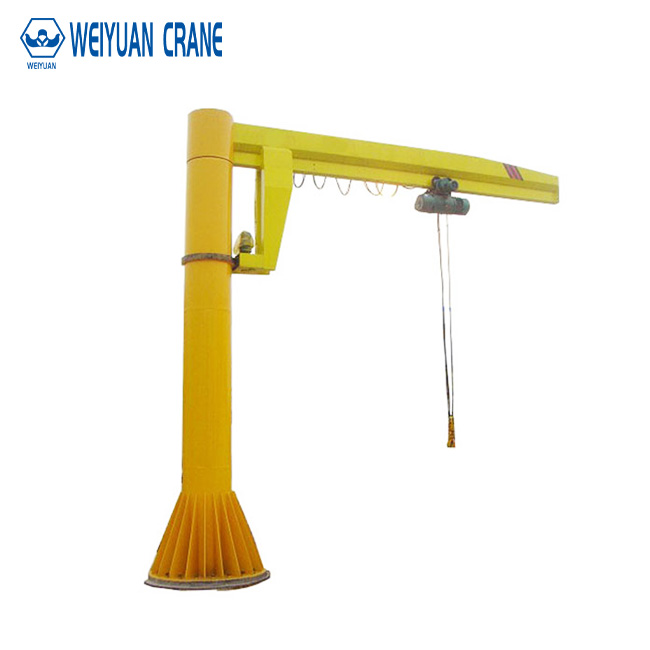
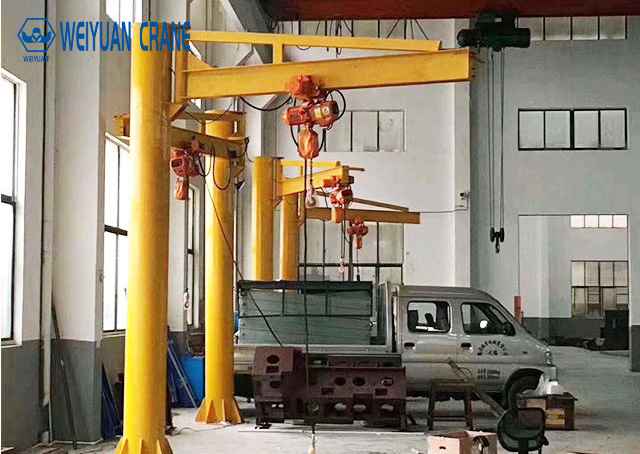
- Pillar-Mounted Jib Cranes: These are the workhorses of localized lifting. A freestanding jib crane consists of a vertical steel pillar bolted to a reinforced concrete foundation, with a rotating boom (the jib) attached. Their key advantage is independence; they can be installed anywhere in your facility with a suitable foundation, offering 360° rotation and extensive coverage.
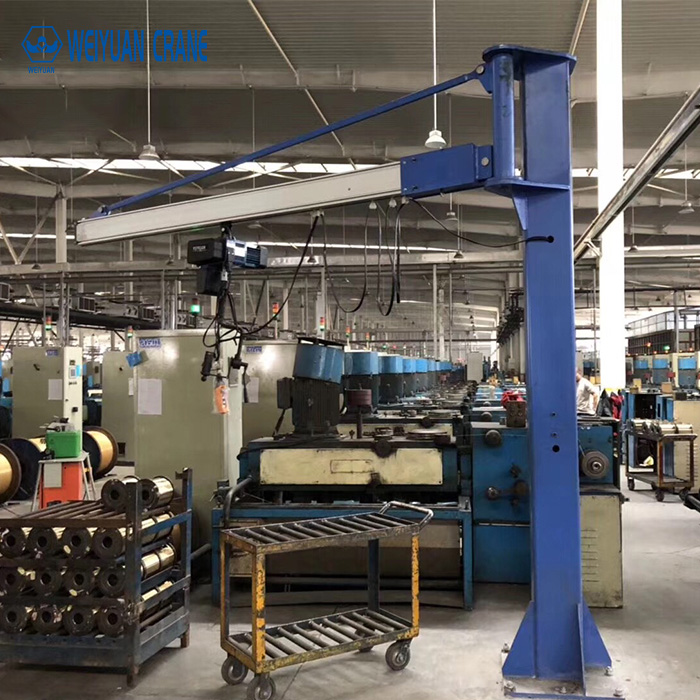
- Wall-Mounted Jib Cranes: This configuration is the ultimate space-saver. The crane is mounted directly onto a structurally sound wall or building column, eliminating the need for any floor foundation. It’s an excellent choice for facilities with existing, robust support structures, providing a 180° to 270° rotation without consuming any valuable floor space.
2. Features and Benefits: A Head-to-Head Comparison
While both types enhance productivity, their features offer different benefits.
Pillar-Mounted Jib Crane
Key Features:
- 360° Boom Rotation: Provides complete circular coverage, maximizing the usable work area.
- Independent Foundation: Does not rely on building structures for support, offering placement flexibility.
- High Capacity Range: Can be engineered to handle heavier loads, often up to 15 tons.
- Versatile Installation: Can be installed indoors or outdoors.
Core Benefits:
- Maximum Coverage: Ideal for open areas or central workstations that need to serve multiple points.
- Structural Independence: Perfect for buildings that cannot support the load of a wall-mounted crane.
- Heavy Lifting: The robust foundation allows for higher capacity models, like a 2 ton jib crane and above.
Wall-Mounted Jib Crane
Key Features:
- Zero Floor Footprint: Mounts to an existing wall or column, keeping the floor clear.
- 180°-270° Rotation: Offers a wide arc of coverage along walls or in specific work cells.
- Lower Installation Cost: Avoids the expense and time associated with pouring a concrete foundation.
- Ideal for Obstructions: Can be positioned above machinery or other obstacles.
Core Benefits:
- Space Optimization: The best solution for crowded workshops or when floor space is at a premium.
- Cost-Effective Setup: Generally less expensive and faster to install, provided your structure is adequate.
- Targeted Workflow: Excellent for serving a series of workstations arranged along a wall.
3. Technical Specifications
Our jib cranes are built to precise standards, with specifications that can be adapted to your needs.
- Lifting Capacity:
- Pillar-Mounted: 250 kg to 15 tons
- Wall-Mounted: 125 kg to 5 tons
- Arm Length (Span): 2 meters to 12 meters for both types.
- Rotation:
- Pillar-Mounted: Standard 270° or 360° (manual or motorized)
- Wall-Mounted: Standard 180° (up to 270° with custom fittings)
- Materials: High-grade structural steel (Q235B/Q355B) for all load-bearing components.
- Power Requirements: 220V-690V, 50/60Hz, 3-Phase for powered hoists and rotation.
- Control: Standard pendant control with emergency stop; optional wireless remote control.
4. Customization Options
Standard models don’t always fit unique challenges. WEIYUAN, a dedicated manufacturer with integrated design and production capabilities, offers complimentary design consultation and deep customization to create the perfect lifting solution for you.
Our customization services include:
- Tailored Capacity & Span: We engineer the crane to your exact load and reach requirements.
- Height & Clearance: The height under the boom is fully adjustable to fit your facility.
- Articulating Jib Arms: An articulated jib crane can be designed for either mounting type, allowing the boom to navigate around corners and obstacles.
- Specialized Finishes: We offer galvanized or epoxy paint finishes for outdoor, marine, or corrosive environments.
- Hoist Integration: We can supply a complete jib crane and hoist package or design the crane to fit your existing hoist unit.
- Motorization: Powered rotation can be added for heavier loads or to improve positioning accuracy.
5. Application Areas
The choice between a pillar-mounted and wall-mounted jib crane often comes down to the specific application.
- Pillar-Mounted Cranes are ideal for:
- Open-plan workshops requiring a central lifting point to serve multiple machines.
- Outdoor loading docks and storage yards.
- Facilities where building columns are not suitably located or strong enough.
- Wall-Mounted Cranes excel in:
- Assembly lines where materials need to be moved sequentially along a wall.
- Individual machining cells where floor space is limited.
- Loading and unloading tasks near building entry/exit points.
6. Safety and Compliance
Your team’s safety is our highest priority. All our cranes are designed and manufactured to meet stringent international safety standards, ensuring reliable and secure operation.
- Structural Integrity: We conduct thorough engineering reviews to ensure the selected crane type is appropriate for your facility’s structure. For wall-mounted cranes, this includes verifying the load-bearing capacity of the wall or column.
- Compliance: Upon request, our products can be certified to meet specific regional standards, such as CE for the European market.
- Safety Features: All cranes include overload protection, emergency stop functions, and high-visibility warning labels. Pillar-mounted models come with detailed foundation requirements to ensure stability.
7. Case Studies
Case Study 1: Pillar-Mounted Crane in a Fabrication Shop
A metal fabrication company needed a lifting solution for a central welding and assembly area. The building’s roof structure was unsuitable for an overhead crane. WEIYUAN designed and installed a 3-ton free standing jib crane in the center of the workspace. Its 360° rotation allowed a single operator to lift heavy steel plates from a staging area, position them in a welding jig, and then move the finished assembly to an outbound pallet, improving workflow for three separate workstations.
Case Study 2: Wall-Mounted Cranes in an Electronics Assembly Plant
An electronics manufacturer needed to lift and position delicate chassis components along a 30-meter assembly line. Floor space was extremely tight, filled with conveyors and test equipment. The solution was a series of ten small jib crane units (wall-mounted) installed on the building’s support columns. This gave each workstation its own dedicated lifting device without adding any footprint, eliminating manual handling and reducing product damage.
8. Installation and Support
As a manufacturing enterprise that integrates design, sales, and installation, we provide end-to-end support.
- Installation: We offer professional on-site installation by our technical teams. Alternatively, we provide highly detailed installation manuals, foundation plans (for pillar-mounted cranes), and live video support to guide your local crew through a safe and efficient setup.
- After-Sales Service: Our commitment continues long after installation. We provide comprehensive operational training, maintenance schedules, and ready access to a full inventory of jib crane parts to ensure maximum uptime.
9. Pricing and Quotes
The investment for a pillar-mounted crane includes the cost of the foundation, while a wall-mounted crane’s cost depends on the need for structural reinforcement. To provide an accurate and competitive price, we offer a personalized quoting process.
Contact our team for a no-obligation consultation. We will help you analyze your needs and provide a detailed proposal comparing the costs and benefits of each option for your specific application.
10. Delivery Timeline
Our typical manufacturing and delivery timeline is between 15 and 30 working days after the final design approval. This timeframe can vary based on the level of customization and project complexity. A firm delivery schedule will be provided with your formal quotation.
11. FAQ: Common Questions Answered
Q1: How do I know if my wall can support a wall-mounted jib crane?
A qualified structural engineer must inspect your wall or column to verify its capacity. We can provide the load information your engineer will need to make this assessment.
Q2: Is a pillar-mounted jib crane more expensive?
The crane itself may not be, but the total project cost can be higher due to the need for a concrete foundation. However, its flexibility and higher capacity can provide a better long-term value.
Q3: Can an articulating arm be used on both types of cranes?
Yes, an articulated jib crane design can be applied to both wall-mounted and pillar-mounted configurations to help navigate around columns, doorways, or other obstructions within the work cell.
Q4: What is the jib of a crane?
The “jib” is the horizontal beam or boom of the crane upon which the hoist travels. Its length determines the crane’s reach or span.
Q5: Are there mobile options available?
Yes, in addition to fixed cranes, there are mobile jib crane designs. These are smaller, portable units on wheels, designed for light-duty tasks and maximum flexibility, but they serve a different purpose than robust, permanently installed workstation cranes.