


Gantry Crane Safety: A Complete Guide
In any industrial setting, from a bustling shipyard to a precision manufacturing floor, a gantry crane is a monumental asset for productivity. It moves materials that would otherwise be impossible to handle. However, with great power comes great responsibility. A single miscalculation or overlooked maintenance task can lead to catastrophic failures, costly downtime, and, most importantly, severe safety risks for personnel.
Understanding and implementing rigorous safety protocols is not just a matter of compliance; it is the foundation of a safe and efficient operation. This guide covers the essential pillars of gantry crane safety: international standards, thorough inspection checklists, understanding safe lifting capacity, and the critical role of operator training.
Core Gantry Crane Safety Standards
Safety isn’t arbitrary. It’s governed by a set of globally recognized standards that ensure equipment is designed, manufactured, and operated with the highest level of protection in mind. While local regulations vary, most adhere to principles set by organizations like ISO (International Organization for Standardization), ASME (American Society of Mechanical Engineers), and EN (European Standards).
A reputable manufacturer, like WEIYUAN, designs and builds equipment that strictly follows these international benchmarks. Key areas covered by these standards include:
- Structural Integrity: Mandates specific steel grades (e.g., Q235/Q345) and welding procedures to guarantee the frame can handle its rated load without fatigue or failure.
- Mechanical Components: Defines requirements for wire ropes, hooks, brakes, and gearboxes to ensure they perform reliably under stress.
- Electrical Systems: Sets guidelines for motor protection, emergency stop circuits, and proper grounding to prevent electrical hazards.
- Safety Devices: Requires the integration of critical safety features, which are non-negotiable in modern crane design.
Built-in Safety Devices: Your First Line of Defense
A modern gantry crane is equipped with an array of automated safety features. These are not optional add-ons but essential components that protect both the operator and the machinery.
Overload Limiter
This is arguably the most crucial safety device. It continuously monitors the weight of the load. If the operator attempts to lift something exceeding the safe lifting capacity, the system will automatically halt the hoisting motion, preventing a structural overload that could cause the crane to collapse.
Limit Switches
These devices prevent the crane from moving beyond its operational boundaries.
- Hoisting Limit Switch: Stops the hook from rising too high and colliding with the trolley or girder.
- Traveling Limit Switch: Stops the crane or trolley from hitting the end stops of the rail or beam.
Emergency Stop Button
Placed in the operator’s cabin and on the pendant controller, this red mushroom-shaped button allows for an immediate shutdown of all crane functions in case of a critical event.
Reputable manufacturers integrate these features seamlessly. For instance, WEIYUAN designs cranes with multiple layers of redundancy, ensuring that if one system fails, another provides a backup to maintain safety.
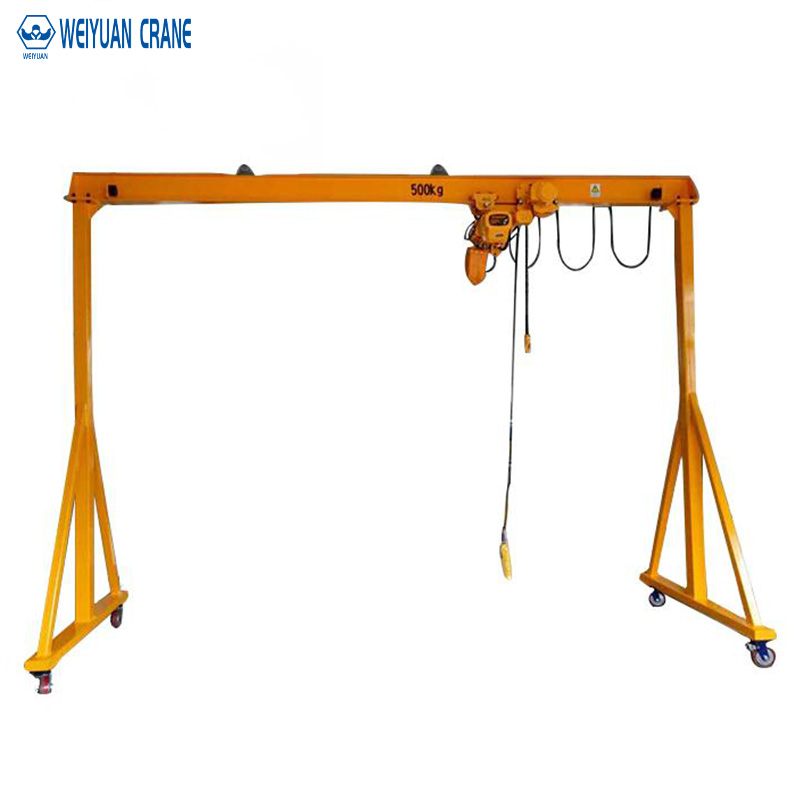
Weiyuan Mobile Single Girder Gantry Crane | 2025 Hot Sale, Portable & Adjustable
The Weiyuan Mobile Single Girder Gantry Crane is a hot-selling portable crane engineered for flexibility, mobility on heavy-duty caster wheels, and customizable span/height options — ideal for workshops, warehouses, and job sites requiring adaptable material handling solutions. :contentReference
View Product / Get QuoteThe Ultimate Crane Inspection Checklist
Regular inspections are the most effective way to identify and fix problems before they lead to accidents. Inspections should be divided into daily checks and periodic, more detailed examinations.
Daily Pre-Shift Inspection (Performed by the Operator)
Before starting any work, the operator should perform a quick visual and functional check.
Your Daily Checklist:
- Work Area: Is the travel path clear of obstacles and personnel?
- Controls: Do the pendant or remote controls function correctly? Is the emergency stop button working?
- Hook and Latch: Is the safety latch on the hook in place and functional? Any signs of stretching or cracks?
- Wire Rope: Is the rope properly seated on the drum and in the sheaves? Any visible signs of fraying, kinks, or broken strands?
- Unusual Noises: During a test run (without a load), are there any grinding, squealing, or other strange sounds?
Periodic Inspection (Monthly/Annually by a Qualified Technician)
A qualified technician must perform a more in-depth inspection at regular intervals. This involves examining components that are not easily visible.
The Professional’s Checklist:
- Structural Components: Check for cracks, corrosion, or deformities in the girders, legs, and end carriages.
- Brakes: Test the holding and motor brakes to ensure they can stop and hold a full load.
- Fasteners: Check for any loose bolts or rivets in the crane’s structure.
- Sheaves and Drums: Look for excessive wear in the grooves where the wire rope runs.
- Electrical Wiring: Inspect for frayed or exposed wires and ensure all connections are secure.
Keeping a detailed log of every inspection is mandatory. This logbook provides a history of the crane’s health and is a critical document for safety audits.
The Importance of Crane Operator Training
You can have the best-built gantry crane in the world, but it is only as safe as the person operating it. Comprehensive crane operator training is not a one-time event; it’s an ongoing commitment.
Effective training programs should cover:
- Operational Knowledge: Understanding the function of every button and lever, including how to smoothly start and stop movements to prevent load swing.
- Load Charts: The ability to read and understand the crane’s load chart, which specifies the safe lifting capacity at different spans and configurations.
- Signaling: Knowing the universal hand signals for crane operations if a signalperson is required.
- Emergency Procedures: Practicing how to react in various emergency scenarios, such as a power failure or a snagged load.
- Daily Inspections: Being proficient in performing the pre-shift checklist.
Investing in certified training ensures that your team not only knows how to operate the equipment but also respects its power and potential hazards.
Conclusion: Safety is a Collective Effort
A safe lifting environment is the result of a partnership between the manufacturer, the management, and the operator. It starts with choosing a well-designed gantry crane from a trusted supplier who prioritizes safety standards. It continues with management’s commitment to a strict inspection and maintenance schedule. Finally, it rests in the hands of a well-trained, vigilant operator.
By making safety the top priority at every stage, you protect your people, your equipment, and your entire operation.
Need to ensure your lifting equipment meets the highest safety standards? Contact the WEIYUAN team today to discuss our crane designs and on-site installation and training support.