


Gantry Crane Safety Guide: Operator Training, OSHA Requirements & Common Hazards
Published by: [Your Brand] Engineering Team | Last Updated: March 2026 | Reading Time: 9 min
Introduction
Gantry cranes are among the most productive material handling systems in industry — and among the most consequential from a safety standpoint. Whether the crane in question is a compact portable shop gantry moving a 1-ton workpiece or a full-span industrial gantry crane traveling on floor-level rails in a steel fabrication yard, the combination of suspended heavy loads, moving machinery, and workers in the vicinity creates a risk environment that demands rigorous safety management at every level.
The statistics are clear and consistent: the Bureau of Labor Statistics and OSHA incident data identify crane-related incidents as a leading cause of fatalities and severe injuries in manufacturing, construction, and logistics operations year after year. The most common fatal outcomes — struck by a suspended load, crane structural failure, and electrocution — are all preventable with the right combination of equipment specification, operator training, operational discipline, and management systems.
This guide provides the complete gantry crane safety framework: the primary hazard categories specific to gantry crane operations, the OSHA regulatory requirements that govern safe use, what effective operator training must include, the daily pre-use inspection practices that catch developing problems before they cause incidents, and the management systems that sustain safe crane operation over the long term.
Part 1: Primary Gantry Crane Hazard Categories
Understanding how gantry crane accidents occur is the foundation of preventing them. Incident investigation data consistently identifies five primary hazard categories in gantry crane operations.
Hazard 1: Struck-By Suspended Load
The leading cause of crane-related fatalities across all crane types. Workers are struck by the suspended load when it swings unexpectedly, when the load is dropped due to rigging failure or equipment failure, or when the crane travels with a suspended load and workers are in the travel path.
Contributing factors specific to gantry cranes:
- Floor-level rail cranes travel through work areas where personnel routinely move, creating elevated risk of workers entering the load travel path
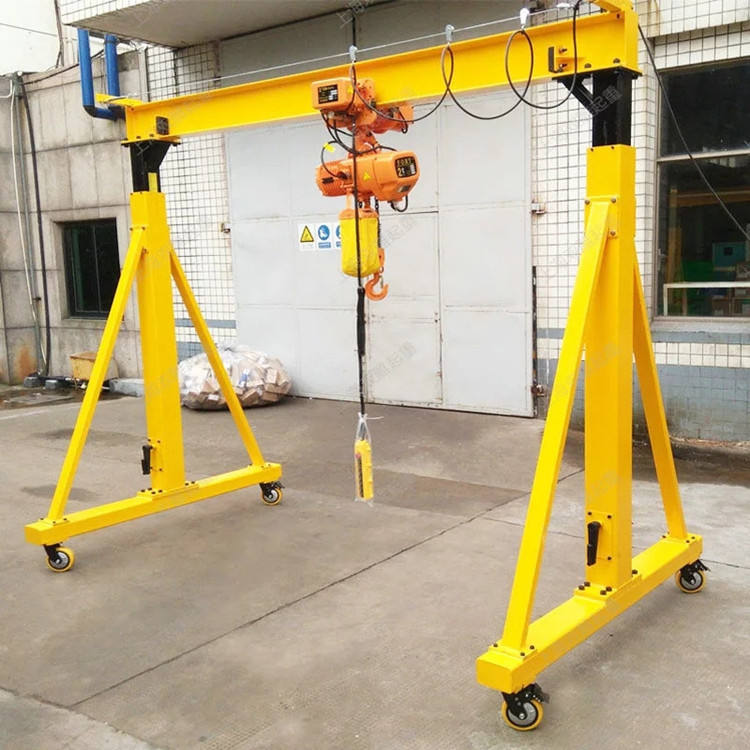
- Portable gantry cranes on caster wheels can be moved by operators who underestimate the swing potential of a suspended load during repositioning
- Inadequate exclusion zone establishment — failure to keep all personnel out of the load travel path during lifts
- Side-pulling (using the gantry crane to drag loads horizontally rather than lifting vertically), which creates uncontrolled load movement
Prevention:
- Establish and enforce absolute exclusion zones beneath and in the path of any suspended load
- Never side-pull with a gantry crane — only vertical lifts
- Use tag lines to control load orientation during travel
- Never leave a suspended load unattended or travel with a load at unnecessary height
Hazard 2: Crane Structural and Mechanical Failure
Gantry crane structural failures — leg collapse, bridge beam failure, end truck failure, and hoist brake failure — while less frequent than struck-by incidents, are among the most catastrophic. They typically result from overloading, deferred maintenance, or incorrect installation.
Contributing factors:
- Overloading beyond rated capacity, which is the single most common cause of structural failure in gantry cranes
- Inadequate foundation for floor-mounted units — insufficient concrete depth or strength causes mast rotation under load
- Side loading on portable gantry cranes — these units are designed for vertical lifting only; lateral forces from uneven surfaces or off-center loads create dangerous bending moments
- Deferred inspection allowing structural cracks, corrosion, and wear to progress to failure
- For wall-mounted jib cranes used as part of a gantry-type system: inadequate structural assessment of the mounting wall
Prevention:
- Never exceed the rated capacity, including all below-hook hardware in the total lifted weight
- Verify foundation adequacy with the crane manufacturer’s specifications before installation of any floor-mounted unit
- Maintain inspection and maintenance schedules rigorously
- Replace structural components showing cracks, deformation, or corrosion beyond manufacturer’s rejection limits
Hazard 3: Rail-Related Incidents (Fixed-Rail Gantry Cranes)
Fixed-rail gantry cranes travel on floor-level rails that run through the working area. These rails create hazards that overhead crane runways — elevated above the work floor — do not.
Contributing factors:
- Workers, forklifts, and vehicles striking the crane legs or end trucks during crane travel
- Personnel tripping over rail tracks embedded in the floor, particularly in low-light conditions or during housekeeping activities
- Load swing during travel striking equipment or personnel adjacent to the crane’s travel path
Prevention:
- Mark rail paths clearly with floor paint, warning signs, and physical barriers at entry points
- Install travel warning lights or audible alarms on the crane bridge that activate whenever the crane is moving
- Train all facility personnel — not just crane operators — on the presence, location, and operating zone of floor-level rail cranes
- Establish clear right-of-way rules between the crane and forklift traffic in shared areas
Hazard 4: Electrical Hazards
Gantry cranes with electric hoists and motorized drives require electrical power delivered to the moving crane bridge via conductor bars, festoon cables, or cable reels. Contact with energized conductors — either by workers performing maintenance near the crane or by rigging materials touching conductor bars — causes electrocution.
Contributing factors:
- Performing maintenance on or near the crane without proper lockout/tagout (LOTO) procedures
- Rigging materials (chains, wire rope slings) swinging into contact with energized conductor bars
- Damaged or deteriorated festoon cable insulation creating unguarded energized surfaces
Prevention:
- Implement and enforce OSHA-compliant LOTO procedures per 29 CFR 1910.147 for all crane maintenance and inspection activities — no exceptions
- Install conductor bar guards in areas where workers may have inadvertent access to energized bars
- Inspect festoon cable and conductor bar systems as part of every frequent inspection
Hazard 5: Portable Gantry Crane Stability
Portable gantry cranes on caster wheels introduce stability hazards that fixed-rail and overhead crane systems do not face. The crane can tip, shift, or roll unexpectedly if stability conditions are not maintained.
Contributing factors:
- Lifting off-center loads that create uneven leg loading
- Attempting to roll a portable gantry crane with a suspended load on uneven or sloped floors
- Exceeding the crane’s rated capacity on any single caster or leg
- Failure to lock all casters before beginning any lift
Prevention:
- Lock all casters before every lift — never lift with any caster unlocked
- Never move a portable gantry crane with a suspended load unless the manufacturer explicitly states this is permitted and provides specific weight and speed limits for doing so
- Level the crane before lifting — portable gantry cranes should only be used on floors with minimal slope (typically less than 1 degree from level)
- Never lift loads that are not centered within the span of the crane bridge
Part 2: OSHA Requirements for Gantry Crane Safety
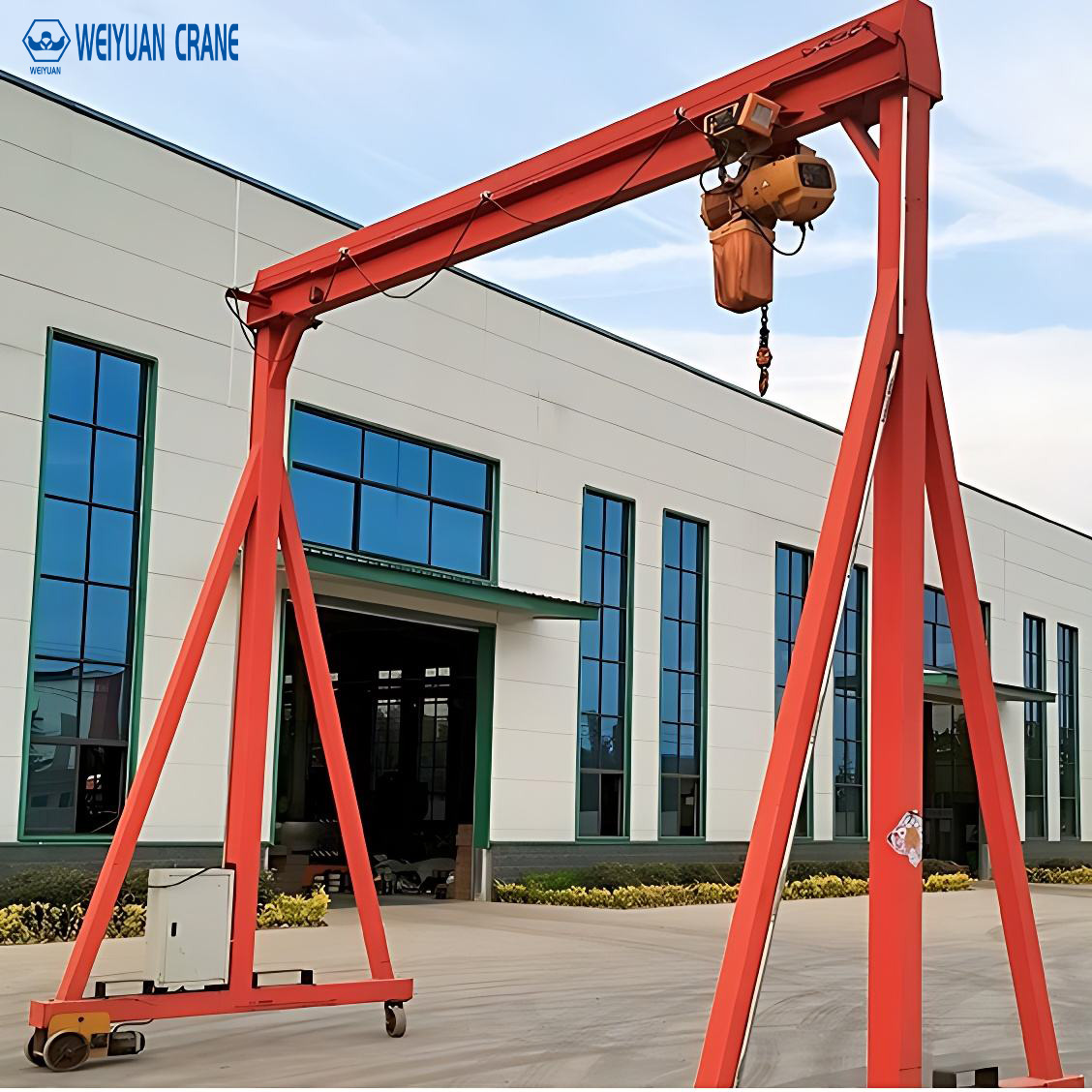
Gantry cranes in U.S. industrial facilities are subject to specific OSHA regulatory requirements. Understanding these requirements is essential for legal compliance and for building an inspection program that will withstand OSHA scrutiny.
Primary OSHA Standards
OSHA 29 CFR 1910.179 — Overhead and Gantry Cranes (General Industry):
The primary federal standard governing gantry cranes in manufacturing, warehousing, and general industrial settings. The standard covers design, installation, inspection, testing, maintenance, and safe operation. Key provisions include:
- Rated load capacity must be marked on the crane and must not be exceeded
- Operators must be trained and designated as qualified
- Pre-use inspections required before each shift
- Frequent inspections required at monthly intervals for light service, weekly to daily for heavy service
- Periodic (annual) inspections required, performed by a qualified person
- Load tests required before placing new or significantly modified cranes in service
OSHA 29 CFR 1926 Subpart CC — Cranes and Derricks in Construction:
Applies to gantry cranes used at construction sites. More prescriptive than 1910.179 in several areas, including operator certification requirements and assembly/disassembly procedures.
ASME B30.2 — Overhead and Gantry Cranes:
Not an OSHA standard but the engineering standard of care that courts and OSHA inspectors reference when evaluating whether a facility’s crane safety program represents reasonable industry practice. Compliance with ASME B30.2 is the professional standard; meeting only OSHA’s minimum requirements without addressing ASME B30.2 is legally defensible but falls below engineering best practice.
Operator Qualification Requirements
OSHA 1910.179 requires that gantry crane operators be trained and designated as qualified by the employer. The standard does not mandate third-party certification for general industry overhead crane operators (unlike construction cranes under 1926 Subpart CC, which do require NCCCO or equivalent certification). However, many facilities voluntarily pursue third-party certification as a best practice and a defense against liability claims.
At minimum, operator training must cover:
- The specific crane’s controls, capacity, and operating characteristics
- Pre-use inspection procedures for that crane
- Safe operating practices: no overloading, no side-pulling, load attachment and rigging requirements
- Emergency procedures: power failure, brake failure, loss of load control
- LOTO requirements for maintenance activities
Part 3: Pre-Use Inspection Checklist for Gantry Cranes
The following checklist should be completed by the operator before every shift. Post a laminated copy at the crane controls.
STRUCTURAL VISUAL INSPECTION:
- Bridge beam shows no visible cracks, deformation, or unusual corrosion
- Legs (for fixed-leg or adjustable units) show no cracks at welds or deformation
- End truck assemblies and wheel mounts show no cracked welds or loose hardware
- For portable units: all joint connections are fully tightened and locked
- Casters (portable cranes): all wheels roll freely, no flat spots, locking mechanisms engage firmly
HOIST AND HOOK:
- Wire rope or chain: no broken wires, kinking, corrosion, or cracked links visible
- Hook: no visible cracks, throat opening within limits, safety latch present and functional
- Hoist body: no unusual noises during no-load operation test
- Upper limit switch: verified functional (slow no-load test — hook stops before contacting hoist body)
- Hoist brake: no drift under no-load hold test (raise hook, release pendant, load should hold position)
RAIL AND TRAVEL SYSTEM (fixed-rail units):
- Rail surface clear of debris for full travel length
- No visible rail joint gaps that would cause impact loading
- End stops present and secure at both ends of travel
- Travel drive operates smoothly in both directions
CONTROLS AND ELECTRICAL:
- Pendant buttons labeled correctly and return to neutral when released
- All travel and hoist functions respond correctly to controls
- Emergency stop (if equipped) tested and functional
- No visible damage to pendant cord or festoon cable
LOAD PATH:
- Area beneath crane travel path clear of personnel and obstructions
- No warning tags or LOTO devices on the crane
IF ANY ITEM FAILS: Tag the crane out of service. Do not operate until the deficiency is corrected by a qualified person.
Part 4: Building an Effective Gantry Crane Safety Program
A crane safety program that works in year one but degrades through turnover and production pressure is not a safety program — it is a compliance exercise. Sustainable programs share these characteristics:
Written procedures: All inspection, operation, and maintenance procedures documented in writing. Available at the crane location (laminated checklists) and in the facility’s safety management system.
Designated responsibility: A specific person assigned ownership of crane safety — responsible for maintaining inspection schedules, tracking operator qualifications, and coordinating annual inspection services.
Documented training records: Signed training records for every designated crane operator. Records of refresher training when new equipment is introduced, when unsafe operation is observed, or on a regular periodic basis.
Non-punitive near-miss reporting: Workers must feel safe reporting near-miss events without fear of discipline. Near-miss reports are advance warning of serious incidents — suppressing them eliminates the best opportunity to prevent the next accident.
Annual safety program audit: Compare the program against current OSHA requirements, ASME B30.2 recommendations, and any changes in crane inventory or operational conditions.
Frequently Asked Questions
Q: Do portable shop gantry cranes fall under OSHA 1910.179?
A: Yes. OSHA 1910.179 applies to all overhead and gantry cranes used in general industry settings, including portable A-frame gantry cranes used in workshops and maintenance bays. The inspection and operational requirements apply regardless of the crane’s size or mobility.
Q: What is the most common OSHA citation related to gantry crane operations?
A: Failure to conduct required inspections — particularly the pre-use daily inspection and the annual periodic inspection — is consistently among the most frequently cited violations under 1910.179. Missing or incomplete inspection records are the most common documentation deficiency.
Q: How do I safely decommission a gantry crane that is no longer in use?
A: A crane that is placed out of service should be physically de-energized (disconnect switch locked out), tagged with a clearly visible out-of-service tag, and — if the risk of inadvertent use exists — physically blocked or secured to prevent accidental operation. If the crane will be idle for more than six months before returning to service, OSHA 1910.179 requires a complete inspection meeting both frequent and periodic inspection requirements before it is placed back in service