


How to Choose the Right Jib Crane for Your Industrial Needs
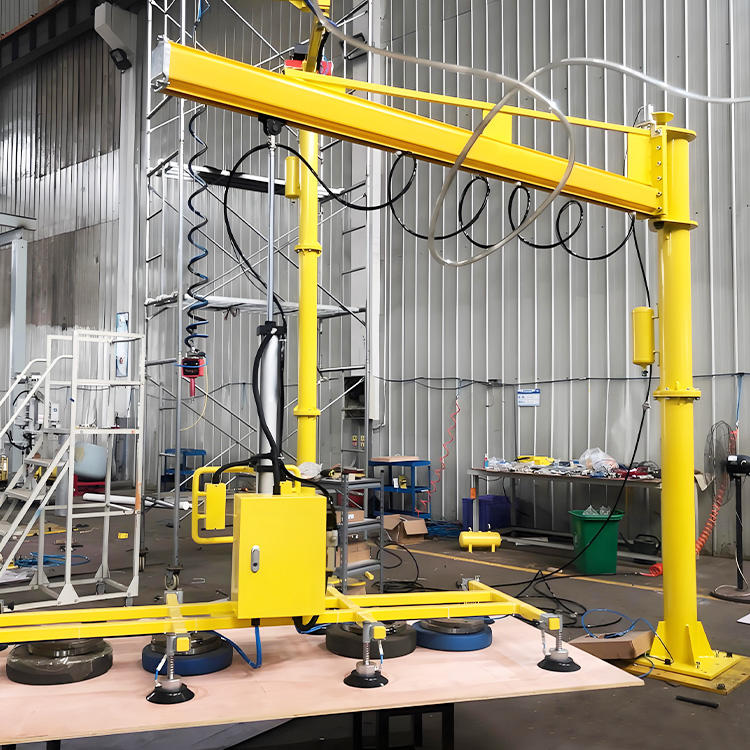
In any high-output industrial facility, efficiency is often won or lost in the smallest movements. While a massive overhead crane system handles the heavy, facility-wide logistics, the real productivity gains come from optimizing the individual workstation. If your skilled operators are waiting for a shared crane or manually handling heavy parts, you are losing valuable production time.
This is where the jib crane becomes a critical tool. Unlike a large-scale system or a heavy-duty Gantry Crane designed for yard operations, the jib crane is a localized powerhouse. It provides dedicated lifting capability to a specific area, ensuring the “micro-logistics” of your shop floor are fast, safe, and efficient.
However, selecting the right jib crane involves more than just matching a weight capacity. It requires a thoughtful analysis of your workflow, facility structure, and long-term goals. This guide will walk you through the key technical and operational factors to ensure your investment is a perfect fit.
1. Start with the Mission: Analyzing Your Lifting Needs
Before looking at crane models, first analyze the task at hand. What problem are you trying to solve? A jib crane’s purpose is to make a specific workstation more productive and safer.
Capacity and the “Future-Proof” Buffer
The Working Load Limit (WLL) is the most important specification. A common mistake is to buy a crane rated for your exact current needs. If your heaviest component is 900 kg, purchasing a 1-ton crane might seem adequate, but a smarter approach is to add a 15-25% capacity buffer. This reduces stress on the hoist and motors, leading to a longer service life and ensuring the crane remains useful if future products are heavier.
Height Under Boom (HUB)
The HUB is the distance from the floor to the underside of the jib’s boom. To calculate this correctly, you must account for the full “stack-up” height:
- The height of the machine or workbench being serviced.
- The height of the load itself.
- The length of all rigging (slings, hooks, or other attachments).
- The headroom of the hoist and trolley.
Getting this wrong can mean you are unable to lift a part high enough to clear equipment, rendering the crane ineffective.
2. Match the Crane to Your Architecture

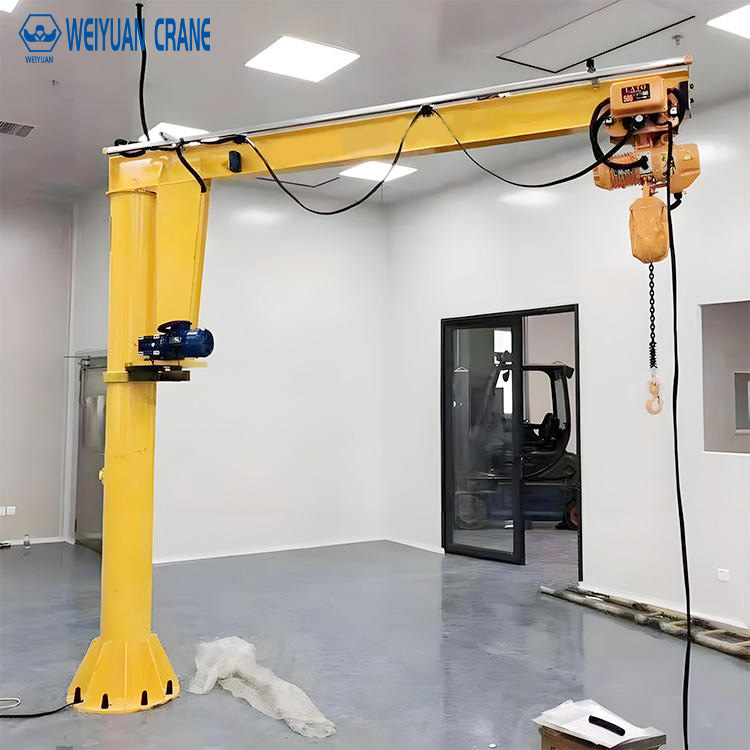
Weiyuan Column Jib Crane
The Weiyuan Column Jib Crane is a versatile and cost-effective lifting solution designed for efficient localized material handling with 360° rotation and robust freestanding structure — ideal for workshops, assembly areas, and maintenance bays.:contentReference
View Product / Get QuoteThere are several primary jib crane configurations, each designed to solve a different spatial challenge.
Freestanding (Pillar-Mounted) Jib Cranes
This is the most common type, featuring a vertical pillar bolted to a concrete foundation. It offers a full 360 degrees of rotation, making it ideal for large, open work areas where one crane needs to service multiple machines. The main consideration is the foundation, which must be engineered to handle the “overturning moment”—the leverage force created by a load at the end of the boom.
Wall-Mounted Jib Cranes
These units require zero floor space, as they are bolted directly to a building’s structural column or wall. They are a cost-effective solution for individual workstations or assembly lines, though their rotation is typically limited to 180–200 degrees. Before installation, a structural engineer must verify that your building can handle the applied forces.
Articulating Jib Cranes
Think of this model as having an “elbow.” Its two-part boom allows the operator to reach around corners, into machine openings, or under obstructions. It offers unmatched maneuverability in crowded work cells where a standard straight boom would collide with other equipment.
3. The Geometry of Span and Rotation
How much floor space do you need the crane to cover?
Boom Span (Reach)
The span is the length of the boom from the pivot point to the tip. However, you must consider the “actual hook coverage.” Due to the trolley’s end-stops and the size of the hoist, the hook cannot travel to the absolute ends of the beam. Always specify a span that is slightly longer than your required working radius.
Rotation: Manual vs. Motorized
- Manual Rotation: For capacities under 2 tons and spans under 16 feet (approx. 5 meters), manual rotation is often sufficient. The operator simply pushes or pulls the load into position.
- Motorized Rotation: For heavier loads or longer spans, the momentum of a swinging load can become difficult and unsafe to control manually. Motorized rotation, especially when paired with a Variable Frequency Drive (VFD), provides smooth, jerk-free movement for precise and safe positioning.
4. Technical Specifications and Duty Cycles
To ensure reliability, you must specify a crane that matches your operational intensity. This is defined by its Duty Cycle. Not all cranes are built for continuous use. Organizations like the Crane Manufacturers Association of America (CMAA) classify cranes based on their intended service.
- Class C (Moderate Service): Suitable for most machine shops and general manufacturing.
- Class D (Heavy Service): Designed for high-volume production lines and constant use.
Using a light-duty crane in a heavy-duty application will result in premature motor and brake failure. While a massive Gantry Crane in a port might be Class E or F, most jib applications fall into Class C or D. Always verify the crane’s classification and its compliance with industry standards like ASME B30.11.
5. Jib Crane vs. Gantry Crane: Choosing the Right Tool
It’s common to weigh these two options when looking for a versatile lifting solution. Here’s a simple way to differentiate them:
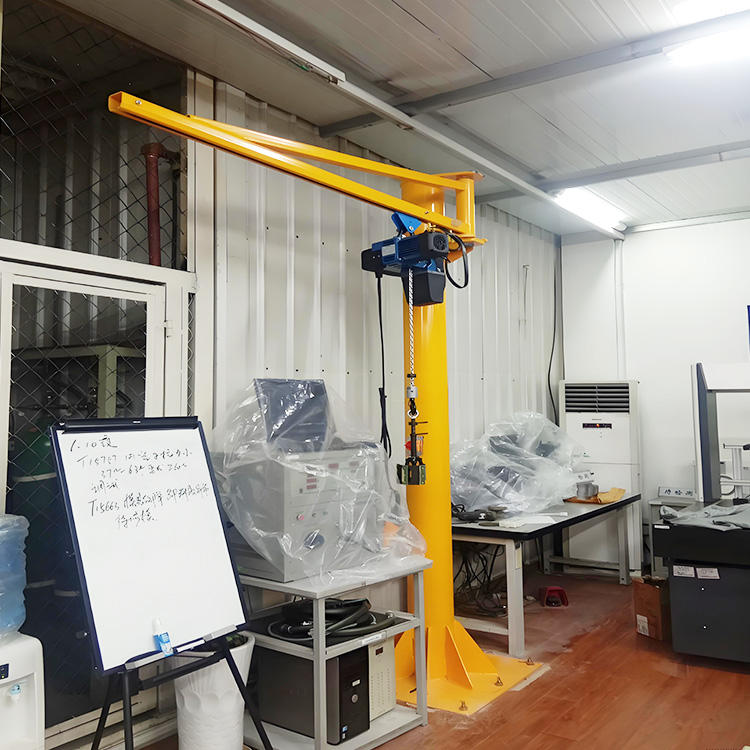
- Choose a Jib Crane for a fixed workstation, high-speed repetitive lifts, or when you need to save floor space by mounting it to a wall. Jibs are for surgical, localized tasks.
- Choose a Gantry Crane when you need to move the entire crane to different parts of a facility, lift heavy loads outdoors, or require capacities well over 15 tons. Gantries are for logistical, wide-area tasks.
In a well-designed facility, these systems are partners. A portable Gantry Crane might bring raw materials to a work bay, where a series of jib cranes then handle the intricate assembly at each station.
Frequently Asked Questions (FAQ)
Q1: Can I install a jib crane myself?
While it may seem straightforward, permanent floor- or wall-mounted systems should be installed by certified professionals. The foundation requirements, bolt torque specifications, and ensuring the mast is perfectly plumb are all critical for safe operation.
Q2: Is a motorized hoist better than a manual one?
For any load over 500 lbs (approx. 225 kg), an electric motorized hoist is highly recommended. It provides far better control and dramatically reduces operator fatigue, which improves both safety and productivity.
Q3: What is the typical lifespan of a jib crane?
With proper maintenance, a high-quality industrial jib crane can easily last 20 to 25 years. The steel structure is exceptionally durable; the hoist and pivot bearings are the components that will eventually require refurbishment or replacement.
Q4: Are jib cranes suitable for outdoor use?
Yes, but they must be specified with a “weatherization package.” This includes epoxy-based paint, stainless steel fasteners, and protective covers for the hoist and electrical systems to prevent corrosion and water damage.