


Maximize Workshop Efficiency: Top Benefits of Installing a Wall-Mounted Jib Crane
In many manufacturing and fabrication workshops, productivity losses rarely come from major equipment failures. Instead, they accumulate quietly at the workstation level—during short waits for lifting support, awkward manual handling, or unnecessary movement around crowded floors. Over time, these small inefficiencies compound into real cost.
This is where the wall-mounted jib crane has gained renewed attention. In 2026, as manufacturers focus on lean layouts and task-level optimization, wall-mounted jib cranes are increasingly used to close the “last-meter” gap in material handling—working alongside larger systems such as overhead cranes and Gantry Crane installations.
Why Wall-Mounted Jib Cranes Are Gaining Momentum in 2026
Unlike freestanding jib cranes, wall-mounted models rely on existing building structures rather than floor foundations. This seemingly small difference has significant implications for space utilization, workflow design, and return on investment.
For facilities pursuing micro-automation or workstation-level autonomy, wall-mounted jib cranes offer a practical balance between capability and simplicity.
1. Floor Space Is Preserved—Not Compromised
Floor space has become one of the most constrained resources in modern workshops. Adding new machinery or expanding production lines often means working within fixed footprints.
A wall-mounted jib crane attaches directly to a structural column or reinforced concrete wall, which means:
- No base plates or anchor bolts occupying floor area
- Clear pathways for forklifts, carts, and AGVs
- Cleaner layouts around workbenches and machines
In contrast, even compact mobile systems such as a portable Gantry Crane still require dedicated floor clearance and maneuvering space. Wall-mounted jibs remove that trade-off entirely.
2. Workstations Gain Independence from Central Cranes
One of the most common sources of idle time in shared facilities is crane availability. When multiple operators rely on a single overhead crane, coordination delays are inevitable.
Installing wall-mounted jib cranes at key workstations decentralizes lifting capacity:
- Operators no longer wait for the main crane to become available
- Small, frequent lifts are handled instantly
- Central cranes are reserved for tasks that genuinely require them
In many facilities, raw materials are delivered to the production area using a Gantry Crane, while wall-mounted jibs handle the repetitive positioning and assembly steps. This division of labor significantly improves overall flow.

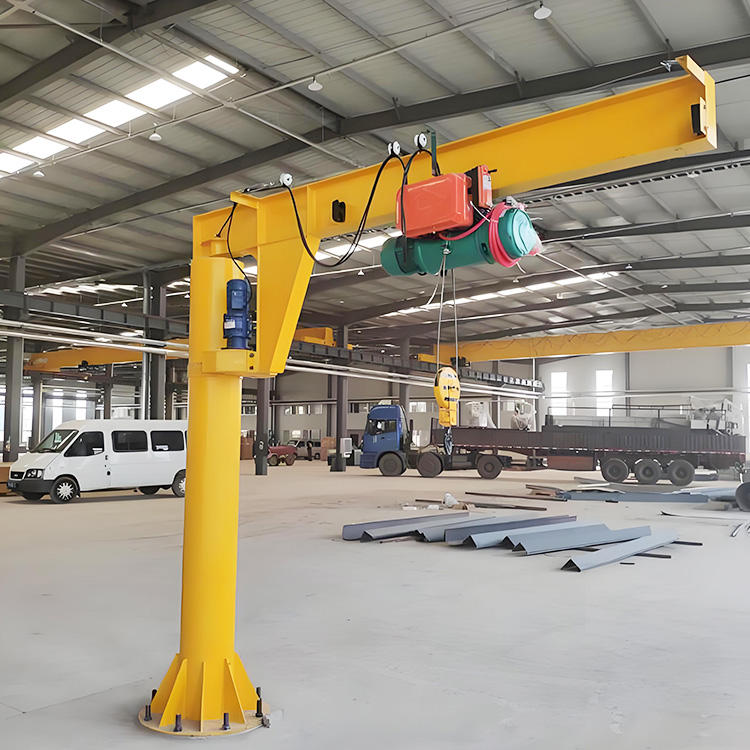
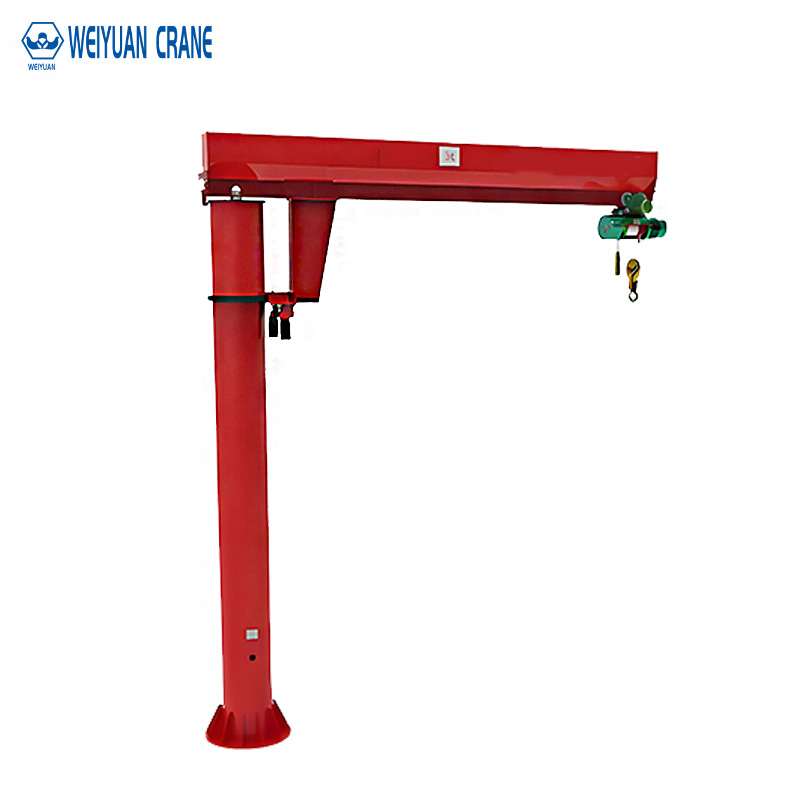
Weiyuan Column Jib Crane
The Weiyuan Column Jib Crane is a versatile and cost-effective freestanding lifting solution designed for precise material handling in workshops, assembly lines, and maintenance areas. With a full 360-degree slewing range and robust steel structure, this crane delivers smooth rotation, dependable performance and enhanced operational flexibility in confined workspaces. :contentReference
View Product / Get Quote3. High Return on Investment with Lower Entry Cost
From a financial perspective, wall-mounted jib cranes consistently rank among the most cost-effective lifting solutions.
The reasons are straightforward:
- No freestanding mast or deep concrete foundation
- Shorter installation time and reduced labor cost
- Lower shipping and handling expenses compared to large-span systems
For small and mid-sized workshops, a wall-mounted jib crane often delivers professional-grade lifting performance at a fraction of the cost of a bay-wide overhead or Gantry Crane system.
4. Ergonomics Improve Without Slowing Production
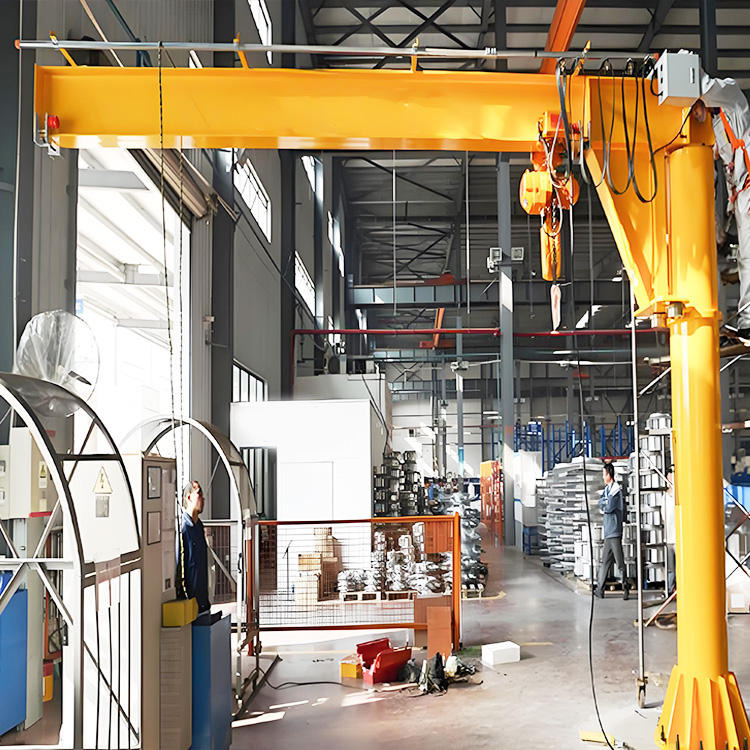
In 2026, ergonomics is no longer treated as a “soft” issue. ISO 45001 and updated OSHA guidelines emphasize reducing repetitive strain and manual handling risks.
Wall-mounted jib cranes contribute directly to safer workstations:
- Loads are lifted and positioned smoothly, without sudden impact
- Modern bearings allow easy rotation with minimal force
- Electric hoists provide precise control for delicate assemblies
Even loads that appear manageable—20 to 40 kg—can cause long-term injury when handled repeatedly. A jib crane eliminates that risk without disrupting production rhythm.
5. Seamless Integration with Existing Lifting Systems
Efficient facilities rarely rely on a single type of crane. Instead, they adopt a layered approach to material handling.
A typical high-efficiency setup looks like this:
- Overhead crane for heavy, bay-wide movement
- Gantry Crane for flexible or outdoor transport
- Wall-mounted jib cranes for fixed, repetitive workstation tasks
This structure ensures that expensive, high-capacity equipment is used only where necessary, while localized systems handle volume work efficiently.
Key Technical Factors to Evaluate Before Installation
Before ordering a wall-mounted jib crane, certain parameters should be clearly defined to avoid mismatches with your building structure or workflow.
| Specification | Typical Range | Why It Matters |
|---|---|---|
| Capacity (SWL) | 0.25 – 5 tons | Determines usable applications |
| Arm Length | 2 – 10 meters | Defines coverage area |
| Rotation | 180° – 200° | Affects machine accessibility |
| Hoist Type | Single / Dual Speed | Precision vs. throughput |
| Mounting Structure | Steel / Reinforced Concrete | Structural safety |
Critical note:
A structural engineer must verify that the supporting column or wall can withstand the moment load generated when the jib is fully extended under maximum capacity. This step is essential and should never be skipped.
When a Wall-Mounted Jib Is Not the Right Choice
While highly efficient, wall-mounted jibs are not universal solutions.
You should reconsider if:
- Building columns cannot support lateral loads
- Required capacity exceeds 5 tons
- Loads must move across multiple, changing locations
In such cases, a freestanding jib or a Gantry Crane may be the safer and more practical option.
FAQ: Wall-Mounted Jib Crane Essentials
Q1: What is the maximum practical capacity for a wall-mounted jib crane?
Most applications fall between 250 kg and 5 tons. Beyond that range, structural limitations often make freestanding designs more suitable.
Q2: Can wall-mounted jib cranes be installed on brick walls?
No. Standard brick walls cannot handle the required lateral forces. Installation must be on reinforced concrete or structural steel.
Q3: How does maintenance compare with a Gantry Crane?
Maintenance is generally simpler. There are no wheels, rails, or floor tracks—only mounting bolts, bearings, and the hoist to inspect.
Q4: Are wall-mounted jibs suitable for cleanrooms or food production?
Yes. Stainless steel finishes and food-grade lubricants are available for sensitive environments.
Q5: How long does installation typically take?
Once the structural assessment is approved, installation usually takes 4–8 hours with minimal disruption to operations.