


Maximizing Workstation Efficiency: A Comprehensive Guide to Modern 【 Jib Cranes】
In a high-intensity manufacturing environment, efficiency is often won or lost at the workstation level. While massive facility-wide systems handle the heavy lifting across long spans, the real friction frequently occurs within individual work cells. When a machinist has to pause production to wait for a shared overhead bridge crane just to load a 100kg steel block, that idle time represents a direct hit to the company’s bottom line.
This specific logistical gap is where 【 Jib Cranes】 establish their dominance. Think of them as the “surgical tools” of material handling—dedicated, agile, and positioned exactly where the work happens. By providing localized lifting power to a single assembly cell or maintenance bay, these systems transform a congested workshop into a streamlined production engine.
This guide provides a technical and strategic deep dive into the world of jib lifting, helping you evaluate which configuration will best serve your long-term operational goals.
1. What Exactly is a Jib Crane?
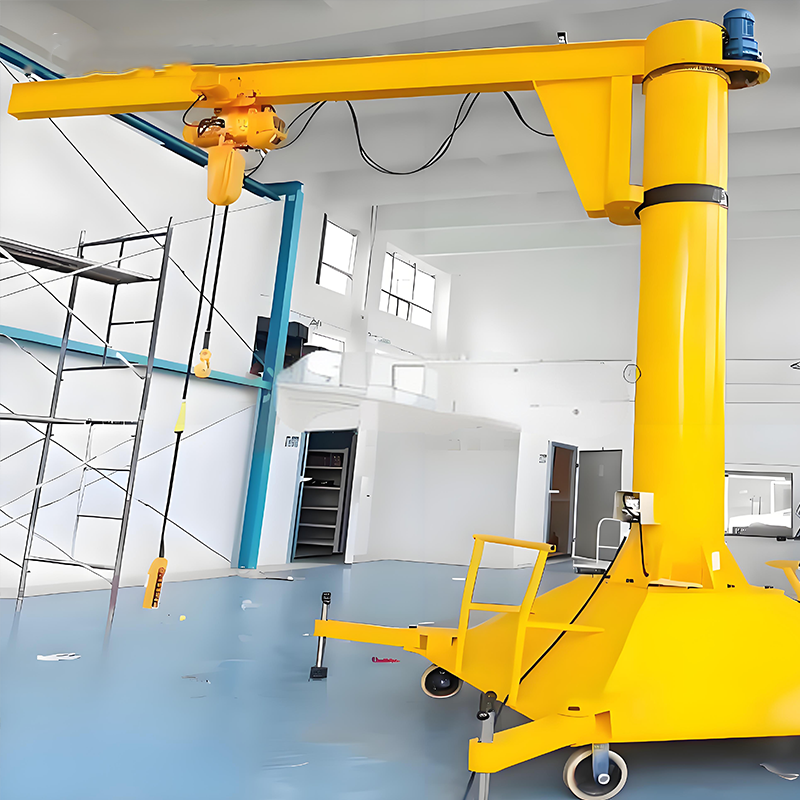
A jib crane is a localized lifting system consisting of a horizontal boom (the jib) that supports a movable hoist and trolley. This boom is either mounted to a floor-standing pillar or attached to a building’s structural column. Unlike the longitudinal travel of a bridge or gantry crane, 【 Jib Cranes】 operate within a circular or semi-circular “swing” radius.
They serve as the perfect intermediary between manual handling and heavy-duty facility cranes. By giving an operator their own dedicated lifting device, you empower them to work independently, safely, and with far greater precision than manual positioning could ever allow.
The Anatomy of the System
To understand the reliability of these machines, you have to look at their mechanical foundation:
- The Mast or Pillar: The vertical backbone. In freestanding models, this is a heavy-wall steel pipe that transfers all lifting forces to the floor.
- The Boom (Jib): The horizontal arm. This is the “reach” of the crane, typically an I-beam or enclosed track.
- The Trolley: The rolling carriage that carries the hoist along the length of the boom.
- The Hoist: The actual lifting unit, which can be electric, pneumatic, or manual, using either wire rope or high-tensile chain.
- The Rotation Pivot: The heavy-duty bearings and hinges that allow the boom to swing smoothly under load.

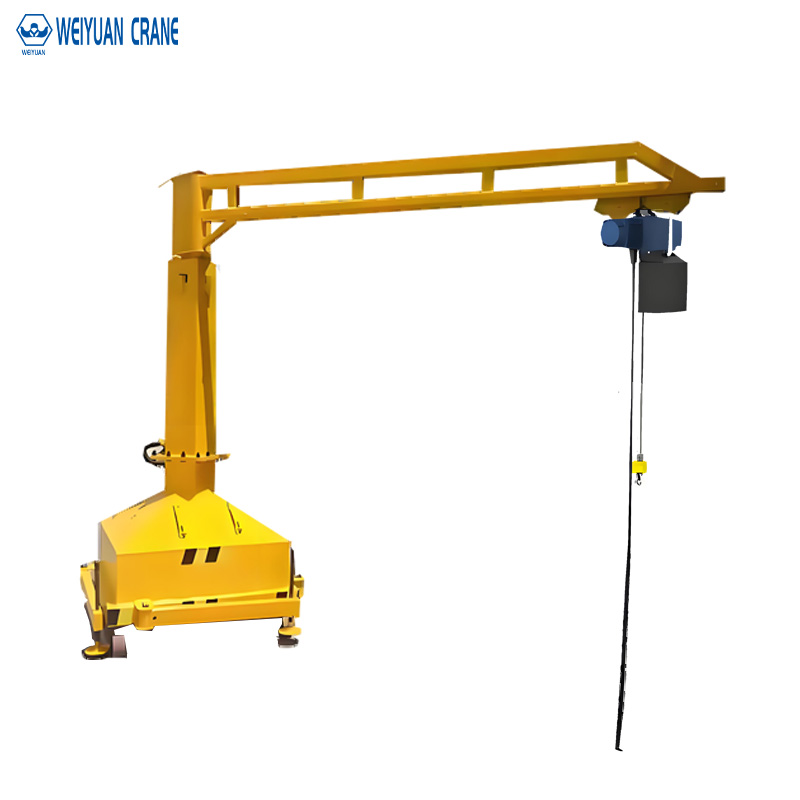
Weiyuan Column Jib Crane
The Weiyuan Column Jib Crane is a versatile and cost-effective lifting solution designed for efficient localized material handling with 360° rotation and robust freestanding structure — ideal for workshops, assembly areas, and maintenance bays.:contentReference
View Product / Get Quote2. Choosing the Right Configuration: A Deep Dive into Types
Industrial sites vary significantly in their structural layouts. To accommodate these differences, manufacturers have developed several distinct variations of the jib design.
Freestanding Pillar Jib Cranes
This is the “gold standard” for versatility. A vertical steel mast is secured to a dedicated concrete foundation, allowing for a full 360-degree rotation.
- Best for: Open-plan factories where you need to service multiple machines or workstations with a single crane.
- Capability: These handle the highest capacities, ranging from 500kg up to 15 tons.
- Why choose it? It is entirely independent of your building’s walls, meaning you can place it anywhere the floor can support the weight.
Wall-Mounted Jib Cranes
If your floor space is already at maximum capacity, look to the walls. These units bolt directly to existing building columns.
- Rotation: Typically limited to 200 degrees because the wall prevents a full circle.
- Best for: Individual assembly stations along a wall or bays where forklift traffic must remain unobstructed.
- The Benefit: Zero floor footprint. However, you must have a structural engineer confirm that your building’s columns can handle the “pull-out” forces.
Mast-Type Jib Cranes
A mast-type crane is a hybrid that anchors into the floor and ties into the overhead roof structure or building beams.
- The Advantage: Because the load is shared between the floor and the ceiling, you don’t need the massive, deep concrete foundations required by freestanding models.
- Requirement: Your facility must have a rigid overhead structure capable of handling the transferred lateral stress.
Articulating Jib Cranes
Standard booms are straight, which can be a limitation in crowded cells. Articulating 【 Jib Cranes】 feature a boom with an “elbow” joint, functioning much like a human arm.
- Precision: The operator can reach around corners, tuck the load into tight machine enclosures, or navigate around structural pillars.
- Application: Ideal for lighter, high-precision assembly tasks (under 1 ton) where maneuverability is more important than raw capacity.
3. Technical Selection: The “Numbers” That Matter
Purchasing a crane is a major capital investment. To ensure it doesn’t become a maintenance headache, you need to be precise with four key metrics.
A. Working Load Limit (WLL)
The WLL is the maximum weight the crane is engineered to lift. A common mistake is buying for the exact weight of your current heaviest part. In the industry, we recommend a 15% to 25% buffer. If your heaviest part is 1 ton, a 1.5-ton crane is a smarter investment. This buffer accounts for the weight of your rigging (slings, magnets, or grabs) and extends the lifespan of the motor by ensuring it isn’t constantly running at its absolute limit.
B. Span and “Hook Reach”
The span is the length of the horizontal boom. However, the trolley cannot travel to the absolute center or the absolute tip of the boom. Your “usable hook reach” is usually about 12 to 18 inches less than the total span. Always measure your furthest required pick-up point and add a small safety margin.
C. Height Under Hook (HUB)
This is the vertical distance from the floor to the lowest part of the hoist hook. You must account for the height of your workbench, the height of the load itself, and the “stack-up” height of your rigging.
Calculation Tip: Total Building Height – (Trolley Depth + Hoist Height + Rigging) = Your True Lifting Room.
D. Duty Cycle (CMAA Classes)
The Crane Manufacturers Association of America (CMAA) classifies cranes based on frequency of use.
- Class A/B: Infrequent use (maintenance or standby).
- Class C: Moderate service (standard machine shops).
- Class D: Heavy service (high-volume production lines).Selecting a Class B crane for a 24/7 production line will result in motor failure within months.
4. The Engineering Reality: Foundations and Structural Stress
A jib crane is essentially a giant lever. When a 2-ton load is at the end of a 6-meter boom, it exerts a massive “overturning moment” on the base.
For freestanding models, the calculation for the moment ($M$) is roughly:
$$M = Load \times Distance$$
(Where the load includes the hoist and the jib itself).
The Foundation: You cannot bolt a heavy freestanding mast to a standard 4-inch warehouse floor. It will eventually crack or pull the anchors out. Heavy-duty models require a “square-footing” foundation, often 3 to 5 feet deep, reinforced with a steel rebar cage.
Wall Stress: For wall-mounted units, the “pull” on the top bracket and the “push” on the bottom bracket are extreme. Never install a wall-mounted jib without a professional review of the building’s structural blueprints.
5. Strategic Benefits: The ROI of Localized Lifting
Why invest in 【 Jib Cranes】 when you already have an overhead bridge crane? The answer lies in the “Micro-Logistics” of your facility.
Ending the “Waiting Game”
In a typical workshop, five stations might share one bridge crane. When Station A is busy, Station B is idling. By giving each station a dedicated jib, you eliminate these bottlenecks. The large overhead system or the outdoor 【Gantry Crane】 can then be reserved for its true purpose: long-range transport and bulk material handling.
Ergonomics as a Competitive Advantage
Worker fatigue is a silent killer of quality. By the sixth hour of a shift, a worker who has been manually maneuvering heavy parts will start to make mistakes. Jib cranes remove 100% of the physical strain. This doesn’t just prevent back injuries; it keeps the production pace consistent from the first minute to the last.
Maximizing Floor Real Estate
Industrial space is expensive. Wall-mounted jibs provide lifting power with zero floor footprint. Even freestanding models have a very small “post” diameter, allowing you to place machinery closer together while keeping aisles clear for forklifts and safety paths.
6. Safety, Maintenance, and E-A-T Compliance
To maintain authority and trust in your facility’s safety standards, a rigorous maintenance hierarchy is required.
Daily Visual Inspections
Before every shift, the operator should:
- Check the wire rope or chain for kinks or frays.
- Test the emergency stop button.
- Verify the limit switches (which stop the hoist before it hits the boom).
- Listen for unusual grinding noises in the rotation bearings.
Periodic Audits
Depending on use, a certified technician should conduct a quarterly or annual audit. This involves checking the torque on foundation bolts, inspecting the brake pad thickness on the hoist, and looking for micro-fractures in the structural welds.
Modern Safety Technology
In 2026, we see a massive shift toward Variable Frequency Drives (VFDs). Instead of a crane that “jerks” into motion, VFDs allow for soft starts and stops. This prevents the load from swinging like a pendulum, protecting both the operator and the expensive machinery from accidental impacts.
7. Comparison: When to Choose a Jib vs. a Gantry Crane
It is easy to confuse these two when looking for “versatile” lifting. Here is a quick reference table:
| Feature | Jib Crane | 【Gantry Crane】 |
| Movement | Circular / Rotational | Linear / Longitudinal |
| Support | Single Pillar or Wall | Freestanding Legs on Rails/Wheels |
| Capacity | Typically 0.25 to 10 tons | 1 to 500+ tons |
| Main Use | Specific workstations / “Spot” lifting | Cross-bay transport / Outdoor yards |
| Footprint | Minimal to none | Requires clear floor paths/rails |
Frequently Asked Questions (FAQ)
Q1: Can I install a jib crane on my existing concrete floor?
It depends on the capacity and the “base plate” size. For very light loads (under 500kg), some manufacturers offer large base plates that can be bolted to a standard 6-inch reinforced floor. For anything heavier, a dedicated concrete foundation is mandatory to prevent the crane from tipping.
Q2: What is the benefit of motorized rotation?
For capacities under 2 tons, manual rotation is usually faster and gives the operator better “feel.” For heavier loads or very long booms, motorized rotation is safer because it prevents the boom from “running away” if the floor isn’t perfectly level.
Q3: How long do 【 Jib Cranes】 typically last?
With proper lubrication and annual inspections, the steel structure is virtually permanent. The wear-parts, such as the hoist chain and pivot bearings, typically last 10 to 15 years in a “Moderate Service” environment before needing refurbishment.
Q4: Can I use a jib crane outdoors?
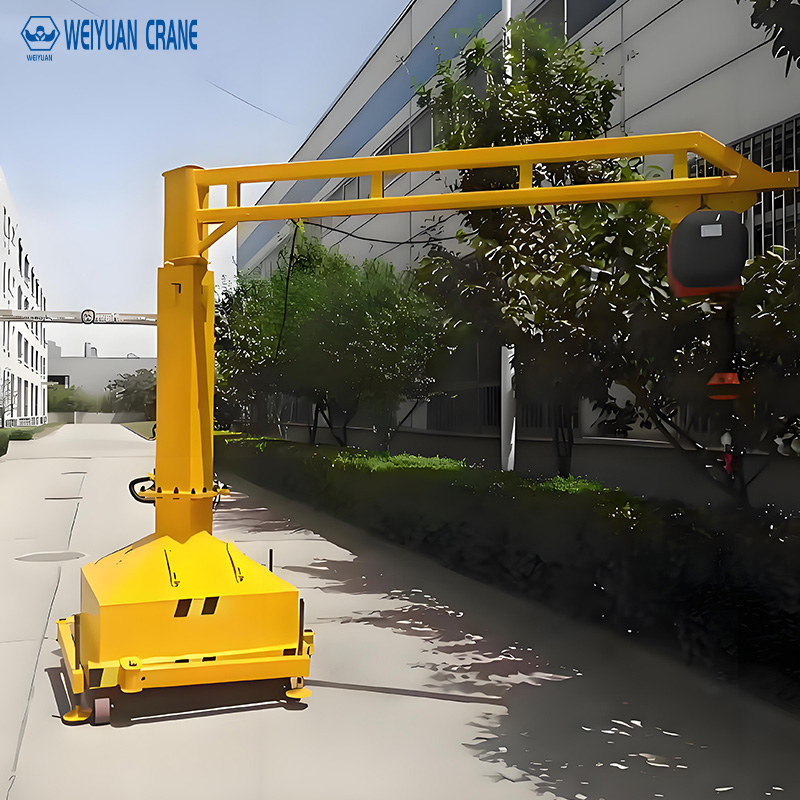
Yes, but you must specify a “Weather Package.” This includes epoxy-based paint to prevent rust, stainless steel fasteners, and specialized covers (doghouses) to protect the hoist and electrical components from rain and snow.
Q5: Is a wire rope hoist better than a chain hoist?
For the workstation-level lifting typical of a jib crane, chain hoists are usually preferred. They are more compact, offer more precise vertical movement (no “hook drift”), and are more cost-effective for loads under 5 tons.