


Overhead Crane for Warehouse & Logistics: How to Maximize Throughput with the Right Lifting System
Published by: [Your Brand] Engineering Team | Last Updated: March 2026 | Reading Time: 9 min
Introduction
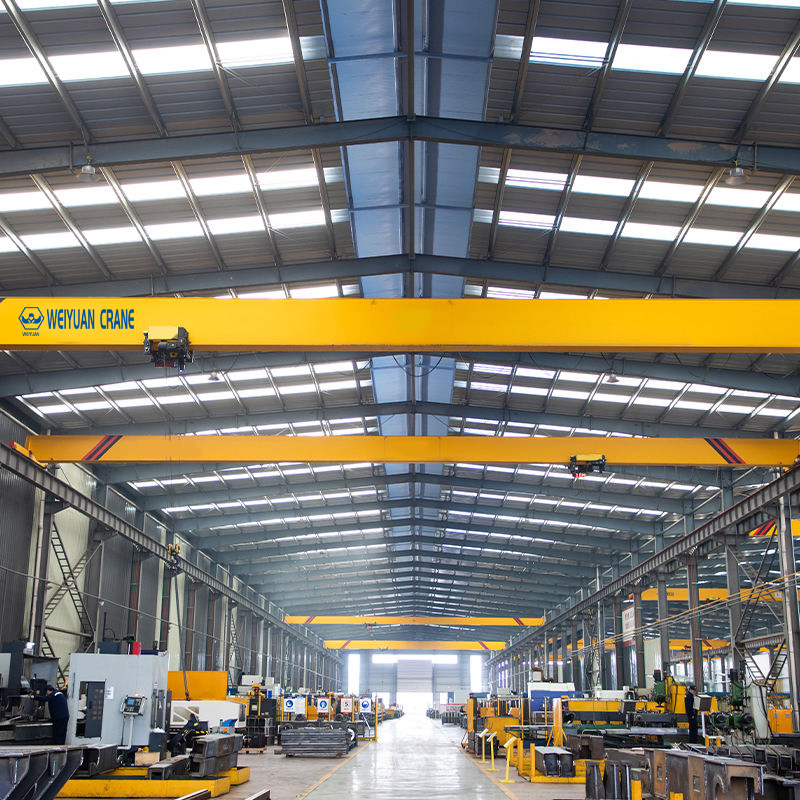
The warehouse and logistics sector has undergone a fundamental transformation over the past decade. E-commerce growth, reshoring of manufacturing, and the expansion of third-party logistics (3PL) operations have driven dramatic increases in the size, throughput requirements, and handling complexity of modern distribution and fulfillment facilities. Where a 200,000 square-foot warehouse was once considered large, million-square-foot fulfillment centers are now routinely constructed.
In this transformed environment, the lifting systems that warehouse and logistics operations depend on — and the criteria by which they should be selected — have evolved alongside the facilities themselves. The overhead crane, historically associated with heavy manufacturing and steel processing, has become an increasingly important component of warehouse material handling systems as the weight, variety, and throughput requirements of modern distribution operations have grown.
This guide addresses overhead crane specification and deployment for warehouse and logistics applications specifically — a sector with requirements distinctly different from traditional manufacturing crane applications. We cover the specific scenarios where an overhead crane delivers measurable throughput improvement and cost reduction, how to size and specify a crane for warehouse constraints, how overhead cranes compare to alternative handling methods in distribution environments, and the best practices that maximize crane productivity in logistics settings.
Why Overhead Cranes Are Growing in Warehouse Applications
The traditional view — that overhead cranes belong in factories and warehouses use forklifts — is increasingly outdated for facilities handling heavy or awkward loads. Several trends are driving overhead crane adoption in warehouse and logistics environments:
Increasing average unit weight: As manufacturing equipment, industrial machinery, server hardware, renewable energy components, and infrastructure materials move through distribution networks, the average weight per handling unit has increased substantially in many logistics segments. Equipment that arrives at a distribution center in 10,000 to 50,000-pound units cannot be efficiently handled with standard forklifts and manual rigging — it requires an overhead lifting system.
Building height utilization: Modern distribution centers are increasingly designed with 40 to 60-foot clear heights to maximize cubic storage capacity. Overhead cranes can access storage positions and loading positions throughout this full height range, complementing racking systems and automated storage that use vertical space more efficiently than floor-level forklifts.
Labor efficiency pressure: Warehouse labor costs have risen significantly in North America and Europe, and labor availability in key logistics markets is constrained. Overhead cranes enable single operators to safely handle loads that would otherwise require two- or three-person manual teams, directly improving throughput per labor dollar.
Safety compliance: OSHA-reportable musculoskeletal injuries from manual material handling are a persistent and expensive issue in warehouse operations. Overhead cranes eliminate the manual lifting, pushing, and pulling that drives these injury rates for heavy-item handling positions.
Part 1: Warehouse Scenarios Where Overhead Cranes Deliver Maximum Value
Scenario 1: Inbound Heavy Equipment and Machinery Receiving
Industrial distribution centers and equipment dealers regularly receive heavy machinery — construction equipment attachments, industrial motors, generators, compressors, CNC machine components, and similar items — that arrive as individual pieces weighing 2,000 to 50,000 lbs or more.
Handling these items safely and efficiently requires a lifting system that can:
- Reach the truck bed height at the loading dock
- Position loads horizontally to inspection tables, staging areas, or storage positions
- Work without requiring the load to be placed on a pallet (which is often impractical for irregular equipment shapes)
An overhead crane spanning the receiving bay, with adequate hook height to clear truck bed height plus rigging headroom, transforms a slow, high-risk manual rigging operation into a fast, single-operator process.
Recommended specification for equipment receiving:
- Capacity: 5 to 20 tons depending on the heaviest incoming units
- Configuration: Single or double girder depending on capacity and hook height requirement
- Span: Full width of the receiving dock area
- Hook height: Dock floor to 12 to 18 feet minimum for most truck-delivered equipment
- Duty class: CMAA Class C (moderate service) for most distribution receiving operations; Class D if receiving is continuous across multiple shifts
Scenario 2: Large-Format Racking and Shelving Installation
Distribution centers and industrial warehouses that store large or heavy items — steel coils, pipe and tubing, structural steel sections, heavy machinery components — use specialized racking systems (cantilever racks, drive-in racks, structural pallet racks rated for heavy loads) that require overhead crane access for loading and unloading.
A forklift cannot safely access cantilever rack arms storing 4-inch structural pipe at a 30-foot height in a narrow aisle. An overhead crane traveling the length of the racking bay provides safe, controlled positioning at any height within the bay.
Recommended specification for large-format storage bay:
- Capacity: Sized to the heaviest stored unit, plus 25% margin
- Span: Full bay width — ensure the crane can serve every storage position from end to end
- Hook height: Maximum storage height plus rigging headroom (typically 3 to 5 feet above the highest storage position)
- Runway length: Full storage bay length, with adequate overrun at each end
- Duty class: CMAA Class C for most storage applications; Class D for high-throughput operations with multiple shifts
Scenario 3: Cross-Dock and Transfer Operations for Heavy Goods
Cross-dock operations — receiving goods from inbound trucks and transferring them directly to outbound trucks with minimal or no storage — are extremely time-sensitive. For cross-dock operations handling heavy industrial products, the ability to move loads quickly and safely between dock positions is a direct determinant of throughput and on-time performance.
An overhead crane spanning a cross-dock bay provides load movement from any inbound position to any outbound position within a single travel path, without requiring forklift lanes that limit floor utilization or create pedestrian-forklift conflict zones.
Recommended specification for cross-dock heavy goods:
- Capacity: Sized for the heaviest unit in the cross-dock flow
- Span: Full bay width between dock faces
- Runway length: Full bay depth, positioned to serve both inbound and outbound dock doors
- Speed: Higher bridge and trolley travel speeds than a typical manufacturing crane are beneficial in cross-dock applications where cycle time is critical — specify VFD controls with higher travel speeds (up to 200 FPM bridge travel) for responsive positioning
- Duty class: CMAA Class C to D depending on throughput volume
Scenario 4: Fulfillment Center Heavy-Item Picking and Packing
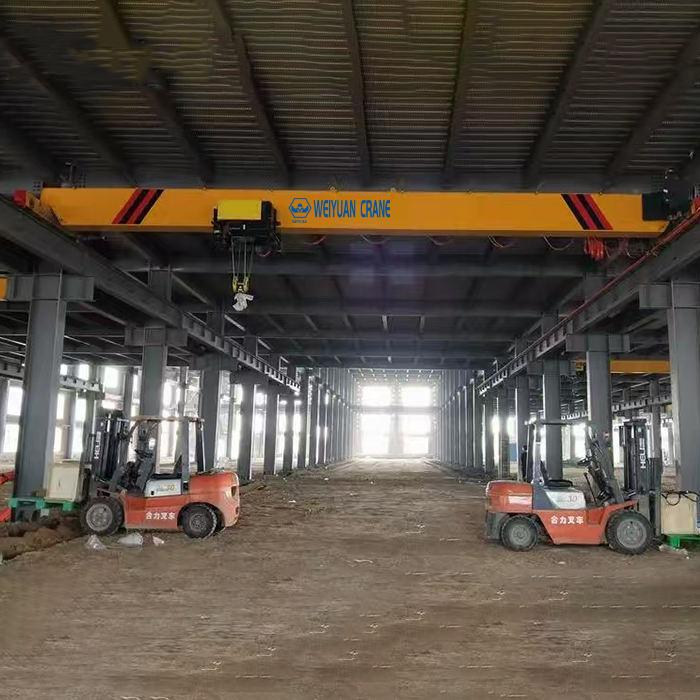
Large-format e-commerce fulfillment centers increasingly include heavy-item pick zones where products weighing 50 to 2,000 lbs are picked, consolidated, packed, and staged for outbound shipping. Manual handling of these items is slow, ergonomically hazardous, and labor-intensive.
Overhead workstation bridge cranes — light-duty overhead crane systems running on a freestanding modular runway structure within a defined pick zone — provide ergonomic lift assistance for operators picking and packing heavy items. These systems can be installed independently of the building structure (freestanding) and can be reconfigured as fulfillment operations change.
Recommended specification for heavy-item fulfillment pick zones:
- Capacity: 150 lbs to 2 tons depending on the heaviest picks in the zone
- Configuration: Workstation bridge crane (freestanding modular runway structure)
- Span: Width of the pick zone work area
- Control: Intelligent assist control (load-sensing) that allows operators to guide loads with minimal effort, rather than pendant push-button — this dramatically reduces operator fatigue and improves productivity in high-cycle picking operations
- Duty class: CMAA Class C to D for continuous pick operations
Scenario 5: Maintenance and Equipment Service in Warehouse Facilities
Large warehouse and distribution facilities include conveyor systems, sortation equipment, automated storage and retrieval systems (ASRS), building mechanical systems, and vehicle maintenance bays that require regular service of heavy components. A maintenance bay crane provides lift capability for motor replacements, conveyor drive replacements, and equipment positioning without pulling the production floor crane from service.
Recommended specification for maintenance bay:
- Capacity: 1 to 5 tons covers most warehouse facility maintenance needs
- Configuration: Single girder, mast-type, or modular workstation crane depending on bay dimensions
- Duty class: CMAA Class B to C (maintenance cranes are typically used infrequently)
Part 2: Crane Selection Considerations Specific to Warehouse Environments
Building Structure Assessment
Warehouse buildings are typically designed as light-gauge or pre-engineered metal buildings with clear-span roof trusses supported by relatively widely spaced columns. These structures are often not designed with crane support in mind, which creates challenges for overhead crane runway installation.
Before specifying any overhead crane for an existing warehouse:
- Have a licensed structural engineer assess the building’s column capacity for the additional crane loads (vertical, lateral, and longitudinal)
- Verify that the roof structure can accommodate runway beam attachment points at the required spacing
- Check the building’s drift (horizontal deflection under lateral loads) — excessive building drift can misalign crane rails over time
In many cases, existing warehouse buildings cannot support a conventional overhead crane runway without structural reinforcement. Freestanding crane runway structures (independent columns and runway beams not attached to the building) are often the more cost-effective solution — they avoid the need for building structural reinforcement entirely.
Overhead Clearance Constraints
Warehouse buildings designed for racking storage have precisely defined clear height requirements. Every foot of available height is allocated to storage. Installing an overhead crane in this environment requires careful analysis of:
- Racking system height versus crane hook path
- Clearance between the crane bridge and the highest racking level
- Sprinkler system elevation and the impact of the crane bridge on sprinkler coverage patterns
- Lighting system interference with crane travel
Low-headroom crane configurations — where the hoist runs in a specially designed low-headroom trolley between the bridge beams rather than below them — are often required in warehouse environments to maximize the available hook height within the building’s clear height constraints.
Fire Suppression System Coordination
Most warehouses have NFPA 13-compliant wet-pipe sprinkler systems with sprinkler heads at specific elevations. The overhead crane bridge traveling through the space can potentially obstruct sprinkler discharge patterns if not properly accounted for in the sprinkler system design.
NFPA 13 includes provisions for crane-obstructed areas, and any overhead crane installation in a sprinklered warehouse must be coordinated with the facility’s fire protection engineer before installation. In-rack sprinkler systems may need to be installed or extended to provide coverage in areas obstructed by the crane bridge.
Forklift and Pedestrian Traffic Coordination
Warehouse operations involve heavy forklift traffic and pedestrian movement that creates potential conflicts with crane operations. Key design and operational considerations:
- Define and mark crane travel paths clearly on the floor with painted lane markings visible to forklift operators and pedestrians
- Install warning lights or audible alerts on the crane bridge that activate during travel
- Establish clear operational rules: no personnel under the crane hook during lifts, crane has right-of-way over forklift traffic in designated crane zones
- Consider load-sensing systems that automatically halt crane travel if an obstruction is detected in the path
Part 3: Overhead Crane vs. Forklift vs. Other Handling Methods in Warehouse Applications
For heavy loads in warehouse environments, the comparison between overhead cranes and alternatives comes down to four factors: throughput, safety, floor space, and total cost of ownership.
Overhead crane advantages in warehouse settings:
- Handles loads at any height within the crane’s hook height range — forklifts are limited by mast height and stability
- Frees up floor space for storage and traffic (no forklift lanes required in crane service areas)
- Single operator can handle loads that require two or more workers with forklifts or manual rigging
- Eliminates the physical damage risk to stored product from forklift mast contact in tight aisles
- Lower energy cost per ton-lift than diesel or LP forklifts for frequent stationary lifting
Forklift advantages over overhead cranes:
- Mobile — can serve the entire facility, not just the crane’s working envelope
- Faster for horizontal transport over long distances
- Lower capital cost for single-position use
- No fixed infrastructure requirement
The most effective warehouse material handling systems typically combine both: overhead cranes in defined heavy-item zones where height utilization, throughput density, and safety justify the infrastructure investment, and forklifts for facility-wide mobility and transport.
Frequently Asked Questions
Q: What is the minimum building height required for an overhead crane in a warehouse?
A: This depends entirely on the crane’s required hook height. The minimum building clear height must accommodate the hook height (distance from floor to hook at maximum lift) plus hoist headroom (distance from hook to bottom of bridge beam at maximum lift) plus bridge beam depth plus runway beam depth plus clearance to roof structure. A typical 5-ton single girder crane requiring 25 feet of hook height might need 32 to 36 feet of building clear height. A structural engineer and crane engineer must verify this for each specific application.
Q: Can an overhead crane be installed in a refrigerated or freezer warehouse?
A: Yes, but the crane must be specified for the operating temperature range. Components requiring special consideration include: lubricants rated for low-temperature operation, electrical enclosures and components rated for the temperature and humidity cycling typical of cold storage environments, and structural steel specified with adequate notch toughness at operating temperature. ASTM A572 Grade 50 steel, which is standard for most crane structures, has adequate toughness for most cold storage temperatures, but very low-temperature applications (below -20°F) may require special material selection.
Q: How does an overhead crane affect warehouse layout planning?
A: The crane’s runway defines a fixed zone of coverage — the rectangular area beneath the runway rails. Everything inside this zone is within crane reach; everything outside is not. Layout planning should position heavy-item receiving, storage, and shipping functions within the crane’s coverage zone. Fixed equipment (racking, conveyor systems, ASRS) within the crane’s travel path must clear the crane’s travel envelope. This typically requires defining the crane layout very early in the facility design process — retrofitting a crane into an existing warehouse layout is significantly more complex and expensive than integrating it from the beginning.