


Maximizing Productivity with Jib Cranes: Key Advantages for Material Handling
In a high-throughput manufacturing facility, minutes are the primary currency. While massive overhead systems are engineered to move multi-ton loads across the entire length of a building, the real friction often occurs at the granular level—within individual work cells. The time an operator spends waiting for a shared bridge crane, or the physical strain of manually positioning a 50kg component, represents a cumulative loss in productivity that can derail even the most optimized production schedule.
This is where the jib crane emerges as the “workstation hero.” By providing dedicated, agile lifting power to a specific area, jib cranes act as the surgical tools of the material handling world. This guide dives deep into why these localized systems are a strategic necessity, how they integrate with larger equipment like the 【Gantry Crane】, and the technical factors that ensure a high return on investment (ROI).
1. What is a Jib Crane? The Precision Instrument of the Shop Floor
A jib crane is a specialized lifting system consisting of a horizontal boom (the jib) that supports a hoist and trolley. This boom is either mounted to a floor-standing pillar or attached to a building’s structural column or wall.
Unlike the facility-wide sweep of a 【Gantry Crane】, the jib crane is designed for a localized “circular” work zone. It allows for 180° to 360° of rotation, giving an operator the ability to lift, swing, and precisely place materials within a defined radius. In modern industrial layouts, these cranes bridge the gap between manual labor and large-scale automation, ensuring that every workstation operates as an independent, high-efficiency hub.
2. Unmatched Space Optimization and Flexibility
In 2026, industrial floor space is more expensive than ever. Every square meter must justify its existence through value-adding activity. Jib cranes are masters of “vertical integration,” allowing you to add lifting power without cluttering the floor.
Wall and Column-Mounted Designs
For facilities where floor space is at a premium, wall-mounted jib cranes are an exceptional solution. By attaching directly to existing structural columns, they require zero floor footprint. This allows for a clear path for forklifts and AGVs (Automated Guided Vehicles) while providing dedicated lifting for the assembly line directly underneath.
Freestanding Jib Cranes
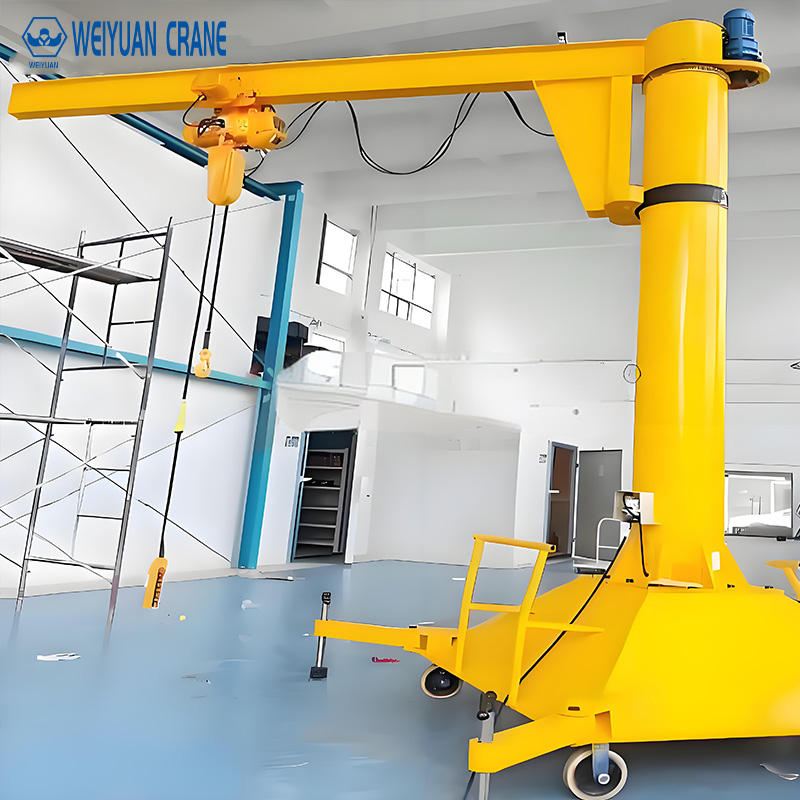
In open-plan workshops, freestanding (pillar-mounted) jib cranes offer 360° of coverage. While they require a concrete foundation, their footprint is minimal compared to the extensive runway structures needed for a bridge system. This makes them ideal for placement next to large CNC machines or in the center of a fabrication cell where materials move between multiple adjacent stations.

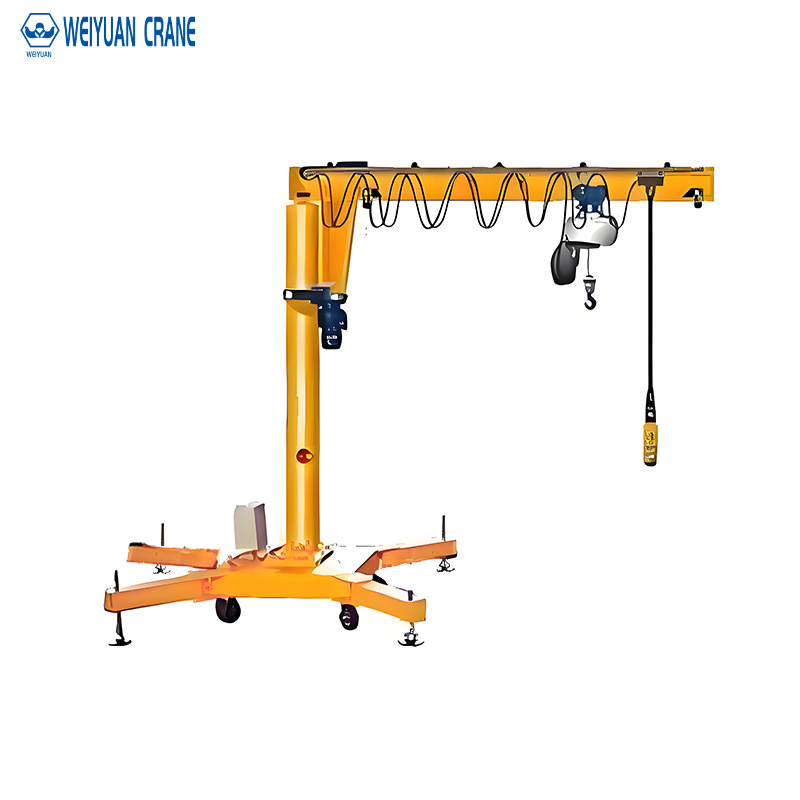
Weiyuan Column Jib Crane
The Weiyuan Column Jib Crane is a versatile and cost-effective lifting solution designed for efficient localized material handling with 360° rotation and robust freestanding structure — ideal for workshops, assembly areas, and maintenance bays.:contentReference
View Product / Get Quote3. The “Waiting Game” Ends: Boosting Workflow Efficiency
The most significant drain on factory productivity is “idle time.” In many traditional setups, four or five workstations share a single overhead bridge crane. When an operator finishes a part and needs to move it, they must wait for the shared crane to become available.
Eliminating Bottlenecks
By installing a jib crane at each critical workstation, you empower operators to work independently. They no longer have to wait for the “big lift.” This autonomy results in a smoother, more predictable workflow. The large overhead systems or the outdoor 【Gantry Crane】 can then be reserved for the heavy-duty tasks they were actually designed for—cross-bay transport and bulk material handling.
Faster Cycle Times
Jib cranes are built for speed and ease of use. The boom is lightweight and rotates with minimal effort, allowing for rapid loading and unloading of machinery. When compared to the slower, more deliberate movement of a rail-mounted 【Gantry Crane】, the jib is undeniably more efficient for the frequent, repetitive lifts (500kg to 5 tons) that make up the bulk of a typical shift.
4. Safety and Ergonomics: Protecting Your Most Valuable Asset
Industrial safety is often discussed in terms of “avoiding accidents,” but it is also about long-term physical health. Musculoskeletal disorders (MSDs), such as back strains and muscle tears, account for a massive percentage of lost workdays and insurance claims.
The Impact on Worker Health
Repeatedly lifting even “manageable” weights (20–40kg) causes cumulative fatigue. By the fourth or fifth hour of a shift, a tired worker is more likely to make a mistake or suffer a strain. A jib crane takes 100% of the physical burden off the human operator.
Precision and Control
Modern jib systems are often equipped with Variable Frequency Drives (VFDs). This technology allows for “soft starts” and “slow-speed positioning.” If an operator is trying to align a heavy die into a precision press, the ability to move the load in millimeter increments is vital. It prevents the sudden jerks that cause load sway, protecting both the operator and the expensive machinery from accidental damage.
5. Cost-Effectiveness: High ROI on a Low Initial Spend
When evaluating the total cost of ownership, jib cranes represent one of the most affordable powered lifting solutions on the market.
- Lower Capital Expenditure: You can often purchase and install several jib cranes for a fraction of the cost of a full-scale 【Gantry Crane】 project.
- Simplified Installation: Wall-mounted units can be installed in a matter of hours. Even freestanding models, which require a foundation, involve localized work that doesn’t disrupt the entire facility.
- Low Maintenance: With fewer moving parts and a simpler structure than bridge or gantry systems, jib cranes have lower annual maintenance costs. A routine check of the pivot bearings and the hoist chain is usually all that’s required to keep them in service for decades.
6. Technical Specifications: What to Evaluate Before You Buy
Choosing the right jib crane requires more than just knowing the maximum weight you need to lift. Professional procurement teams look at these three key metrics:
Working Load Limit (WLL) and Deflection
The boom of a jib crane will naturally “dip” slightly when loaded at the very tip. This is called deflection. High-quality engineering ensures that this deflection stays within strict limits (typically 1/150 of the span). If a boom has too much deflection, the trolley will want to “roll” toward the end of the beam, making precise positioning difficult.
Rotation Requirements
Do you need a wall-mounted unit for 180° of movement, or a freestanding unit for 360°? Consider your “swing path.” Are there other machines, pillars, or lighting fixtures in the way? Some modern jib cranes come with electronic rotation limits that prevent the boom from hitting obstacles.
Duty Cycle (Service Class)
CMAA (Crane Manufacturers Association of America) classes define how often the crane will be used. A jib crane used in a maintenance shop (Class A/B) can be lighter and simpler than one used in a 24/7 assembly line (Class D), which requires more robust motors and heat-resistant components.
7. The 2026 Material Handling Ecosystem: Synergy in Motion
In the most advanced factories, different crane types are not competitors; they are partners. The synergy between the jib and the 【Gantry Crane】 creates a multi-layered lifting environment.
- The Gantry Crane: Handles the “Macro” logistics. It brings large raw material slabs or shipping containers into the work bay.
- The Jib Crane: Handles the “Micro” logistics. It takes the smaller components from the gantry’s drop point and moves them precisely through the assembly process.
By layering your lifting solutions this way, you ensure that no single piece of equipment becomes a bottleneck for the others.
Frequently Asked Questions (FAQ)
Q1: Can I install a jib crane on a standard concrete floor?
A: It depends on the capacity. Most freestanding jib cranes require a reinforced concrete foundation (often 3 to 4 feet deep) to handle the “overturning moment” when the crane is loaded. However, some light-duty models (under 500kg) can be installed using specialized “large-base” plates on a standard 6-inch reinforced floor.
Q2: What is an articulating jib crane, and when do I need one?
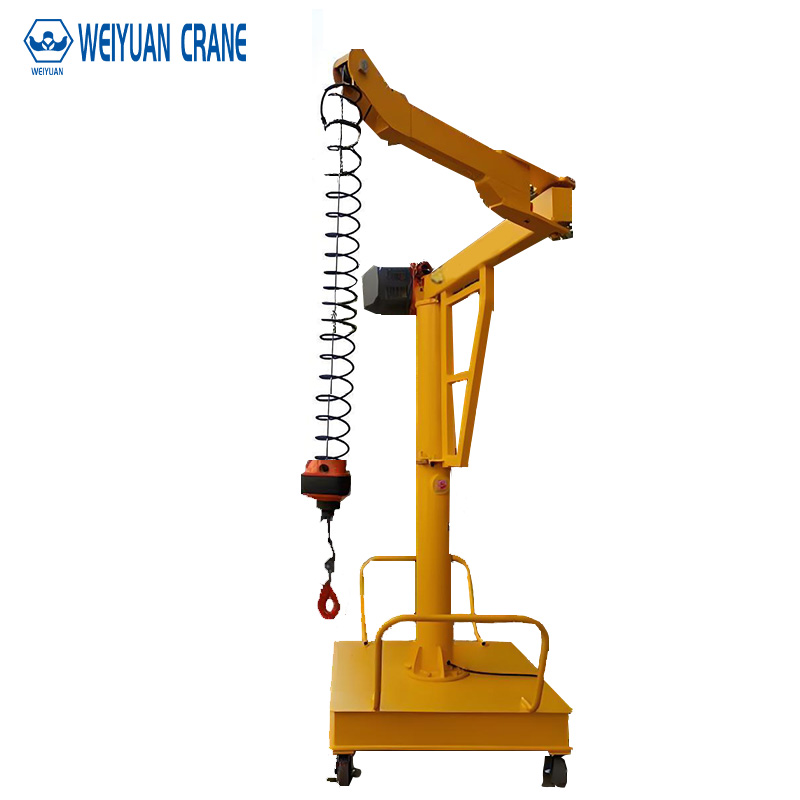
A: An articulating jib has two arms that pivot independently, much like a human elbow. This allows the crane to “reach around” corners or obstacles (like a large machine pillar) that a straight-boom crane cannot navigate. It is the ultimate solution for crowded or complex work cells.
Q3: Are jib cranes suitable for outdoor use?
A: Yes, but they require a “weather package.” This includes epoxy-based coatings to prevent rust, stainless steel fasteners, and specialized covers for the hoist and electrical components to prevent water ingress.
Q4: How long does a typical jib crane last?
A: With proper maintenance and a duty cycle that matches the workload, an industrial-grade jib crane can easily last 20 to 30 years. The structural steel is virtually permanent; only the hoist and wear-parts (like bearings) will eventually need refurbishment.
Q5: Is a motorized rotation necessary?
A: For capacities under 2 tons and shorter boom lengths, manual rotation is usually sufficient and offers more “feel” for the operator. For higher capacities or very long booms, motorized rotation is recommended to prevent worker strain and ensure smoother load control.