


What is the Difference Between a Jib Crane and an Overhead Crane?
In the complex ecosystem of material handling, selecting the right equipment is pivotal to operational efficiency. Two of the most common solutions are the jib crane and the overhead crane (often called a bridge crane). While both serve the fundamental purpose of lifting and moving heavy loads, they function on entirely different principles and serve distinct roles within a facility.
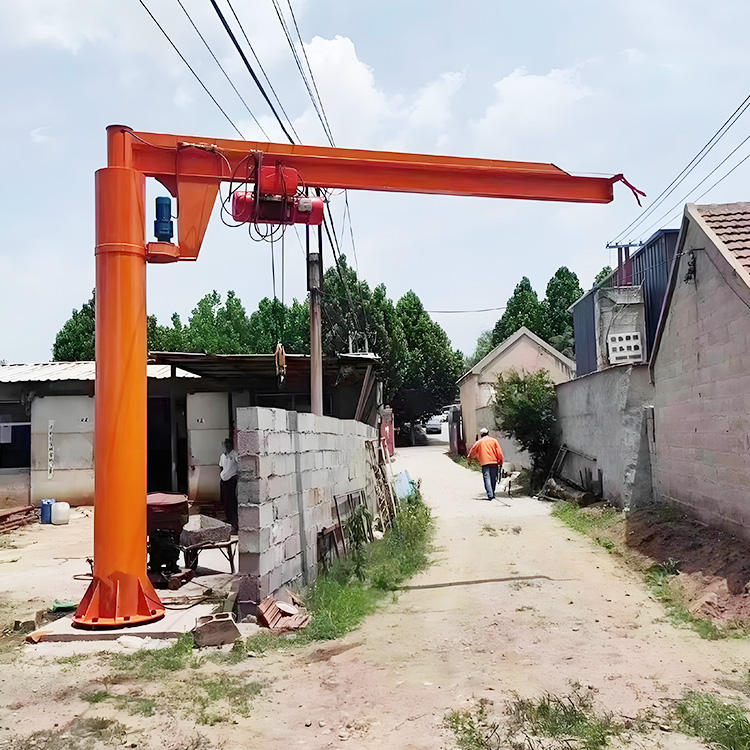
The primary difference lies in their coverage area and structural design. An overhead crane spans the width of a building and travels longitudinally, covering a large rectangular area. In contrast, a jib crane consists of a horizontal arm (jib) attached to a wall or floor-mounted pillar, providing rotational coverage over a specific circular or semi-circular area.
This guide delves deep into the capabilities of the jib crane, explaining why it is often the superior choice for workstation-specific tasks, and how WEIYUAN, as a professional production manufacturer integrating production, sales, design, and installation, can tailor these systems to your exact needs.
1. Product Description: The Power of Localized Lifting
A jib crane is a versatile lifting device characterized by a horizontal boom (the jib) that supports a movable hoist. This boom is fixed to a vertical mast or a wall bracket, allowing it to rotate.
Product Purpose:
While overhead cranes are the “arteries” of a factory, moving goods from one end to the other, the jib crane acts as the “capillaries,” handling the vital, localized work. Its purpose is to service a specific workstation, machine, or loading bay. Whether used as a shop jib crane in a welding bay or a marine jib crane on a dock, it creates a dedicated lifting zone.
Advantages and Attraction:
The core attraction of this equipment is independence. In many factories, workers lose valuable time waiting for the main overhead crane to become available. By installing a floor mount jib crane directly at the assembly station, you empower the operator to lift materials instantly. This reduces idle time, minimizes worker fatigue, and significantly speeds up production cycles. The system utilizes a jib crane trolley that glides along the boom, allowing for precise positioning of loads like engines, molds, or pallets.
2. Features and Advantages: Engineering for Efficiency
Our industrial cranes are engineered to provide maximum efficiency with a minimal footprint. Understanding the features of a jib crane helps clarify why it is an essential complement to, or replacement for, larger overhead systems.
Key Features:
- Rotational Range: Depending on the mounting style, our cranes offer between 180 degrees (wall-mounted) and 360 degrees (pillar-mounted) of rotation.
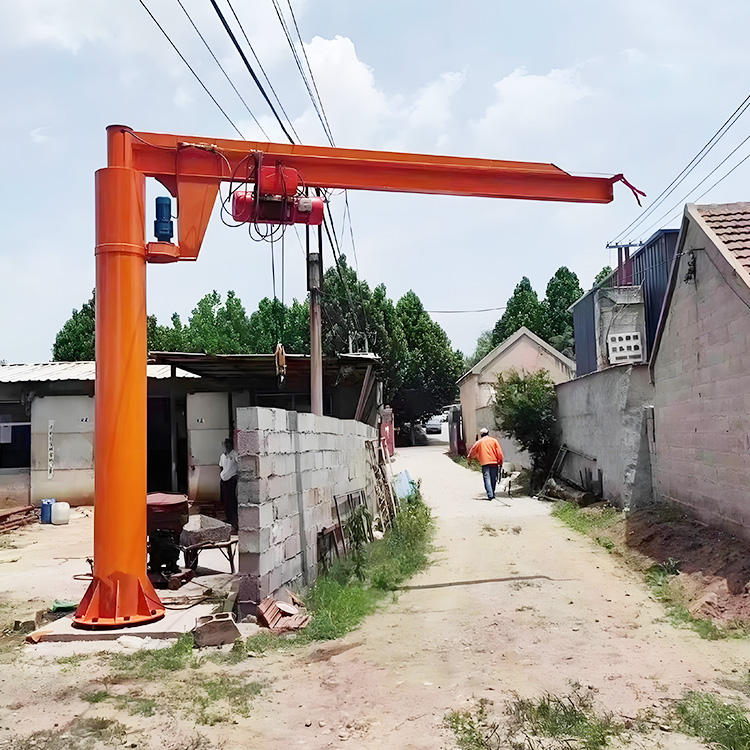
- Diverse Mounting Options: We offer pillar jib crane models for open floor spaces and wall mounted jib cranes to utilize existing building columns, saving valuable floor space.
- High-Strength Construction: WEIYUAN uses high-grade structural steel, ensuring the boom remains rigid even under maximum load, preventing “drift” where the load slides unintentionally.
Efficiency Gains:
The implementation of a cantilever jib crane at a workstation typically improves efficiency by 30 to 50 percent. It allows a single operator to handle loads that would otherwise require a forklift or multiple workers. Furthermore, our designs minimize the effort required to rotate the arm, reducing strain and injury risks.
3. Technical Specifications
Selecting the right specifications is critical for safety and performance. As a manufacturer, WEIYUAN ensures every unit meets rigorous industrial standards.
Standard Specifications:
- Lifting Capacity: Our standard range includes the popular 1 2 ton jib crane, 1 ton, and 5 ton jib crane models. Custom engineering allows for capacities up to 20 tons.
- Span (Arm Length): Standard reaches range from 2 meters to 12 meters. The length of the arm determines the working radius.
- Lifting Height: Typically 3 meters to 6 meters, but fully customizable based on your facility’s ceiling clearance.
- Rotation:
- Floor mounted jib cranes: 360-degree continuous rotation.
- Wall mounted jib cranes: 180 to 200-degree rotation.
- Operation: Manual push/pull rotation for lighter loads; Motorized electric rotation for heavy-duty applications.
- Power Supply: 220V, 380V, 400V, 415V (3-Phase, 50/60Hz) tailored to local grids in Europe, Asia, or Africa.
- Hoist Type: Electric Chain Hoist or Wire Rope Hoist.
4. Customization Options: WEIYUAN Personalized Solutions
Standard off-the-shelf products do not always fit unique industrial constraints. WEIYUAN provides complimentary design and personalized customization services.
- Specialized Environments: For marinas or offshore applications, we manufacture the boat jib crane using specialized anti-corrosion paints and IP65-rated electrical components to withstand saltwater environments.
- Mobility Solutions: For facilities requiring flexibility, we can design a forklift jib crane attachment or a portable base system, allowing the lifting point to be moved as needed.
- Structural Adjustments: We customize the cantilever jib crane brackets to fit specific building column dimensions or design low-headroom booms for areas with vertical height restrictions.
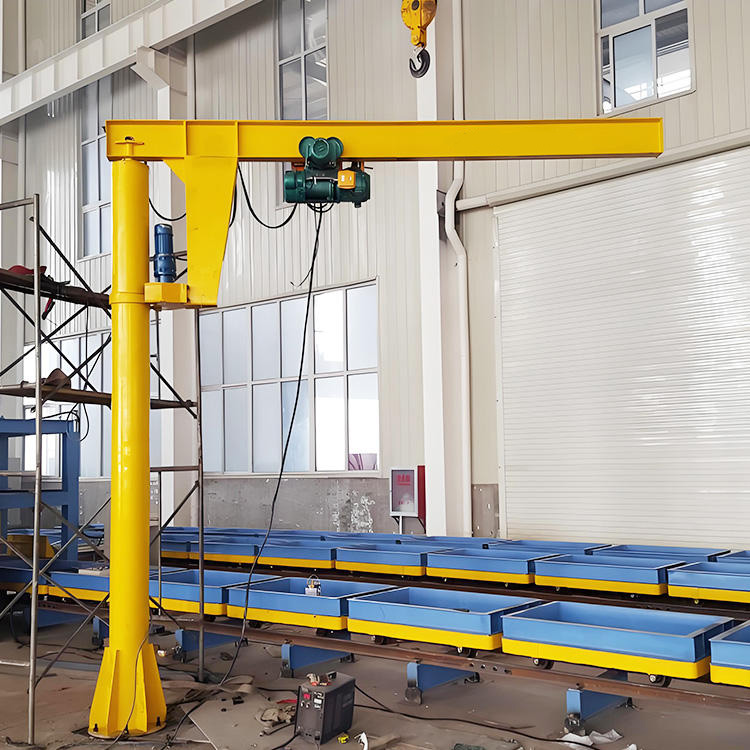
- Branding: We offer custom color painting to match your company’s branding or safety coding requirements (e.g., Safety Yellow).
5. Application Fields
The adaptability of the jib crane makes it a staple across numerous industries.
- Manufacturing & Assembly: Used as a shop jib crane for loading raw materials into CNC machines or lathes.
- Warehousing: Installed at loading docks to move heavy palletized goods from trucks to ground level.
- Marine Industry: A marine jib crane is essential for lifting tenders, jet skis, and supplies onto yachts or commercial vessels.
- Automotive Repair: Mechanics use these cranes to lift engines and transmissions safely.
- Construction Support: Used in precast yards for handling concrete forms and rebar bundles.
6. Safety and Compliance
Safety is the non-negotiable foundation of our manufacturing process. While you may find a used jib crane for sale on the market, buying new ensures the structural integrity of the metal has not been compromised by fatigue.
- Certifications: WEIYUAN products comply with ISO, CE, and can be built to meet UL standards. This ensures compliance with local safety regulations.
- Safety Devices: Every motorized unit includes overload protection, emergency stop buttons, and travel limit switches.
- Structural Stability: For floor mount jib crane installations, we provide detailed engineering calculations for the foundation. The concrete footing must be sufficient to counteract the overturning moment generated by the load.
- Inspection: We recommend regular inspections of the pivot points and the jib crane trolley wheels to ensure smooth operation.
7. Case Study: Optimization in a Heavy Equipment Plant
Client Profile: A manufacturer of agricultural machinery components in Eastern Europe.
The Challenge: The factory relied on two large overhead cranes to service 20 workstations. Machinists spent an average of 40 minutes per day simply waiting for an overhead crane to become available to lift 800kg castings. This bottleneck was costing the company significant production time.
The WEIYUAN Solution: We designed and installed ten units of 1 2 ton jib crane (Pillar Mounted) systems, placing one between every two workstations.
The Results:
- Eliminated Wait Time: Operators had immediate access to lifting power.
- Increased Throughput: Daily production of machined parts increased by 25 percent.
- Enhanced Safety: The localized jib crane trolley allowed for precise positioning of heavy castings into the machine chucks, reducing hand injuries. The investment was recovered in less than six months due to efficiency gains.
8. Installation and Support
We view the sale as the beginning of a long-term partnership. WEIYUAN provides comprehensive support to ensure your equipment is installed safely.
- Installation Guidance: We provide detailed installation manuals, electrical schematics, and foundation drawings. For complex jib crane installation projects, our technical team offers remote video guidance or on-site supervision.
- After-Sales Support: We stock genuine replacement parts. Even if you are looking for gorbel jib crane parts or components for other brands, our high-quality hoists and trolleys are often compatible upgrades.
- Maintenance: We provide maintenance schedules to keep your equipment running smoothly for decades.
9. Pricing and Quotation
The jib crane price varies based on capacity, span, and features.
- Competitive Value: As a direct manufacturer, WEIYUAN offers factory-direct pricing, eliminating the markup of local distributors.
- Get a Quote: Contact us for a personalized proposal. A manual push-pull unit will be significantly lower in cost than a fully motorized 5 ton jib crane.
- Transparency: Our quotes break down the cost of the steel structure, the hoist, and the shipping, so you know exactly what you are paying for.
10. Delivery Cycle
We understand that industrial projects run on tight schedules.
- Standard Models: Standard pillar jib crane and wall mounted jib cranes are typically shipped within 7 to 10 working days.
- Customized Models: Specialized orders, such as marine-grade units or those with custom dimensions, generally require 15 to 25 working days for engineering and fabrication.
- Logistics: We handle professional packaging and can arrange freight to major ports globally.
11. FAQ: Common Questions
Q: Should I buy a used jib crane?
A: We strongly advise caution when looking for a used jib crane or browsing used jib cranes for sale. Metal fatigue is invisible to the naked eye. A used crane may have been overloaded by a previous owner, compromising its safety factors. A new crane comes with a warranty and load certificates.
Q: What is the difference between a cantilever and a pillar jib?
A: A pillar jib crane (or floor mounted) has its own mast and requires a foundation, offering 360-degree rotation. A cantilever jib crane (usually wall mounted) attaches to an existing building column, saving floor space but usually limiting rotation to 180 degrees.
Q: Can I install a jib crane myself?
A: Small wall-mounted units can be installed by competent maintenance teams. However, heavy-duty jib crane installation, particularly floor-mounted units requiring a concrete foundation, should be supervised by professional engineers to ensure the anchor bolts can withstand the tipping forces.
Q: Do you offer mobile solutions?
A: Yes, we can design portable bases for smaller cranes, essentially creating a forklift jib crane setup that allows the unit to be moved around the factory floor.
Q: How do I get a price list?
A: Because steel prices fluctuate and every need is different, we do not publish a static list. Contact WEIYUAN with your required capacity (e.g., 5 ton jib crane) and arm length for an instant jib crane price quote.
Ready to transform your workshop efficiency? Contact WEIYUAN today for a professional consultation and discover how a dedicated jib crane solution can streamline your operations.