


What is the Difference Between a Jib Crane and an Overhead Crane? Your Definitive Guide to Industrial Lifting Solutions
Defining the Core Differences: Area Coverage and Function
The question, “What is the difference between a jib crane and an overhead crane?” addresses the fundamental divide in industrial material handling strategy. While both are indispensable tools for lifting and moving heavy loads, they serve distinct purposes dictated by their structural design and coverage area.
An overhead crane (or bridge crane) typically spans the entire width and length of a factory bay, utilizing runways to provide comprehensive, three-dimensional coverage for large-scale, heavy-duty material transport across the entire facility.
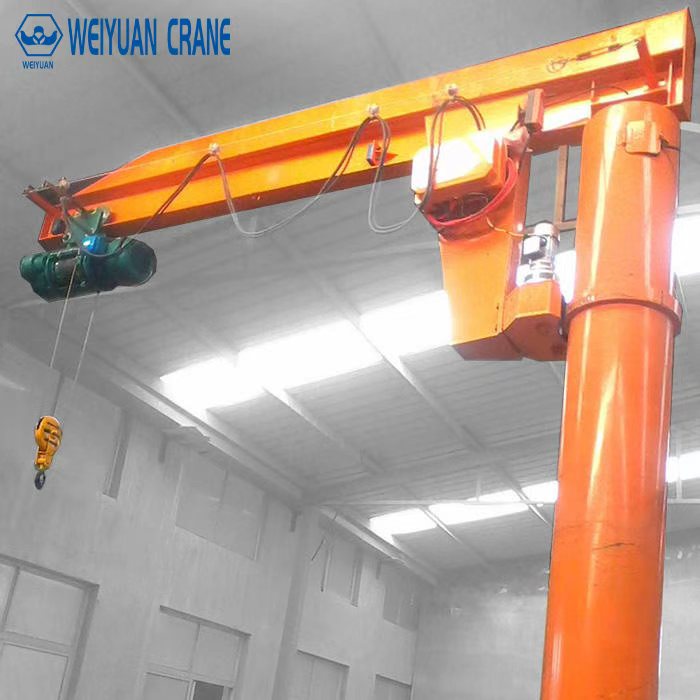
In contrast, a jib crane provides localized, circular, or arc-shaped coverage. It’s a dedicated lifting station, perfect for individual work cells or servicing machinery. Its structure, typically a mast or pillar supporting a rotating jib crane arm, makes it a cost-effective solution for short-distance, repetitive tasks where a large bridge crane is either impractical or too slow. The primary distinction boils down to reach and purpose: factory-wide transport versus workstation efficiency.
Product Description: WEIYUAN Jib Crane Solutions—Filling the Efficiency Gap
At WEIYUAN, we specialize in manufacturing and designing both overhead and jib crane systems, giving us unique insight into when and where each system delivers maximum value. Our electric jib crane models are engineered to address the critical need for localized lifting power, significantly enhancing operational speed and reducing reliance on shared lifting resources.
A high-performance pillar jib crane from WEIYUAN integrates a rigid column, a robust rotating arm, and a precision jib crane with hoist. This combination creates an immediate lifting resource that dramatically improves worker efficiency by reducing the time spent manually positioning components or waiting for an overhead crane to become free.
Enhancing Worker Output in Specialized Sectors
For operations like marine repair yards (where a specialized boat jib crane is necessary) or assembly factories, the quick, dedicated movement offered by a jib crane is a game-changer. For example, implementing a series of 3 ton jib crane units at welding stations ensures that workers can position heavy steel sections immediately, increasing their throughput by up to 30% compared to systems requiring complex communication or remote queueing for lifting services.
WEIYUAN is a professional manufacturing entity integrating production, sales, design, and installation. While we respect the quality of competitors, our focus is on delivering customized, integrated lifting solutions that directly solve specific workflow bottlenecks, offering a better long-term return on investment than off-the-shelf or used jib crane alternatives.
Features and Advantages: The Jib Crane Edge
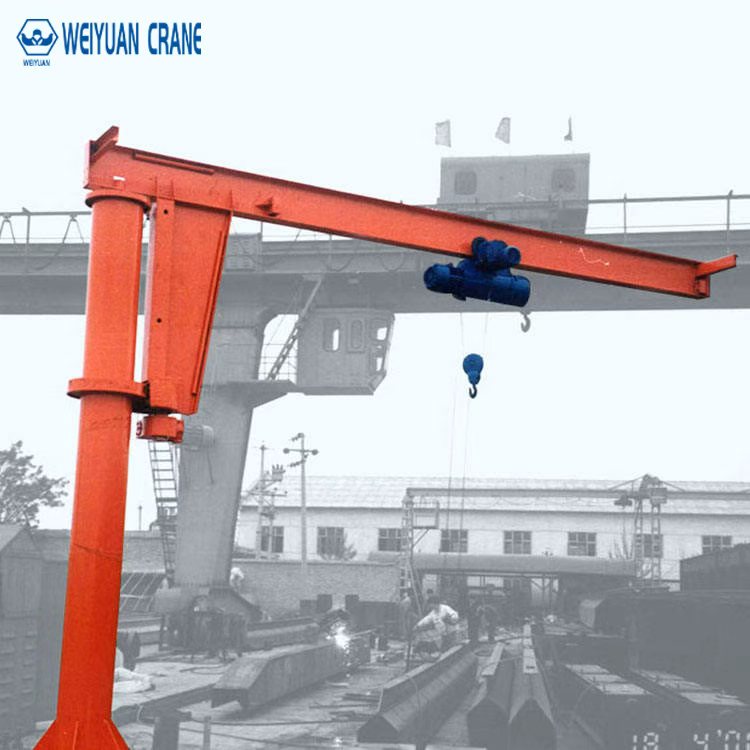
The specific features of a jib crane give it inherent advantages over larger overhead systems for certain applications.
Core Design Advantages
- Cost-Effective Localized Coverage: The initial investment and jib crane installation costs are substantially lower than installing factory-wide overhead runway systems.
- Space Optimization: Wall mounted jib cranes save critical floor space by anchoring directly to existing building columns, a feature impossible with large bridge cranes.
- Rotational Flexibility: Models like our jib crane floor mounted systems offer full 360-degree rotation, ensuring complete coverage of the work cell.
- Modularity and Relocation: Smaller units, like a portable jib crane on wheels, can be easily moved and repurposed as production lines change, offering adaptability that a fixed overhead crane cannot.
Safety and Component Quality
- Integrated Hoisting: Each jib crane is supplied as a complete system with an optimized electric hoist, gearbox, and control panel, ensuring component compatibility and maximized safety margins.
- Material Excellence: We use high-grade structural steel and precision bearings designed for the heavy radial and thrust loads unique to jib operation.
- Custom Anchoring: Freestanding pillar jib crane systems include engineered foundation plans to guarantee stability and compliance with local load requirements.
Technical Specifications: Tailoring the Fit
Understanding the technical dimensions of a jib crane is crucial for successful deployment.
Key Technical Parameters
| Specification | Detail | Applicability Insight |
| Capacity Range | From 0.5 Ton up to 10 Ton (e.g., our popular jib crane 2 ton model). | Overhead cranes often handle 50T+; jib cranes focus on precision light-to-medium loads. |
| Rotation Angle | 360° (Freestanding) or 200° – 270° (wall mount jib cranes). | Defines the working footprint and space utilization. |
| Span/Reach | Customized up to 10 meters. | Overhead cranes typically span the entire building width (e.g., 30m+). |
| Power Supply | 3-Phase, 380V / 50Hz standard, customizable for global markets (e.g., 440V, 60Hz). | Ensures compatibility across Europe, Asia, and Africa. |
| Jib Type | Pillar jib crane, Wall-Mounted, Cantilever, or specialized forklift jib crane attachments. | Determines installation method and structural reliance. |
Precision Customization and Design Flexibility
WEIYUAN offers FREE design and personalized customization services. Our deep manufacturing capacity allows us to adjust critical parameters to your exact needs:
- Tonnage and Span: If a standard 3 ton jib crane isn’t quite enough, we custom-engineer the mast and arm for intermediate capacities and non-standard reaches.
- Environmental Protection: Custom coatings for outdoor use (e.g., ports) or explosion-proof electrics for hazardous areas.
- Controls: Integration with radio remote controls or specialized pendants with variable speed drives for delicate operations.
Even if you are seeking a component to repair a competitor’s product, such as gorbel jib crane parts, our technical team can often assist with compatible solutions or replacement units.
Application Fields: Where the Jib Crane Dominates
The jib crane shines in areas where an overhead crane is overkill or inaccessible.
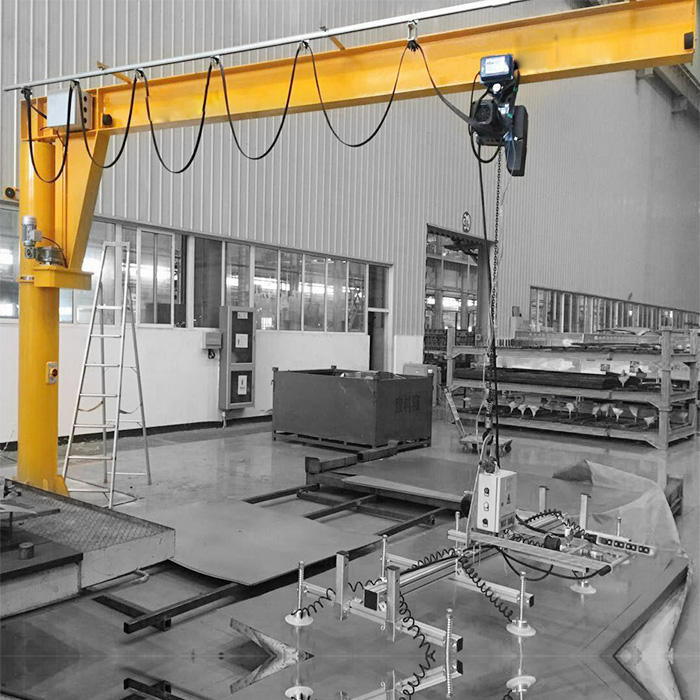
- Fabrication & Welding Shops: Positioning steel plates for cutting or welding, utilizing a workstation jib crane.
- Machinery Maintenance: Servicing large equipment by providing an immediate lift point for motors, tooling, or components. A jib crane repair can often be done without disrupting the main overhead system.
- Shipping Docks & Vehicle Bays: Loading and unloading smaller trucks or providing engine lift capability using a specialized forklift jib crane or truck-mounted jib crane for truck.
- Waterfront & Marine: Handling small launches, dinghies, or supplies on yachts and docks with a boat jib crane.
- Assembly Lines: Providing fast, ergonomic component handling for repetitive tasks, often using wall mounted jib cranes to maximize floor space.
Safety, Compliance, and Installation Support
We ensure that every WEIYUAN electric jib crane is built to global standards, guaranteeing safety and compliance wherever it is installed.
International Compliance and Quality
- CE Certification: Our products adhere to the European Union’s stringent safety and health standards, essential for our European clientele.
- Safety Overload Systems: All units include mandatory overload sensing devices and high-quality braking systems, exceeding baseline industry requirements.
- Outdoor Use: For operations at ports or in yards, units receive specialized IP-rated electrical components and anti-corrosion marine finishes to ensure durability and safety in harsh weather.
Installation and Dedicated Support
Reliable equipment requires expert setup. We provide:
- Detailed Documentation: Comprehensive manuals and certified foundation plans for smooth jib crane installation.
- On-site Technical Teams: For complex projects, our site-technical team can assist with assembly, testing, and commissioning, ensuring smooth handoff.
- Online Guidance Service: We offer remote guidance via video consultation for simpler installations, providing rapid support to customers across Asia and Africa.
Case Study: Optimizing a European Automotive Supplier
A major German automotive parts supplier needed to increase production speed across 12 machining cells without investing in a new overhead crane system. We delivered 12 customized pillar jib cranes (2.5T capacity, 5m span), designed to fit around existing machine guards. The customization included VFD controls for extremely smooth, slow starts—crucial for positioning delicate molds. The result: A 15% reduction in cycle time per part and zero recorded positioning errors in the first year, demonstrating the value of dedicated, high-precision workstation lifting.
Pricing, Quotation Process, and Delivery Timelines
Obtaining a Quote for Jib Cranes Prices
Since every jib crane is customized, we do not have a fixed jib cranes prices list. Pricing is highly dependent on: capacity, span, rotation type, and the complexity of the electric hoist.
To receive a fast, accurate, and personalized quote, please contact us with your specifications. Our engineering team can often provide preliminary design options and pricing within 24 hours. We encourage you to contact us now instead of searching for a potentially risky used jib crane for sale or generic alternatives.
Estimated Delivery Cycle
Our commitment to quality means adhering to precise manufacturing schedules:
- Standard Models: For common configurations (e.g., a standard jib crane floor mounted 1T or jib crane 2 ton), the typical lead time from confirmed order to factory shipment is approximately 4 to 6 weeks.
- Highly Customized Units: For bespoke designs or high-capacity systems, the cycle may extend to 8 to 12 weeks to allow for specialized component manufacturing and rigorous testing.
Frequently Asked Questions (FAQ)
Can I use a forklift jib crane attachment with any forklift?
A forklift jib crane attachment is designed to slip over the tines of a standard forklift. However, you must always verify that the attachment’s capacity, combined with the load, does not exceed the forklift’s rated load center capacity. Safety first.
What is a workstation jib crane?
A workstation jib crane is a light-capacity lifting device, often used as part of a modular system. It focuses on ergonomic handling and fast, repetitive movements, primarily aimed at reducing manual effort and preventing worker injury at individual assembly benches.
Where can I find a reliable used jib crane for sale?
While WEIYUAN focuses on new, custom-built solutions, if you require a used jib crane for sale, look for certified dealers who can provide detailed maintenance records and ensure the unit’s compliance with current safety standards. A low price often means a high-risk liability.
What is the role of a jib pole crane?
A jib pole crane is essentially a column-mounted or pillar jib crane where the support structure (the pole or mast) is anchored to the floor, providing a fixed, centralized point for lifting operations. They offer maximum rotation coverage (360°).