



Cranes
Wall Mounted Jib Crane vs Pillar Mounted: Which Type Fits Your Workspace?
Published by: [Your Brand] Engineering Team | Last Updated: March 2026 | Reading Time: 8 min
Introduction
The first question in any jib crane project is not “what capacity do I need?” It is “where does the crane mount?”
The mounting decision defines everything else. It determines whether the crane needs a concrete foundation. It determines the rotation arc. It determines whether the building structure must be assessed by a structural engineer. And it determines the total installed cost — which can differ by 40 to 80% between wall-mounted and pillar-mounted configurations at the same rated capacity.
Wall-mounted jib cranes attach to an existing wall or building column. They take up zero floor space. Pillar-mounted jib cranes stand on their own foundation. They are self-supporting and independent of the building structure.
Both serve the same lifting function. But they make completely different demands on the facility. This guide explains the five critical differences — and provides a clear decision framework for choosing the right mounting type for your workspace.
Part 1: Structural Definitions
Wall-Mounted Jib Crane
A wall-mounted jib crane has two mounting brackets attached to a wall or building column — one upper bracket and one lower bracket. The crane’s mast or pivot assembly fits between these brackets. The boom extends horizontally from the pivot.
The upper bracket is the critical structural element. When the crane lifts a load at the end of the boom, it creates an overturning moment at the mounting point. This moment pulls the upper bracket outward — away from the wall — and pushes the lower bracket inward.
The upper bracket tension force is the governing structural load. For a 1-tonne crane with a 4-metre boom and 1.2-metre bracket spacing:
Upper bracket tension = (1,000 kg × 9.81 m/s² × 1.15 × 4.0 m) ÷ 1.2 m = 37,700 N ≈ 3.8 tonnes of outward pull.
This force is applied to the wall or column at every lift. The wall or column must carry it safely.
Pillar-Mounted (Floor-Mounted) Jib Crane
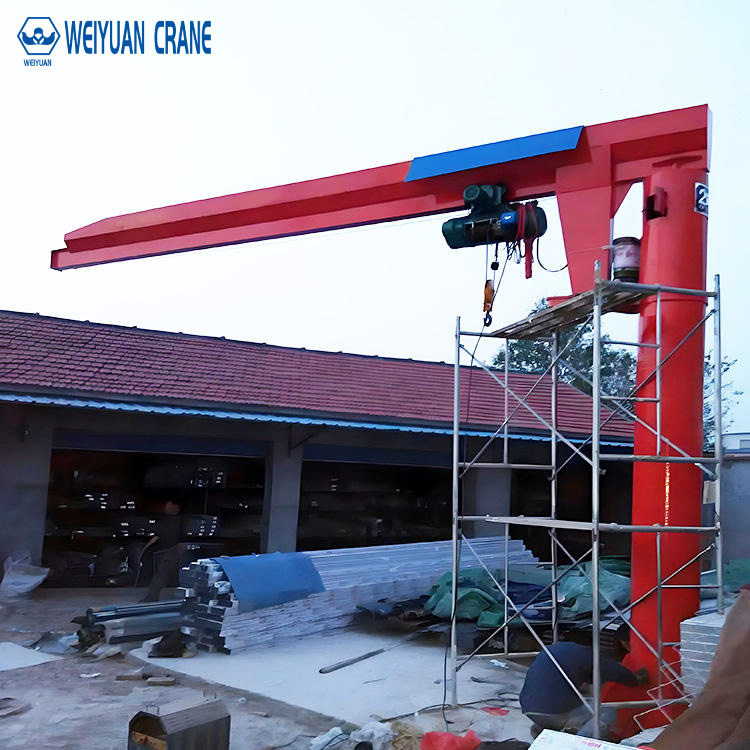
A pillar-mounted jib crane has a steel mast anchored to a reinforced concrete foundation embedded in the floor. The boom attaches to a slewing bearing at the top of the mast. The crane is entirely self-supporting — it does not rely on any wall or column for structural support.
The foundation resists the overturning moment from the load at the boom end, the vertical weight of the crane and load, and the horizontal shear from lateral forces.
The mast stands independently in the floor. It requires space for the foundation — typically a concrete cylinder 600 to 1,500mm in diameter — but it does not impose any load on the building’s walls or columns.
Part 2: Difference 1 — Floor Space Requirement
Wall-Mounted: Zero Floor Footprint
A wall-mounted jib crane installs on an existing vertical surface. It adds no structure to the floor. There is no mast base, no foundation bump, no obstacle for forklifts, AGVs, or personnel to navigate around.
In facilities where floor space is at a premium — dense production areas, narrow aisles, facilities with AGV traffic routes — the wall-mounted crane’s zero floor footprint is a decisive advantage.
When not in use, many wall-mounted jib cranes can be swung back against the wall. The boom rests parallel to the wall surface, clearing the working area entirely.
Pillar-Mounted: Foundation at Floor Level
A pillar-mounted crane has a mast base at floor level. The mast itself occupies approximately 200 to 400mm in diameter. The foundation around the mast may create a raised lip at the floor surface — or be flush with the floor surface if designed correctly.
More importantly: the mast and its immediate surrounding area cannot be used as a forklift path. The mast is a permanent obstacle at a fixed floor position. Any production layout change that conflicts with the mast location requires either relocating the crane (expensive) or working around it.
Winner for floor space: Wall-mounted — no floor footprint, no permanent obstacle.
Part 3: Difference 2 — Rotation Arc and Coverage
Wall-Mounted: 180° Standard
A wall-mounted crane attaches to a wall or column. The wall or column limits the boom’s rotation arc — the boom cannot pass through the wall. Standard wall-mounted jib cranes provide 180° to 200° of rotation arc.
This 180° arc covers the half-circle in front of the wall. For most workstation applications — where the crane serves positions in front of the wall — 180° is adequate.
Pillar-Mounted: Up to 360°
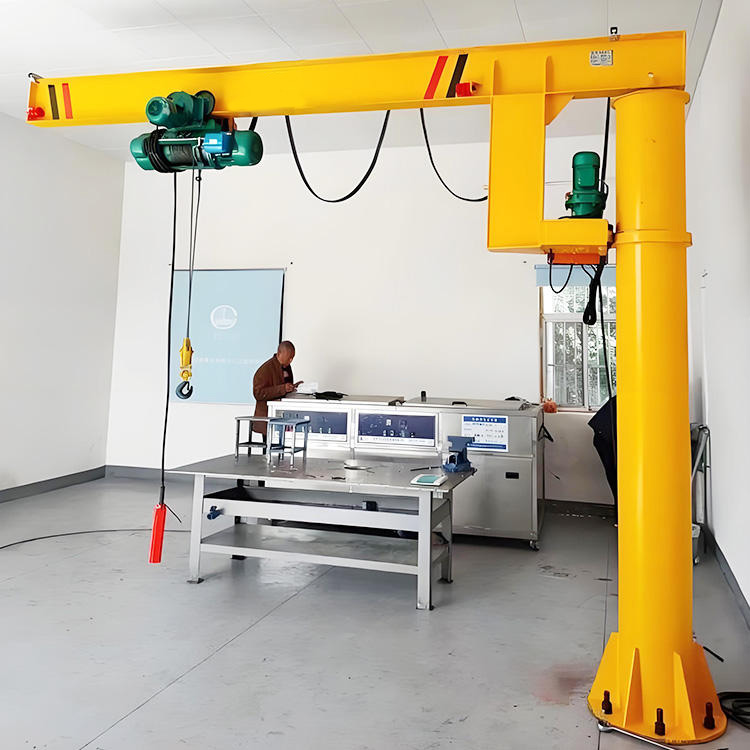
A pillar-mounted crane stands free of any wall or column. Nothing blocks the boom’s rotation. The crane can rotate 360° — covering the full circle around the mast.
360° rotation allows the crane to serve positions on all sides of the installation point. This suits isolated workstations, loading dock positions, and applications where loads must be transferred between positions on opposite sides of the crane.
Winner for coverage: Pillar-mounted — 360° rotation covers all directions. Wall-mounted is limited to 180° in most installations.
Part 4: Difference 3 — Structural Requirements
Wall-Mounted: The Building Structure Must Be Verified
The wall-mounted crane’s structural requirement falls entirely on the building’s wall or column. The upper bracket tension force is substantial — as calculated in Part 1, a 1-tonne crane generates approximately 3.8 tonnes of outward pull at the upper bracket.
This requirement eliminates many potential mounting structures immediately:
Masonry block walls: typical hollow concrete block walls have limited anchor pull-out capacity. Most cannot carry wall-mounted jib crane bracket loads without reinforcement.
Lightweight steel framing: standard steel stud walls and light-gauge steel framing are not structural elements — they cannot carry crane loads.
Gypsum board partitions: cannot carry any crane load. Not acceptable under any circumstances.
Acceptable mounting structures for wall-mounted jib cranes:
Reinforced concrete columns and walls (minimum 250mm thickness for 1 to 2-tonne cranes).
Solid brick masonry walls with adequate thickness and condition.
Structural steel columns of sufficient section and connection capacity.
Before any wall-mounted jib crane installation: a licensed structural engineer must assess the mounting structure and confirm it can carry the upper and lower bracket forces. This is not optional. Skipping the structural assessment and discovering the wall is inadequate after the crane is loaded is a safety incident waiting to happen.
Pillar-Mounted: Foundation Design Required
The pillar-mounted crane requires a reinforced concrete foundation. The foundation must resist the overturning moment, vertical force, and horizontal shear from the crane loads.
Foundation sizing from the manufacturer’s load data: typical foundation dimensions for standard pillar jib cranes:
1-tonne capacity, 4-metre boom: 700 to 900mm diameter, 1,000 to 1,300mm deep.
2-tonne capacity, 5-metre boom: 900 to 1,100mm diameter, 1,300 to 1,600mm deep.
5-tonne capacity, 6-metre boom: 1,200 to 1,500mm diameter, 1,600 to 2,000mm deep.
The foundation requires concrete to cure for 28 days before the mast can be installed and loaded. This curing period is the dominant schedule driver for pillar-mounted crane projects.
Winner for structural simplicity: Neither — both require engineering assessment. Wall-mounted needs a structural engineer for the building structure. Pillar-mounted needs a foundation design.
Part 5: Difference 4 — Installation Time and Cost
Wall-Mounted Installation
Step 1: structural assessment of the mounting wall or column (1 to 14 days depending on whether original structural drawings are available).
Step 2: drill and install anchor bolts into the wall or column (1 day).
Step 3: mount upper and lower brackets, install pivot assembly and boom (1 day).
Step 4: install hoist and electrical connection (half day).
Step 5: load test (half day).
Total mechanical installation time: 2 to 3 days. But the structural assessment adds 1 to 14 days of pre-work before installation can begin.
Typical installation cost (excluding crane purchase price):
Structural assessment: $500 to $2,000.
Mechanical installation (1 to 2-tonne crane): $800 to $2,000.
Electrical connection: $400 to $1,200.
Load test: $300 to $600.
Total installed cost premium: $2,000 to $5,800.
Pillar-Mounted Installation
Step 1: excavate foundation pit (1 day).
Step 2: pour reinforced concrete foundation (1 day).
Step 3: cure concrete — 28 days minimum.
Step 4: install mast on foundation, plumb and torque anchor bolts (1 day).
Step 5: install slewing bearing and boom (1 day).
Step 6: install hoist and electrical connection (half day).
Step 7: load test (half day).
Total elapsed time from start to load test: 33 to 35 days for a new concrete foundation. The 28-day concrete cure period is unavoidable.
Typical installation cost:
Foundation excavation and concrete: $2,000 to $6,000.
Mechanical installation: $800 to $2,500.
Electrical connection: $400 to $1,200.
Load test: $300 to $600.
Total installed cost premium: $3,500 to $10,300.
Winner for installation speed: Wall-mounted — no 28-day concrete cure period. Faster from decision to first lift.
Winner for installation cost: Wall-mounted — lower total installation cost in most cases.
Part 6: Difference 5 — Capacity and Boom Length Limits
Wall-Mounted Capacity Limits
Wall-mounted jib cranes are limited by the mounting structure’s capacity to carry the upper bracket tension force. As capacity increases and boom length increases, the upper bracket tension force increases proportionally.
Practical capacity limits for wall-mounted jib cranes:
On a reinforced concrete column (300mm × 300mm minimum): up to 3 to 5 tonnes.
On a reinforced concrete wall (250mm minimum thickness): up to 2 to 3 tonnes.
On a structural steel column: up to 5 tonnes with adequate column section.
Above 5 tonnes: the upper bracket tension forces typically exceed what standard building structures can carry without major reinforcement. Pillar-mounted becomes the practical choice.
Pillar-Mounted Capacity Limits
Pillar-mounted jib cranes are limited by the mast and foundation structural design — not by an existing building structure. Standard commercial pillar-mounted jib cranes are available to 16 tonnes. Custom designs extend beyond this.
The foundation can always be designed larger to carry higher loads. There is no inherent upper limit as long as the floor can accommodate the required foundation dimensions.
Winner for heavy capacity: Pillar-mounted — handles up to 16 tonnes as standard. Wall-mounted is practical to approximately 5 tonnes.
Part 7: Decision Framework
Choose Wall-Mounted When:
Floor space is at a premium and zero-footprint mounting is essential.
The building wall or column has been confirmed by a structural engineer to carry the bracket forces.
The required capacity is 3 tonnes or below.
Quick installation (no concrete curing wait) is a priority.
The crane will serve a workstation directly in front of a wall — 180° arc is adequate.
Budget is limited — wall-mounted installation is typically cheaper.
Choose Pillar-Mounted When:
360° rotation is required — the crane must serve positions on all sides.
Capacity exceeds 3 to 5 tonnes.
The building wall or column has been assessed and found inadequate for wall-mounted loads.
The facility layout will evolve — pillar-mounted cranes can be relocated (expensively but possible) while wall-mounted systems are fixed to the structure.
Long boom length is required — pillar-mounted handles longer booms without the upper bracket tension penalty.
No suitable structural wall or column exists near the required installation position.
Part 8: 2026 Price Comparison
Wall-mounted jib crane (brackets + pivot + boom, without hoist):
1 tonne, 3m boom: $1,200 to $2,800
2 tonne, 4m boom: $2,200 to $5,000
3 tonne, 4m boom: $3,500 to $7,500
Pillar-mounted jib crane (mast + slewing bearing + boom, without hoist):
1 tonne, 4m boom: $2,000 to $4,500
2 tonne, 5m boom: $3,500 to $8,000
5 tonne, 6m boom: $8,000 to $18,000
Pillar-mounted premium over wall-mounted at equivalent capacity: 30 to 60% on crane equipment price.
Installation cost premium (pillar over wall): $1,500 to $5,000 for the foundation vs structural assessment cost difference.
Frequently Asked Questions
Q: Can I convert a wall-mounted crane to a pillar-mounted crane if the wall is not strong enough?
A: Not as a conversion — they are different products. If the wall assessment reveals inadequate capacity, the wall-mounted crane hardware cannot be reused as a pillar-mounted system. A new pillar-mounted crane must be purchased and installed separately. This is why the structural assessment must happen before purchasing the crane — not after it arrives.
Q: My building column is steel I-section. Can I mount a jib crane directly to it?
A: Possibly — but only with a structural engineer’s written confirmation for the specific column section and the specific crane’s bracket forces. Steel I-section columns vary enormously in flange thickness, web depth, and overall section capacity. A column adequate for the building’s roof loads may not be adequate for the additional lateral bracket force from a jib crane. Do not proceed without the engineer’s written sign-off.
Q: Is there a wall-mounted option that provides more than 180° rotation?
A: Yes. Some wall-mounted designs use a cantilevered bracket that projects the crane’s pivot point away from the wall. This allows the boom to swing past the wall plane — providing up to 270° rotation. These extended-rotation wall-mounted designs impose higher loads on the mounting brackets than standard 180° designs. The structural assessment requirement is even more critical for these configurations.