


Electric Hoist for Mining & Underground Operations: Duty Requirements, Explosion-Proof Ratings & Safety Standards
Introduction
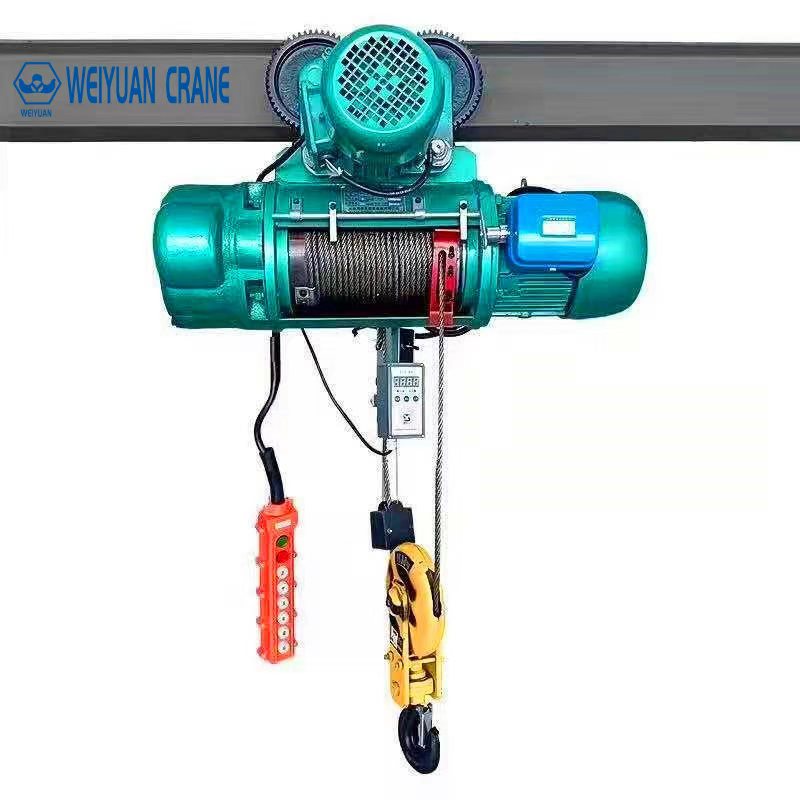
Standard industrial electric hoists are engineered for factories, warehouses, and workshops — environments where the atmosphere is breathable air, the floor is level and lit, and a failed hoist produces downtime rather than fatalities. Underground mining and tunneling operations exist in a fundamentally different risk environment. Methane released from freshly cut coal seams can explode if ignited. Rock dust from drilling and blasting is abrasive enough to destroy standard gearbox seals in weeks. Groundwater seepage creates persistent high humidity that destroys standard motor insulation within months. And in the confined geometry of an underground heading, a dropped load or structural failure has consequences far more severe than any surface industrial incident.
These realities explain why mining-specification electric hoists exist as a distinct product category — not as a variant of standard industrial hoists, but as purpose-engineered equipment with mandatory third-party certification, redundant safety systems, and construction standards that are substantially more demanding than any surface industrial specification. Using a standard industrial hoist underground in a coal mine is not merely suboptimal — in China and most other major mining jurisdictions, it is a regulatory violation that can result in mine closure and criminal liability.
This guide provides the complete technical reference for electric hoist specification in mining environments: the specific hazards that drive the specification requirements, the hoist types that serve different underground functions, the Chinese MA certification framework that governs coal mine equipment globally, the international equivalents, the mandatory safety devices, and the maintenance practices that sustain safe performance in the underground environment.
Part 1: Mining Environment — What Makes It Different
Explosive Atmosphere: The Defining Hazard
Underground coal mines and gas-bearing metal mines contain methane (firedamp) released from coal seams and rock formations, and coal dust that becomes explosible when suspended in air above certain concentrations. An electric hoist operating in this atmosphere with standard electrical components — contactors that arc during switching, motors that generate surface heat, brushes that spark — is a potential ignition source for an explosive mixture. The consequences of ignition in a confined underground space are catastrophic.
This explosive atmosphere hazard is the primary specification driver that separates mining hoists from all other industrial lifting equipment categories. Every country with significant underground coal mining has enacted mandatory explosion-proof equipment certification requirements. Operating uncertified electrical equipment in a classified underground atmosphere is universally illegal and is consistently identified as a contributing factor in underground explosion accidents.
Abrasive Dust and Particle Contamination
Underground mining environments generate continuous abrasive dust from drilling, blasting, ore loading, and conveyor operations. This dust — which may contain quartz, feldspar, pyrite, and other hard mineral particles — penetrates any opening in standard IP54 or IP55 electrical enclosures within weeks of installation, abrading contact surfaces and contaminating lubricants. Mining hoists require IP65 minimum protection on all electrical enclosures, with coal dust ingress prevention provisions required by mining certification standards beyond basic IP classification.
High Humidity and Water Ingress
Groundwater seepage, mine ventilation condensation, and dust suppression water create persistently high humidity in underground workings — often approaching 100% relative humidity in active development headings. Standard electrical insulation rated for normal industrial environments degrades rapidly under continuous moisture exposure, leading to insulation resistance failure and ground faults that disable the hoist and create safety hazards. Mining hoists require motor insulation Class H or F with moisture-resistant treatment, hermetically sealed contactor assemblies, and drain provisions in electrical enclosures.
Shock and Impact Loading
Underground mining operations subject hoists to load dynamics that surface applications rarely encounter. Rock bolting operations, steel arch support installation, ore transfer to skip loading stations, and emergency equipment handling all involve sudden load application that imposes impact forces significantly above the static load weight. Mining hoist structural design must incorporate appropriate dynamic amplification factors — typically 1.25 to 2.0 for mining applications, compared to 1.15 for standard industrial use — to ensure structural adequacy under realistic operating conditions.
Part 2: Hoist Types for Mining Applications
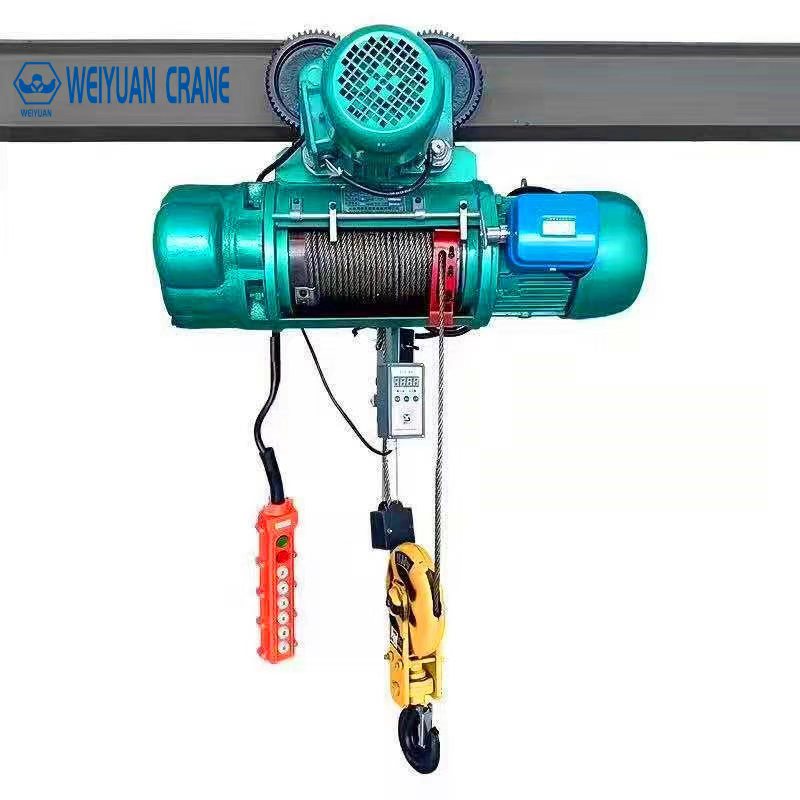
Underground Maintenance Hoists (1 to 10 Tons)
The largest category of electric hoist use in underground mining — and the primary subject of this guide. Maintenance hoists serve underground equipment workshops where mine haul trucks and LHD vehicles are repaired, pump chambers housing large dewatering pumps, crusher chambers serving primary ore reduction, and underground electrical substations housing transformers.
These hoists are typically installed as overhead bridge cranes or monorails in excavated underground chambers specifically designed to provide the headroom and clear span for the maintenance functions they serve. Capacity typically ranges from 1 to 10 tons for most underground maintenance applications, up to 20 to 30 tons for large crusher maintenance chambers.
Required specification: MA certification (Chinese coal mines) or ATEX Group I / MSHA approval (international); IP65 minimum; Class D minimum duty rating for continuous workshop use; cold-weather lubricants for cold-climate mines.
Rock Bolt and Support Installation Hoists (100 to 500 kg)
Installation of rock bolts, wire mesh, and steel arch supports in development headings is one of the most repetitive underground operations. Ergonomic assist hoists mounted on light rail systems in active headings reduce the manual handling effort of support material and lower musculoskeletal injury rates among underground workers. These light-duty hoists must carry full explosion-proof certification because they operate in active development headings — the highest-methane-risk zone in any underground mine.
Exploration and Raise Boring Equipment Hoists
Mineral exploration drilling programs require hoists to handle drill rod sections (typically 3 to 6 meters per section, 100 to 500 kg per rod) during continuous drilling operations. These hoists operate at surface or near-surface and may not require underground explosion-proof certification, but the continuous cycling of the drilling process — dozens of rod trips per hour across multi-day campaigns — demands duty class specifications appropriate for continuous industrial service rather than the light-duty ratings typical of construction hoists.
Part 3: Chinese MA Certification — The Global Mining Standard
The Chinese MA (Mine Safety) certification system — administered by the National Mine Safety Administration (NMSA, 国家矿山安全监察局) — is the most comprehensive and most widely applied mining-specific hoist certification standard globally, reflecting both the scale of China’s coal mining industry (the world’s largest) and the depth of regulatory development following major underground accidents in the 1990s and 2000s.
MA Certification Legal Basis
Article 96 of China’s Coal Mine Safety Regulations (煤矿安全规程) mandates that all electrical equipment used in coal mines must carry the MA mark (矿用安全标志). Operating non-MA-certified electrical equipment in a Chinese coal mine is a violation of the Coal Mine Safety Law and can result in mine suspension, equipment confiscation, and personal liability for mine management.
Technical Standards Governing MA-Certified Hoists
GB 3836 series (Explosive Atmospheres): The Chinese equivalent of IEC 60079, specifying explosion protection methods. The primary applicable standards for mining hoists: GB 3836.1 (general requirements for explosion protection), GB 3836.2 (flameproof enclosures, designation Ex d), and GB 3836.3 (increased safety, designation Ex e).
GB/T 25972 (Mining Electric Hoists): The product-specific standard that specifies requirements for mining electric chain hoists and wire rope hoists beyond the general explosion protection framework. Key requirements include structural material minimum toughness standards, load limiting device mandatory provision, and redundant braking requirements.
MA-Specific Design Requirements
Motor surface temperature limit: No surface of the motor, gearbox, or electrical enclosure may exceed 150°C under any operating or fault condition. This limit is set well below coal dust ignition temperatures (approximately 250°C for most coal types) to ensure that even in a fault condition, the hoist cannot serve as a coal dust ignition source.
Dual braking systems: Mining hoists must have two independent braking systems, either of which can hold 125% of rated load without the other. This redundancy ensures that a single brake component failure cannot result in an uncontrolled load descent.
Load limiting device: An automatically acting load limiter that cuts motor power when the lifted load exceeds the rated capacity. Mining hoists require the cutout threshold at 110% of rated capacity — more conservative than the ASME B30.16 standard of 125% — reflecting the higher safety requirements of the underground environment.
MA Certification Process
Third-party testing: MA certification requires testing of representative samples at an NMSA-designated test institute. Type approval testing covers explosion protection performance, load limiter accuracy, brake holding force, motor surface temperature under fault conditions, and IP ingress protection verification.
Factory inspection and ongoing surveillance: After type approval, the manufacturer’s production facility is inspected to verify production quality control. Ongoing annual surveillance audits confirm that production units continue to match the certified design.
MA mark: The certification mark (矿用安全标志编号) must be permanently affixed to each certified hoist, with the certificate number traceable to the NMSA’s public certification database.
Part 4: International Certification Frameworks
ATEX Group I vs Group II — A Critical Distinction
European ATEX certification divides explosion protection into two equipment groups: Group I for mining applications and Group II for surface industry applications. This distinction is critical and frequently misunderstood.
Group II equipment (the category that covers petroleum refineries, chemical plants, and grain facilities) is designed for surface hazardous locations. Group I equipment is designed specifically for underground coal mining, with more stringent requirements reflecting the unique hazards of that environment, including:
- More conservative maximum surface temperature limits (relevant for coal dust ignition temperatures)
- Enhanced structural requirements for underground mechanical impact and vibration
- Additional provisions for the continuous methane exposure present in underground coal workings
An ATEX Group II explosion-proof hoist — even with the highest certification category (Ex ia, Zone 0) — does not satisfy the requirements for use in underground coal mines where Group I certification is required. Specifying Group II equipment for underground coal mining is a compliance error with serious legal and safety consequences in most jurisdictions.
IECEx International System
The International Electrotechnical Commission’s IECEx system provides internationally recognized explosion protection certification based on IEC 60079 standards. IECEx Group I certification corresponds to mining applications and is recognized in over 60 countries as an alternative to national certification. For multinational mining companies operating across multiple jurisdictions, IECEx certification simplifies equipment procurement by providing a single internationally recognized mark.
MSHA Approval (United States)
The U.S. Mine Safety and Health Administration administers a mandatory approval process for electrical equipment used in underground coal mines. MSHA approval is issued after testing at MSHA-designated laboratories and is separate from ATEX or IECEx certification. Non-MSHA-approved electrical equipment in a U.S. underground coal mine is a federal violation under the Federal Mine Safety and Health Act.
Part 5: Mandatory Safety Devices for Mining Hoists
Load Limiting Device
An automatically acting device that cuts motor power when the lifted load reaches the rated capacity limit. Mining certification requires this device to operate at 110% of rated capacity — tighter than the 125% standard in ASME B30.16 for surface industrial hoists.
Slack Rope / Slack Chain Detection
A device that detects when the wire rope or load chain becomes slack — indicating the hook has landed on a surface and is no longer supporting a suspended load. Without this device, the operator may continue lowering after contact, causing rope pile-up on the drum, chain kinking, or — in the worst case — the hook landing on a worker who has moved into the load zone. Slack detection is mandatory in mining certification standards and is considered a critical life-safety device.
Over-Travel Limit Switches (Explosion-Proof)
Both upper and lower limit switches must be present and functional, carrying explosion-proof certification equivalent to the hoist itself. The upper limit switch prevents two-blocking — the hook block being drawn into the hoist body — and the lower limit switch prevents the chain or rope from being completely run off the drum. In the underground environment, limit switch failure modes and maintenance requirements must be assessed in the context of explosive atmosphere exposure.
Thermal Protection
Motor winding temperature protection that cuts power before the motor surface reaches 150°C — the MA certification limit. Standard Class H insulation with a calibrated thermal cutout is the minimum provision. In continuous-duty underground maintenance workshops, thermal monitoring with remote indication to the maintenance control room is best practice.
Manual Load Lowering Provision
In the event of power failure underground, the ability to lower a suspended load without electrical power is a mandatory safety requirement. All mining hoists must provide controlled manual lowering through the gear train, typically via a manual brake release mechanism with a mechanical lowering rate limiter. The ability to lower a load manually in the dark, in poor ventilation conditions, following an underground power event, is a life-safety requirement that no other industrial hoist application imposes in the same terms.
Part 6: Maintenance in the Underground Mining Environment
Inspection Intervals — More Frequent Than Surface Standards
ASME B30.16’s standard inspection intervals — monthly frequent inspection, annual periodic inspection — are minimum baselines that must be increased for underground mining hoists:
Daily pre-shift inspection: Required by mining safety regulations in most jurisdictions. The operator documents: brake function test, load limiter test (lift a test load to rated capacity and confirm cutout), limit switch test, rope or chain visual condition, and enclosure integrity. This inspection is recorded in the shift safety log.
Weekly frequent inspection: Full ASME B30.16 frequent inspection checklist plus dust contamination check and removal, rope or chain lubrication check, and IP seal integrity verification. In active development headings, weekly inspection may not be sufficient — daily inspection of explosion-proof enclosure integrity is appropriate.
Quarterly periodic inspection: Gearbox oil sample analysis for metal particle content, motor insulation resistance measurement (megger test — values below 1 MΩ require motor investigation), load limiter calibration verification under measured test load, explosion-proof enclosure flame gap measurement per GB 3836.2 or equivalent, and structural weld inspection at primary connections.
Sealed Gearbox Lubrication Management
Underground environments impose specific lubrication challenges: fine rock and coal dust penetrates open lubrication points within days, high humidity promotes oil emulsification in gearboxes not properly sealed, and cold-climate mines require lubricants with adequate fluidity at minimum start-up temperature.
Mining hoists must use sealed gearboxes with oil-bath lubrication — no open gear or splash systems. Gearbox seals must prevent both rock and coal dust ingress and oil leakage into the underground environment (oil contamination of underground workings is both an environmental violation and a fire hazard). Annual oil change with analysis, rather than the 2 to 3-year interval appropriate for surface industrial hoists, is the correct interval for underground service.
Frequently Asked Questions
Q: Can a standard explosion-proof industrial hoist (ATEX Group II) be used in a Chinese coal mine?
A: No. Chinese coal mines require MA-certified equipment. An ATEX Group II certified hoist, regardless of its certification category, does not carry MA certification. Using non-MA-certified equipment in a Chinese underground coal mine violates the Coal Mine Safety Regulations and can result in mine suspension, equipment confiscation, and personal liability.
Q: What distinguishes a mining hoist from a standard industrial explosion-proof hoist?
A: Beyond the explosion protection certification category (Group I for mining versus Group II for surface), mining hoists have additional mandatory provisions that standard industrial explosion-proof hoists do not: 110% load limiter cutout, dual independent braking systems, slack rope/chain detection, 150°C maximum surface temperature limit, and manual load lowering capability without electrical power. These provisions reflect the specific hazard profile of the underground mining environment.
Q: Is MA certification recognized outside China for international mining projects?
A: MA-certified hoists meet the technical requirements of GB 3836 (technically equivalent to IEC 60079) and exceed standard industrial hoist safety device requirements. They are technically suitable for overseas mining applications. However, local regulatory acceptance varies by jurisdiction — some countries specifically require ATEX, IECEx, or MSHA certification. Confirm the applicable local certification requirement before specifying MA-certified hoists for overseas projects.