


Gantry Crane Span Calculator: How to Determine the Right Span, Leg Height & Rail Length for Your Yard
Introduction
Specifying the wrong span for a gantry crane is a more consequential error than specifying the wrong capacity. A crane with insufficient capacity can be derated or used within its actual limits for lighter loads; the load range is a recoverable parameter. A crane with insufficient span simply cannot reach the positions it needs to reach — and no operational workaround exists. Every lift that requires the hook to travel to a position outside the crane’s effective working width requires moving the load manually to a position within coverage, or moving the crane itself — both of which eliminate the productivity advantage the crane was purchased to provide.
Yet span and leg height calculations are among the most frequently estimated — rather than calculated — parameters in gantry crane procurement. Buyers round to convenient numbers, match competitor installations without verifying that the competitor’s layout matches theirs, or simply accept the manufacturer’s nearest standard size without checking whether it actually covers the required working area. The result is a population of installed gantry cranes that technically function but fail to serve significant portions of their intended working area.
This guide provides the complete calculation methodology for all three primary dimensions of a gantry crane installation: span (the distance between the two runway rails), leg height (the distance from the floor to the bottom of the bridge beam), and runway length (the distance the crane can travel along its rails). It also covers cantilever (outrigger) design for cranes that must reach beyond the runway rail, the most common sizing mistakes, and a standard specification table that provides a sanity-check reference for common configurations.
Part 1: Core Dimensional Concepts
Rail Span vs Effective Working Width
These two dimensions are not the same — and confusing them is one of the most common gantry crane sizing errors.
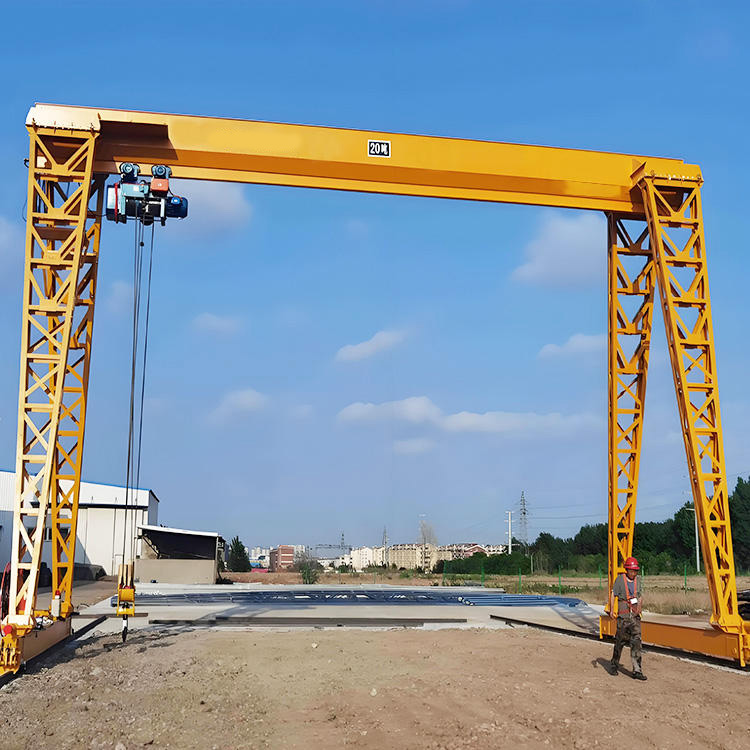
Rail span is the center-to-center distance between the two runway rails. It is the number that appears in the crane’s designation (for example, “20-meter span gantry crane”).
Effective working width is the actual width of the floor area over which the hook can be positioned. It is smaller than the rail span by the approach distances at each side — the minimum distance from the runway rail centerline to the nearest point the trolley can travel.
The approach distance is determined by the crane’s end truck design and the trolley’s minimum stop distance from the end of the bridge beam. Typical values: 200 to 400mm per side for most industrial gantry cranes.
Effective working width = Rail span − (2 × approach distance per side)
For a 20-meter span crane with 350mm approach on each side:
Effective working width = 20,000 − 700 = 19,300mm (19.3 meters)
If the required working area is 19.5 meters wide, this crane cannot cover it despite appearing adequate from the nominal span number. The correct minimum span for this application is 20.2 meters — specify 21 meters.
Leg Height vs Usable Hook Height
Leg height is the vertical distance from the floor to the bottom flange of the bridge beam (for single girder cranes) or to the bottom of the crane rail on the bridge (for double girder top-running cranes).
Usable hook height is the vertical distance from the floor to the hook at its highest position. It is smaller than the leg height by the hoist’s headroom dimension — the distance from the hook at maximum lift to the bottom of the bridge beam.
Usable hook height = Leg height − hoist headroom
For a crane with 6-meter leg height and a hoist with 550mm headroom (standard single girder chain hoist, 1 to 3-ton range):
Usable hook height = 6,000 − 550 = 5,450mm (5.45 meters)
If the application requires 5.6 meters of hook height, this crane is insufficient by 150mm — less than 6 inches — and every lift requiring maximum height will be impossible.
Runway Length vs Working Coverage Length
Runway length is the total length of the installed runway rail. The crane bridge can travel the full runway length from end stop to end stop.
Working coverage length is the longitudinal distance over which the crane can perform useful lifts. It equals the runway length minus the overrun at each end — the distance from the end stop to the last usable hook position.
Working coverage length = Runway length − (2 × end overrun)
End overrun is determined by the bridge travel speed and braking distance, plus clearance for the bridge end structure. Typical values: 500mm to 1,500mm per end.
For a 30-meter runway with 800mm overrun at each end:
Working coverage length = 30,000 − 1,600 = 28,400mm (28.4 meters)
Part 2: Five-Step Span Calculation
Step 1: Map All Required Coverage Positions
On a scaled floor plan or yard layout, mark every position where the hook must be able to reach: all material pickup points, all deposit positions, all processing equipment the crane must serve, and all staging areas. Include positions the crane must serve only occasionally as well as those used continuously.
This mapping step is the most important and most frequently skipped step in span calculation. Without a complete map of required positions, there is no basis for a defensible span calculation.
Step 2: Measure the Maximum Width of Required Coverage
Identify the two positions in the required coverage map that are farthest apart in the lateral direction (perpendicular to the runway direction). Measure this distance — it is the minimum effective working width the crane must provide.
Step 3: Add Approach Distances on Each Side
The effective working width must equal the maximum coverage width. To convert this to the required rail span:
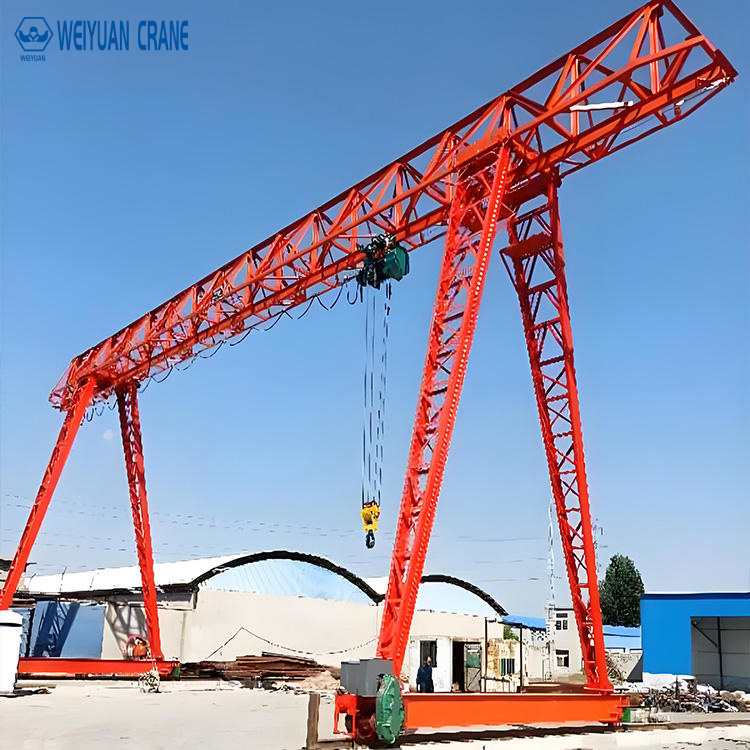
Required rail span = Effective working width + (2 × approach distance)
Use the actual approach distance from the crane manufacturer’s dimensional data for the specific crane configuration being considered. If this data is not yet available, use 350mm per side as a conservative estimate for standard industrial gantry cranes.
Step 4: Check Against Building Column Spacing and Structural Constraints
The runway rail centerlines must be positioned where the runway beams can be adequately supported — typically at or near the building column rows. Verify that the required rail span is achievable with the column layout of the specific facility.
If the required span falls between column rows, one of two solutions applies: accept the larger span to reach the next outboard column row (adding span width that may allow future expansion), or install a cantilevered runway beam bracket from an existing column to reach the required rail position (a structural engineering task that adds cost).
Step 5: Round Up to the Next Standard Span
Standard gantry crane spans are produced in increments that vary by manufacturer but commonly include: 5, 6, 8, 10, 12, 15, 16, 18, 20, 22, 25, 28, 30, 35, and 40 meters.
The required rail span from Step 3 must be rounded up to the next available standard span — never down. Rounding down produces a crane that does not cover the required working width.
Worked Example
A precast concrete yard requires crane coverage of a 17.8-meter wide storage area. Approach distance 350mm per side. Required rail span = 17,800 + 700 = 18,500mm. Next standard span = 20 meters. Specify a 20-meter span gantry crane.
Part 3: Four-Step Leg Height Calculation
Step 1: Determine the Maximum Lifted Load Height
The tallest load that will be lifted in the crane’s working area — measured from the floor to the top of the load including all packaging, fixtures, or attached hardware — defines the minimum height the load must be raised above the floor before traveling.
Step 2: Determine the Maximum Deposit Position Elevation
If the crane must lift loads over existing equipment, place them on elevated platforms or racks, or serve any position where the deposit surface is above floor level, the deposit elevation must be included in the hook height calculation.
Required hook travel height = Maximum deposit elevation + Required clearance above deposit surface
Step 3: Add Rigging Height
The rigging height is the vertical distance from the top of the load to the hook centerline, including all slings, shackles, spreader beams, and below-hook hardware. For wire rope slings at standard angles: add 400 to 800mm depending on sling length and angle. For a spreader beam: add the spreader beam depth plus sling length above and below.
Step 4: Add Safety Clearance and Hoist Headroom
Safety clearance: The minimum vertical gap between the bottom of the loaded hook block and the highest obstacle in the travel path — typically 300 to 500mm for most industrial applications.
Hoist headroom: The distance from the hook at maximum elevation to the bottom of the bridge beam. Obtain this dimension from the hoist manufacturer’s data sheet for the specific hoist model being considered. Standard values:
- 1-ton electric chain hoist: 400 to 600mm
- 2-ton electric chain hoist: 500 to 700mm
- 5-ton wire rope hoist: 600 to 900mm
- 10-ton wire rope hoist crab: 800 to 1,200mm
Required usable hook height = Deposit elevation + load height + rigging height + safety clearance
Required leg height = Required usable hook height + hoist headroom
Worked Example
Precast beam yard, maximum beam height 1,200mm, beams stacked 3 high on 400mm saddles:
Maximum deposit elevation = 3 × (1,200 + 400) = 4,800mm
Required clearance above top beam: 300mm
Rigging height (spreader beam + slings): 900mm
Safety clearance: 300mm
Required usable hook height = 4,800 + 300 + 900 + 300 = 6,300mm
Hoist headroom (10-ton crab): 1,000mm
Required leg height = 6,300 + 1,000 = 7,300mm → Specify 8-meter leg height.
Part 4: Runway Length Planning
Basic Formula
Required runway length = Working area length + (2 × end overrun)
End overrun = Maximum bridge travel speed (m/min) × brake application time (seconds) / 60 + end structure clearance
For most industrial gantry cranes at standard travel speeds (20 to 40 m/min): end overrun of 800 to 1,500mm per end is a conservative practical value.
Two-Crane Runway Systems
When two cranes share the same runway, minimum crane-to-crane separation must be maintained at all times. The minimum separation between crane bridges is determined by:
Minimum separation = Combined end truck lengths + minimum spacing for anti-collision system operation + clearance for maintenance access
Practical minimum: 1,500 to 3,000mm between adjacent crane bridge structures for most configurations.
The runway length must be sufficient that both cranes can travel their full required working length simultaneously without the anti-collision system limiting one crane’s access to a portion of the runway.
Part 5: Cantilever (Outrigger) Design
When Cantilevers Are Needed
A standard gantry crane provides hook coverage only between the two runway rails. When the working area extends beyond one or both runway rails — because the rails must be positioned inside the working area boundary rather than outside it — a cantilever extension on one or both sides of the bridge provides coverage of the area beyond the rail.
Typical applications for cantilever bridges: precast yards where the crane rails must be positioned along the center of the storage area rather than at the outer edges, loading docks where the rail cannot be positioned at the outer edge of the dock face, and storage yards where the crane must reach over a boundary fence or wall.
Cantilever Structural Effect
A cantilever extension beyond the runway rail creates an eccentric load on the bridge beam and end trucks that standard symmetric bridge design does not account for. The cantilever creates an upward reaction at the opposite rail — the end truck on the side opposite the cantilever load is “lifted” by the eccentric moment, reducing its effective wheel load. At sufficient cantilever length and load, this upward reaction can exceed the end truck’s self-weight, causing the rail wheel to lift off the rail.
For this reason, cantilever gantry cranes require specific structural engineering to verify that wheel uplift does not occur at the maximum cantilever load position, and anti-uplift provisions (hold-down wheels or rail clamps) are typically required.
Cantilever Capacity Reduction
Most gantry crane designs with cantilever extensions carry a reduced rated capacity at the cantilever tip compared to the rated capacity in the standard (between-rails) position. Reduction factors of 70 to 80% of rated capacity at maximum cantilever extension are common. Always confirm the actual allowable load at the specific cantilever tip position from the crane engineer before assuming the crane’s full rated capacity applies throughout its working envelope.
Part 6: Most Common Sizing Mistakes
Mistake 1 — Span from building width, ignoring column encroachment: The building’s interior clear width is reduced by the building columns. A building with 20-meter bay width may have only 18.8 meters of clear space between column faces. Rail centerlines positioned 300mm inboard of each column centerline give a rail span of 20,000 − 600 = 19,400mm. Not 20 meters.
Mistake 2 — Leg height from building net height, no hoist headroom deducted: A facility with 8-meter clear height sounds like it can accommodate an 8-meter leg height crane — but the hoist headroom of 800 to 1,200mm reduces usable hook height to 6.8 to 7.2 meters. If 7.5 meters of hook height is required, the leg height must exceed 8 meters, which exceeds the building clearance. A crane with a lower-headroom hoist configuration is required.
Mistake 3 — Runway length equals work area length exactly: With no end overrun, the bridge cannot stop with the hook at the final work position — the stopping distance carries the bridge end into the buffer zone and the hook position beyond the planned coverage. Add minimum 800mm overrun at each end.
Mistake 4 — Cantilever capacity assumed equal to mid-span capacity: Using the crane’s rated capacity for a cantilever lift that exceeds the cantilever’s actual reduced rating overloads the structure at the rail connection point — the highest-stress location in the cantilever design.
Part 7: Standard Specification Reference Table
SINGLE GIRDER GANTRY CRANE STANDARD SPECIFICATIONS
Span 10m | Max recommended capacity: 10 ton (M4) or 5 ton (M5-M6) | Standard leg heights: 4m, 5m, 6m
Span 12m | Max recommended capacity: 16 ton (M4) or 10 ton (M5-M6) | Standard leg heights: 4m, 5m, 6m, 7m
Span 16m | Max recommended capacity: 20 ton (M4) or 16 ton (M5) | Standard leg heights: 5m, 6m, 7m, 8m
Span 20m | Max recommended capacity: 20 ton (M3-M4) | Standard leg heights: 6m, 7m, 8m, 9m
DOUBLE GIRDER GANTRY CRANE STANDARD SPECIFICATIONS
Span 16m | Capacity range: 10 to 50 ton | Standard leg heights: 5m, 6m, 7m, 8m, 9m
Span 20m | Capacity range: 10 to 80 ton | Standard leg heights: 6m, 7m, 8m, 9m, 10m
Span 25m | Capacity range: 20 to 100 ton | Standard leg heights: 7m, 8m, 9m, 10m, 12m
Span 30m | Capacity range: 32 to 200 ton | Standard leg heights: 8m, 9m, 10m, 12m, 14m
Note: These ranges represent common commercial products. Specific structural calculations are required for each installation — these values are reference only and do not substitute for engineering analysis.
Frequently Asked Questions
Q: Can I order a non-standard span that falls between the standard sizes?
A: Yes. Most gantry crane manufacturers can produce custom spans to any required dimension. Custom spans add cost (typically 10 to 20% over the nearest standard span) and extend delivery time by 2 to 4 weeks. For applications where the required span falls between standard sizes by a small margin, verify whether accepting the next larger standard span provides adequate value over the cost of a custom span — in most cases, it does.
Q: How do I measure the approach distance for a crane that has not been selected yet?
A: Use 350mm per side as a conservative planning value for standard industrial single and double girder gantry cranes. Once the specific crane model is identified, obtain the actual dimensional data from the manufacturer and verify the span calculation. If the actual approach distance is smaller than the 350mm planning value, the calculation is conservative — the crane covers more area than calculated. If the actual approach distance is larger, recalculate.
Q: What is the maximum practical span for a single girder gantry crane?
A: Standard single girder gantry cranes are produced to spans of approximately 30 to 35 meters at capacities up to 10 tons. Beyond this range, the bridge beam depth required to maintain deflection within L/600 limits becomes large enough that double girder construction is more structurally efficient. Above 20-meter span and 10-ton capacity, double girder is almost always the correct structural choice.