


KBK Crane vs Overhead Crane: Which Light Lifting System Is Right for Your Workstation?
Introduction
When a facility needs to add a lifting solution to a workstation or production area, the two most common alternatives are a KBK modular light crane system and a conventional overhead bridge crane. Both provide three-axis coverage of a rectangular work area. Both can be equipped with electric hoists and VFD controls. Both can be ceiling-suspended or supported on floor-mounted structures. On the surface, they appear to serve the same function.
In practice, the differences are substantial — in cost, installation requirements, flexibility, capacity range, and the type of applications each serves best. Choosing the wrong system produces a crane that either underperforms the application’s needs or is significantly over-engineered (and over-priced) for what the workstation actually requires.
This guide provides a rigorous, application-based comparison of KBK crane systems and conventional overhead bridge cranes across every dimension that matters for a real procurement decision: structural differences, cost profiles, installation requirements, flexibility and future-proofing, capacity range, and a decision framework that points clearly toward the right choice for specific workstation types.
Part 1: Structural Differences — What Makes These Systems Fundamentally Different
Conventional Overhead Bridge Crane: Custom-Engineered for a Fixed Application
A conventional overhead bridge crane is designed and fabricated as a single integrated system for a specific set of parameters: rated capacity, span, hook height, runway length, and duty class. The bridge girder — a structural steel beam spanning the full working width — is sized by an engineer for the specific loads and deflection limits of the application. The end trucks connecting the bridge to the runway rails are fabricated to match the bridge dimensions. The runway beams are sized for the crane wheel loads and the column spacing of the specific building.
This custom-engineered approach produces a crane that is optimized for its specified parameters — maximum structural efficiency for the designed load, span, and duty — but inherently inflexible. Changing the span requires replacing the bridge girder. Changing the runway length requires extending the runway beam and adding structural supports. Changing the hook height requires a different hoist configuration.
KBK System: Modular Standard Components for Flexible Assembly
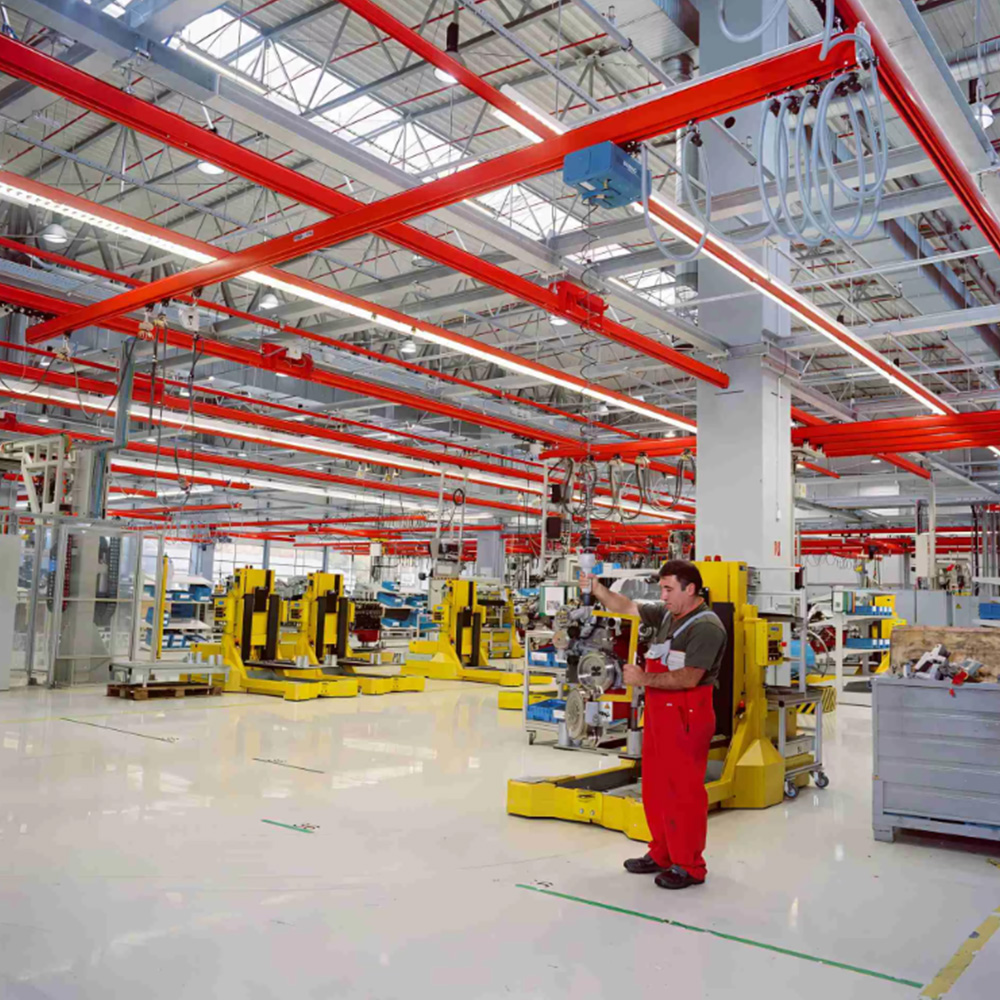
A KBK system is assembled from a catalog of standard, interchangeable components — rail sections, suspension hardware, trolleys, bridge beams, and switches — that are connected by bolted joints without welding or custom fabrication. The system’s configuration is determined by how these standard components are assembled, not by a custom engineering process.
This modular architecture makes the KBK system inherently flexible: any configuration change is accomplished by adding, removing, or repositioning standard components. But it also means the system’s structural design is based on standard component ratings rather than custom optimization — which is why KBK systems are not the most cost-efficient choice for heavy loads or long spans, where custom-engineered bridge cranes can achieve better structural efficiency.
Part 2: Cost Comparison
Cost is the most common decision driver in workstation crane selection, and the KBK system’s cost advantage in the light-duty range is substantial.
Purchase Price
For equivalent capacity and coverage in the 125 kg to 2,000 kg range:
KBK single girder bridge crane (500 kg, 5-meter span, 10-meter runway):
Typical purchase price range: $4,000 to $9,000 including rails, trolleys, suspension hardware, electric chain hoist, and pendant control.
Conventional single girder overhead crane (500 kg, 5-meter span, 10-meter runway):
Typical purchase price range: $8,000 to $18,000 for an equivalent specification.
The KBK system’s purchase price advantage in this capacity range is typically 40 to 60% — primarily because the KBK uses standard mass-produced components while the conventional crane requires custom fabrication of the bridge girder, end trucks, and runway beams.
At higher capacities:
- At 2,000 kg: KBK double girder approximately $10,000 to $20,000; conventional double girder approximately $18,000 to $35,000. KBK still 30 to 45% less expensive.
- At 5,000 kg: KBK heavy-duty approximately $25,000 to $45,000; conventional approximately $30,000 to $55,000. Gap narrows to 15 to 25%.
- Above 5,000 kg: Conventional crane is typically more cost-efficient — the KBK system’s standard component ratings become less economical at high loads.
Installation Cost
KBK installation is significantly faster and lower-cost than conventional crane installation because:
- No field welding required — all connections are bolted
- Rails ship in standard sections that can be transported and handled without heavy equipment
- Installation requires standard hand tools, not crane equipment for most of the assembly
- No civil works (embedded anchors, concrete pads) for ceiling-suspended installations
- Typical installation time for a 10-meter runway, 5-meter span KBK system: 1 to 2 days for a two-person installation team
Conventional crane installation time for equivalent configuration: 3 to 5 days, including runway beam installation, crane bridge erection (requiring a temporary crane or forklift for bridge placement), electrical connections, and commissioning.
Modification and Expansion Cost
This is where the KBK system’s lifetime cost advantage is most pronounced. When a facility layout changes — a new machine is added, a workstation is relocated, a production line is reconfigured — the cost of modifying each system type is dramatically different:
KBK modification: Add or remove rail sections, reposition suspension points, relocate the bridge start and end positions. Typical modification cost: $500 to $3,000 depending on scope. Completed in hours to a single shift.
Conventional crane modification: Extending a runway requires new runway beam sections, new column brackets or supports, and structural engineering review. Shortening or relocating a runway may require new beam fabrication. Typical modification cost: $5,000 to $25,000+ depending on scope. Completed in days to weeks.
For facilities that anticipate layout changes — which is most modern manufacturing environments operating on lean principles — the KBK system’s lower modification cost can eliminate its remaining price premium within the first one or two layout changes.
Part 3: Installation Requirements
Building Structure Requirements
KBK ceiling-suspended systems: The ceiling or roof beams must carry the suspension point loads — rail dead weight plus the crane and lifted load distributed to the suspension points. Typical suspension point loads for a 1,000 kg KBK system: 400 to 800 kg per suspension point depending on suspension spacing.
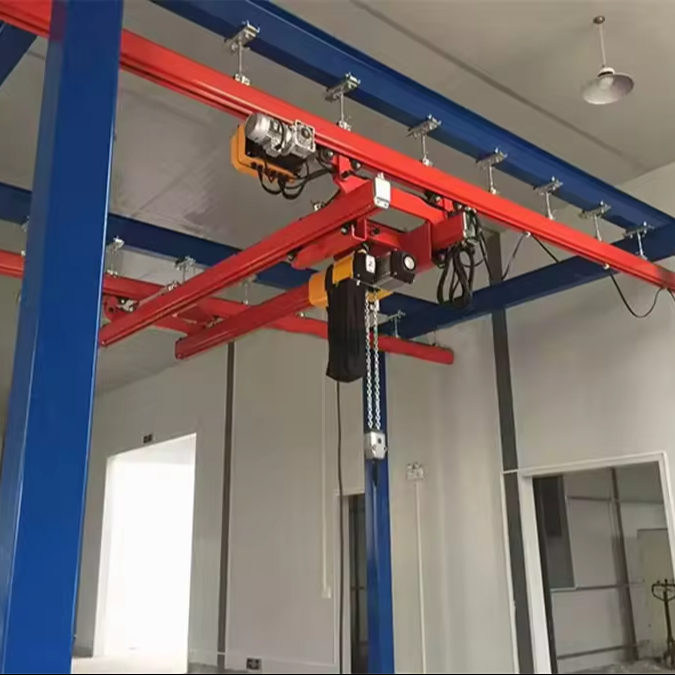
If the ceiling structure cannot carry these loads, a freestanding KBK support frame (floor-mounted columns and overhead horizontal beams) supports the rails independently of the building structure. Freestanding frames add cost but eliminate the structural limitation.
Conventional crane runway: Runway beams must carry the full crane wheel loads — which are higher than KBK suspension loads for equivalent capacity because the conventional crane’s end trucks concentrate the load at two wheel contact points per side rather than distributing it across multiple suspension points. For a 1,000 kg conventional crane, runway beam reactions of 1,500 to 2,500 kg per support point are typical — 3 to 5× the KBK suspension load for equivalent capacity.
This structural load difference is a critical factor in existing building retrofits. Many buildings that cannot accept conventional crane runway loads can accept KBK ceiling suspension loads without structural reinforcement.
Headroom Requirements
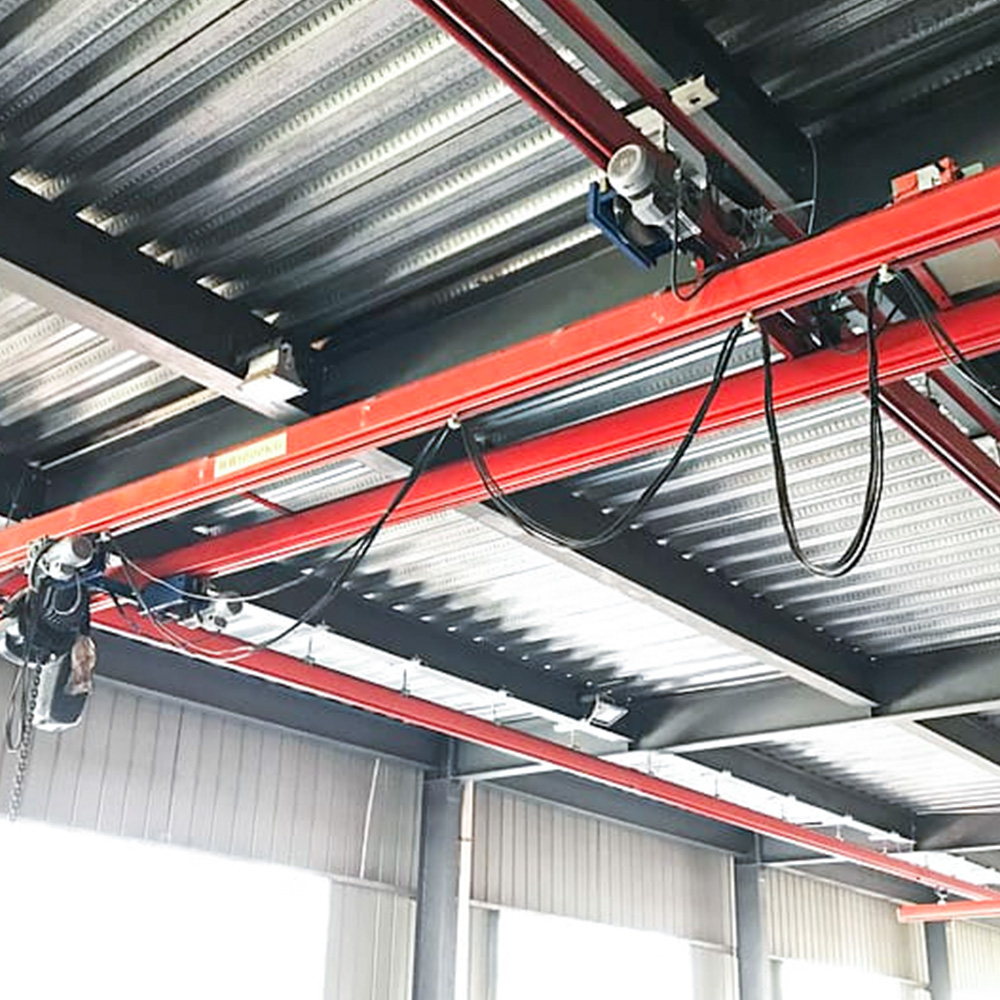
KBK systems require less headroom than conventional cranes for equivalent hook height because:
- KBK rails have shallower section depth than conventional runway beams (typically 100 to 200mm versus 300 to 500mm for conventional runway beams)
- KBK flexible suspension cranes fit within an overall system height of 400 to 700mm from ceiling attachment to hook block at maximum height
- The KBK double girder configuration provides very low hook approach (distance from bottom of bridge to hook at maximum height)
For buildings with limited clear height, KBK systems frequently provide 200 to 500mm more usable hook height than equivalent conventional crane installations.
Part 4: Flexibility and Future-Proofing
Layout Flexibility During Initial Design
A KBK system’s rail layout can follow any path that the standard component catalog supports — straight sections, 90-degree curves, gradual curves, switches to branch lines, and turntables for direction changes. This layout flexibility allows the crane system to be designed around the facility’s actual workflow rather than requiring the workflow to be designed around the crane’s fixed rectangular coverage zone.
A conventional overhead crane provides a fixed rectangular coverage zone — it cannot be curved, branched, or routed around building columns. The facility layout must work within this rectangular constraint.
Adaptation to Production Changes
Modern manufacturing increasingly operates on flexible production principles — product mix changes, line rebalancing, and layout reorganization are expected events, not exceptional ones. The crane system must either adapt to these changes at low cost or become a constraint that prevents optimal layout changes.
KBK advantage: Rail sections can be added, removed, or repositioned in a single shift. Branches can be added without touching the existing system. The bridge span can be changed by substituting a different length bridge beam. These modifications are within the capability of a standard maintenance crew.
Conventional crane constraint: Any meaningful layout change requires structural engineering review, new beam fabrication or modification, and extended production shutdown for the modification. In practice, this cost and disruption causes many facilities to tolerate suboptimal layouts rather than modify the crane system to match production improvements.
Part 5: Capacity and Duty Cycle Limits
KBK systems have inherent capacity and duty cycle limitations that make them unsuitable for some applications where conventional cranes are the correct choice.
Capacity Limits
Standard KBK systems are practical up to approximately 5,000 kg. Above this threshold, the KBK rail sections become heavy, the bridge beams require deep structural sections that consume headroom, and the cost advantage over custom conventional cranes disappears. For capacities above 5,000 kg — typical of die handling in stamping plants, heavy component handling in steel processing, and large assembly operations — conventional double girder overhead cranes are the appropriate solution.
Duty Cycle Limits
Standard KBK systems are rated for duty class A1 to A3 — appropriate for low to medium frequency operations with average daily operating times up to approximately 8 hours. For continuous high-cycle production environments (CMAA Class D, E, or F equivalent) — where the crane makes 20+ lifts per hour across multiple shifts — the KBK system’s standard components are not designed for the cumulative fatigue loading.
High-duty-cycle production applications require the heavier structural specifications, higher-rated motors, and more robust brakes of CMAA Class D or E conventional overhead cranes.
Part 6: Decision Framework — KBK or Conventional Crane?
Choose KBK crane when:
- Capacity is 5,000 kg or below
- Duty class is A1 to A3 (low to moderate frequency)
- Installation in an existing building where structural loads must be minimized
- Layout changes are anticipated in the next 5 years
- Headroom is limited and maximum hook height is critical
- The application benefits from curved rail paths, branches, or multi-station coverage
- Budget favors lowest total cost of ownership including anticipated modification costs
- Cleanroom or hygienic environment requires aluminum rail system
Choose conventional overhead crane when:
- Capacity exceeds 5,000 kg
- Duty class is CMAA Class C, D, E, or F (moderate to continuous heavy service)
- The application requires the long span (above 10 to 12 meters) and stiffness of a custom-engineered bridge girder
- The facility layout is fixed and no changes are anticipated
- Very high travel speeds are required (above the KBK system’s standard travel speed range)
When capacity is 1,000 to 5,000 kg and duty class is moderate: analyze the total cost of ownership including anticipated modifications, the building’s structural capacity for crane loads, and the layout change frequency. In most cases, the KBK system delivers better total lifetime value in this range for typical manufacturing applications.
Frequently Asked Questions
Q: Can a KBK system and a conventional overhead crane share the same building space?
A: Yes — in many larger facilities, KBK systems serve individual workstations and cells while a conventional overhead crane covers the full bay for inter-station material movement. The two systems operate at different elevations — the KBK system at workstation level, the conventional crane above it — and do not interfere with each other’s operation.
Q: Is a KBK system suitable for outdoor use?
A: Partially. Steel KBK rails with appropriate weatherproof coatings and stainless steel fasteners can be used in covered outdoor environments (canopies, semi-enclosed areas). Full outdoor exposure to rain, UV, and temperature cycling is not recommended for standard KBK aluminum components. For outdoor applications, conventional cranes or purpose-designed outdoor KBK configurations with full weatherproof hardware are the appropriate solutions.
Q: Can existing conventional crane runway beams be reused as KBK runway supports?
A: Not directly — KBK rails attach to the building structure through their own suspension system, not to conventional runway beams. However, if existing runway beams are structurally sound, they can serve as the overhead structure from which KBK suspension hardware is attached — effectively converting the conventional crane runway into a KBK support structure while the conventional crane is removed.