


5 Innovative Gantry Crane Designs for
Operational Flexibility
By Crane Technology Editorial | Updated June 2025 | 14 min read
Introduction
If you’ve spent any time sourcing lifting equipment, you already know that the phrase “gantry crane” covers an enormous range of hardware — from a lightweight 500 kg aluminium frame rolled around a workshop floor to a 600-tonne rubber-tyred behemoth straddling a container terminal. What that range doesn’t always make obvious is how dramatically innovative gantry crane designs have expanded the performance envelope in recent years. Flexibility — once treated as a secondary consideration after rated capacity and span — has become a primary engineering objective.
This article is written for engineers, procurement managers, and operations leads who want more than a catalogue summary. We cover five genuinely distinct design philosophies, explain the engineering logic behind each, and offer a practical framework for deciding which approach suits a given site. Every design discussed here is commercially available today, and each solves a real operational problem that a conventional fixed-frame crane simply cannot address.
Why Crane Design Is Evolving Beyond Fixed-Duty Machines
The traditional approach to gantry crane specification was built around a fixed operating scenario: known load, known lift height, known travel path. That model worked well when production lines were static and throughput volumes were predictable. Neither of those conditions holds reliably in 2025.
Three structural shifts in industry are driving demand for more flexible crane configurations. First, manufacturing cells are retooling more frequently — product lifecycles have shortened, and a crane that perfectly fits today’s assembly line may obstruct tomorrow’s layout. Second, infrastructure projects — offshore wind, modular construction, data centre build-outs — require cranes to be rapidly deployed, repositioned, and sometimes entirely reconfigured on-site. Third, the widespread adoption of lean and just-in-time production philosophies has raised the cost of any asset that introduces constraint into a workflow.
Key industry benchmarks:
- 3× faster site deployment vs. welded-frame cranes (modular systems)
- 40% cycle time reduction with anti-sway VFD systems
- 25-year design life in C5-M marine environments (ISO 12944-9)
The five gantry crane designs for operational flexibility covered below each address one or more of these pressures from a distinct engineering angle.
The 5 Innovative Gantry Crane Designs
Design 1 — Adjustable-Leg Telescoping Gantry
Category: Height Flexibility
The telescoping-leg gantry solves a problem that sounds simple but is surprisingly common: a single facility with multiple bays, each with different floor-to-obstruction clearances. Hydraulic cylinders or mechanical screw jacks built into each leg allow the clear height under the crossbeam to be adjusted — typically across a range of 2 m to 8 m or more — without disassembly or specialist tooling.
What makes this genuinely innovative is not the telescoping mechanism itself (which has existed for decades in smaller workshop cranes) but the application of modern hydraulic proportional control to larger SWL classes, now reaching 30–50 tonnes in some product lines. Synchronised cylinder control ensures that both legs extend at equal rates, preventing the asymmetric loading that was a historic limitation of the design.
Best applications: Multi-bay workshops, outdoor yards with varying ground conditions, maintenance facilities that serve both heavy and light equipment on the same footprint.
Key constraint: Extended-leg configurations increase the effective moment arm on the leg-to-crossbeam connection. Structural analysis must cover the full height range under worst-case horizontal loading (wind, seismic, accidental impact), not just at minimum height.
Design 2 — Variable-Gauge Rubber-Tyred Gantry (RTG)
Category: Span Flexibility
Rubber-tyred gantry cranes are a mature technology in container terminals, but recent engineering advances have extended the RTG concept far beyond port operations. The variable-gauge innovation allows the axle track width — and therefore the straddled load width — to be adjusted in the field, enabling the same crane to handle ISO containers one week and oversized modular process skids the next.
Modern general-purpose RTGs incorporate electric-diesel hybrid or full-electric drivetrains, substantially reducing fuel costs and indoor air-quality concerns. Active anti-sway pendulum control, combined with absolute encoder-based travel positioning, enables precise load placement at travel speeds up to 130 m/min without requiring a skilled operator to manually counteract swing.
Best applications: Multi-product logistics yards, intermodal terminals, heavy prefabrication facilities, and any site where load geometry varies significantly between jobs.
Key constraint: Variable axle steering adds mechanical complexity and requires a higher standard of maintenance discipline than fixed-gauge alternatives. Turning radius requirements must be factored into yard layout planning from the outset.
Design 3 — Bolt-Together Modular Gantry System
Category: Structural Scalability
Where welded-fabrication cranes are permanent infrastructure, bolt-together modular systems are closer to precision construction kits. Standardised box-section or tube-section nodes connect via high-tensile bolted flanges, allowing an operator to increase span, raise the crossbeam height, or add a second hoist trolley without returning the crane to a workshop or bringing in heavy lifting equipment.
Flat-pack shipping geometry is a genuine differentiator: a 10-tonne-capacity modular gantry can typically be transported on a standard flatbed and erected by three or four technicians in under eight hours. This makes the design uniquely valuable for project-based industries — civil construction, defence, film production, disaster-response logistics — where a crane must arrive quickly, perform reliably, and be recoverable or repositioned at short notice.
Best applications: Rapid deployment sites, temporary facilities, operations with annual layout changes, and organisations that need multiple crane positions across different locations.
Key constraint: Structural integrity is only as good as the documented torque values applied to every bolted joint. A rigorous pre-use inspection regime — specifically checking for joint relaxation under cyclic loading — is non-negotiable for safe long-term operation.
Design 4 — AI-Assisted Automated Rail-Mounted Gantry (ARMG)
Category: Digital Intelligence
The automation layer applied to modern rail-mounted gantry cranes represents a step-change from the RMGs of the previous generation. Where early automated cranes followed pre-programmed position sequences, contemporary systems combine machine-vision cameras, lidar point-cloud scanning, and real-time kinematic GPS to execute genuinely adaptive pick-and-place cycles — adjusting trajectory, speed, and final position based on what sensors detect in real time.
Integration with warehouse management systems (WMS) or terminal operating systems (TOS) allows the crane to accept dynamic task assignments, prioritise lifts based on shipping schedules, and log every cycle event for predictive maintenance analytics. Some advanced systems now incorporate machine-learning models that improve positioning accuracy over time as they accumulate operational data from a specific site’s geometry and load types.
Best applications: High-throughput container terminals, automated distribution centres, defence logistics hubs, and any facility where consistent precision and full lift-cycle traceability are operational requirements.
Key constraint: Integration lead time between crane OEM and facility IT/OT systems is often underestimated. Budget for a minimum of three to six months of commissioning and interface testing, and ensure cybersecurity review is included in the project scope from day one.
Design 5 — Corrosion-Engineered Harsh-Environment Gantry
Category: Environmental Durability
Operating flexibility means nothing if a crane degrades to unusable condition within five years of installation. In marine, offshore, chemical processing, and tidal-zone environments, corrosion is not a long-term concern — it is an immediate and relentless operational threat. The corrosion-engineered gantry addresses this by substituting material and coating choices at every structural level, not just applying a protective paint system over standard components.
Primary structural members in demanding marine environments are specified in S355 weathering steel with hot-dip galvanisation, duplex stainless steel, or HDPE encasement depending on the specific aggressive agent. Drive components are rated to IP67 or IP68 for water and particle ingress. Sacrificial anode cathodic protection systems are integrated into the design from the outset. Surface treatment systems are certified to ISO 12944-9 (C5-M environment category). Fibre-reinforced polymer (FRP) secondary structures offer further weight and corrosion benefits where platform load budgets are constrained.
Best applications: Offshore wind installation vessels, tidal-range port berths, chemical and petrochemical processing plants, water treatment infrastructure.
Key constraint: Unit costs are significantly higher than equivalent-rated standard cranes. This is a whole-life-cost argument: a correctly specified harsh-environment crane with a 25-year design life typically delivers a lower NPV than a standard crane replaced every seven to ten years in the same environment.
Key Engineering Factors Across All Five Designs
Regardless of which design philosophy applies to a specific project, three engineering principles cut across all five configurations and deserve careful attention in any specification process.
Dynamic Load Analysis and Fatigue Classification
Cranes optimised for operational flexibility will, by definition, experience a wider range of load eccentricities, travel speeds, and hoist frequencies than a dedicated single-purpose machine. ISO 4301 load spectrum methodology and FEM 1.001 fatigue category classification must be applied across the full operational envelope, not calibrated solely to the rated SWL at rest. Skipping this step during design review is the most common source of premature structural fatigue failures in field-adjustable crane designs.
Control System Quality and Anti-Sway Logic
Variable-frequency drives (VFDs) with closed-loop encoder feedback are now standard across all five design types. The differentiating factor is anti-sway algorithm quality. Pendulum-physics-based electronic anti-sway systems — as opposed to simple travel-speed ramping — reduce load positioning time by 30–40% in high-cycle applications. For automated systems, this translates directly to throughput capacity; for manually operated cranes, it reduces operator fatigue and the risk of load collisions.
Whole-Life Cost and Maintainability
More configurable designs contain more articulated joints, sliding interfaces, and electrical terminations — all potential failure points if maintainability is not designed in from the outset. Specifying accessible service points, standardised cross-range spare part numbers, and OEM-supported remote condition monitoring telemetry from commissioning will protect the total cost of ownership position that an advanced crane design is supposed to deliver.
Industry lifecycle data consistently shows that facilities implementing remote condition monitoring at the point of commissioning achieve 20–35% reductions in unplanned downtime over a ten-year operating period — with the larger gains concentrated in variable-environment and high-cycle applications where conventional calendar-based maintenance schedules are inadequate.
How to Match Design to Your Site’s Real Needs
A structured four-question decision sequence prevents the most common procurement mistake: over-specifying rated capacity while under-specifying the flexibility characteristics that will determine how useful the crane actually is in daily operation.
Question 1 — What does your load envelope look like? Define the heaviest, widest, and longest load you will ever need to lift — and separately, the most typical lift in a normal working week. A large gap between these two answers is a signal that a fixed-duty machine will always be either over-engineered or under-utilised.
Question 2 — Does the crane need to travel between zones or sites? If yes, wheeled mobility (RTG or road-transportable modular) is likely required. If the crane is permanently sited, rail-mounting delivers superior positioning precision at lower per-unit cost.
Question 3 — What is the dominant environmental challenge? Salt air, chemical splash, and explosion-risk atmospheres each impose specific design obligations. Retro-fitting corrosion protection or ATEX compliance after procurement is expensive and rarely achieves the same integrity as specifying for the environment from day one.
Question 4 — Where are you on the automation journey? Specifying a manual crane today when the facility’s five-year roadmap includes automated storage creates a likely stranded-asset problem. Conversely, imposing full ARMG integration on a facility with no WMS infrastructure adds cost without near-term operational return.
Practical note: If your answers to questions 1 and 2 point in different directions — high variability in load geometry combined with a need for permanent siting — a modular bolt-together crane on a dedicated foundation offers a useful middle ground: reconfigurable without being mobile.
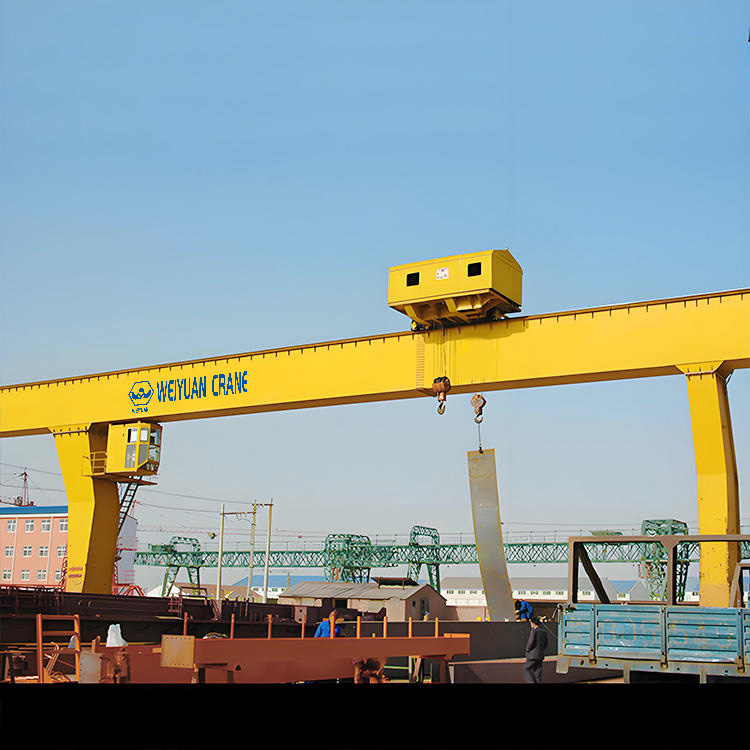
Weiyuan L-Shape Leg Walk Gantry Crane | Manufacturer Direct, Enhanced Mobility
The Weiyuan L-Shape Leg Walk Gantry Crane is a high-performance single-girder gantry crane with a distinctive L-shaped leg design that offers superior clearance for long and oversized loads, and smooth “walk” travel on ground rails — direct from the manufacturer for competitive pricing and reliable quality. :contentReference
View Product / Get QuoteWhat the Next Five Years Look Like for Gantry Innovation
The five designs in this article represent the current production frontier, but the engineering pipeline points toward further expansion of operational flexibility over the coming years. Carbon-fibre-reinforced polymer (CFRP) bridge beams are in advanced prototype trials at several European OEMs, targeting a 40–50% weight reduction in the crossbeam for long-span configurations — which would allow substantially lighter runway structures and open gantry crane deployment to facilities whose floor or roof structures currently cannot support the loading.
Real-time digital twin technology — already standard in aerospace maintenance — is transitioning to heavy industrial crane applications. A continuously updated structural health model, fed by onboard strain gauges, thermal sensors, and cycle counters, will eventually replace fixed inspection intervals with condition-triggered maintenance events. The practical effect is extending service life while simultaneously reducing the risk of undetected fatigue accumulation between inspections.
Perhaps most consequentially, the integration of innovative gantry crane systems with collaborative robotics is producing hybrid lifting cells where the crane handles macro-positioning of large assemblies and robot arms mounted to the hoist trolley perform precision alignment and fastening at the deposit point. These combined human-robot-crane configurations are already operational in Tier 1 automotive and aerospace facilities, and their design DNA will be visible in general-purpose industrial equipment by the end of the decade.
The direction of travel is consistent: gantry crane design for operational flexibility will continue to advance as long as industrial operations demand assets that can adapt faster than product lifecycles change. Understanding the five current design families — their strengths, constraints, and ideal applications — is the starting point for making procurement decisions that will still look correct in ten years.
Frequently Asked Questions
Q1: Which of the five designs is easiest to relocate between job sites? The bolt-together modular gantry is specifically engineered for rapid relocation. It can be fully disassembled into flat-packable sections, transported on a standard flatbed, and re-erected at a new site in a single shift by a small crew. Variable-gauge RTGs are also relocatable under their own power, but require suitable hardstanding and driving-route clearances. The other three designs are generally intended for fixed or semi-permanent installations.
Q2: Is an automated rail-mounted gantry suitable for a mid-size warehouse? It depends on throughput volume and available IT infrastructure. ARMG systems deliver the strongest return in high-cycle environments — typically 50+ lifts per day — where the labour and accuracy benefits compound meaningfully. For lower-volume mid-size warehouses, the integration complexity and upfront cost may not deliver payback within a reasonable period. A simpler manual or semi-automated system with VFD anti-sway control is often the better fit below this threshold.
Q3: How does the corrosion-engineered gantry differ from simply applying marine paint to a standard crane? Surface coating alone addresses the most visible corrosion pathway but leaves drive components, structural joints, fasteners, and electrical terminations exposed to aggressive environments at their material’s native corrosion resistance — which may be entirely inadequate. A corrosion-engineered design specifies the correct material grade at every component level: IP-rated sealed drives, stainless or hot-dip galvanised fasteners, cathodic protection for structural members, and FRP for secondary structures where weight matters. This is a fundamentally different level of engineering commitment to the operating environment.
Q4: What load capacity range do modular bolt-together gantry cranes typically cover? The most common commercial range for modular bolt-together designs is 500 kg to 20 tonnes SWL, with spans from 3 m to around 20 m. Some specialist manufacturers extend to 30–40 tonnes for military and offshore applications, though at those capacities the connection design becomes very demanding and the time/cost advantage over fabricated alternatives narrows. The sweet spot where modular design delivers the clearest benefits — speed, reconfigurability, transportability — is in the 1–15 tonne range.
Q5: What standards govern the structural design of adjustable-leg telescoping gantries? There is no single standard specific to adjustable-leg gantries; they are governed by the same framework that applies to overhead cranes generally — principally ISO 4301 (load spectrum classification), FEM 1.001 (rules for design of hoisting appliances), and EN 13001 (crane safety) in European jurisdictions. The critical addition for height-adjustable designs is that the structural analysis must cover every configuration within the adjustment range under the applicable load combinations, not just the nominal or most common height setting. Seismic and wind load cases are particularly sensitive to leg-height variation.
Q6: Can variable-gauge RTGs operate indoors? Yes — modern electric-drive RTGs produce no exhaust emissions and operate quietly enough for indoor deployment. The practical constraints are floor loadbearing capacity (RTG wheel loads are substantial and must be checked against slab design), aisle width for travel and turning, and overhead clearance for the crane structure and hoist. Full-electric RTGs also require charging infrastructure, which needs to be incorporated into the facility electrical design. Given these requirements, indoor RTG deployment tends to be most viable in purpose-built or substantially retrofitted facilities rather than existing warehouses with standard specifications.