


Electric Hoist Buying Guide: How to Choose the Right Hoist for Your Crane or Workstation
Introduction
Buying the wrong electric hoist is a mistake that facilities pay for over years, not days. An undersized hoist burns out prematurely. An incorrectly specified duty class leads to accelerated wear, unexpected downtime, and potential safety incidents. A hoist without the right safety features is a liability waiting to materialize.
Yet choosing the right electric hoist is not complicated — once you know the six parameters that define every hoisting application and understand how to match those parameters to the products on the market.
This buying guide is written for facility managers, plant engineers, maintenance supervisors, and procurement professionals who need to make a well-informed electric hoist purchase. We cover every decision point from capacity and duty class to power supply, control type, and supplier evaluation — and we give you the practical, engineering-grounded framework that separates a confident purchase from an expensive guess.
By the end of this guide, you’ll know exactly what to specify, what to ask suppliers, and what red flags to avoid.
Step 1: Define Your Required Lifting Capacity
The first and most important specification is rated capacity — the maximum load the hoist must lift.
How to calculate it correctly:
Start with the weight of your heaviest actual load. To this, add the weight of all below-hook hardware: the hook block (if separate), shackles, lifting slings, spreader bars, lifting beams, or any other device that will be attached between the hoist hook and the load.
Then apply a safety margin of at least 25% above this total. This margin accounts for load weight uncertainty, dynamic effects during lifting, and ensures the hoist operates well below its rated capacity during normal use — which directly extends service life.
Example:
- Heaviest load: 1,800 lbs
- Below-hook hardware: 200 lbs
- Total: 2,000 lbs
- With 25% margin: 2,500 lbs minimum rated capacity
- Select: 1.5-ton (3,000 lb) rated electric hoist
Never select a hoist rated at exactly your maximum load. Operating at 100% of rated capacity on every lift is the fastest way to shorten hoist life and increase failure risk.
Common capacity ranges and typical applications:
1/4 ton to 1/2 ton: Light workstation use, jib cranes for ergonomic assist, maintenance positioning.
1 ton to 2 tons: General manufacturing workstations, jib cranes, light overhead crane systems.
3 tons to 5 tons: Medium industrial production, steel service center coil handling, equipment installation.
5 tons to 10 tons: Heavy manufacturing, large assembly operations, gantry crane systems in outdoor yards.
Above 10 tons: Heavy industry, steel mills, shipbuilding, large overhead crane systems — wire rope hoists required.
Step 2: Determine Your Required Lift Height
Lift height is the vertical distance the hook must travel from its lowest position to its highest position. This sounds straightforward, but it has important implications for both chain and wire rope hoist selection.
For electric chain hoists:
The chain must fit in the chain bag at full retraction. Standard catalog electric chain hoists are available with lift heights from 10 to 30 feet in most configurations. Longer lift heights are available but increase the chain bag size and add weight to the hoist. Confirm that the required lift height is available for your chosen capacity.
For wire rope hoists:
The rope winds onto a drum, so lift height is determined by drum length and rope diameter. Wire rope hoists can accommodate much greater lift heights than chain hoists — 30 to 100+ feet is standard in many configurations, and custom drum specifications extend this further for very tall facilities.
For any hoist, confirm the headroom requirement:
Headroom is the distance from the top of the hoist mounting point (the beam flange or hook above the hoist) to the bottom of the hook at maximum lift position. This determines how much ceiling clearance is consumed by the hoist itself. If your building has limited overhead space, verify headroom requirements before selecting a hoist model. Low-headroom hoist designs are available for tight-clearance applications.

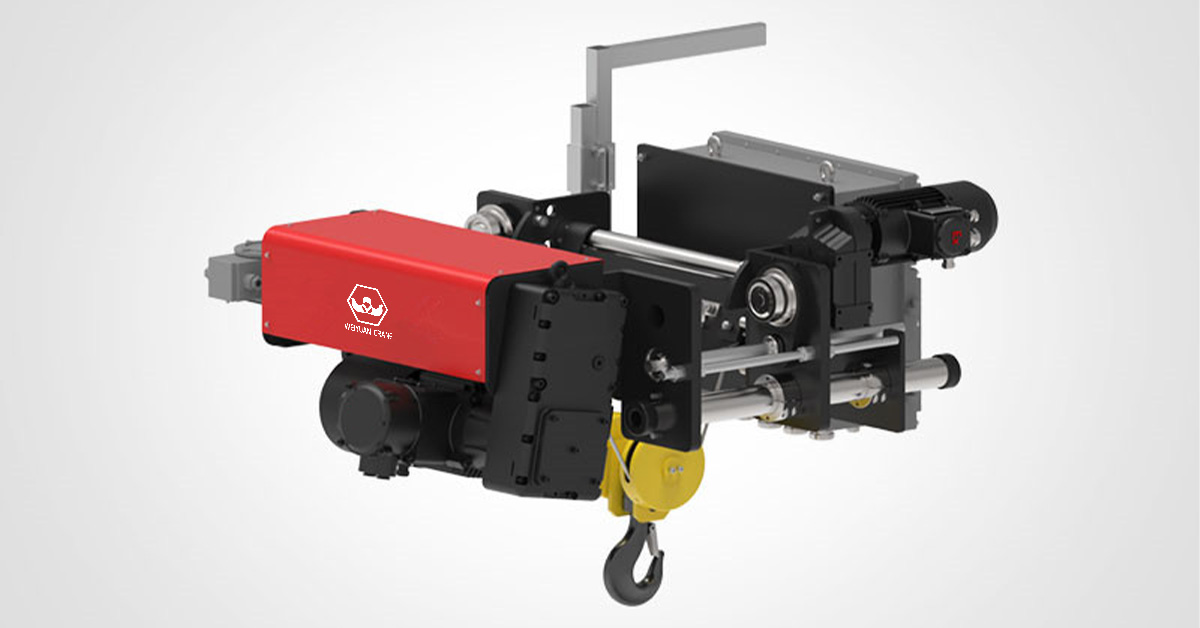
Weiyuan 1 Ton Remote Control Monorail Electric Hoist
The Weiyuan 1 Ton Remote Control Monorail Electric Hoist is designed for efficient material handling in workshops, warehouses, and light industrial environments. Equipped with wireless remote control and a monorail trolley system, it ensures precise load positioning, smooth travel, and safe lifting operations up to 1 ton.
View Product / Get QuoteStep 3: Establish Your Duty Class
Duty class is the specification that most buyers get wrong — and it’s the one that matters most for long-term hoist reliability.
Duty class defines how hard the hoist works: how often it lifts, at what percentage of its rated capacity, and over what total service life. A hoist designed for occasional light use will fail prematurely if used in continuous heavy production — even if the loads are within its rated capacity.
FEM duty classes most commonly encountered:
M3 (Light Industrial): Up to 2-3 lifts per hour on average, loads typically 25-40% of rated capacity. Suitable for maintenance operations, occasional material handling, infrequent production use.
M4 (Standard Industrial): 5-8 lifts per hour, loads averaging around 50% of rated capacity. The most common class for general manufacturing, warehouse operations, and standard production environments.
M5 (Heavy Industrial): 8-15 lifts per hour, loads averaging 63% of rated capacity. Required for high-throughput production lines, steel service centers, and operations with consistent heavy loads.
M6 (Very Heavy): Near-continuous operation with loads frequently at or near rated capacity. Required for demanding production environments such as foundries, heavy press rooms, and continuous process operations.
How to honestly assess your duty class:
Count the actual number of lifts per shift or per hour during your busiest production period — not your average. Estimate the average load as a percentage of the hoist’s rated capacity. If your busiest period requires 10+ lifts per hour at loads above 50% of rated capacity, specify M5 at minimum. When in doubt, specify one class higher than you think you need — the cost difference is modest compared to the cost of premature failure.
Step 4: Select the Right Hoist Type
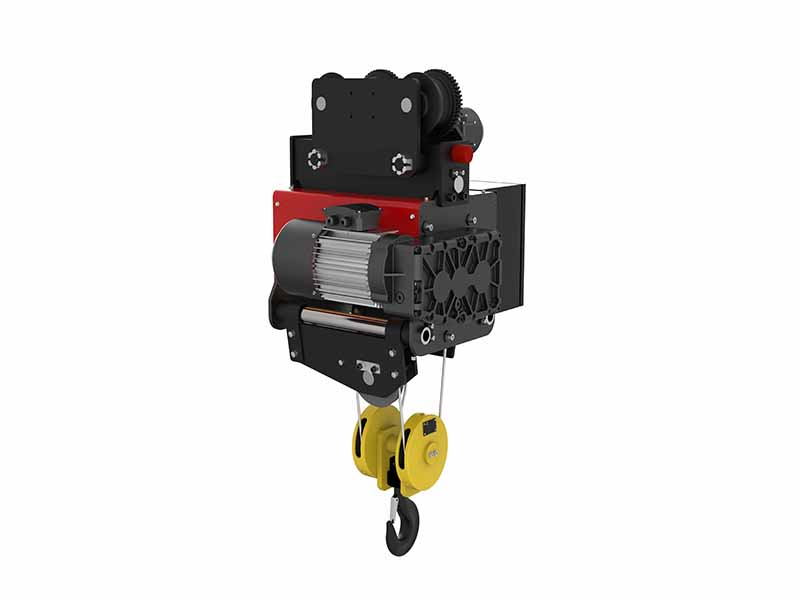
Based on your capacity, lift height, and duty class requirements, the hoist type becomes clear:
Choose an electric chain hoist when:
- Capacity is 5 tons or less
- Lift height is 30 feet or less
- Duty class is M3 to M4 (some M5 designs available)
- The application is a jib crane, light overhead crane, or workstation
- Compact size and low weight are important (e.g., jib crane moment load limits)
- Budget is a primary consideration
Choose a wire rope electric hoist when:
- Capacity is above 5 to 10 tons
- Lift height exceeds 30 feet
- Duty class is M5 or M6
- The application is a heavy overhead crane or gantry crane in continuous production
- High lifting speed is required to meet cycle time requirements
- VFD smooth control is a design requirement for load positioning accuracy
Choose a low-headroom variant when:
- Building clearance is severely limited and standard headroom requirements cannot be met
Choose an explosion-proof hoist when:
- The operating environment is classified as hazardous per NEC Article 500 (Class I, II, or III, Division 1 or 2)
Choose a stainless steel or cleanroom hoist when:
- The environment requires corrosion resistance, contamination control, or washdown capability (food, pharma, semiconductor)
Step 5: Select Your Power Supply and Control Type
Power supply:
Single-phase 115V or 230V: Available on smaller chain hoists (typically up to 1 ton). Suitable for shops and garages with standard single-phase electrical service. Limited duty cycle capability.
Three-phase 230V or 460/480V: Standard for industrial chain hoists above 1/2 ton and all wire rope hoists. Provides greater power density, more efficient motor operation, and supports higher duty cycles. Required for most production applications.
Confirm the available electrical service at your installation point before specifying hoist voltage. Mismatched voltage is a common and easily avoidable procurement error.
Control type:
Wired push-button pendant: The standard control method for most industrial electric hoists. A pendant hangs from the hoist or a separate festoon cable system, providing lift, lower, and (if applicable) trolley travel controls. Simple, reliable, and low-maintenance.
Wireless radio remote: Allows the operator to position away from the load during lifting, improving safety and ergonomics. Increasingly standard for production applications where operators cannot safely stand directly under suspended loads. Range typically 30 to 300+ feet depending on the system.
VFD (Variable Frequency Drive) control: Provides stepless variable speed from near-zero to full speed. Eliminates the jolt of across-the-line motor starting, reduces load swing, improves positioning accuracy, and extends motor and mechanical component life. Strongly recommended for precision assembly, machine loading, and any application where controlled positioning matters.
Step 6: Verify Safety Features and Compliance
Before accepting any electric hoist for industrial use, verify these non-negotiable features:
Electromagnetic brake: Must hold rated load with zero motor power. Must engage automatically on power loss.
Upper and lower limit switches: Both must be present and functional. Test before placing in service.
Thermal motor protection: Prevents motor burnout from overheating during extended use.
Overload protection: Slip clutch (chain hoists) or electronic overload relay (wire rope hoists) that prevents lifting above rated capacity.
Hook safety latch: Functional spring-loaded latch on the lifting hook.
Load test certificate: A new hoist must be load tested at 125% of rated capacity before service per ASME B30.16. Require this documentation.
Compliance standard: Verify that the hoist is designed to ASME B30.16 (U.S.) or EN 14492 (European standard). These standards define minimum design, testing, and performance requirements. Non-compliant hoists expose your facility to liability and OSHA citation risk.
Understanding Electric Hoist Pricing
Electric hoist pricing varies significantly based on capacity, duty class, type, and features. Here is a realistic pricing framework:
Electric chain hoists (crane-ready, industrial grade, without trolley):
1/2 ton, M3 class: $400 – $900
1 ton, M3/M4 class: $700 – $1,800
2 ton, M4 class: $1,400 – $3,500
3 ton, M4 class: $2,500 – $6,000
5 ton, M4/M5 class: $5,000 – $12,000
Wire rope electric hoists (industrial grade, without trolley):
1 ton, M4 class: $1,500 – $4,000
3 ton, M4/M5 class: $4,000 – $9,000
5 ton, M5 class: $7,000 – $16,000
10 ton, M5 class: $15,000 – $35,000
Add 20-40% for VFD control, 30-60% for explosion-proof or stainless steel variants, and 15-30% for wireless remote control systems.
Extremely low pricing relative to these ranges is a red flag. Hoists priced significantly below market rates often have inflated capacity ratings, inadequate safety features, non-compliant designs, or no service support infrastructure.
What to Look for in an Electric Hoist Supplier
After-sales support: Can the supplier provide local service, replacement parts, and technical assistance after delivery? A hoist is a long-term investment — a supplier who disappears after payment creates real operational risk.
Documentation package: Full documentation should include the operator’s manual, maintenance manual, wiring diagram, load test certificate, and compliance certifications. Suppliers who cannot provide complete documentation are a red flag.
Warranty terms: Industrial-grade electric hoists from reputable manufacturers typically carry 12 to 24-month warranties on parts and workmanship. Short or limited warranties on new equipment warrant scrutiny.
Technical expertise: Can the supplier answer detailed questions about duty class, headroom requirements, trolley compatibility, and installation requirements? A knowledgeable supplier is as valuable as the hoist itself.
Frequently Asked Questions
Q: Should I buy a trolley with my electric hoist?
A: If the hoist will be used on a beam, runway, or jib crane — yes. The trolley allows the hoist to traverse horizontally along the beam. Manual push trolleys are standard for lower-frequency use; motorized trolleys are recommended for high-frequency production or loads above 2 tons where manual traversing causes operator fatigue.
Q: Can I use the same electric hoist on multiple cranes?
A: Yes, if the hoist is compatible with the beam flange width and rated capacity of each crane, and if the hoist is not left in a partially-used chain or rope condition. Confirm trolley compatibility with each beam before moving a hoist between crane systems.
Q: How do I know when to replace the chain on an electric chain hoist?
A: ASME B30.16 and the hoist manufacturer’s maintenance manual specify the chain wear limits. Chain stretch beyond 2% of the original pitch length, any visibly cracked or deformed links, surface corrosion pitting, or any link showing wear to 90% of the original cross-section thickness are grounds for immediate chain replacement. Never continue operating with a chain that has reached these limits.
Q: Is it worth paying more for a VFD-controlled hoist?
A: For any application involving precise load positioning, sensitive loads, high-value equipment, or operators working near the load during lifting, yes — the VFD premium is justified by reduced load swing, lower structural shock, better positioning control, and longer mechanical component life. For occasional maintenance lifting where precision is not critical, a standard two-speed hoist is usually sufficient.