


Electric Hoist for Construction & High-Rise Applications

Introduction
Construction and high-rise work push electric hoists in a direction that industrial and mining applications never demand. On a tower crane collar, a formwork lift, or a facade installation platform, the challenge is not explosive gas — it is precision, weather exposure, and relentless duty cycles.
A hoist that sits idle in a warehouse for weeks might lift a few dozen times per shift. A construction hoist on an active high-rise project can run hundreds of cycles per shift, in rain, wind, and dust, for months on end. It must place a concrete bucket within centimetres, hold a steel beam steady in gusting wind, and do it thousands of times without a brake failure.
This guide walks procurement managers and equipment buyers through the complete specification framework for construction and high-rise hoists: the EN 14492-2 standard, variable speed control, load limiting devices, weatherproofing, duty classification, and 2026 pricing. The goal is simple — help you buy the right hoist once, avoid downtime, and stay compliant.
Part 1: Construction Site Hazards vs. Mining — Different Risks, Different Specs
Why Construction Hoists Are a Separate Category
Mining hoists solve for explosive atmospheres and deep shaft mechanics. Construction hoists solve for a different set of problems entirely. Getting this distinction right at the procurement stage saves you from over-specifying (paying for ATEX certification you don’t need) or under-specifying (buying a warehouse hoist that fails outdoors within a season).
The dominant hazards on a construction or high-rise site are:
Weather exposure: Construction hoists work outdoors, often for the full duration of a multi-year project. Rain, UV, temperature swings, and airborne dust attack the motor, brake, and control gear continuously.
High duty cycles: Concrete pours, material lifts, and formwork cycling mean the hoist runs far more often than a typical factory unit. Under-rated duty classification is the single most common cause of premature construction hoist failure.
Precision placement: Positioning a load next to workers on a scaffold, or landing a beam onto a connection point, demands controlled, creep-speed movement. A single-speed hoist that only knows “full speed” and “stop” is a safety and productivity problem.
Wind and sway: At height, suspended loads catch the wind. Uncontrolled sway is dangerous and slows every lift.
By contrast, construction hoists rarely need explosion protection. This is where buyers can control cost — you do not pay the 3 to 6× ATEX premium that mining equipment carries. Your budget goes instead into duty rating, control precision, and weather protection.
The Procurement Takeaway
Specify a construction hoist against its real hazards: weather, duty, and precision. Match the certification to the site, not to a generic “heavy-duty” label. This alignment is where procurement cost discipline begins.
Part 2: EN 14492-2 — The Governing Standard for Powered Hoists
What EN 14492-2 Covers
EN 14492-2 is the European harmonized standard for power-driven hoists. It sits under the Machinery Directive and defines the safety and design requirements a powered hoist must meet to carry the CE mark. For construction procurement in Europe — and for most international projects that reference European standards — EN 14492-2 compliance is the baseline you should require in every tender.
The standard covers:
Load bearing components: Minimum safety factors for the rope, chain, hook, and drum. Ropes are typically specified at a minimum factor of 4 to 5 against breaking load, depending on the duty group.
Braking systems: Requirements for the holding brake, including the mandatory ability to hold the rated load with the drive de-energized.
Overload protection: A mandatory device that prevents the hoist from lifting beyond its rated capacity (covered in detail in Part 4).
Control systems: Requirements for emergency stop, directional control, and protection against unintended movement.
Duty classification: Alignment with FEM and ISO duty groups so the hoist mechanism and motor are correctly rated for the expected work (covered in Part 7).
Why It Matters for Buyers
A hoist marked “CE” without a specific reference to EN 14492-2 is a red flag. The CE mark alone does not prove the unit was designed and tested as a powered hoist. When you write a purchase specification, require the supplier to provide the Declaration of Conformity citing EN 14492-2 and the associated technical file reference. This single document protects you in an audit, an insurance claim, or a site inspection.
Ask suppliers for:
- Declaration of Conformity referencing EN 14492-2
- CE marking on the nameplate
- The duty group classification (FEM/ISO) stated on the nameplate
- Test certificates for the rope, chain, and hook
Part 3: Variable Speed Drives — Precise Load Control That Pays for Itself
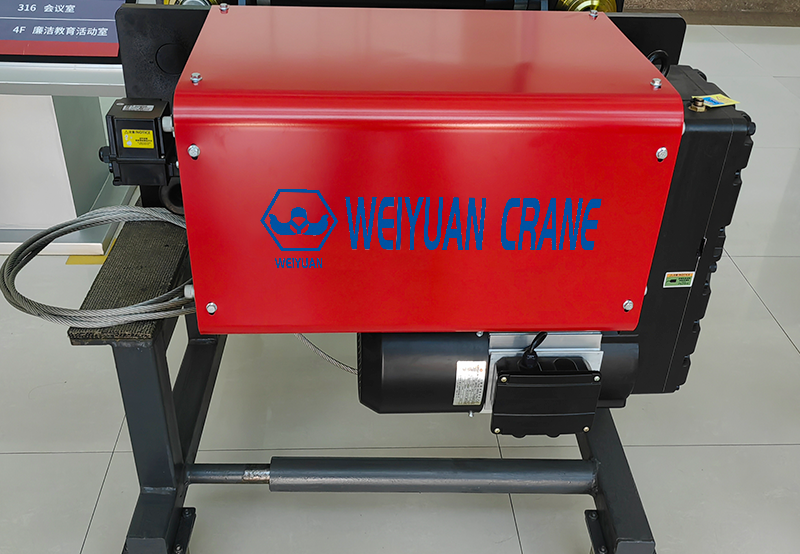
Why Single-Speed Hoists Cost You Money
A traditional two-speed hoist gives you a fast speed and a slow speed — nothing in between. Every start is a jolt. Every stop swings the load. On a high-rise site, that means slower cycles, more re-positioning, and higher rope and gear wear.
A variable speed drive (VSD) — also called a frequency inverter — changes this completely. The VSD controls motor speed smoothly across the full range, from a fine creep to full hoisting speed.
The Measurable Benefits
Precise positioning: Creep speeds as low as 10% of full speed let an operator land a load within a few centimetres, first time. This directly reduces cycle time on repetitive lifts.
Soft start and soft stop: The VSD ramps the load up and down gradually. This eliminates the mechanical shock that damages ropes, brakes, and gearboxes — extending component life and cutting maintenance spend.
Reduced load sway: Smooth acceleration and deceleration mean the load does not lurch. Less sway means faster, safer placement at height.
Lower energy draw and demand charges: Soft starting avoids the high inrush current of a direct-on-line motor start. On sites with multiple hoists, this reduces peak electrical demand.
The Cost-Benefit for Procurement
A VSD adds roughly 15 to 30% to the hoist price. The return comes from three places: longer component life (fewer rope and brake replacements), faster cycle times (more lifts per shift), and reduced downtime. On a high-duty construction application, a VSD-equipped hoist typically pays back the premium within the first project through improved uptime alone.
Part 4: Slipping Clutch and Load Limiter Specifications
Overload Protection Is Mandatory, Not Optional
EN 14492-2 requires every powered hoist to have an overload protection device. This device stops the hoist from lifting a load that exceeds its rated capacity. On a construction site, where loads are often estimated rather than weighed, this device is your last line of defence against a structural overload or a dropped load.
There are two common approaches:
Mechanical Slipping Clutch
A slipping clutch is a friction device set to slip when the load torque exceeds a preset limit. When the load is too heavy, the clutch slips and the drum simply stops turning — the hoist cannot lift further.
Advantages: Simple, robust, no electronics to fail, works even during a control system fault.
Limitations: Less precise than an electronic limiter, and the friction surfaces wear over time. A slipping clutch should be verified during periodic inspection to confirm it still trips at the correct load.
For chain hoists in construction service, a slipping clutch that engages at 110 to 125% of rated capacity is the common specification. It also serves as top and bottom over-travel protection when the chain reaches its end stop.
Electronic Load Limiter
An electronic load limiter uses a load cell or a motor current sensor to measure the actual load. When the load reaches the set threshold, the control system cuts the hoisting command.
Advantages: Precise, adjustable, and can feed a load display and data logging. Many units log every overload event — useful evidence for both safety audits and supplier warranty claims.
Limitations: Higher cost and more components to maintain.
The Buyer’s Position
For high-value or high-risk lifts, specify an electronic load limiter with a load display. For general material handling on a budget, a well-maintained slipping clutch meets the EN 14492-2 requirement. Either way, require the overload set point to be stated in the documentation and verified at commissioning.
Part 5: Weatherproofing for Outdoor Construction Use
The Outdoor Reality
Unlike a factory hoist, a construction hoist lives outdoors. Water ingress and dust are the two failure drivers you must design against. The Ingress Protection (IP) rating tells you how well the enclosure resists both.
IP54 is the practical minimum for a covered or partly sheltered outdoor construction hoist. It protects against dust and against water splashing from any direction. For a hoist under a working platform or inside a building shell, IP54 is adequate.
IP55 is the recommended specification for fully exposed construction hoists. It protects against dust and against low-pressure water jets from any direction — the condition you get in driving rain. For any hoist that will sit uncovered on a tower or facade, specify IP55 as your baseline.
The difference in cost between IP54 and IP55 is small — typically 5 to 15% on the control gear. Given the cost of a weather-related failure mid-project, IP55 is nearly always the smarter procurement choice for exposed applications.
Beyond the IP Rating
An IP rating alone does not guarantee a long outdoor life. For construction and high-rise service, also specify:
UV-stable cabling and covers: Standard PVC degrades under sustained sunlight. Specify UV-resistant cable and control pendant housings.
Corrosion protection: A coastal or humid site accelerates corrosion. Specify a durable powder-coat or two-coat paint system and galvanized or stainless fasteners.
Motor insulation and heaters: For sites with wide temperature swings or high humidity, an anti-condensation heater in the motor and control panel prevents moisture damage during idle periods.
Sealed pendant or radio control: The operator control is handled in wet, dirty conditions. Specify a sealed pendant rated to at least IP65, or a weatherproof radio remote.
Part 6: Building Codes and LOLER Compliance
LOLER — The UK Baseline
In the United Kingdom, construction hoists used for lifting operations fall under the Lifting Operations and Lifting Equipment Regulations 1998 (LOLER). LOLER applies wherever lifting equipment is used at work, and construction sites are squarely within scope.
Key LOLER duties for construction hoists:
Thorough examination: Lifting equipment must be thoroughly examined by a competent person at defined intervals. For equipment lifting people, this is at least every 6 months. For equipment lifting only loads, it is at least every 12 months — or in line with an examination scheme drawn up by a competent person.
Marking of safe working load (SWL): Every hoist must be clearly marked with its SWL. Where the SWL depends on configuration, the information must be available to the operator.
Positioning and planning: Lifting operations must be properly planned by a competent person, appropriately supervised, and carried out safely.
Records: Reports of thorough examination must be kept and made available to inspectors.
Wider Building and Site Codes
Construction hoist compliance rarely rests on one regulation alone. Depending on the project and location, you may also need to satisfy:
- National building and construction safety codes (for example, the CDM Regulations in the UK, which cover the safe planning of construction work)
- Local authority permits for temporary lifting installations on high-rise sites
- Structural sign-off for the attachment of the hoist to the building or tower structure
- Manufacturer-specified inspection and maintenance schedules, which underpin any warranty
The Procurement Angle
When you buy, ask the supplier what documentation ships with the hoist: the Declaration of Conformity, the test certificate, the SWL marking, and the recommended examination schedule. A supplier who provides a clean, complete document pack saves your compliance team hours per unit and reduces your audit risk.
Part 7: Duty Classification — FEM and ISO Groups M5 to M8
Why Duty Class Is the Most Important Number You’ll Specify
Duty classification is the single specification that most often gets ignored — and most often causes early failure. It tells you how hard the hoist is designed to work over its lifetime. Buy a hoist with too low a duty rating for your cycle demand, and it will wear out years early, no matter how good the brand.
The two systems you’ll see are FEM (European) and ISO (international). They align closely:
| FEM Group | ISO Group | Typical Application |
|---|---|---|
| 1Bm | M3 | Light, infrequent use |
| 1Am | M4 | Regular use, light loads |
| 2m | M5 | Regular use, medium to heavy loads |
| 3m | M6 | Heavy, frequent use |
| 4m | M7 | Very heavy, continuous use |
| 5m | M8 | Severe continuous duty |
Duty class combines two factors: how often the hoist runs (the operating time) and how heavy the average load is relative to the maximum (the load spectrum).
Matching Duty to Construction Applications
M5 (2m): Suitable for general construction material handling with moderate cycle frequency — for example, an occasional formwork or material lift where the hoist is not the bottleneck.
M6 (3m): The common choice for active high-rise material handling — regular lifting through the working day with mixed loads.
M7 to M8 (4m–5m): Specify these for the highest-demand applications — continuous concrete placement, heavy repetitive facade installation, or any operation where the hoist runs almost continuously through every shift.
The Cost Discipline
Under-specifying duty class to save on purchase price is a false economy. A hoist rated M4 pressed into M7 service may need major overhaul or replacement within a single project. A correctly rated hoist runs the full project and often several more. When comparing quotes, always normalise them to the same duty group — a cheaper hoist at a lower duty rating is not a like-for-like comparison.
Part 8: Anti-Sway and Load Positioning for High-Rise Work
The Sway Problem at Height
Every suspended load on a long rope behaves like a pendulum. Start or stop too quickly, or catch a gust of wind, and the load swings. At height, that swing is larger, slower to settle, and dangerous near workers and structure. Waiting for sway to settle before every placement wastes minutes on every lift — minutes that add up across a project.
Control Solutions
VSD-based soft motion: As covered in Part 3, smooth acceleration and deceleration are the first and most cost-effective anti-sway measure. Much sway is created by abrupt starts and stops — remove the abruptness and you remove most of the sway.
Anti-sway control systems: For high-value crane and hoist installations, dedicated anti-sway controllers calculate rope length and load motion and adjust the drive to actively cancel the swing. These systems can reduce residual sway dramatically and are increasingly common on tower crane hoists.
Precise positioning encoders: A position encoder on the drum lets the control system stop the load at a preset height repeatably. On repetitive high-rise lifts — the same landing height, cycle after cycle — this speeds placement and reduces operator fatigue.
Dual-hook and tag-line integration: For long or awkward loads such as steel beams and facade panels, specify hoists that support controlled positioning aids to keep the load oriented.
The Productivity Case
Anti-sway and positioning features carry a real cost, so they suit high-cycle, high-rise applications where placement time drives the schedule. On a project where the hoist handles hundreds of precision lifts per week, the time saved per lift — multiplied across the project — usually justifies the investment. For low-frequency general lifting, a good VSD alone delivers most of the benefit at a fraction of the cost.
Part 9: 2026 Price Reference for Construction Hoists
Use these figures as a planning baseline for 2026 budgets. Actual pricing varies with brand, duty group, control options, and order volume.
Standard two-speed electric chain hoist, 1 tonne (light construction, IP54):
$1,200 to $3,000.
VSD-equipped electric chain hoist, 1 tonne (IP55, variable speed, load limiter):
$2,500 to $5,500 — the VSD and IP55 upgrade over the base unit.
Electric wire rope hoist, 3 tonne, M6 duty (IP55, VSD, electronic load limiter):
$6,000 to $14,000.
High-rise construction hoist, 5 tonne, M7 duty (VSD, load display, position encoder, weatherproofed):
$15,000 to $32,000.
Heavy continuous-duty hoist, 10 tonne, M8 (full control package, anti-sway ready):
$30,000 to $65,000 — often configured to order.
Option premiums to budget for:
- VSD over two-speed control: +15 to 30%
- IP55 over IP54: +5 to 15% on control gear
- Electronic load limiter with display over slipping clutch: +$800 to $3,500
- Anti-sway control system: +$5,000 to $20,000 depending on capacity and integration
- Position encoder and repeatable stop: +$1,500 to $6,000
Procurement tip: When you compare quotes, normalise them to the same duty group, IP rating, and control package. A headline price that looks 20% cheaper often reflects a lower duty class or a missing load limiter — not a genuine saving.
Frequently Asked Questions
Q: Do I need ATEX or explosion-proof certification for a construction hoist?
A: In almost all cases, no. ATEX certification addresses explosive gas and dust atmospheres found in mining and some chemical plants. General construction and high-rise work does not carry that risk, so specifying ATEX equipment simply adds 3 to 6× cost for no benefit. Focus your budget on duty class, weather protection, and control precision instead. The exception is construction work in a confirmed hazardous area — such as near a gas installation — where a hazardous-area assessment applies.
Q: What IP rating should I specify for an outdoor high-rise hoist?
A: IP55 is the sensible baseline for a fully exposed hoist, protecting against dust and driving rain. IP54 is acceptable only where the hoist is sheltered under a platform or inside a building shell. The cost difference is small — typically 5 to 15% on the control gear — so IP55 is usually the better procurement decision for anything on an open tower or facade.
Q: How do I choose the right FEM/ISO duty class?
A: Match the duty class to how hard the hoist will actually work. For occasional material handling, M5 (2m) is adequate. For regular daily high-rise lifting, specify M6 (3m). For near-continuous operation such as ongoing concrete placement, specify M7 to M8 (4m–5m). Under-rating the duty class is the most common cause of early hoist failure, so if your usage is uncertain, round up rather than down.
Q: Is a variable speed drive worth the extra cost?
A: For construction and high-rise work, usually yes. A VSD improves positioning precision, reduces load sway, softens starts and stops, and extends the life of the rope, brake, and gearbox. The 15 to 30% premium typically pays back within the first project through reduced downtime and faster cycle times. For truly light, infrequent lifting, a two-speed hoist may be enough.
Q: What documentation should I require from the supplier?
A: Require the Declaration of Conformity citing EN 14492-2, the CE marking on the nameplate, the stated FEM/ISO duty group, test certificates for the rope or chain and hook, the SWL marking, and the recommended inspection and maintenance schedule. A complete document pack protects you in audits, insurance claims, and LOLER thorough examinations — and signals a supplier who understands compliance