


Electric Hoist for Sale | Chain Hoist vs Wire Rope Hoist – Which One Do You Need?
Introduction
Shopping for an electric hoist and not sure whether to go with a chain hoist or a wire rope hoist? You’re not alone. This is the single most common question buyers face when evaluating an electric hoist for sale — and it’s a decision that has real consequences for performance, maintenance cost, and long-term reliability in your specific application.
The good news: the answer is not complicated once you understand what separates the two technologies and how each maps to different lifting requirements. This guide gives you a complete, engineering-grounded breakdown of both types, covers the key specifications that matter most when purchasing, and provides clear guidance on which option is right for your facility, crane system, or workstation.
Whether you’re equipping a jib crane at a manufacturing workstation, outfitting a new overhead crane runway, or replacing aging hoisting equipment, this is the article to read before you finalize any purchase decision.
Electric Chain Hoists: What They Are and When to Use Them
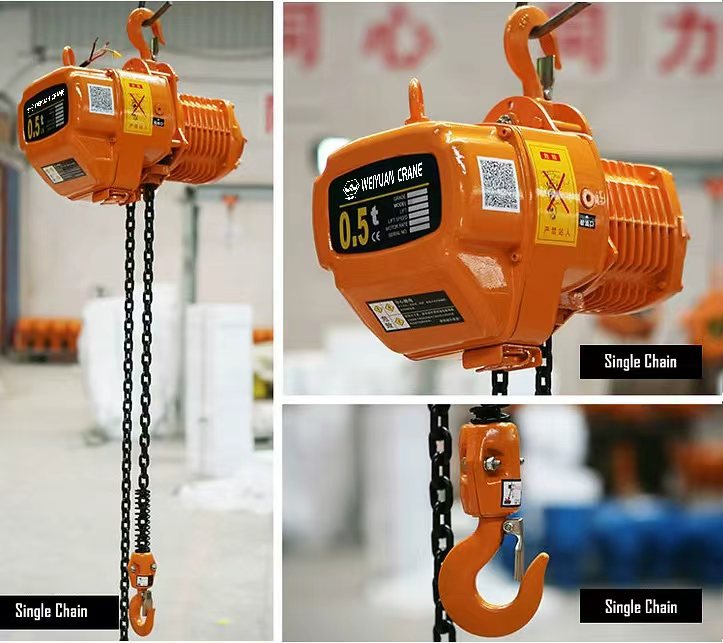
An electric chain hoist uses a precision-machined alloy steel chain as its lifting medium. The chain passes through a load sheave driven by an electric motor, lifting the hook and load attached to the chain’s end. The chain stores in a chain bag suspended from the hoist body as lifting height is used.
How an Electric Chain Hoist Works
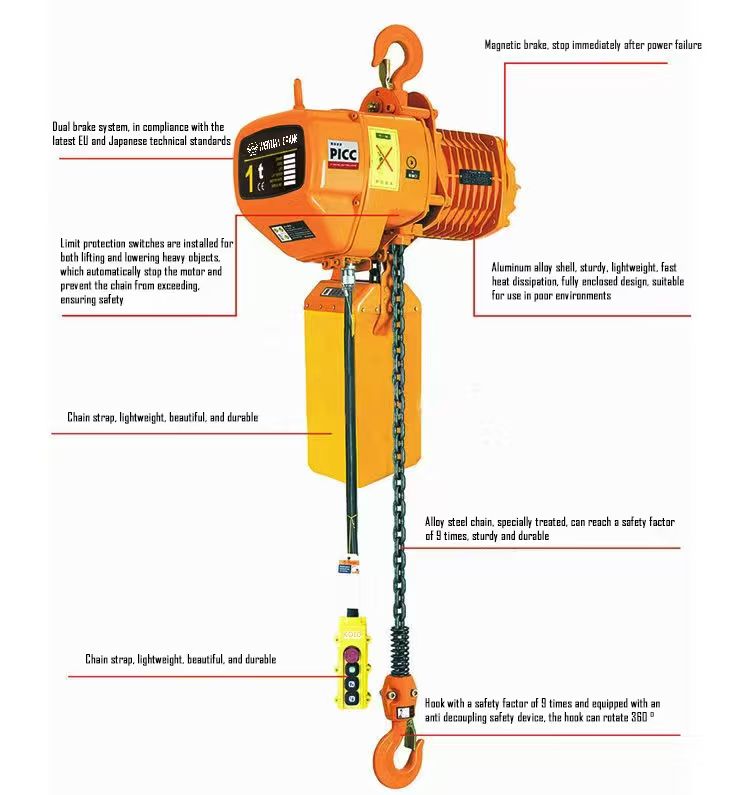
The motor drives a gearbox, which turns the load sheave. The sheave engages the chain’s pockets and drives it upward to lift the load. An electromagnetic disc brake holds the load stationary when the motor is not running — this is a critical safety feature that must be present on any industrial-grade electric chain hoist.
Upper and lower limit switches automatically cut motor power when the hook reaches the maximum lift height or returns to the lowest position, preventing the chain from running off the sheave or the hook from slamming into the hoist body.
Capacity Range
Electric chain hoists are available from approximately 250 lbs (1/8 ton) to 10 tons in standard catalog configurations. Most industrial applications in the 1/4-ton to 5-ton range are well-served by chain hoist technology. Above 5 to 10 tons, wire rope hoists become the standard choice for reasons explained below.
Ideal Applications for Electric Chain Hoists
- Jib crane workstations in manufacturing cells and assembly lines
- Overhead crane systems in light to medium industrial applications (1 to 10 tons)
- Maintenance bays where moderate lift frequency is required
- Loading dock positions
- Machine tending in production environments
- Cleanroom or food-grade environments (stainless steel chain hoist options are available)
Advantages of Electric Chain Hoists
Compact and lightweight: Chain hoists are significantly lighter and more compact than wire rope hoists of equivalent capacity. This matters for jib crane applications where the hoist’s weight contributes to the moment load on the crane structure, and for overhead cranes where minimizing dead weight reduces runway structural demands.
Lower headroom requirement: Because the chain stores in a bag rather than winding onto a drum, chain hoists typically have lower minimum headroom than wire rope hoists at equivalent capacity. In buildings with limited overhead clearance, this can be the deciding factor.
Lower purchase and maintenance cost: Electric chain hoists are generally less expensive to purchase than wire rope hoists and simpler to maintain. Chain inspection and lubrication are straightforward; chain replacement is less complex and less expensive than wire rope replacement.
Wide availability: Electric chain hoists are produced by numerous reputable manufacturers worldwide, providing broad sourcing options and competitive pricing.
Limitations of Electric Chain Hoists
Lift height is limited by chain bag capacity: As lift height increases, the chain bag must grow to accommodate more chain, adding weight to the hoist. Very long lift heights (above 20 to 30 feet) become increasingly impractical with chain technology compared to wire rope.
Speed: Electric chain hoists are generally slower than wire rope hoists at equivalent capacity. For high-throughput production environments where lift speed drives cycle time, wire rope hoists may be the better choice.
Duty cycle limitations: Standard electric chain hoists have defined duty cycle ratings (typically H2 or H3 class). For very high-frequency lifting in continuous production, wire rope hoists or high-duty-cycle chain hoists designed for H4 or H5 service are required.
Wire Rope Electric Hoists: What They Are and When to Use Them
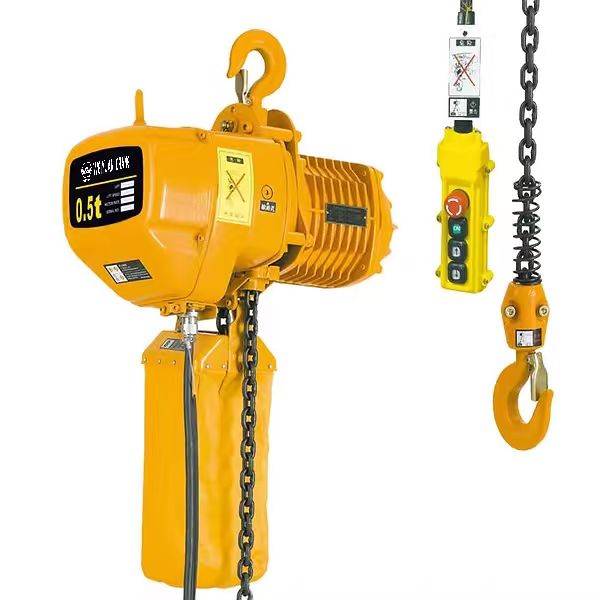
An electric wire rope hoist uses a multi-strand steel wire rope wound onto a drum as its lifting medium. The drum is driven by an electric motor through a gearbox, winding the rope to lift the load or unwinding it to lower.
How a Wire Rope Electric Hoist Works
The motor drives the drum directly or through a gearbox. As the drum rotates, the wire rope winds in precise helical grooves machined into the drum surface. The rope connects to the hook block via a system of sheaves — single-reeved for higher speed and lower capacity, multiple-reeved for higher capacity and more mechanical advantage.
Like chain hoists, wire rope hoists use electromagnetic brakes and limit switches as standard safety features. Higher-performance models add variable frequency drive (VFD) controls for smooth starts, stops, and precise load positioning.
Capacity Range
Wire rope electric hoists are available from approximately 1/4 ton to several hundred tons in custom configurations. They are the standard choice for industrial crane applications above 5 to 10 tons and are also used in lower-capacity applications where lift height, speed, or duty cycle requirements favor rope technology.
Ideal Applications for Wire Rope Electric Hoists
- Overhead cranes in heavy manufacturing (above 5 to 10 tons)
- Applications requiring long lift heights (above 20 to 30 feet)
- High-throughput production environments where lift speed is critical
- Steel mills, foundries, shipyards, and heavy fabrication facilities
- Gantry cranes in outdoor yard operations
- Any application requiring continuous heavy-duty service (CMAA Class D, E, or F)

Weiyuan 1 Ton Remote Control Monorail Electric Hoist
The Weiyuan 1 Ton Remote Control Monorail Electric Hoist is designed for efficient material handling in workshops, warehouses, and light industrial environments. Equipped with wireless remote control and a monorail trolley system, it ensures precise load positioning, smooth travel, and safe lifting operations up to 1 ton.
View Product / Get QuoteAdvantages of Wire Rope Electric Hoists
Greater capacity range: Wire rope hoists scale to capacities that chain technology cannot practically achieve. For loads above 10 tons, wire rope is the only viable electric hoist option in standard industrial configurations.
Higher lift heights: Wire rope drums accommodate much greater rope lengths than chain bags can hold chain, making wire rope the standard choice for tall buildings or applications with very long lift requirements.
Higher speeds: Wire rope hoists are generally faster than chain hoists at equivalent capacity, improving productivity in high-cycle production environments.
Higher duty cycle capability: Wire rope hoists designed for heavy industrial service routinely achieve CMAA H4 and H5 duty ratings, supporting continuous production use far beyond what standard chain hoists are designed for.
VFD compatibility: While VFD controls are available on premium chain hoists, they are standard or near-standard on quality wire rope hoists, providing superior load control, reduced mechanical shock, and better positioning accuracy.
Limitations of Wire Rope Electric Hoists
Higher cost: Wire rope hoists are more expensive to purchase than chain hoists at equivalent lower capacities.
Greater headroom requirement: The drum and multi-part reeving system of a wire rope hoist requires more vertical space than a chain hoist, which can be a constraint in low-clearance buildings.
More complex maintenance: Wire rope inspection, lubrication, and replacement are more involved than chain maintenance. Wire rope must be inspected carefully for broken wires, kinking, and wear — and replaced on schedule regardless of apparent condition.
Heavier and larger: Wire rope hoists are physically larger and heavier than equivalent-capacity chain hoists, which matters for jib crane and portable hoist applications.
Side-by-Side Comparison: Electric Chain Hoist vs Wire Rope Hoist
Feature | Electric Chain Hoist | Wire Rope Hoist
Capacity range | 1/8 ton to 10 tons (standard) | 1/4 ton to hundreds of tons
Standard lift height | Up to 20-30 ft practical | 30 ft to 100+ ft
Lifting speed | Lower (typical 8-16 FPM) | Higher (typical 16-32 FPM)
Headroom required | Lower | Higher
Physical size/weight | Compact and lightweight | Larger and heavier
Purchase cost | Lower | Higher
Maintenance complexity | Lower | Higher
Max duty class (standard) | H3 (some H4) | H5 (continuous heavy)
VFD control | Available (premium models) | Standard on quality units
Best for | Workstations, light-medium industrial | Heavy industrial, long lift, high cycle
Key Specifications to Evaluate When Buying an Electric Hoist
Rated capacity: The maximum load the hoist is designed to lift, including all below-hook hardware. Always apply a minimum 25% safety margin over your heaviest actual load.
Lift height: The maximum vertical distance the hook can travel from its lowest to its highest position. For chain hoists, confirm the chain bag accommodates the required lift height. For wire rope hoists, confirm drum capacity.
Lifting speed: Measured in feet per minute (FPM). Single-speed hoists provide one fixed speed; two-speed hoists offer a slow speed for precision positioning and a fast speed for travel. VFD-controlled hoists offer stepless variable speed.
Duty class: Defined by FEM (Federation Europeenne de la Manutention) or ASME standards. H1/H2 for infrequent use; H3/H4 for production use; H5 for continuous heavy service. Match the duty class to your actual lift frequency and load profile.
Power supply: Single-phase 115V or 230V for lighter-duty and portable applications. Three-phase 230V or 460/480V for industrial chain and wire rope hoists above approximately 1 ton.
Control type: Wired pendant (push-button station), wireless radio remote, or cabin control for large crane applications. Wireless remotes improve operator safety by allowing positioning away from the load.
Safety features: Electromagnetic brake, upper and lower limit switches, thermal motor protection, and overload protection (friction clutch or electronic overload relay) are non-negotiable for any industrial-grade electric hoist.
Red Flags When Evaluating Electric Hoists for Sale
- No duty class rating published or available
- No load test certificate provided
- Missing upper/lower limit switches
- No electromagnetic brake (mechanical braking only is insufficient for industrial use)
- Capacity ratings that appear unusually high for the price point
- No ASME or CE compliance documentation
- Supplier cannot provide local service or spare parts support
Frequently Asked Questions
Q: Can I use an electric chain hoist outdoors?
A: Yes, but the hoist must be rated for outdoor use with weatherproof enclosures for electrical components and corrosion-resistant materials. Standard indoor hoists are not suitable for direct weather exposure. Always verify the IP (Ingress Protection) rating and environmental suitability with the manufacturer before outdoor installation.
Q: How long does an electric hoist last?
A: A properly specified and maintained industrial electric hoist typically achieves 10 to 20 years of service life. Hoist life depends heavily on duty class match — a hoist used at higher frequency or load than its rated duty class will fail far earlier. Chain and wire rope are wear components that require periodic replacement regardless of overall hoist condition.
Q: Do I need a qualified person to install an electric hoist?
A: Yes. Electric hoists must be installed per the manufacturer’s instructions, with electrical connections made by a licensed electrician. Load testing at 125% of rated capacity is required before the hoist is placed in service per ASME B30.16. The installation must be documented.
Q: What is the difference between a hoist and a winch?
A: A hoist is specifically designed for vertical lifting of loads, with a braking system rated to hold a suspended load stationary. A winch is designed primarily for horizontal pulling and is not rated for vertical lifting of personnel loads or unsupported suspended loads. Never use a winch in a vertical lifting application where a hoist is required.