


Electric Wire Rope Hoist Price Guide: What You Should Pay in 2026 for Standard and Heavy-Duty Models
Introduction
Wire rope hoist prices run from about $900 to well over $70,000 for standard industrial models. That spread confuses a lot of buyers, and it leads to two expensive mistakes: paying too much for a specification you do not need, or paying too little for one that fails early and drags your line down with it.
The wide range is not random. Every figure inside it reflects a clear combination of capacity, duty class, drum and rope design, control system, and specification level. Once you understand what drives the number, you can request an accurate quote the first time, compare offers fairly, and judge whether any price you receive is reasonable for the job it has to do.
Wire rope hoist pricing gets misunderstood for a simple reason. Two hoists with the same nameplate capacity can differ in price by two or three times — and the lower one is not automatically the better deal. The difference usually hides in the duty class, the drum design, and the rope specification, none of which show up in a one-line quote. A hoist priced for light, occasional use looks cheap next to one built for continuous heavy duty, right up until it is asked to do the heavy job and wears out in a fraction of the time.
This guide gives you 2026 reference prices for standard and heavy-duty electric wire rope hoists from 500 kg to 50 tonnes. It explains the seven variables that push the price above the base level, compares Chinese and European brand pricing, and lays out the total installed cost — not just the hoist purchase price — so your budget reflects the real investment. The goal is straightforward: help you optimize your procurement decision with the numbers and the reasoning behind them.
Part 1: Wire Rope Hoist vs Chain Hoist Price Relationship
Before pricing a wire rope hoist, it helps to know where it sits against the electric chain hoist — the other common option — because the choice between them sets the base price.
Electric Chain Hoist
A chain hoist lifts with a precision alloy steel load chain running over a toothed pocket wheel. It is the standard for lighter, lower-headroom work.
Chain hoists fit best for: capacities up to about 5 tonnes, low-headroom installations, cleanroom and food settings where chain is easier to keep clean, and budget-conscious jobs within the chain’s practical capacity.
Electric Wire Rope Hoist
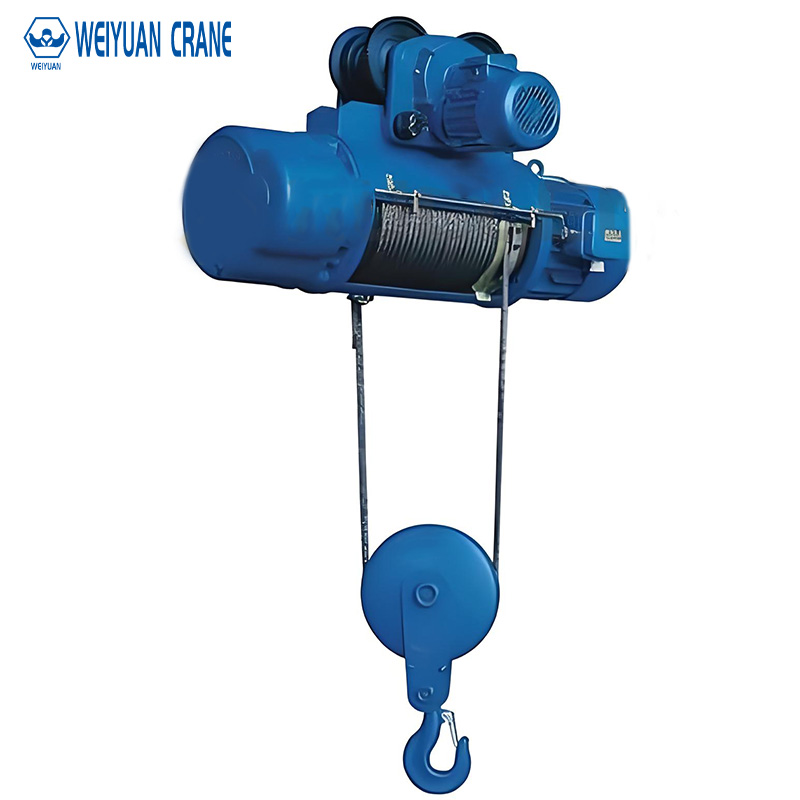
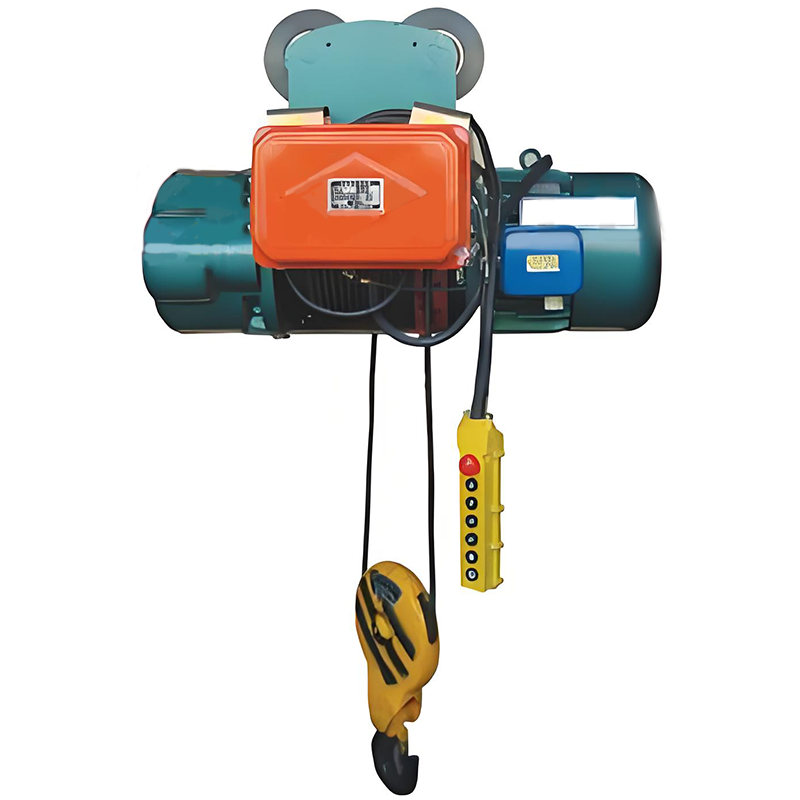
A wire rope hoist lifts with a steel wire rope winding onto a grooved drum, driven by the motor through a gearbox. It is the standard once loads, speeds, or duty climb.
Wire rope hoists fit best for: capacities above 5 tonnes, higher lifting speeds, flexible rope lengths, and heavy-duty service (CMAA Class E and F) where rope outlasts chain under high cycle counts.
The Price Relationship
In the 2-to-5-tonne overlap where both types work, the wire rope hoist costs roughly 30 to 50% more than an equivalent chain hoist. That premium buys higher speed, better fatigue life, and a longer service life under heavy duty.
Above 5 tonnes, the comparison mostly ends — wire rope is the only practical choice for most applications, so the question shifts from “chain or rope” to “which wire rope specification.” The rest of this guide answers that.
Bottom line: below 5 tonnes you are weighing a chain hoist’s lower cost against a wire rope hoist’s speed and durability; above 5 tonnes, wire rope is the default, and specification — not type — drives the price.
Part 2: 2026 Price Reference — Electric Wire Rope Hoists
All prices below are for the hoist unit only — no trolley, no installation. They assume FEM M5 (CMAA Class D) standard duty, standard control, and standard indoor environmental specification (IP54). Use them to build a realistic budget and to sense-check any quote you receive.
500 kg – 1 Tonne
| Configuration | 2026 price range (USD) |
|---|---|
| Standard speed | $900 – $2,500 |
| Two-speed | $1,400 – $3,500 |
| VFD variable speed | $2,500 – $5,500 |
2 Tonnes
| Configuration | 2026 price range (USD) |
|---|---|
| Standard speed | $2,500 – $6,000 |
| Two-speed | $3,500 – $8,000 |
| VFD variable speed | $5,500 – $12,000 |
3 Tonnes
| Configuration | 2026 price range (USD) |
|---|---|
| Standard speed | $3,800 – $8,500 |
| Two-speed | $5,000 – $11,000 |
| VFD variable speed | $7,500 – $16,000 |
5 Tonnes (Most Common Heavy Specification)
| Configuration | 2026 price range (USD) |
|---|---|
| Standard speed | $5,500 – $13,000 |
| Two-speed | $7,500 – $17,000 |
| VFD variable speed | $10,000 – $22,000 |
10 Tonnes
| Configuration | 2026 price range (USD) |
|---|---|
| Standard speed | $10,000 – $25,000 |
| Two-speed | $14,000 – $32,000 |
| VFD variable speed | $18,000 – $40,000 |
16 Tonnes
| Configuration | 2026 price range (USD) |
|---|---|
| Standard speed | $16,000 – $36,000 |
| VFD variable speed | $27,000 – $58,000 |
20 Tonnes
| Configuration | 2026 price range (USD) |
|---|---|
| Standard speed | $20,000 – $45,000 |
| VFD variable speed | $32,000 – $70,000 |
32 Tonnes
| Configuration | 2026 price range (USD) |
|---|---|
| Standard speed | $34,000 – $70,000 |
| VFD variable speed | $52,000 – $105,000 |
50 Tonnes
| Configuration | 2026 price range (USD) |
|---|---|
| Standard speed | $55,000 – $110,000 |
| VFD variable speed | $85,000 – $165,000 |
At the higher capacities, many 32- and 50-tonne hoists use a double-rope or twin-drum arrangement, which is reflected in the figures above. Confirm the reeving with your supplier, since it affects both the price and the hook height — covered in Part 3.
Bottom line: capacity sets the base figure, control system widens the range within each capacity, and the heaviest models carry design features that move them into a different price tier — match the configuration to your real duty before comparing quotes.
Part 3: Seven Variables That Add to the Base Price
The tables above are the starting point. Seven variables push the price up from there, and each one is a defined, predictable premium. Knowing them lets you read a quote line by line instead of guessing.
Variable 1: Duty Class
Duty class reflects how hard and how often the hoist works — and it is the variable buyers under-specify most.
- FEM M5 (CMAA Class D), base: the reference for all prices above.
- FEM M6 (CMAA Class E): +20 to +35%.
- FEM M7 (CMAA Class F): +45 to +75%.
- FEM M8 (severe continuous): +70 to +110%, often a special order.
Under-specifying saves 15 to 30% at purchase and costs several times that in premature failure and downtime over five years. For continuous production or process duty, the higher class is not an upgrade — it is the correct specification, and it directly protects equipment uptime.
Variable 2: Drum Layers
The number of rope layers wound on the drum affects both price and rope life.
- Single-layer or two-layer drum (standard): base price. Longer drum, gentler on the rope, longer rope life.
- Multi-layer drum (3+ layers): +10 to +20%. A shorter, more compact hoist for the same lift height, but the rope crosses over itself, which increases rope wear and shortens rope replacement intervals.
The trade is real: a multi-layer drum buys a compact hoist at the cost of more frequent rope changes. For high-lift or high-cycle work, the longer single- or two-layer drum usually wins on total cost.
Variable 3: Rope Type and Grade
The rope itself is a specification, not a commodity.
- Standard galvanized rope (base): suits general indoor duty.
- Higher-grade or rotation-resistant rope: +5 to +12%. Needed for long single-line lifts, free-rotating loads, or higher duty classes where ordinary rope spins or fatigues early.
- Stainless or specialty-coated rope: +15 to +30%. For corrosive, washdown, or marine settings.
Rope is a wear part, so the right grade up front lowers the running cost of replacements over the hoist’s life.
Variable 4: Control System
The control system shapes how the hoist starts, stops, and places the load.
- Contactor (standard): base price.
- Two-speed (pole-changing motor): +15 to +25%.
- VFD variable speed: +35 to +60%. Smooth starts and stops, precise placement, and longer brake and motor life.
- VFD with wireless remote: +50 to +85%.
- VFD with anti-sway and encoder positioning: +75 to +130%.
VFD pays back fastest on high-cycle and precision work, where it cuts load swing, reduces wear, and steadies cycle times.
Variable 5: Environmental Specification
The operating environment sets the protection level, and protection costs money.
- Standard indoor IP54 (base).
- Outdoor / IP65: +8 to +15%.
- Washdown / IP66: +15 to +25%.
- Food grade (NSF H1 lubricants, stainless hardware): +30 to +50%.
- ATEX Zone 2 (Ex nA): +40 to +80%.
- ATEX Zone 1 (Ex d): +80 to +150%.
- Cold storage (-25°C): +20 to +35%.
For mining and outdoor industrial sites, the outdoor or washdown rating is rarely optional — it is what keeps the hoist running reliably in dust, weather, and washdown.
Variable 6: Certification and Documentation
Certification is both a compliance need and a quality signal.
- Standard supply (manufacturer’s test report): base price.
- CE Declaration of Conformity with technical file: +5 to +12%. Required for the EU market and many international buyers.
- Third-party witnessed load test certificate: +$400 to $1,200 per unit.
- Full documentation package (wiring diagrams, maintenance manual, spare parts list): usually included by reputable manufacturers — request it explicitly if it is not mentioned.
Variable 7: Reeving Factor
Reeving — how many rope falls support the hook — sets the relationship between capacity, speed, and hook height.
- Standard reeving (2/1 or 4/1 for the capacity): base price.
- Higher reeving factor (more rope falls): +10 to +25%. Lifts heavier loads on the same rope and drum, but lowers the lifting speed and consumes more hook height.
- True low-headroom reeving: +15 to +30%. Recovers hook height in tight buildings, at a price premium.
Reeving is where capacity, speed, and headroom meet — get it confirmed early, because changing it later means changing the hoist.
Bottom line: read every quote against these seven variables; each is a defined premium, and the most common costly error is under-specifying duty class to win a lower headline price.
Part 4: Chinese vs European Brand Pricing
The same nominal specification can carry very different prices depending on where the hoist is made. Understanding why helps you decide where the premium is worth paying.
The Price Difference
- Chinese brand wire rope hoist, 5-tonne, standard speed: $5,500 to $13,000.
- European brand (Konecranes, Demag, SWF, STAHL) equivalent: $13,000 to $30,000.
The gap is roughly 2 to 2.5 times for equivalent nominal specifications.
What Drives the Difference
European brands carry higher costs for in-house R&D, European labor rates, full CE technical file preparation, a global service network, and longer warranty support. Chinese brands manufacture at lower cost and source components domestically, which lowers price but can lengthen the wait for international spare parts.
When Chinese Brands Deliver Good Value
A Chinese-brand hoist is the right call when:
- The application is standard, with no special certification or unusual environment.
- Your maintenance team can work with generic or locally sourced components.
- The hoist serves a non-critical role where a 2-to-4-week parts wait is acceptable.
- Your market does not require CE or equivalent certification.
- Budget is tight and the price difference is significant against the application’s value.
Well-built Chinese hoists deliver dependable performance and a much lower total cost on the broad middle of industrial duty — which is exactly where most manufacturing and mining lifting sits.
When European Brands Justify the Premium
A European-brand hoist earns its premium when:
- CE certification with a full technical file is required by your quality system, insurer, or regulator.
- The hoist serves a regulated application (pharmaceutical, food, nuclear, aerospace).
- Global spare parts availability across multiple sites is a procurement requirement.
- Downtime cost makes a multi-week parts wait unacceptable, and regional distribution centers cut lead time to days.
- An OEM end customer specifies a named European brand.
Bottom line: for standard manufacturing and mining duty, a quality Chinese-brand hoist usually delivers the better total value; reserve the European premium for regulated, critical, or multi-site operations where certification and fast parts genuinely pay back.
Part 5: Total Installed Cost — Not Just the Hoist Price
The hoist quote is the visible number, but it is not the budget. Several cost items rarely appear in the hoist price, and leaving them out is how a project runs over. Build them in from the start.
The Costs Beyond the Hoist
- Trolley: a production hoist almost always needs one. A standard motorized trolley adds roughly $700 to $4,000 depending on capacity, and a VFD trolley more. Not included in the hoist price.
- Electrical supply: running a three-phase circuit from the nearest panel to the hoist: $400 to $2,500, depending on distance and panel capacity.
- Installation labor: mounting, wiring, and commissioning: $400 to $1,500.
- Load test (if required): test weights plus inspector time: $300 to $800.
- Annual inspection (recurring): required by ASME B30.16 and good practice, by a qualified person: $250 to $700 per year.
Complete Installed Cost Examples
5-tonne, three-phase, standard-speed wire rope hoist — general production:
| Item | Cost range (USD) |
|---|---|
| Hoist | $5,500 – $13,000 |
| Motorized trolley | $1,500 – $3,500 |
| Electrical supply | $500 – $1,800 |
| Installation and test | $700 – $1,500 |
| Total first-year installed cost | $8,200 – $19,800 |
10-tonne, three-phase, VFD wire rope hoist — heavy handling:
| Item | Cost range (USD) |
|---|---|
| Hoist | $18,000 – $40,000 |
| VFD motorized trolley | $4,000 – $9,000 |
| Electrical supply | $800 – $2,500 |
| Installation and test | $1,000 – $2,500 |
| Total first-year installed cost | $23,800 – $54,000 |
20-tonne, three-phase, VFD wire rope hoist — heavy industrial / mining:
| Item | Cost range (USD) |
|---|---|
| Hoist | $32,000 – $70,000 |
| VFD motorized trolley | $7,000 – $16,000 |
| Electrical supply | $1,200 – $3,500 |
| Installation and test | $1,500 – $3,500 |
| Total first-year installed cost | $41,700 – $93,000 |
Bottom line: budget the trolley, power supply, installation, and recurring inspection alongside the hoist — the true first-year cost typically runs 30 to 60% above the hoist price alone.
Frequently Asked Questions
Q: Why do some suppliers quote far below the ranges in this guide?
A: A much lower quote usually reflects one or more hidden cutbacks: a lower duty class than you specified (M4 instead of M5 or M6), domestic-only components with limited international spare parts, reduced certification (no CE technical file), a shorter warranty, or higher defect rates that surface after delivery. Before comparing prices, ask every supplier to confirm the duty class, component brands, certification scope, and warranty terms in writing. A quote 40% under the market for an identical specification is a warning sign, not a saving — it almost always means the specification is not actually identical.
Q: Is a VFD wire rope hoist worth the premium for heavy but infrequent lifting?
A: It depends on the loads, not just the cycle count. For genuinely infrequent lifting — a handful of lifts per shift — the VFD premium (35 to 60%) does not pay back through component-life or cycle-time savings alone. But heavy loads make swing dangerous and placement difficult, and VFD’s smooth starts, stops, and slow-speed positioning directly reduce that risk. If you lift heavy, awkward, or high-value loads where swing could strike equipment or people, VFD is worth it regardless of frequency. If the lifts are heavy but simple and well clear of obstructions, a two-speed hoist often gives enough control at lower cost.
Q: How does drum layering affect long-term cost?
A: A multi-layer drum makes the hoist more compact and slightly cheaper to install in a tight space, but the rope winds over itself, which increases wear and shortens the rope replacement interval. A single- or two-layer drum is a little more expensive up front and needs a longer hoist, but it treats the rope gently and stretches out replacement intervals. Over a high-cycle hoist’s life, rope changes add up — both in parts and in downtime — so for heavy or frequent duty the longer drum usually wins on total cost. For occasional lifting in a height-constrained bay, the compact multi-layer drum can be the better practical choice.
Q: What duty class should I specify for continuous production or mining service?
A: For continuous, hard-working service, plan on FEM M6 (CMAA Class E) at minimum, and M7 (Class F) for the heaviest, most relentless duty. The temptation is to save 20 to 35% by specifying a lower class, but a hoist worked beyond its rated duty wears its rope, brake, and gearbox far faster and fails years early — the downtime alone usually costs several times the saving. Classify the duty honestly by how many lifts the hoist makes per shift and how heavy they are, then specify the class that matches. The right duty class is the single biggest lever you have on long-term reliability and equipment uptime.