


Gantry Crane Selection Guide: Types, Load Capacity, Span & CMAA Duty Classes
Introduction
Buy the wrong gantry crane and you’ll live with the mistake for fifteen years. That’s the blunt reality most procurement buyers don’t hear until it’s too late — after the crane is bolted down, the rails are grouted, and the thing turns out to be a size too small for the loads your production floor actually moves.
I’ve watched it happen more than once. A plant orders a crane rated for the “typical” lift, skips the duty class question entirely, and eighteen months later the hoist motor is burning out because the crane runs three times more often than anyone told the supplier. Now you’re buying a second crane to do the job the first one couldn’t. That’s not a cost overrun. That’s paying twice.
The good news: a gantry crane is one of the more forgiving pieces of heavy equipment to specify correctly — if you ask the right questions before you write the purchase order. There are only a handful of decisions that really matter, and once you understand them, comparing quotes becomes straightforward instead of guesswork.
This guide is the first of three on gantry crane procurement. Here we cover the foundations: the four main gantry crane types and when each one earns its place, how to size load capacity without under-rating or over-paying, why span and height quietly drive your budget, the CMAA duty classes that separate a crane that lasts from one that fails early, and a 2026 price reference so you can build a defensible number before you talk to a single supplier.
What you’ll take away:
- Which gantry crane type fits your operation — and which ones you can rule out fast
- How to size load capacity for the lift you actually make, not a round figure
- Why span and lift height matter more to cost than most buyers expect
- How to read CMAA duty classes A through F and match them to your usage
- 2026 pricing so your budget survives the first supplier conversation
Part 1: The Four Gantry Crane Types — And Where Each One Belongs
A gantry crane is, at its core, a bridge crane that carries its own legs. Instead of running on rails mounted to a building’s structure, the gantry stands on its own supports, either rolling on floor rails, ground wheels, or a mix of the two. That independence is the whole point — you get overhead lifting without paying to reinforce a building, and in many cases without a building at all.
But “gantry crane” covers four distinct configurations, and picking the wrong one wastes money in both directions. Here’s how they actually differ on the floor.
Portable Gantry Crane
A portable gantry is the lightweight end of the range — a freestanding A-frame structure on castors or wheels, usually rated from 250 kg up to around 5 tonnes. You roll it where you need it, lift, and roll it away.
Where it earns its place: maintenance bays, workshops, small assembly cells, and any operation where the lifting point moves around. Engine shops, mold-change stations, and repair facilities lean on portable gantries because the crane goes to the load instead of the load coming to a fixed crane.
Where it doesn’t: high-frequency production lifting, or anything above a few tonnes. Portable units trade capacity and duty for mobility. Ask one to run a full production shift and it’ll wear out fast — it was never built for it.
Semi-Gantry Crane
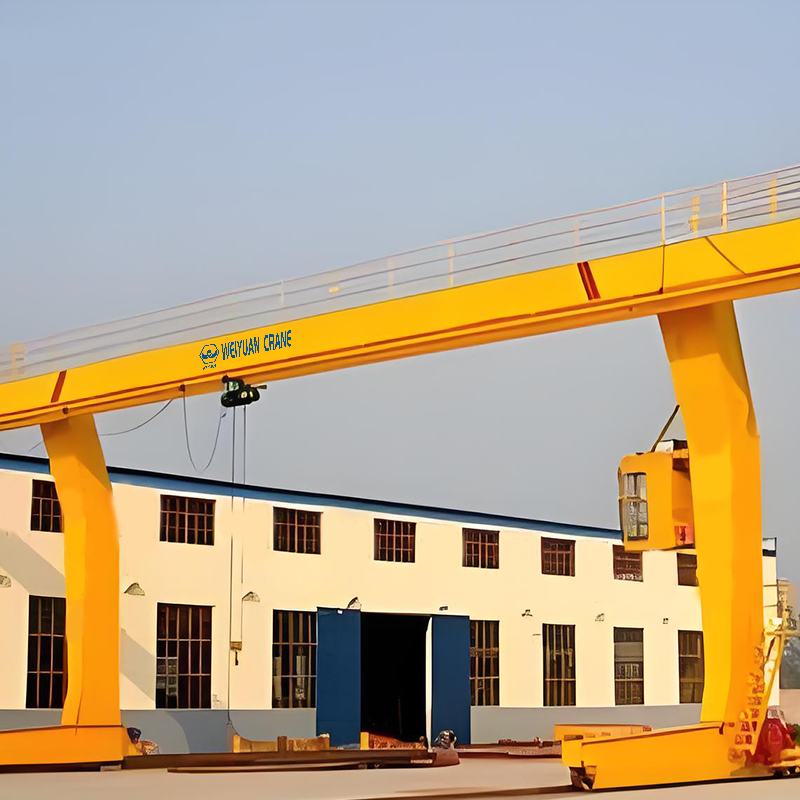
A semi-gantry is a hybrid. One side of the bridge runs on a floor rail on its own leg; the other side runs on an elevated runway rail mounted to the building wall or columns. So it’s half gantry, half overhead crane.
Where it earns its place: buildings where you already have — or can add — a wall-mounted runway on one side, but can’t or don’t want to support a full runway on the other. The single leg keeps the floor on one side clear, which matters when you’re threading a crane through an existing plant layout. Semi-gantries are common in bays alongside a production line, where floor space on the line side is precious.
Where it doesn’t: open yards with no building structure to hang a runway on, or operations that need the full floor clear on both sides.
Full Gantry Crane
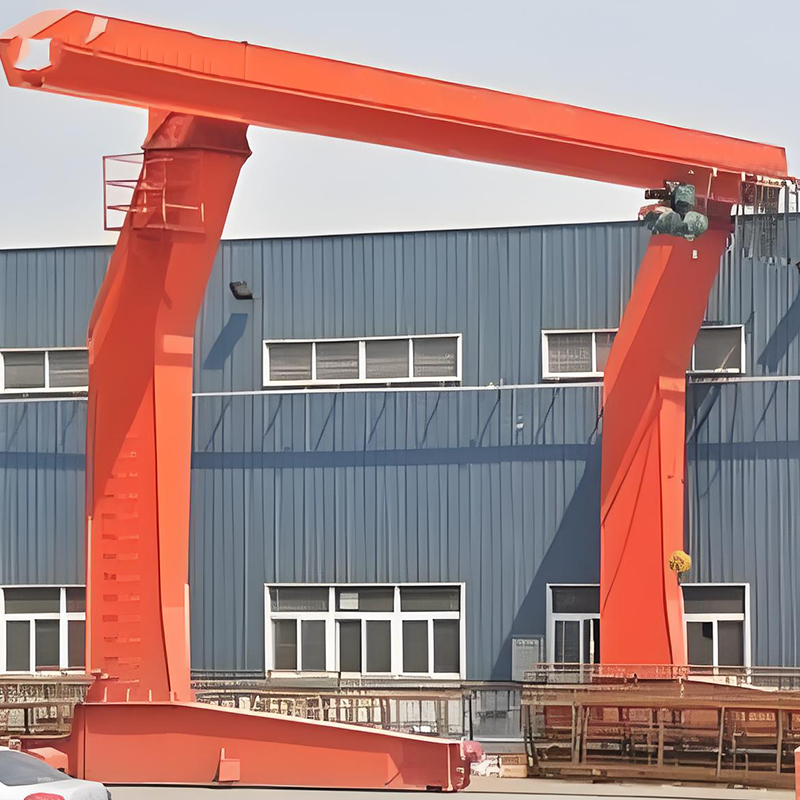
The full gantry is what most people picture: a bridge spanning two legs, both legs running on ground-level rails, the whole structure standing independent of any building. Capacities run from a few tonnes to several hundred, spans from a handful of metres to fifty-plus.
Where it earns its place: outdoor yards, storage areas, precast concrete plants, container handling, and any large open area where building a structure to hang an overhead crane makes no sense. This is the workhorse for heavy outdoor lifting. Both legs on rails means the full working width between the legs is usable, and the crane can travel the full length of the rail run.
Where it doesn’t: tight indoor spaces where the leg travel path eats floor you can’t spare — a wall-mounted overhead crane may serve better there.
Overhead Rail Gantry (Rail-Mounted Gantry)
The overhead rail gantry — often called a rail-mounted gantry, or RMG in port and intermodal work — is a heavy full-gantry variant purpose-built to run long, precise rail runs. Think container terminals, intermodal yards, and large-scale material handling where the crane travels hundreds of metres along fixed rails with tight positioning tolerances.
Where it earns its place: high-volume, repetitive handling over a long fixed path — stacking containers, feeding rail wagons, serving a long storage run. The rails give repeatable positioning and support very high capacities.
Where it doesn’t: anywhere the lifting path changes, or where you can’t justify the civil cost of a long, engineered rail foundation. RMGs are a serious capital commitment, foundation included.
The Quick Selection Logic
Strip it down and the choice usually falls out of three questions:
- Does the lifting point move around a lot, and are the loads light? Portable gantry.
- Are you working inside a building where you can hang a runway on one side? Semi-gantry.
- Is it an open yard or heavy outdoor lifting with no building to lean on? Full gantry.
- Is it long-run, high-volume, repetitive handling on a fixed path? Overhead rail gantry.
Get this right first. Everything else — capacity, span, duty class — sits on top of the type decision.
Part 2: Sizing Load Capacity — Rate for the Real Lift
Load capacity is where buyers most often go wrong, and it goes wrong in both directions. Under-rate the crane and it fails early or simply can’t do the job. Over-rate it and you’ve spent money on capacity that never gets used, plus the heavier structure, bigger foundations, and larger drives that come with it.
The fix is to rate for the real lift, and to include everything that hangs on the hook.
Rated Capacity Is the Whole Lift, Not Just the Load
Here’s the sizing error I see most: buyers spec capacity against the bare weight of the heaviest part they move, and forget everything else that goes up with it. Your rated capacity has to cover:
- The heaviest load you’ll actually lift
- The lifting device — spreader beam, magnet, grab, C-hook, or vacuum lifter
- Any rigging, slings, and shackles in the load path
A spreader beam or lifting magnet can add hundreds of kilograms — sometimes several tonnes on large lifts. Leave it out and your “10-tonne crane” is quietly under-rated for the 10-tonne load you bought it to handle. Add the lifting gear weight, then add a sensible margin, and that’s your rated capacity.
Match the Number to a Standard Rating
Manufacturers build to standard capacity steps — 2, 3.2, 5, 10, 16, 20, 32, 50 tonnes and up. There’s rarely a reason to specify an odd in-between figure. Calculate your true lift weight, add margin, then round up to the next standard step. This keeps you on catalog-standard components, which means lower cost, faster lead time, and easier spare-parts support down the line. A non-standard capacity almost always means a custom quote and a longer wait.
Don’t Confuse Capacity With Duty
A crane rated for 20 tonnes can lift 20 tonnes. It says nothing about how often it can do so. A crane that lifts near capacity dozens of times a shift needs a completely different mechanical specification than one that makes an occasional heavy lift — even at the same tonnage. That “how often” question is the duty class, and it’s covered in Part 4. Keep the two separate in your thinking: capacity is how heavy, duty is how hard.
Part 3: Span and Height — The Quiet Cost Drivers
Two dimensions shape a gantry crane’s price as much as its capacity: the span between the legs and the lifting height. Buyers tend to focus hard on tonnage and treat these as afterthoughts. That’s backwards — span and height often move the budget more than an extra few tonnes of capacity.
Span: Wider Costs More Than You Think
Span is the distance between the two legs — the clear working width the crane bridges. It sounds like a simple dimension, but the cost relationship isn’t linear. A wider span means a longer main girder, and a longer girder has to be deeper and heavier to carry the same load without excessive deflection. So a small increase in span can drive a surprisingly large increase in girder weight, structural cost, and wheel loads on the foundation.
The practical guidance: specify the span you need, not the span that feels safe. Every extra metre of span you add “just in case” costs real money in steel and foundation. Measure the actual working width your operation requires, add a reasonable clearance, and stop there. If you genuinely expect the layout to widen later, that’s a deliberate decision to document and price — not a default padding to throw on every quote.
Lift Height: Measure the Full Picture
Lift height — how high the hook can raise the load — sounds straightforward, but there are several dimensions the supplier needs, and getting them wrong causes real headaches at installation:
- Lift height (hook travel): how far the hook rises from its lowest to highest point
- Under-clearance: the space beneath the girder for the load and lifting gear to pass
- Overall height: the total height of the crane, which matters if it works indoors under a roof or has to clear a doorway or gate
The classic mistake is specifying enough lift height for the load but forgetting the lifting gear underneath it. A 4-metre lift height with a 1-metre spreader beam gives you only 3 metres of usable clearance for the load itself. Account for the full stack — hook, rigging, lifting device, and load — when you state your height requirement.
Wheel Loads and Foundations
Span and height don’t just affect the crane — they drive the wheel loads the crane puts into the ground, which in turn sets your foundation and rail requirements. A taller, wider, heavier crane concentrates more load onto each wheel. For full gantries and rail-mounted gantries especially, the foundation and rail civil works can rival the crane itself in cost. Get the wheel load figures from your supplier early and hand them to your civil engineer before you commit to a layout — foundation surprises are among the most expensive a crane project can spring.
Part 4: CMAA Duty Classes A Through F — The Number That Decides Crane Life
If there’s one specification that separates a crane that runs for decades from one that fails in a few years, it’s the duty class. And it’s the one buyers skip most often, because it doesn’t show up as a headline number the way tonnage does.
The CMAA (Crane Manufacturers Association of America) duty classification tells you how hard a crane is built to work over its life. It combines two things: how often the crane operates, and how heavy the average lift is relative to its rated capacity. Two cranes rated for the same tonnage can sit in completely different duty classes — and cost very differently — because one is built to work all day and the other isn’t.
The Six Classes, In Plain Terms
| CMAA Class | Service Level | Typical Usage |
|---|---|---|
| Class A | Standby / infrequent | Rarely used; precise handling at slow speeds. Powerhouses, public utilities, maintenance cranes used occasionally. |
| Class B | Light service | Light loads, slow speeds, low cycle rates. Repair shops, light assembly, service buildings. |
| Class C | Moderate service | Moderate loads, moderate frequency. General machine shops and fabricating — the most common workshop class. |
| Class D | Heavy service | Heavy loads at high frequency through the shift. Steel warehouses, foundries, heavy machine shops. |
| Class E | Severe service | Near-continuous operation at or near rated capacity. Bulk material handling, scrap yards, cement plants. |
| Class F | Continuous severe | Around-the-clock operation, critical loads, harsh conditions. Steel mills, container handling, heavy custom applications. |
How to Place Your Operation
Be honest about how the crane will actually be used — not how you’d like to think it’ll be used. Ask:
- How many lifts per hour, per shift? Occasional lifts point to Class A–B. Steady lifting through the shift is C–D. Near-continuous cycling is E–F.
- How heavy are the lifts relative to capacity? Mostly light lifts with the odd heavy one is easier duty. Consistently lifting near rated capacity pushes the class up.
- How many shifts? A single-shift workshop and a three-shift mill running the same tonnage are worlds apart on duty.
Why This Is a Budget Decision, Not Just an Engineering One
Under-specifying duty class is the single most expensive mistake in the crane budget — not on day one, but over the crane’s life. A Class C crane pushed into Class E service will chew through hoist motors, brakes, wheels, and gearboxes far ahead of schedule, and the unplanned downtime costs more than the crane. A correctly rated crane runs its full design life with predictable maintenance.
The flip side matters too: over-specifying duty burns capital you didn’t need to spend. A genuine light-service operation doesn’t need a Class F crane, and paying for one is money that could have gone elsewhere.
When you compare quotes, normalize them to the same duty class. A cheaper crane at a lower duty rating is not a like-for-like comparison — it’s a different product that happens to share a tonnage figure. This one check catches more bad “bargains” than any other.
Part 5: Key Structural Components — What You’re Actually Buying
You don’t need to be a crane engineer to specify one well, but knowing the main components helps you read a quote, ask sharp questions, and spot where a supplier has cut a corner.
Main Girder (Bridge)
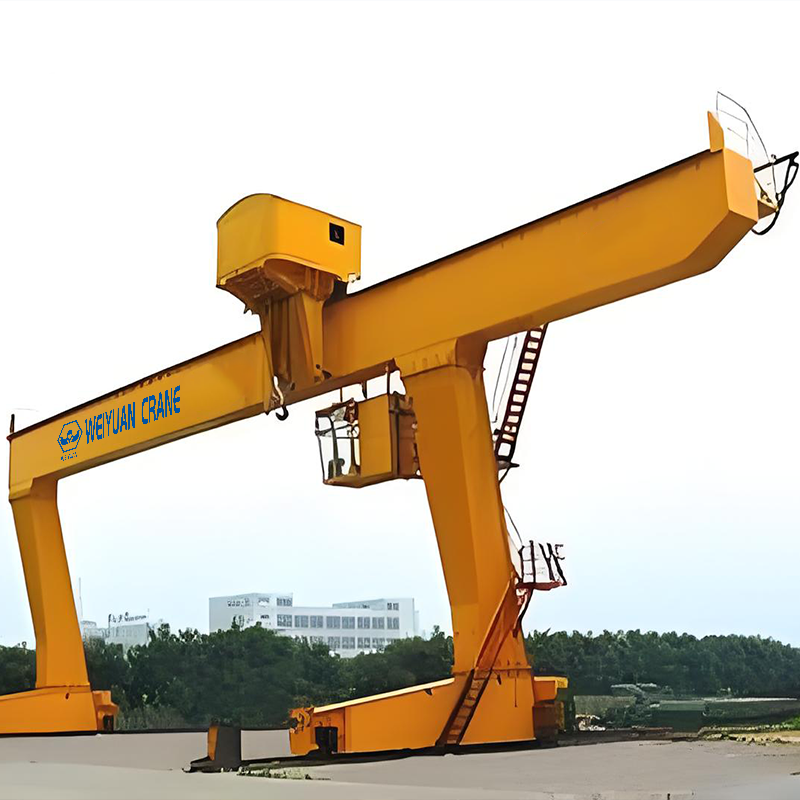
The main girder is the horizontal beam that spans the legs and carries the trolley and hoist. It’s the backbone of the crane and the single biggest factor in structural cost. Girders come in two main forms:
- Single girder: one main beam, with the hoist running on the bottom flange. Lighter, cheaper, and fine for most capacities up to roughly 20 tonnes and moderate spans. The usual choice where the loads and duty allow.
- Double girder: two parallel beams with the trolley running on top. More expensive, but gives higher capacity, greater lift height (the hook can rise between the girders), and better stability at long spans and heavy duty. The right call for heavy service, high lifts, or where you need to mount auxiliary equipment.
Legs and End Carriages
The legs transfer the load from the girder down to the travel wheels. On a full gantry, both legs; on a semi-gantry, one leg and one runway-mounted side. The end carriages (or end trucks) sit at the base and house the travel wheels and drive. Wheel quality and bearing spec here matter more than buyers realize — cheap wheels on a heavy-duty crane are a false economy that shows up as rail wear and downtime.
Hoist and Trolley
The hoist does the lifting; the trolley carries the hoist across the girder. This is the most-worked mechanical assembly on the crane, and it’s where duty class bites hardest. A hoist sized for the right duty class and fitted with proper controls (a variable-speed drive for smooth, precise handling) pays for itself in longevity and reduced load sway. Skimp here and it’s the first thing to fail.
Travel Wheels, Rails, and Drives
The wheels, rails, and travel drives move the whole crane along its run. For rail-mounted gantries especially, the rail and its foundation are a major cost line in their own right. Match the wheel and rail specification to the wheel loads (see Part 3) and the duty class — under-spec here and you’ll be regrinding rails and replacing wheels far too often.
Controls and Safety Systems
Modern gantry cranes carry a stack of control and safety features that are worth specifying deliberately rather than accepting whatever’s cheapest:
- Variable-frequency drives (VFDs) for smooth start/stop and precise positioning — less load sway, less mechanical shock, longer component life
- Overload protection to prevent lifting beyond rated capacity
- Limit switches on hoist and travel to prevent over-travel
- Anti-collision systems where multiple cranes share a runway
These features aren’t just safety boxes to tick. Smooth control directly extends the life of the girder, hoist, and drives by cutting the shock loads that abrupt starts and stops hammer into the structure.
Part 6: Industry Applications — Matching Crane to Sector
The right gantry crane looks different depending on what industry it serves. Here’s how the specification shifts across the sectors that buy the most.
Steel Fabrication
Steel shops move heavy, awkward loads — plate, beams, weldments — through repeated cycles all shift. That combination points to a double-girder full gantry in Class D or E duty, often with a lifting magnet or beam clamp rather than a plain hook. Capacity commonly runs 10 to 50 tonnes. The premium here goes into duty class and hoist quality, because the crane works hard and downtime stops the whole shop.
Shipyards
Shipbuilding demands the extremes — very high capacity, very wide span, and often outdoor operation. Full gantries and heavy rail-mounted gantries dominate, with capacities from tens to hundreds of tonnes and spans wide enough to straddle a hull section or block. Duty is heavy to severe. These are major capital projects where the foundation and rail civil works are a substantial part of the total.
Warehouses and Storage Yards
Warehousing and open storage favor full gantries where there’s no building steel to hang an overhead crane from, or semi-gantries inside existing structures. Loads are moderate, duty is typically Class C to D, and the priority is reliable, repeatable handling over a defined area. Capacity often sits in the 5 to 20-tonne range. Here the buyer’s edge is not over-specifying — a warehouse rarely needs mill-grade duty.
Heavy Manufacturing
General heavy manufacturing — machine building, equipment assembly, foundry work — runs the full range depending on the specific process. Double-girder full or semi-gantries in Class C to E cover most of it. The key is matching the crane to the actual production rhythm: an assembly cell making a few heavy lifts a shift is a different crane from a foundry pouring continuously, even at the same tonnage.
The Cross-Sector Lesson
Notice the pattern: the type follows the environment (indoor vs. outdoor, fixed vs. open), while the duty class follows the work intensity. Nail both to your actual operation and you land on the right crane. Copy a spec from a different sector and you’ll almost certainly over- or under-buy.
Part 7: 2026 Price Reference for Gantry Cranes
Use these as planning figures to build a defensible budget before you approach suppliers. Actual pricing varies with capacity, span, lift height, duty class, controls, and — for rail-mounted units — the foundation and rail civil works, which are often quoted separately.
| Crane type & spec | Capacity / span | 2026 price range (crane only) |
|---|---|---|
| Portable gantry (light workshop, castors) | 1–5 t / 3–5 m | $1,500 – $8,000 |
| Single-girder semi-gantry (Class C, indoor) | 5–10 t / 10–15 m | $18,000 – $45,000 |
| Single-girder full gantry (Class C–D, outdoor) | 5–16 t / 12–20 m | $30,000 – $80,000 |
| Double-girder full gantry (Class D–E, heavy) | 20–50 t / 20–30 m | $90,000 – $280,000 |
| Heavy double-girder full gantry (Class E–F) | 50–100 t / 30–40 m | $250,000 – $650,000+ |
| Rail-mounted gantry (RMG) (container/intermodal) | 40–65 t / 30–50 m | $800,000 – $3,000,000+ |
Option and cost drivers to budget for:
- Variable-frequency drives over basic two-speed control: +10 to 25%
- Higher duty class (e.g., Class D to Class E): +15 to 40% depending on capacity
- Outdoor weatherproofing and corrosion protection: +5 to 15%
- Foundation and rail civil works (full and rail-mounted gantries): frequently 20 to 60% of the crane price — quoted separately, and easy to overlook
- Special lifting devices (spreader beams, magnets, grabs): priced per application
Procurement tip: when you compare quotes, normalize them to the same capacity, span, duty class, and control package — and confirm whether the foundation and rail works are included or separate. A headline price that looks 20% cheaper often reflects a lower duty class, a narrower span, or an excluded foundation, not a genuine saving. That single check is the difference between a real comparison and a costly one.
Frequently Asked Questions
Q: What’s the difference between a semi-gantry and a full gantry crane, and how do I choose?
A: A full gantry stands on two legs, both running on ground rails, completely independent of any building. A semi-gantry runs on one ground-level leg and one elevated runway rail mounted to a building wall or columns — so it needs building structure on one side. Choose a full gantry for open yards and outdoor work with no building to lean on. Choose a semi-gantry when you’re inside a building, can hang a runway on one side, and want to keep the floor clear on that side. The environment usually makes the choice for you.
Q: How do I calculate the load capacity I actually need?
A: Start with the heaviest load you’ll genuinely lift. Add the weight of the lifting device — spreader beam, magnet, grab, or C-hook — plus any rigging and slings in the load path. Add a sensible margin on top. Then round up to the next standard manufacturer capacity step (5, 10, 16, 20, 32, 50 tonnes and so on). The most common error is rating against the bare load weight and forgetting the lifting gear, which can leave the crane under-rated for the very job it was bought to do.
Q: What CMAA duty class do I need?
A: Match the class to how hard the crane will really work. Occasional, infrequent lifting is Class A–B. Steady lifting through the shift at moderate loads is Class C–D — the range that covers most workshops and warehouses. Near-continuous cycling at or near rated capacity, especially across multiple shifts, is Class E–F, typical of steel mills and heavy material handling. Be honest about actual usage: under-rating the duty class is the most common cause of early crane failure, so if usage is uncertain, round up rather than down.
Q: Why does span affect the price so much?
A: A wider span needs a longer main girder, and a longer girder must be deeper and heavier to carry the same load without excessive sag. The cost doesn’t rise in a straight line — a modest increase in span can drive a disproportionate increase in girder weight, structural cost, and the wheel loads pushed into your foundation. That’s why you should specify the span your operation actually needs plus reasonable clearance, rather than padding it “just in case.” Every extra metre costs real money in steel and civil works.
Q: What ongoing costs should I budget for beyond the purchase price?
A: Three main areas. First, the foundation and rail civil works for full and rail-mounted gantries — frequently 20 to 60% of the crane price and often quoted separately. Second, routine maintenance and periodic inspection, which a correctly duty-rated crane keeps predictable and an under-rated one makes expensive through premature wear. Third, wear components — wheels, brakes, hoist parts, and ropes or chains — whose replacement frequency ties directly to how well the duty class was matched to actual use. A crane specified correctly on day one keeps all three of these predictable and low